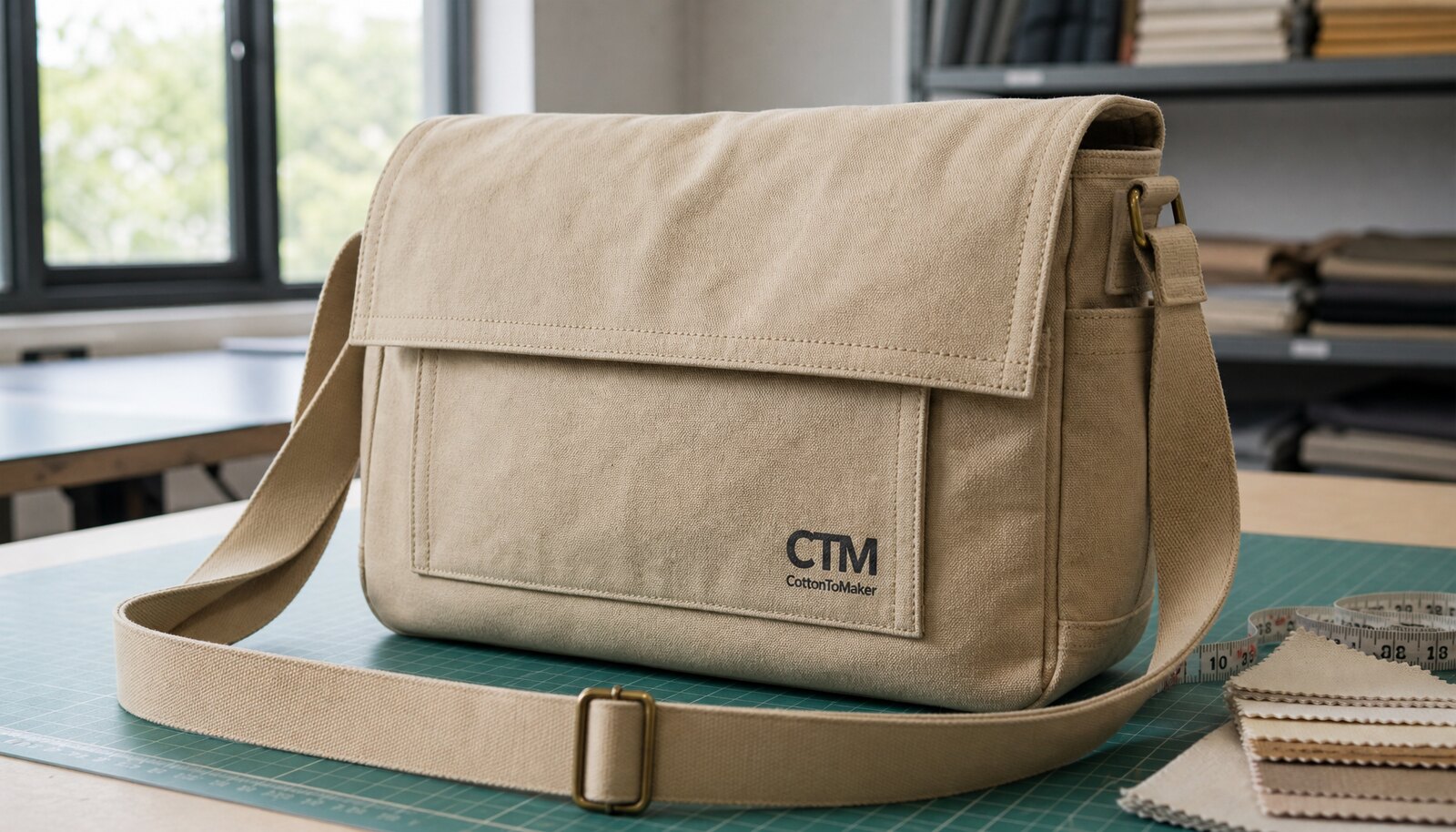
1. Start with the retail job, not the fabric
For gift shops, canvas messenger bags are rarely bought as pure utility goods. They sit at the intersection of souvenir, gift, and everyday carry, which means the bag has to look good on a shelf, survive customer handling, and still leave enough margin for the retailer. That is why fabric weight should be decided after you define the retail role of the bag, not before. A bag made for postcards and small gifts can be lighter and softer than a bag that must hold books, a tablet sleeve, or a bundled souvenir set.
This is where many procurement teams get stuck. They ask suppliers for “a canvas messenger bag” and receive three very different constructions: a thin promotional flap bag, a medium-weight retail bag with simple lining, and a heavy premium version that is closer to a work bag. If you want comparable quotes, start with the shelf price, target customer, and expected carry load. Only then choose the canvas weight that supports the commercial goal.
A useful rule for gift shops is to ask one question before anything else: should the bag feel like an impulse purchase, a practical gift, or a premium souvenir? That answer determines how much structure you need, how visible the stitching will be, whether the bag needs lining, and how much cost you can absorb in freight and packaging.
- Impulse purchase: light, simple, low-cost, easy to display
- Practical gift: balanced structure, clean sewing, reliable logo finish
- Premium souvenir: stronger body, sharper shape, better hardware and packing
2. Use GSM as a buying language, but verify the fabric in ounces too
Canvas weight is usually discussed in ounces or GSM, and both are useful if you make the supplier define them clearly. For cross-border procurement, GSM helps compare mills and factories more precisely, while ounce weight is often easier for buyers to visualize. The problem is that some quotes use rough marketing language, not a measured finished-fabric standard. The same phrase can hide different weave densities, finishing treatments, and shrinkage behavior.
For a gift-shop assortment, 8 oz to 16 oz is the practical range you will see most often. Eight-ounce canvas can work for low-price souvenir programs, but it may feel too soft for a bag that is meant to be sold as a durable retail item. Ten-ounce canvas usually feels a step more substantial and is often a good value tier. Twelve-ounce canvas is the most reliable all-round choice because it balances body, print performance, and price. Sixteen-ounce canvas is a premium option, but it adds sewing load, carton weight, and cost quickly.
Do not treat GSM as a standalone quality promise. Ask what finishing has been applied, whether the canvas is washed or unwashed, and whether the quoted weight is the finished cloth weight or the greige weight before processing. If one factory quotes 12 oz finished canvas and another quotes 12 oz greige canvas, those are not equivalent products. Buyers should insist on a swatch and a production reference sample, not just a number in an email.
- 8 oz / about 270 GSM: light souvenir use, simplest construction, lowest material cost
- 10 oz / about 340 GSM: value retail step-up with better body
- 12 oz / about 400–420 GSM: best mainstream gift-shop balance
- 16 oz / about 540 GSM: premium structure and stronger shelf presence
3. Compare how fabric weight changes shelf appeal, print, and perceived margin
In gift shops, shelf appeal is often the difference between a bag that moves and one that sits. Fabric weight changes the way the bag hangs on a hook, whether the flap stays crisp, and whether the body looks intentionally shaped or just empty. That matters because a canvas messenger bag is usually sold by appearance before it is sold by function. If the bag looks flimsy, buyers assume it is cheap; if it looks too rigid, it may feel overbuilt for the price point.
Print quality is also affected by weight. Lighter canvas may show more strike-through from heavy ink, and the weave can distort fine lines if the logo is too small. Heavier canvas supports stronger visual presence, but the texture can make delicate details break up. For most gift-shop branding, a bold logo, a simple icon, or a short wordmark is more reliable than a thin-line illustration. If the brand needs a premium look, a woven label or embroidered patch may be better than a large printed area.
From a margin standpoint, the key is not to chase the heaviest fabric. The retail price of the bag has to absorb freight, duties, and the retailer’s own markup. If a heavier canvas pushes the landed cost too high, the shop may not price it competitively. In many programs, 12 oz is the point where the bag looks substantial enough to justify retail presentation without forcing a premium shelf price that the store cannot support.
- Light fabric can save cost but may weaken shelf perception
- Heavier fabric can increase perceived value but also raise freight and sewing cost
- Simple artwork usually prints more reliably than small, detailed graphics
4. Build the comparison table around tradeoffs, not one-line recommendations
A thin comparison table is useful for quick screening, but procurement decisions need tradeoffs. Buyers should compare the same bag across several weights, not just ask which one is “best.” The right question is: what do I gain and what do I risk at each weight? That is especially important for gift shops, where a small increase in unit cost can be recovered if the bag supports a better shelf price, but a poor material choice can drag down sell-through.
When you compare 8, 10, 12, and 16 oz canvas, review five things together: handfeel, print performance, sewing complexity, freight impact, and shelf-ready presentation. A lower weight may help landed cost but create a soft, less giftable bag. A higher weight may improve structure but slow production and increase carton gross weight. The sweet spot usually depends on whether the shop wants a value item or a premium display piece.
One practical method is to order one production-style sample in each candidate weight and place them side by side on a shelf or hook under normal retail lighting. The difference in visual weight, crease behavior, and logo clarity is often more revealing than a factory photo. Buyers should also test the bag with a realistic insert load so they can see how the shape behaves when full, not only when empty.
- Compare side by side under retail lighting, not only in a sample room
- Ask the factory to quote the same size and hardware across multiple fabric weights
- Use a realistic load insert so structure and strap behavior can be judged consistently
5. Specify the construction details that make weight meaningful
Fabric weight alone does not create a durable messenger bag. The sewing specification determines whether the bag survives repeated retail handling and casual daily use. For procurement buyers, the quote must include the construction details that make one 12 oz bag better than another 12 oz bag. That means seam allowance, needle choice, thread type, reinforcement method, and how the strap is anchored to the body.
For standard canvas bag sewing, a common and practical approach is a consistent seam allowance in the 8–10 mm range, with a heavy-duty needle appropriate to the fabric weight and a bonded polyester or equivalent high-tenacity thread for load-bearing seams. The exact sizes should be set by the factory based on the approved sample and confirmed in the tech pack. Buyers do not need to dictate machine settings, but they do need to ask what the factory will use and how they will verify it during production.
The highest-risk points are the strap anchors, pocket corners, top edge, and any place where the flap or gusset turns under stress. If the factory uses a simple single line of stitching where a reinforced pattern is needed, the bag may still look good in a photo but fail during real use. Ask for seam photos, not just a finished product shot. A factory that understands canvas bag production should be able to show reinforcement close-ups without hesitation.
- Confirm seam allowance and topstitch distance in the tech pack
- Ask for needle size and thread type suitable for the selected fabric weight
- Inspect reinforcement at straps, corners, and top hem before approving bulk
6. Write QC standards that are specific enough for factory buying
QC is where procurement becomes real. If the quality requirements are vague, the factory will use its own internal standards, which may not match your retail expectations. A useful QC plan for canvas messenger bags should cover fabric tolerance, dimensions, stitching, decoration, performance, and packing. The goal is not to over-engineer the order; it is to make sure the finished bag matches the approved sample and the retail promise.
Start with fabric weight tolerance. For standard canvas programs, a practical bulk tolerance is often a small band around the approved finished GSM, but the exact allowance should be written into the PO or spec sheet. Then define shrinkage and color tolerances, because dyed canvas can vary enough between lots to affect shelf presentation. If the bag is washed, printed, or otherwise finished after weaving, that should be stated because the finished weight may differ from the cloth roll weight.
Performance QC matters just as much as appearance. The factory should confirm a basic strap and seam load check that reflects how the bag will be used. If the bag is meant for light gift carry, the test target can be modest; if the bag is positioned as an everyday messenger, the load target should be higher. For decoration, request dry rub and, if relevant, wet rub checks for printed logos. The ink should not smear, transfer, or crack badly when the bag is folded and handled. For packaging, inspect fold consistency, polybag clarity, barcode placement, carton marks, and carton strength, because these affect both receiving efficiency and damage rate.
- Set a finished GSM tolerance rather than leaving weight as a marketing phrase
- Require load or pull tests on straps and seam anchors
- Add rub resistance checks for screen print or transfer graphics
- Approve packing fold and barcode placement before bulk shipment
7. Decide whether lining, hardware, and closures belong in the first-order spec
Many quote differences come from details that buyers forget to standardize. Lining, zipper grade, flap closure, magnetic snap, webbing width, and hardware finish can move the order into a different cost and workmanship tier. If the bag is going into gift shops, these details matter because they affect both presentation and margin. A lined bag feels more finished, but it adds labor and can raise MOQs. A simple unlined bag may be perfectly suitable if the exterior finish is clean and the interior stitching is neat.
The right approach is to decide which features are part of the retail promise and which are optional. For example, if the bag is sold as a premium gift item, lining and a stronger closure may be worth the extra spend. If the bag is a value souvenir, a clean unlined build with a well-finished seam and one good pocket may be the better commercial choice. The same logic applies to hardware. A metal buckle, snap, or decorative rivet can improve perceived value, but it also adds sourcing complexity and more chances for mismatch between samples and bulk.
Ask the factory whether they produce the hardware and labels in-house or buy them from outside vendors. Outsourced parts are not a problem by themselves, but they should be visible in the quote and in the QC plan. If a supplier cannot explain who controls the hardware quality or how they inspect the finished bag after assembly, the buyer is taking on hidden risk.
- Use lining when the shelf price can absorb the extra labor and material
- Keep the first order simple if you are testing a new design or new market
- Ask which trims, labels, or hardware items are outsourced and who inspects them
8. Compare direct factory, trading company, and converter roles before you buy
Sourcing guidance is most useful when it explains who actually makes the bag. A direct factory usually handles cutting, sewing, and final packing in one site. That gives better visibility into the line, easier QC discussions, and more control over fabric weight, reinforcement, and carton spec. But “factory” should not be accepted at face value. Buyers should ask for proof of bag specialization, not just a product catalog. A real bag factory can show sewing lines, bar-tack stations, print or transfer capability, inspection points, and finished bag samples from similar canvas weights.
A trading company can be useful when you need lower MOQs, mixed categories, or simpler communications. The tradeoff is that the true factory may be hidden behind several layers, which makes it harder to verify which mill supplied the canvas and who is responsible for QC if the bag fails in bulk. Trading companies are not automatically lower quality, but they require sharper documentation. Ask for the upstream factory name, what parts are in-house versus outsourced, and how defects are handled after shipment.
Converters sit between those two models. They may buy blank bags and add decoration, or they may source fabric and convert it into finished bags with limited sewing capability. Converters can be efficient for decorated retail programs, but buyers should check whether the converter actually controls the critical construction steps or only the print step. If the bag is structural, the best supplier is the one that can prove control over the parts that matter most: canvas source, stitching quality, reinforcement, and packing consistency.
- Direct factory: best for repeat orders and better control over construction
- Trading company: useful for consolidation, but require more documentation
- Converter: useful if decoration is the main value-add, but verify who controls sewing and QC
9. Build a quote request that produces a real comparison
A strong RFQ is still necessary, but it should not feel like a formality. Buyers need enough detail to force equivalent pricing across suppliers. The most common mistake is to ask for a bag name and a logo, then compare quotes that contain different body sizes, different canvas weights, or different packaging assumptions. That creates false price gaps and wastes procurement time. The RFQ should lock down the non-negotiables: dimensions, fabric weight, decoration method, strap details, packing method, and any required performance checks.
The most useful quote questions are specific enough to show whether the supplier understands production. Ask what fabric weight they are quoting, what needle and thread they will use, what seam allowance they plan to sew, and how they test straps or seams before shipment. A supplier that can answer these questions clearly is more likely to manage bulk consistency. A supplier that only answers with a unit price may still be useful, but they are not yet proving readiness for a retail program.
For seasonal gift shop programs, timing matters too. Separate sample lead time from bulk lead time and ask what events can extend the schedule. If the bag needs special printing, embroidery, or hardware, build in enough time for correction rounds. The safest procurement habit is to approve the sample against a checklist, then release bulk only after the supplier confirms the same fabric, the same decoration method, and the same packing method will be used in production.
- Lock dimensions, fabric weight, decoration, and packing before price comparison
- Ask for line-item pricing on lining, extra pockets, closure changes, and packaging inserts
- Separate sample lead time from bulk lead time in every quote
- Request the supplier’s confirmation that bulk materials will match the approved sample
10. Manage gift-shop margin with merchandising, not just manufacturing
Gift-shop buyers need one more lens that general bag buyers often ignore: how the item looks and sells at retail. A canvas messenger bag is not just a sewn product; it is an item that has to earn its place on a shelf, a hook, or near a cash wrap. That means the fabric weight should support not only durability, but also visual value. A bag that feels too casual may need a lower price point than the shop wants to offer. A bag that feels too premium may need a higher ticket, and that changes the entire assortment plan.
Merchandising starts with the first impression. Does the bag hold shape well enough to look intentional when empty? Does the logo read from a normal browsing distance? Does the flap sit cleanly, or does it collapse in a way that makes the bag look unfinished? These small points influence sell-through. Retailers also care about replenishment. A product that packs flat, cartons efficiently, and arrives ready to hang is easier for a gift shop team to restock quickly.
When comparing fabric weights, think in terms of price bands. Lighter canvas can work in entry-level souvenir ranges, but the design must be simple and the expectations modest. Twelve-ounce canvas is usually the most flexible choice for mainstream gift shops because it looks substantial without overloading the cost structure. Sixteen-ounce canvas can support a premium story, but only if the shop can price it appropriately and the design uses the extra structure to create real shelf value rather than unnecessary weight.
- Use fabric weight to support the shelf price, not just the manufacturing cost
- Check whether the bag stands, hangs, and packs in a retail-friendly way
- Keep first-run SKUs simple so sell-through data is easier to read
Specification comparison for buyers
| Decision area | 8 oz / 270 GSM | 10 oz / 340 GSM | 12 oz / 400–420 GSM | 16 oz / 540 GSM |
|---|---|---|---|---|
| Best retail role | Entry souvenir bag, event giveaway, lightweight gift carry | Value retail bag with modest structure | Core gift-shop messenger bag; best all-around option | Premium shelf piece with strong body and higher perceived value |
| Handfeel and structure | Softest, most casual, can wrinkle and collapse | Slightly more body, still flexible | Balanced structure; stands up better on hooks and shelves | Very structured, rigid feel, best for premium presentation |
| Print appearance | Canvas texture can show through more, especially on large solid areas | Good for simple logos, but small details still need review | Most forgiving for retail branding and repeat orders | Best support for heavy ink coverage, but coarse weave can affect fine details |
| Sewing and reinforcement load | Easier to sew, lower needle stress | Moderate sewing load, still manageable for most bag lines | Common factory sweet spot for strap anchors and pocket reinforcement | Higher load on needles, thread, and operator skill |
| Shelf appeal in gift shops | Lowest premium look unless design is very simple | Good for low-price souvenirs | Strong mainstream retail appearance with manageable cost | High-end visual impact and stronger shelf presence |
| Freight and packing efficiency | Best cube efficiency and lower carton weight | Efficient for mixed retail cartons | Balanced carton weight and presentation | Heavier cartons, fewer units per export carton, higher freight cost |
| Typical risk if misapplied | May feel too thin or inexpensive for gift-shop resale | May still look underbuilt for premium gifting | Usually the safest choice for first production | Can become too heavy, expensive, or slow to sew |
| Best when you need | Lowest cost and simple decoration | A step up in presentation without major cost jump | A reliable default for most gift-shop programs | A premium gift item with higher margin potential |
| QC focus | Transparency, seam strain, print show-through | Consistency in fabric lot and shape retention | Needle holes, seam allowance, and strap anchor strength | Needle wear, seam stability, and shipping weight control |
Buyer checklist before sampling
- Define the retail job first: souvenir carry, everyday messenger use, or premium gift item, then select a target fabric weight before requesting quotes.
- State the exact body size, gusset depth, pocket count, strap width, flap style, closure type, and lining requirement so factories do not quote different constructions.
- Ask suppliers to quote fabric weight in both oz and GSM, and clarify whether the number refers to finished fabric or greige fabric before washing and printing.
- Require a sample approval set that includes fabric swatch, pre-production sample, print strike sample, and final packed sample if the order is seasonal or high volume.
- Confirm acceptable GSM tolerance, shrinkage allowance, seam allowance, and stitch density in writing before production release.
- Specify print method, artwork dimensions, color count, and the required rub resistance or wash resistance standard for the decoration.
- Ask for carton count, fold method, polybag thickness, barcode placement, and master carton marks so retail receiving is predictable.
- Request a factory photo of the sewing line, QC checkpoint, and packing area if the supplier claims in-house production.
- Compare like-for-like quotes by separating base bag price, decoration, packing, and optional hardware instead of judging by unit price alone.
- Plan a small pilot order first if the bag is new to your gift shop assortment, then expand the weight range only after sell-through is proven.
Factory quote questions to send
- What exact fabric weight are you quoting in oz and GSM, and is the number based on finished fabric after treatment or on raw cloth before finishing?
- What GSM tolerance do you hold in bulk production, and how do you handle lot-to-lot variation if the mill shipment changes slightly?
- What is the seam allowance on side seams, bottom seams, and pocket seams, and what topstitch distance do you use from the edge?
- What needle size, thread type, and thread count do you use for this fabric weight, especially at strap anchors and stress points?
- What load or pull test do you perform on straps and seams, and what is your rejection threshold for failed samples or bulk pieces?
- Which decoration method is included in the quote, what is the setup cost, and what changes the price if the artwork is larger or has more colors?
- Can you show a photo or sample from a previous run using the same or similar canvas weight, strap construction, and print method?
- What is the sample lead time, what is the bulk lead time after approval, and which steps are most likely to extend production?
- What packing method do you use, how many pieces per carton, and what is the expected carton size and gross weight?
- Which processes are in-house and which are outsourced, and who signs off on QC before shipment?
Quality-control points to confirm
- Fabric weight tolerance: agree a practical bulk tolerance before production, such as ±5% on finished GSM for standard canvas programs, and inspect whether the actual handfeel matches the approved sample.
- Seam allowance: confirm the target seam allowance, typically 8–10 mm for standard bag construction unless the tech pack specifies otherwise, and verify it is consistent at all visible seams.
- Needle and thread spec: require a suitable heavy-duty needle size for canvas weight and a bonded polyester thread or equivalent thread suitable for load-bearing seams; the exact size should match the approved sample and factory capability.
- Stitch density: check uniform stitches per inch on strap anchors, pocket edges, and top hem reinforcement; uneven density is a common sign of rushed sewing or machine setup drift.
- Strap anchor strength: inspect bar-tacks, box-X reinforcement, or equivalent reinforcing pattern at load points; the strap should not peel, twist, or distort under normal carry load.
- Pull-test target: ask the factory to state a pull-test or seam-strength target for strap anchors and then run a pre-shipment spot check on at least one carton lot if the order is large enough.
- Load test: use an agreed insert weight that reflects actual retail use; the bag should hold the load without seam gaping, strap elongation, or base deformation.
- Print rub resistance: for screen print, request dry rub and wet rub checks on the approved fabric; the ink should not smear, crack excessively, or transfer visibly to adjacent surfaces.
- Wash or wipe standard: if the bag is expected to be cleaned by the end user, require a simple wash or wipe durability check and record acceptable fading and cracking levels.
- Logo registration: confirm that print placement stays within the approved boundary and that any front pocket, flap, or gusset print lines up correctly on both sides if mirrored branding is used.