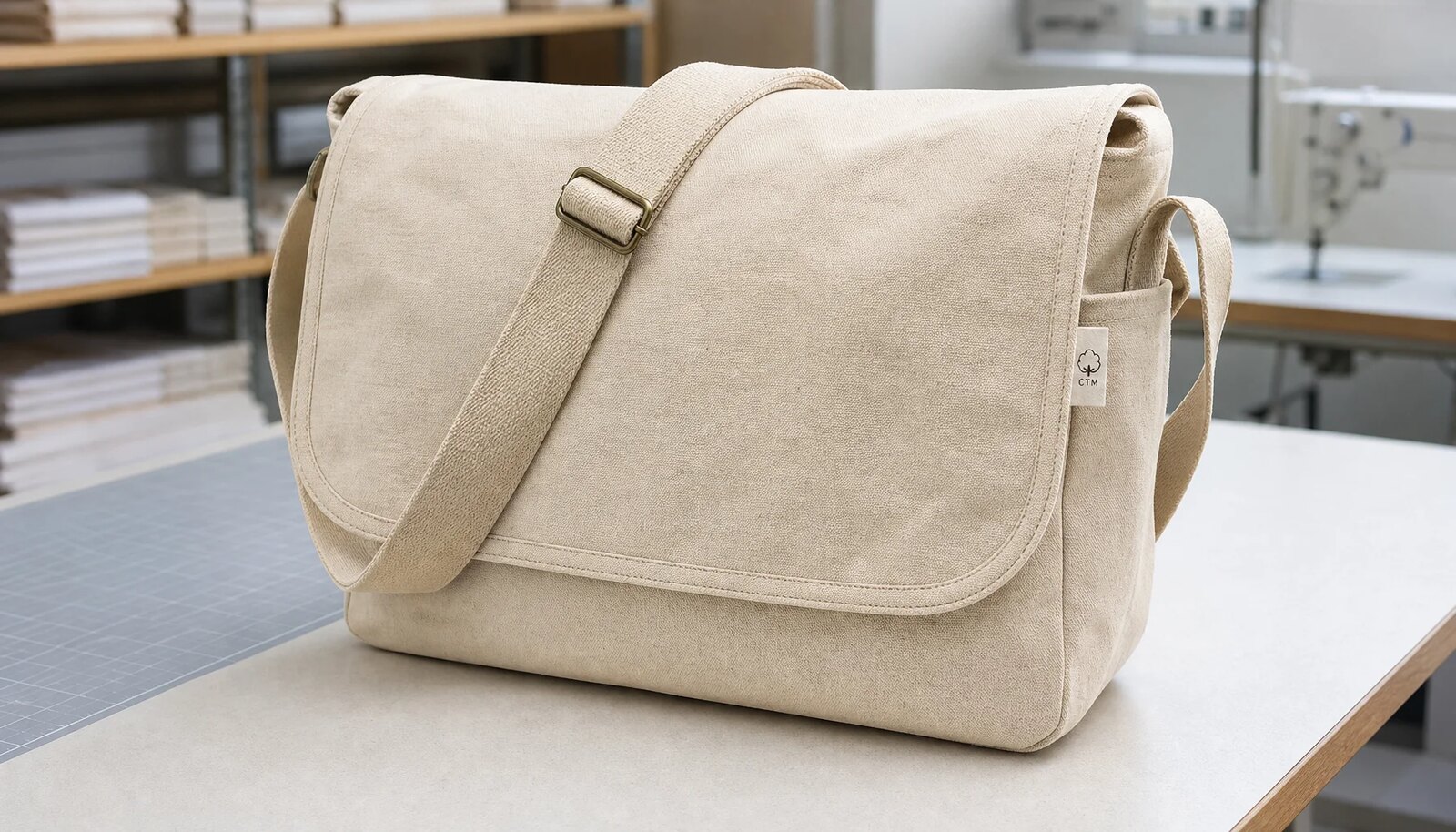
1. Start with the gift job, not the fabric number
A useful canvas messenger bags fabric weight guide for corporate gifting has to begin with the bag's actual job. The same product name can mean a light document carrier for a one-day conference, a structured employee welcome bag, a client gift with lining and zipper, or a distributor item that will move through warehouses before it reaches the final recipient. Fabric weight matters, but it is not a substitute for a clear use case.
Procurement teams should define what the bag will carry, how it will be handed out, how long it should feel useful, and what the brand is trying to signal. A one-day event bag may only need to carry brochures, a badge insert, a pen, and a folded T-shirt. A client gift might hold a notebook, bottle, charger, card, small box, or tech accessory. Those two programs should not be quoted as the same bag.
Presentation changes the right specification. Some gift bags must fold flat into a kit carton, so very heavy canvas, thick bottom boards, and bulky hardware can become a packing problem. Other bags need to look substantial when placed on a registration table or sent to a VIP recipient. That may justify a heavier canvas, lining, boxed corners, or a cleaner closure. Put that expectation in the RFQ instead of hoping the supplier guesses correctly.
Avoid buying the heaviest canvas simply because it sounds more premium. A 14 oz bag with weak strap stitching is still a weak bag. A well-made 12 oz bag can feel better, carry better, and ship more efficiently than a heavier bag with rough seams. The right target is the lightest construction that meets the load, presentation, logo, packing, and reuse requirement.
- Event handouts: prioritize unit cost, flat packing, clean logo placement, and predictable carton counts.
- Employee onboarding: prioritize 10 oz to 12 oz canvas, useful capacity, neat seams, and comfortable straps.
- Client gifts: prioritize fabric consistency, refined finishing, better closure, and tighter cosmetic inspection.
- Distributor programs: prioritize repeatable specs, barcode accuracy, carton discipline, and low defect risk.
2. Understand oz, GSM, and what the numbers miss
Canvas weight is usually stated in ounces per square yard or GSM, meaning grams per square meter. The standard conversion is 1 oz/yd2 equals about 33.9 GSM. In practical terms, 10 oz canvas is about 339 GSM, 12 oz is about 407 GSM, and 14 oz is about 475 GSM. Suppliers often round these numbers, so a quote may describe 10 oz as about 340 GSM or 12 oz as about 400 GSM.
Those conversions are useful for aligning quotes, but they are not a complete quality standard. Two fabrics with the same GSM can feel different if yarn count, weave density, fiber blend, washing, dyeing, or finishing changes. A tightly woven 10 oz canvas may feel more stable than a loose 12 oz cloth. A washed canvas may feel softer and more casual, while also bringing more shade variation or shrinkage risk.
For B2B sourcing, ask the supplier to state both oz/yd2 and GSM, then add the measurement basis. The quote should identify composition, such as 100% cotton, recycled cotton, organic cotton, cotton-poly blend, or another disclosed fiber mix. It should also say whether the cloth is stock, dyed to order, washed, pigment dyed, or specially finished. These details affect MOQ, lead time, decoration, and repeat-order consistency.
Set a fabric-weight tolerance before cutting begins. Textile production naturally varies, and a small variance is not always a defect. The issue is whether both sides know what is acceptable. A written percentage or GSM range is more useful than a vague promise of heavy canvas. If hand feel is important, approve swatches and a pre-production sample made from the intended production fabric.
- 10 oz / about 339 GSM: suitable for cost-controlled messenger bags with light contents and flat packing.
- 12 oz / about 407 GSM: the balanced starting point for many corporate gifting messenger bags.
- 14 oz / about 475 GSM: useful for stronger body when seam bulk, foldability, and freight still work.
- 16 oz and above: reserve for retail-style structures where sewing capability and carton weight are already planned.
3. Match fabric weight to construction, size, and carry load
Fabric weight cannot rescue weak construction. Messenger bags usually fail at predictable points: strap anchors, top opening, flap corners, bottom seam, boxed corners, zipper ends, snap tabs, and internal pocket openings. A buyer who specifies only 12 oz canvas may still receive a bag that photographs well but performs poorly once it is loaded.
Strap design deserves early attention because corporate gift bags rarely carry perfectly even loads. Recipients add bottles, notebooks, chargers, and personal items after the event. Wider cotton webbing can improve comfort and perceived value, but only if it is sewn securely into the body. Reinforcement may include box stitching, cross stitching, bartacks, backing patches, or seam tape. The right method depends on the design, and it should be visible on the approved sample.
Bag size changes how a fabric behaves. A compact document messenger can use lighter canvas because the panels do not sag as much. A wider bag with a large flap or gusset needs more stability, especially if the flap must stay aligned when the bag is full. A zipper top needs a stable edge so the track opens smoothly. An unlined bag needs bound, overlocked, or otherwise controlled internal seams so it does not look unfinished when opened.
Heavier canvas also asks more from the factory. Thick layers at strap anchors, boxed corners, and flap seams can create skipped stitches, uneven feeding, broken needles, and rough edges if the sewing line is not set up for them. This is why a swatch is not enough. Approve a complete sample with final seams, straps, trims, closure, lining if used, and the intended packing fold.
- Light carry: 10 oz to 12 oz canvas, reinforced strap anchors, clean top hem, and controlled internal seams.
- Mixed gift contents: 12 oz canvas, boxed corners, reinforced bottom seam, and wider webbing.
- Tech or travel gifts: zipper closure, lining, inner pocket, smoother trims, and closer functional inspection.
- Flat kit packing: avoid thick bottom boards and bulky hardware unless the carton layout is designed around them.
4. Choose logo decoration for the actual canvas surface
Logo execution is one of the most visible risks in corporate gifting. Canvas has texture, and texture affects ink coverage, edge sharpness, registration, and fine detail. A digital mockup can show placement, but it cannot prove print quality. A logo that looks crisp on a screen may lose thin lines, small type, or tight spacing when printed on coarse cotton canvas.
Screen printing is often the best starting point for bold one-color or two-color logos. It is efficient for volume orders and can be durable when ink selection, mesh, curing temperature, and fabric surface are controlled. It is less forgiving for gradients, tiny copy, and high-detail marks. If the artwork is complex, suppliers may suggest heat transfer, DTF, woven labels, patches, or embroidery. Each method needs a real sample.
Embroidery can look premium, but dense stitches may pucker lighter canvas or distort a flap. Heat transfers and DTF can reproduce detail, yet buyers should test edge lift, cracking, hand feel, and adhesion after flexing. Woven labels and sewn patches can be a cleaner option when the brand mark has fine detail and the canvas weave is too textured for sharp printing. Sometimes the strongest answer is a simple screen print plus a small woven side label.
Set placement tolerance before production. Messenger bags have flaps, seams, gussets, and folds that change how centered artwork appears after assembly. Placement should be measured from fixed reference points such as top edge, side seam, flap centerline, or pocket edge. If the bag will be loaded for photography or display, approve the logo position in that loaded state too.
- Use simplified artwork and adequate line thickness for textured canvas.
- Test white, light, metallic, or high-coverage inks on the selected fabric color.
- Avoid critical artwork across seams, fold lines, zipper tape, or high-abrasion corners.
- Approve the actual decorated sample, not only Pantone references or digital proofs.
- Check curing, rub resistance, flex behavior, opacity, and edge cleanliness before bulk printing.
5. Build an RFQ that suppliers can price cleanly
Supplier quotes often vary because the suppliers are not pricing the same bag. One factory may assume 10 oz stock natural canvas, one-color screen print, no zipper, no lining, and bulk carton packing. Another may include 12 oz dyed canvas, zipper closure, inner pocket, individual polybag, carton labels, and stricter inspection. The lower unit price may simply be a lower specification.
Normalize the product before comparing numbers. Use one finished size, one fabric weight, one fabric color, one logo version, one decoration method, one strap specification, one closure, one lining decision, and one packing method. Ask each supplier to quote the same quantity breaks, such as 300, 500, 1,000, 3,000, and 5,000 pieces. This makes MOQ behavior and setup charges easier to see.
Ask suppliers to separate the cost lines. The base unit price should be clear, but so should sample fee, screen charge, embroidery digitizing, woven-label charge, transfer setup, barcode label, carton label, special packing, and inland freight where relevant. Request optional adders for zipper, lining, inner pocket, second print position, upgraded webbing, bottom reinforcement, metal buckle, and individual packaging. That gives procurement room to value-engineer without reopening the whole quote.
Carton data belongs in the first quote round, not after the purchase order is drafted. Fabric weight and packing method affect pieces per carton, gross weight, and shipping cost. A bag that looks attractive on FOB unit price can lose value if cartons are oversized, underpacked, or too heavy for the receiving plan. Ask for carton dimensions, net weight, gross weight, and pieces per carton early.
- Normalize size, fabric weight, trims, decoration, lining, closure, and packing before comparing price.
- Request the same quantity breaks from all suppliers.
- Separate base cost from setup charges, sample fees, labels, packing, and optional upgrades.
- Ask for carton dimensions, carton count, net weight, gross weight, and shipping term.
- Record each supplier assumption so later revisions are traceable.
6. Use fabric weight as a cost and logistics lever
Fabric weight affects more than hand feel. It influences material consumption, cutting yield, sewing speed, needle and thread choices, carton weight, freight cost, and packing density. Moving from 10 oz to 14 oz can make a messenger bag feel more substantial, but it can also reduce pieces per carton and increase gross weight. For corporate gifting, compare landed cost per acceptable bag, not factory unit price alone.
Dimensions can create cost jumps that are not obvious from a drawing. A slightly wider flap, deeper gusset, longer strap, or added pocket can change fabric consumption and cutting waste. If the mill fabric width is fixed, some panel layouts are much more efficient than others. Ask the supplier whether the proposed dimensions are efficient for their cutting layout. A small adjustment may reduce waste without changing the recipient experience.
Construction upgrades should earn their place. Reinforced strap anchors, consistent canvas, clean logo execution, and disciplined packing are usually high-value investments. Zippers, linings, inner pockets, woven labels, and bottom boards can be useful for the right program, but they add material cost, sewing steps, and inspection points. Metal hardware may raise perceived value, while also adding finish consistency, corrosion, weight, noise, and scratch risks.
Decoration can carry hidden cost too. Extra print colors require setup, registration, curing, and additional inspection. A second print location means more handling and more chances for placement variation. Embroidery may require digitizing, backing, thread matching, and slower output. None of these are problems when they are planned. They become problems when introduced after the quote has already been approved.
- High-impact cost choices: fabric weight, finished size, strap construction, closure, lining, and packing method.
- High-impact value choices: fabric consistency, strap reinforcement, logo quality, seam finishing, and receiving accuracy.
- Common over-specification: excessive fabric weight, too many logo positions, unnecessary metal trims, and complex retail packaging.
- Landed-cost inputs: unit price, setup charges, carton dimensions, carton quantity, net weight, gross weight, and Incoterm.
7. Choose the sourcing route by control, timing, and accountability
The best sourcing route depends on order quantity, customization depth, timeline, and risk tolerance. Buyers commonly source canvas messenger bags through a direct factory, a trading company, a promotional-products distributor, or a local decorator using blank stock. Each route can work. Each one gives procurement a different level of control over fabric, construction, decoration, inspection, and packing.
A direct factory can be useful for repeat programs, custom sizes, custom canvas, and tighter control over sewing details. If cutting, sewing, inspection, and packing are in-house, it is easier to trace defects and keep production aligned with the approved sample. If printing or embroidery is outsourced, the factory should still disclose the process and remain accountable. Direct sourcing is not automatically stronger; the factory must have real experience with branded export orders at the required quality level.
A trading company or promotional-products partner can help when the campaign includes multiple items, consolidation, shifting timelines, or heavy project management. The key question is transparency. Procurement should know which processes are controlled directly and which are subcontracted. If a problem appears before shipment, the buyer needs one accountable party who can resolve print defects, sewing defects, substitutions, and packing errors.
Local decoration on blank messenger bags can suit urgent or small orders, especially when artwork changes late. The tradeoff is limited control over fabric weight, bag construction, color availability, and repeat consistency. For a large corporate gifting campaign, blank stock shortages and mixed production lots can create risk. Match the route to the program instead of forcing every project through the same channel.
- Use direct factory sourcing for repeatable custom construction and larger controlled orders.
- Use a trading or promotional partner for multi-item projects, consolidation, and communication management.
- Use local decoration for small quantities, urgent programs, or late-stage artwork changes.
- Ask which processes are in-house: fabric sourcing, cutting, decoration, sewing, inspection, packing, and export.
- Define responsibility for defects before shipment, especially when decoration is subcontracted.
8. Approve samples with written tolerances
Sample approval is the strongest protection before bulk production. A showroom sample can show general workmanship, but it does not prove the final order unless it uses the same canvas, weight, color, webbing, thread, trims, lining, closure, and decoration process. A similar fabric can hide issues with drape, print absorption, shade, seam bulk, and folding behavior.
The pre-production sample should become the sealed reference for the order. It should show final logo size, logo position, thread color, strap width, strap adjustment, closure, pocketing, labels, internal seams, and packing fold. If the bag will hold a specific kit, test the sample with representative contents. This quickly reveals sagging, strap comfort, flap alignment, zipper strain, and whether the bag still looks presentable when full.
Use measurable tolerances wherever possible. Finished width, height, gusset, flap length, strap length, strap drop, and logo placement should all have acceptable ranges. The exact range depends on the design and production method, but it must be written before production starts. Print color tolerance should be tied to the approved sample or swatch because fabric color and texture can shift how a Pantone target appears.
Keep a change log after approval. If the buyer changes artwork, logo size, fabric color, closure, lining, or packing, the supplier should confirm cost, lead time, and whether a revised sample is required. That may sound administrative, but it protects the delivery date. In corporate gifting, a small late change can ripple through printing, trims, inspection, and packing.
- Approve a pre-production sample made from intended bulk fabric, trims, and decoration method.
- Keep one sealed sample with the buyer and one with the supplier, both marked by version and date.
- Attach size, logo, color, stitching, construction, and packing tolerances to the PO or tech pack.
- Test representative contents before approving structure, strap length, flap alignment, and closure.
- Photograph approved details: logo placement, strap anchor, zipper end, seam finish, fold method, and carton label.
9. Inspect the points most likely to fail
A finished messenger bag can look acceptable at first glance while hiding defects that create complaints later. Quality control should focus on the points most likely to fail or disappoint: fabric mismatch, crooked decoration, weak stitching, poor strap reinforcement, zipper problems, stains, odor, loose threads, wrong packing, and carton count errors. A practical inspection plan follows the product from incoming material to final carton.
At material stage, inspect canvas weight, shade, weave uniformity, odor, stains, holes, severe slubs, and roll variation. Natural canvas may include small flecks, but the buyer should define what is acceptable, especially on the front flap and logo area. Cutting should keep panels consistent and avoid mixing visibly different lots on the same bag. If panels are off-grain, the finished bag may twist or hang unevenly.
At decoration stage, check placement before the full batch is printed or embroidered. Confirm logo size, color, opacity, registration, edge quality, curing, and cleanliness. White ink on dark canvas, thin lettering, and large ink coverage need extra attention. For transfers, check adhesion and edge lift. For embroidery, check puckering, thread tension, backing, and whether the panel remains flat.
At sewing and final inspection, test function and appearance together. Strap anchors should show the approved reinforcement and secure backstitching. Zippers should open smoothly without wavy tape or snagging at seam intersections. Flaps should align, snaps should close, pockets should be usable, and lining should not twist. Final cartons should match the approved fold method, count, carton marks, barcode needs, SKU, PO number, and destination labels.
- Material: weight, shade, weave, odor, stains, holes, slubs, and roll-to-roll consistency.
- Decoration: position, color, opacity, curing, registration, rub resistance, flex behavior, and logo-area cleanliness.
- Sewing: stitch density, skipped stitches, seam allowance, strap anchors, boxed corners, top hem, and flap alignment.
- Function: zipper movement, snap strength, strap adjustment, pocket usability, and loaded carry behavior.
- Packing: fold method, individual bag, carton quantity, carton marks, SKU, PO number, barcode, and destination.
10. Write the PO so production does not depend on guesses
A strong purchase order or tech pack turns the sourcing conversation into production instructions. It should not say only "canvas messenger bag with logo." That wording leaves the supplier to choose fabric weight, weave, trim grade, seam finish, print method, packing, and tolerances. In B2B procurement, every open assumption can become a cost change, delay, or defect dispute.
Start with commercial details: order quantity, quantity tolerance if any, delivery deadline, destination, shipping term, payment term, required inspection window, and shipment-ready date. Then specify the product: finished dimensions, gusset, flap, canvas weight, composition, color, finish, strap width, strap length range, closure, lining, pocketing, labels, reinforcement, hardware color, thread color, and any bottom support. Include approved artwork files, print dimensions, logo placement, color references, and decoration method.
Quality requirements belong in the same document. State the approved sample version, fabric-weight tolerance, finished-size tolerance, logo-placement tolerance, shade standard, print acceptance, stitch expectations, defect classification, and whether third-party inspection is allowed. If the order is time sensitive, define when pre-shipment inspection must occur and what happens if major defects are found.
Packing instructions should be treated as production instructions. State whether each bag needs a polybag, paper wrap, silica gel if appropriate, hangtag, barcode, insert, or gift-kit orientation. Confirm fold method, pieces per inner carton if used, pieces per master carton, carton dimensions if constrained, carton label format, PO number, SKU, destination mark, and pallet requirements. These details help the supplier quote accurately and help the receiving team avoid rework.
- Include finished size, fabric weight, composition, color, closure, strap, lining, pockets, reinforcement, decoration, and packing.
- Request base price, quantity breaks, setup charges, sample fee, sample lead time, production lead time, and shipment-ready date.
- Attach artwork, Pantone or brand references, approved swatch, packing instruction, carton mark format, and inspection expectations.
- Ask for carton dimensions, pieces per carton, net weight, gross weight, and whether the quote is EXW, FOB, CIF, DDP, or another term.
- Require suppliers to state assumptions clearly so differences are visible before sampling and production.
Specification comparison for buyers
| Spec decision | Recommended option | When it fits | Buyer risk to check |
|---|---|---|---|
| Canvas weight | 10 oz to 12 oz cotton canvas for most corporate gifting; 14 oz when the bag needs more body and the sample still folds, sews, and packs well | Conference kits, onboarding packs, client gifts, distributor programs, and logo-led campaigns where presentation and freight cost both matter | Too light may wrinkle, sag, and look disposable; too heavy can create bulky seams, slower sewing, higher freight, and harder folding |
| Measurement basis | Ask for oz/yd2 and approximate GSM, plus composition, weave, finish, and stated fabric-weight tolerance | International sourcing where mills, factories, and buyers may use different weight conventions | GSM alone does not confirm hand feel, weave density, shrinkage, shade control, or print behavior |
| Practical GSM range | About 340 GSM for 10 oz, about 407 GSM for 12 oz, and about 475 GSM for 14 oz, using the standard oz/yd2 to GSM conversion | RFQ alignment, supplier comparison, and early costing before swatches are approved | Some suppliers round conversions loosely; final approval should be based on tested fabric from the intended production lot |
| Material composition | 100% cotton canvas for a natural feel; cotton-poly or recycled-content canvas only when composition and performance are disclosed | Corporate gifts where brand positioning, durability, sustainability claims, or budget must be balanced | Undisclosed blends can change shrinkage, dye shade, print adhesion, hand feel, and labeling requirements |
| Print method | Screen print for bold 1-2 color logos; embroidery, woven label, patch, heat transfer, or DTF only after testing on the actual canvas | Logo-focused programs with stable artwork and repeatable decoration requirements | Small text can fill in on coarse canvas; transfers can edge-lift; embroidery can pucker lighter panels |
| Construction | Reinforced strap anchors, controlled seam allowance, top hem, boxed corners, bottom seam reinforcement, and consistent stitch density | Messenger bags carrying notebooks, brochures, apparel, bottles, chargers, or small gift boxes | A clean exterior can hide weak backstitching, skipped stitches, narrow seam allowance, or underbuilt load points |
| Inner build | Unlined with bound or overlocked seams for cost control; lined with inner pocketing for higher-value kits | Unlined for simple event or onboarding gifts; lined for tech, metal items, pens, chargers, or resale-style presentation | Lining adds cost and inspection points; unlined bags need neat seam finishing and controlled fraying |
| Closure style | Top zipper for security; flap with snap or hook-and-loop for casual access; open top only for simple kit packing | Zipper for travel or tech gifts, flap for messenger styling, open top for low-complexity event programs | Low-grade zippers snag; flaps can misalign after loading; open tops reduce item security |
| MOQ structure | Keep the first order to one fabric color, one logo version, one trim color, one closure, and one packing method where possible | Buyers who need stable unit cost, fewer approval loops, and cleaner production planning | Multiple colors, logo versions, or pack styles split production and can trigger extra setup, cutting loss, and carton complexity |
Buyer checklist before sampling
- Define the use case: conference handout, onboarding kit, client gift, distributor campaign, retail-style bundle, or internal company merchandise.
- State the expected contents and approximate loaded weight, including notebooks, bottles, apparel, chargers, laptop sleeve, gift box, or literature pack.
- Give finished bag width, height, gusset or boxed-corner depth, flap length if used, strap width, strap length range, and desired strap drop.
- Specify target fabric weight in oz/yd2 and approximate GSM, plus composition, weave type if known, finish, color, and acceptable variation.
- Ask whether the canvas is stock, dyed to order, washed, pigment dyed, recycled-content, organic, cotton-poly blend, or another material route.
- Decide whether the bag should fold flat, hold light structure when empty, stand better with contents, or fit into a larger gift-kit carton.
- Lock logo artwork, logo size, color count, Pantone or brand reference, print position, orientation, and whether the artwork crosses a seam or flap.
- Choose or request testing for screen print, embroidery, woven label, patch, heat transfer, DTF, or another decoration method on the actual canvas.
- List closure, lining, pocket count, zipper type, snap or buckle style, strap hardware, bottom reinforcement, and internal seam finish clearly.
- Request swatches and a pre-production sample made from the intended production fabric, webbing, trims, thread, lining, and decoration method.
Factory quote questions to send
- What canvas weight are you quoting in oz/yd2 and GSM, and what tolerance do you apply before cutting bulk fabric?
- How do you verify fabric weight: roll weight, GSM cutter, mill certificate, internal incoming inspection, or another method?
- Is the fabric 100% cotton, recycled cotton, organic cotton, cotton-poly blend, or another composition, and can you state the fiber content on the quote?
- Is the quoted fabric stock canvas, dyed-to-order canvas, washed canvas, pigment-dyed canvas, or custom woven canvas?
- Will the bulk order use the same canvas, webbing, thread, zipper, lining, hardware, and print process as the approved pre-production sample?
- What decoration method do you recommend for this artwork on the selected canvas, and what minimum line width or text height should we avoid?
- Is the price based on one-side print, two-side print, woven label, embroidery, patch, no branding, or another decoration setup?
- What setup charges apply for screens, embroidery digitizing, transfer films, woven labels, paper patterns, cutting dies, carton labels, or barcode labels?
- What is the MOQ by fabric color, logo version, trim color, closure option, lining, label type, and packing style?
- How does the unit price change at 300, 500, 1,000, 3,000, and 5,000 pieces using the same specification?
Quality-control points to confirm
- Canvas weight is checked against the approved spec within a written tolerance, commonly agreed as a percentage or GSM range before production.
- Fabric composition, weave, hand feel, shade, finish, and odor match the approved swatch or sealed sample before panels are cut.
- Roll-to-roll shade variation is controlled so the front, back, flap, gusset, and strap-facing areas on the same bag do not look mismatched.
- Finished width, height, gusset depth, flap length, strap width, strap length, and strap drop are measured against the approved tolerance.
- Logo placement is checked from fixed reference points such as top edge, side seam, flap centerline, or pocket edge, not by eye only.
- Print opacity, edge sharpness, registration, curing, rub resistance, and flex behavior are checked on the actual canvas color and finish.
- Small text, thin lines, white ink, metallic ink, and high-coverage artwork are inspected more tightly because textured canvas can expose defects.
- Top hem, bottom seam, flap seam, boxed corners, and strap anchors show even stitch length, secure backstitching, and no skipped stitches.
- Stress points such as strap ends, D-rings, buckles, snap tabs, zipper ends, and pocket openings are reinforced according to the approved sample.
- Zippers open and close smoothly, zipper tape sits flat, pullers are secure, and the track does not wave or snag at seam intersections.