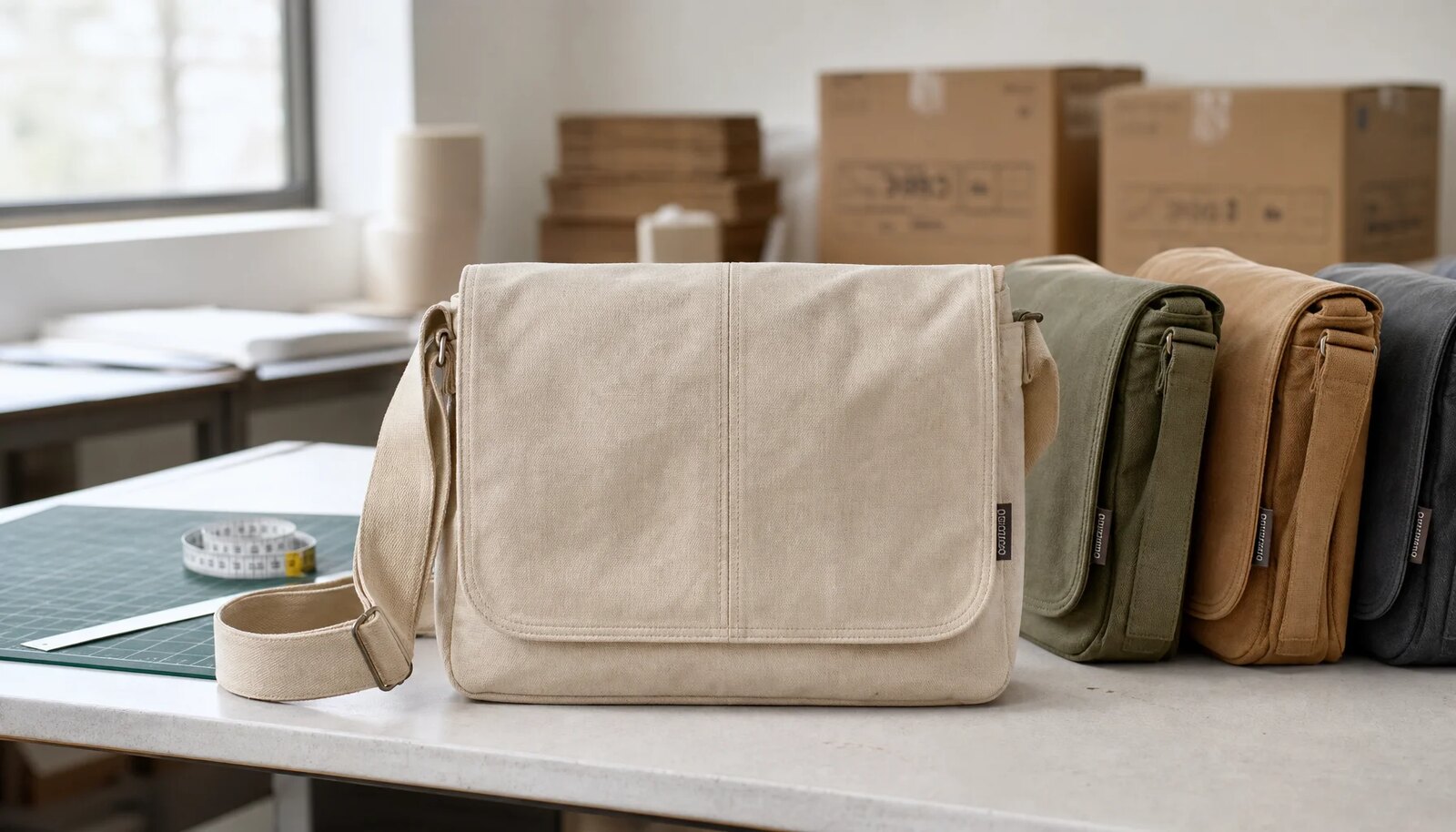
Why carton planning changes the quote
For canvas messenger bags, the product price is only one part of the buying decision. A flat 12 oz bag, a lined 14 oz bag, and a zipper version with pockets do not occupy the same carton space, and that difference can change freight more than the unit price moves. If the factory quotes only the bag and leaves the carton open, the buyer is forced to absorb a second round of cost changes once packing starts.
Event planners usually buy for a date, a venue, or a kit count, not for open-ended inventory. That means the carton plan must support quick receiving, clean counts, and easy staging at the destination. If cartons are too large, you pay for empty air. If they are too tight, bags arrive with bent zippers, pressed corners, or scuffed logos, and the receiving team ends up doing the repack work the factory should have solved.
- Carton size changes CBM, not just warehouse convenience.
- Packing density affects damage risk, loading quantity, and pallet count.
- Lock the carton spec before booking freight or comparing landed cost.
Set the bag spec that drives packing
The carton plan starts with the bag spec that actually changes volume. For standard event use, 12 oz natural canvas is a practical baseline because it holds shape without becoming bulky. Move to 14 oz when the buyer expects a more premium hand feel or repeated carry, and reserve 16 oz for heavier use, more structure, or retail programs where the bag has to look full even when empty. A lighter 10 oz body can work for simple giveaways, but it will crease more easily and may need tighter folding control inside the carton.
Print and trim choices matter as much as fabric weight. Screen print is the most predictable option for one or two spot colors and gives the factory a stable repeat process. Heat transfer is useful for shorter runs or more detailed artwork, but the buyer should watch for added thickness and fold memory. Zippers, gussets, internal pockets, and lining all increase the folded thickness. If the RFQ only shows a product photo, the factory can easily quote the wrong carton count because the actual packed shape is still undefined.
- State finished size, not pattern size.
- Specify print placement in millimeters, not only as a front-side note.
- Tell the factory whether the bag folds flat or needs a protected fold path.
Choose a packing format that matches the route
Event-only programs usually favor a simple bulk fold because the destination team cares more about count accuracy and low freight cost than retail presentation. In that route, a clean polybag may be enough for surface protection, and in some cases the bag can ship without a polybag if the material is dry, clean, and folded consistently. Retail or distributor programs are different. They usually need a neater presentation, barcode control, and a packing method that survives multiple touches before the product reaches the shelf.
A practical sourcing approach is to ask for two pack-out options in the same quote: compact bulk pack and retail pack. The bulk pack should be optimized for carton count, CBM, and easy palletization. The retail pack should be optimized for appearance and repacking speed. For many flat canvas messenger bags, the carton count can sit anywhere from 20 to 50 pieces per carton, but the right number depends on gusset depth, lining, hardware, and whether the bag is folded with an insert. The buyer should not fix the piece count before seeing the actual folded sample.
- Keep one carton format per SKU whenever possible.
- Avoid mixing colorways in the same carton unless the warehouse has strict count control.
- Ask for carton dimensions, net weight, gross weight, and CBM on the first quote.
Compare supplier quotes on carton facts, not headline price
Direct factories, trading companies, and sourcing agents can all sell canvas messenger bags, but they do not control the same parts of the job. A direct factory is usually the cleanest route when you need the bag spec, print, and carton plan to stay aligned under one production line. A trader can be useful when you need to combine multiple products into one shipment, but the quote may hide the real pack-out or treat the carton as an afterthought. The cheapest unit price is not the cheapest landed cost if the carton is oversized or if the pack-out is unstable.
The quote should separate product price, print setup, sample fee, packing fee, carton fee, and freight basis. If the supplier bundles those items, push for the pack details anyway. The useful comparison is not just unit price; it is unit price plus carton dimensions, pieces per carton, loading quantity per container, and whether the supplier has actually packed this kind of bag before. Two suppliers can quote the same bag at the same unit price, but one may pack 30 pieces into a tight export carton while the other uses a looser carton that adds dead space and drives up freight.
- Compare suppliers on the same pack method and same carton basis.
- Request pack photos or a carton sample before approval.
- Use CBM and gross weight to test whether the quote is real.
Use sample approval to prevent carton surprises
The sample stage should cover three things at once: the bag, the print, and the pack-out. A pre-production sample tells you whether the canvas weight, zipper pull, pocket depth, and logo size are right. A carton sample tells you whether the folded bag sits well in the box and whether the carton still closes without crushing the zipper or creasing the front panel. If the sample looks good on the table but fails when stacked in a carton, the production run is not ready.
Do not approve a sample just because the color is close enough. Measure the finished bag, fold it the way the factory will fold it, and count actual pieces into the target carton. If the sample needs tissue, a corner board, a different folding order, or a slightly deeper carton to hold shape, that change should be built into the quote before bulk production starts. Otherwise, the factory will solve the problem late, usually by changing carton count, adding labor, or packing too tightly.
- Approve the print strike-off before full production.
- Verify carton marks, SKU labels, and count labels on the sample carton.
- Keep one signed sample as the production reference for inspection and receiving.
Set QC thresholds that warehouse staff can live with
QC for messenger bags is not only about fabric defects. For event buyers, the bigger risk is inconsistency: one carton arrives neatly packed, the next arrives loose, and the third arrives with scuffed prints from over-compression. Set measurable thresholds before production starts. Stitch density should be consistent across the run, bartacks should be present at every stress point, and the logo placement should stay in a narrow tolerance so the cartons remain uniform and easy to receive.
If the carton is going to be stacked or palletized, add a simple compression and drop check. The carton should survive normal transfer handling without bursting at the seam, opening at the tape joint, or deforming badly on the corners. Inside the carton, the bags should not show sharp fold lines, transferred ink, broken zipper teeth, or pressure marks from hard accessories. That matters more on humid lanes and multi-stop distribution routes, where a weak carton quickly becomes a warehouse dispute.
- Use a 2 to 3 mm print registration tolerance for simple logos.
- Require handle bartacks or equivalent reinforcement at the stress points.
- Reject cartons with soft corners, moisture, or open tape joints.
What actually moves landed cost
When two quotes look close, the real difference is usually in volume, labor, or freight class. Canvas weight changes product cost, but packing format changes the freight bill. A heavier 16 oz bag can still be a smart buy if it replaces extra inserts or a fragile retail pack, while a lighter 10 oz bag can become expensive if it needs a larger carton to hold shape. The buyer should treat pack-out as part of the product, not as a warehouse detail handed off at the end.
Landed cost should include unit price, print setup, carton fee, internal pack labor, carton dimensions, gross weight, CBM, origin handling, and the chosen freight mode. Air freight is especially sensitive to overpack. One unnecessary centimeter in carton height can multiply across a big order. Ocean freight is more forgiving on the rate line, but bad carton planning still hurts because pallet count, warehouse labor, and damage claims all grow when the pack-out is sloppy. Ask every supplier to quote the same pack method so the comparison is real.
- Compare CBM as carefully as unit price.
- Include carton fee and packing labor in the quote review.
- If the order is seasonal, build a buffer for rework and freight booking delays.
Build the schedule around sample, packing, and transit
A realistic schedule for custom canvas messenger bags has four stages: sample approval, bulk production, carton confirmation, and freight booking. Simple jobs may move faster, but the buyer should still allow time for screen setup, color approval, and a final packing test. If the design includes a zipper, lining, multiple pockets, or a woven label, the packing method often needs one more revision than the bag itself. That is normal, and it is better to absorb that change early than to discover it when the goods are ready to move.
For event deadlines, the biggest risk is often not the sewing line; it is the gap between production finish and freight pickup. If the carton spec is not locked, the goods can sit waiting for a new box size or a revised packing list. That delay is avoidable. Book the forwarder only after the carton dimensions and gross weight are approved, then build a buffer for customs, port congestion, and venue receiving windows. A good schedule protects the launch, not just the factory calendar.
- Leave calendar room for re-samples and freight rebooking.
- Do not leave carton artwork and shipping marks for the final week.
- Add extra time when you are sourcing during peak freight season.
RFQ data that prevents vague answers
A useful RFQ does not just say 'custom messenger bags.' It says the finished size, canvas GSM, print method, number of colors, lining, zipper or flap construction, piece count, target carton count, and the market the bags are going into. If the bags are for conference kits or event registration packs, the RFQ should also mention the receiving channel and whether the warehouse wants palletized cartons or loose cartons. Those details change labor and packaging, which means they change the quote.
The factory should also know whether you need mixed SKUs, individual barcode stickers, master cartons, or shipping marks in a specific language. If those items are missing, the supplier will quote against assumptions and then expand the cost later with packing fees or a different carton structure. The buyer gets a cleaner purchase order when the first RFQ already contains the pack-out logic. That is usually where the margin is won or lost on a bag program that looks simple on the surface.
- Specify the channel: event kit, distributor, retail, or mixed.
- State whether carton counts must match venue or store case quantities.
- Include sample approval deadlines and ship-to city in the RFQ.
Use a simple sourcing workflow
The cleanest workflow is simple: define the bag, define the pack-out, review a carton sample, then release bulk production. That order keeps the supplier from optimizing one part of the job while damaging another. A good factory will tell you where the bag can be folded without visible creasing, how many pieces fit safely in a carton, and what carton grade is needed for your route. That is the kind of information that turns a vague quote into a usable buying decision.
For recurring event programs, standardize the carton plan and keep it stable across seasons. For one-off launches, customize the carton only if the channel demands it. The goal is not to build the most complicated pack-out; it is to deliver clean, countable cartons that arrive on time and protect margin. If the buyer can compare quotes on the same carton basis, the rest of the sourcing decision becomes much easier.
- Lock one reference pack method for repeat orders.
- Use the same carton basis when comparing suppliers.
- Treat carton changes as a cost item, not a side note.
Specification comparison for buyers
| Spec decision | Recommended option | When it fits | Buyer risk to check |
|---|---|---|---|
| Supplier route | Direct factory with in-house packing control and export cartons | When you need the bag spec, print, and carton plan to stay aligned under one quote | Trader quotes can hide the real pack-out; request carton photos, carton size, and loading data |
| Fabric weight | 12 oz to 14 oz for most event use; 16 oz only when structure matters | Conference kits, branded giveaways, distributor programs, or light retail resale | Too-light fabric looks cheap and can wrinkle; too-heavy fabric raises carton bulk and freight cost |
| Print method | Screen print for simple logos; heat transfer for short runs; woven label or embroidery for premium feel | When the artwork is simple and the buyer needs repeatability across multiple shipments | Thick prints can increase fold thickness and affect carton count or scuff during packing |
| Packing density | Flat fold with a carton count set to the bag size and freight mode | Bulk event orders, venue kits, and palletized ocean shipments | Overfilled cartons crush corners and zippers; underfilled cartons waste volume and raise CBM |
| Carton grade | Single-wall B/C flute for standard export; double-wall if stacking or humidity risk is high | Long transit routes, warehouse stacking, and mixed handling environments | Weak cartons collapse on the edge or absorb moisture during transit |
| Sample route | Pre-production bag sample plus carton sample with measured pack-out | Any custom size, new print, or first-time supplier relationship | Skipping the carton sample can create a freight quote mismatch after production is finished |
| MOQ logic | Set MOQ by color and print, then align carton count to full-carton multiples | Multiple event accounts, mixed SKUs, or repeat seasonal programs | Odd MOQs create partial cartons, extra labor, and higher unit packing cost |
| Freight mode | Ocean freight for planned programs; air only for urgent samples or launch stock | Seasonal events, fixed opening dates, and orders with stable forecast demand | Air freight punishes oversized cartons, and one extra centimeter can matter at scale |
Buyer checklist before sampling
- Finished bag size, gusset depth, and folded size are fixed before quote comparison.
- Canvas GSM, lining, closure type, and handle reinforcement are written into the RFQ.
- Print method, print placement, and number of colors are approved with a strike-off or sample.
- Carton count target, gross weight target, and carton dimension target are agreed in advance.
- Carton grade, tape spec, and shipping marks are included in the packing requirement.
- Sample bag, carton sample, and pack-out method are signed off before bulk production.
- Freight mode, ship-to city, and receiving window are confirmed before the factory books cartons.
- The quote separates unit price, print setup, packing fee, carton fee, and CBM.
Factory quote questions to send
- What is the finished size, folded size, and recommended carton size for this messenger bag?
- Which canvas GSM is quoted, and what changes if we move from 12 oz to 14 oz or 16 oz?
- What print method is included, and what are the setup charges for screens, plates, or labels?
- How many pieces per carton do you recommend for this exact size and packing method?
- Do you include polybags, tissue, barcode stickers, and shipping marks in the packing quote?
- Can you send a carton sample photo or blank carton spec before bulk production starts?
- What are the sample lead time, bulk lead time, and packing confirmation timeline after approval?
- What are the quoted gross weight, CBM, and loading quantity for this carton plan?
Quality-control points to confirm
- Canvas GSM should stay within the agreed tolerance, with no thin spots or fabric distortion.
- Stitching should be straight and reinforced at handle stress points, pocket edges, and zipper ends.
- Print placement should stay within 2 to 3 mm for simple logos, with no cracking on the fold line.
- Zippers, snaps, and closures should open and close smoothly on every sampled unit.
- The folded bag should fit the approved carton without forcing the zipper, gusset, or front panel.
- Carton seams, tape, and corner crush resistance should survive normal warehouse handling and stacking.
- Packing labels, carton marks, and piece counts must match the packing list and purchase order.
- No damp smell, oil marks, loose threads, or print scuff should be present in finished cartons.