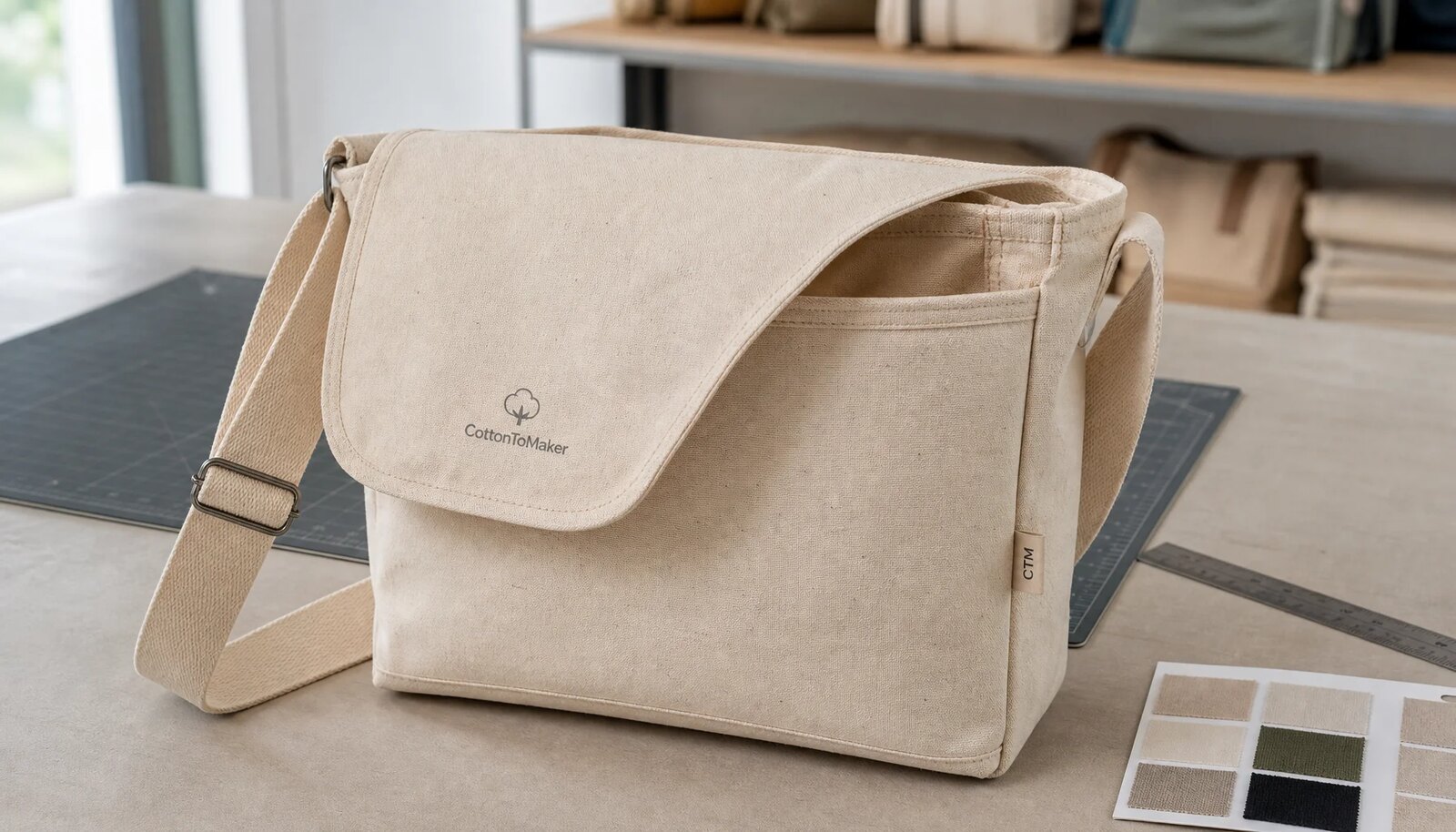
Buying Problem: Craft Fair Bags Fail Differently
Canvas messenger bags used at craft fairs face rougher handling than many standard retail giveaway bags. They are opened repeatedly at booths, hung from display hooks, carried cross-body for hours, packed with samples or purchases, and often folded back into cartons after the event. A bag that looks fine in a product photo can still fail at the strap join, flap crease, snap area, or printed logo after one weekend of use.
The key buying problem is not simply finding a heavy canvas bag. Procurement teams need a specification that balances durability, retail appearance, carton efficiency, and repeatable factory production. A durability testing checklist helps the buyer avoid vague RFQs such as heavy canvas messenger bag with logo and replace them with measurable requirements that suppliers can quote accurately.
- Define the expected use: vendor staff bag, retail merchandise, gift-with-purchase, or attendee welcome bag.
- Set the load assumption in kilograms and list typical contents such as catalog, water bottle, notebook, tablet, or small purchases.
- Decide whether the bag must look structured on a booth table or can be softer and foldable for lower freight cost.
- Treat the front flap, strap ends, bottom corners, and closure points as the main failure zones.
Fabric Weight and Canvas Construction
For messenger bags, fabric weight should be specified in both ounces and GSM because mills and factories may describe canvas differently. A practical range for craft fair retail bags is often 12 oz to 16 oz cotton canvas, roughly 400 to 540 GSM depending on yarn, weave, dyeing, and finishing. Lighter canvas can work for low-load promotional use, but it may collapse on display and show stress around the strap attachment sooner.
Natural canvas, dyed canvas, washed canvas, and coated canvas do not behave the same in cutting, printing, or shrinkage. Dyed fabric may have longer lead time and stricter MOQ because the mill needs a dye lot. Washed canvas can feel premium but may produce more shade variation and dimensional tolerance movement. A buyer comparing quotes should not accept fabric weight alone as proof of durability.
- Request fabric composition, GSM, oz rating, yarn style if available, and finish type.
- Set shrinkage expectations if the bag may be damp wiped, steamed, or lightly washed by end users.
- Ask whether the supplier uses stock greige fabric, stock dyed fabric, or custom dyed fabric.
- Keep a signed fabric swatch with the approved sample to control shade and hand feel.
Shape, Size, and Load Path
Messenger bag durability depends on how weight travels through the bag. A wide flap and large front panel may look good for branding, but the real load is carried through the side seams, strap anchor points, and bottom gusset. If the gusset is too narrow, the bag bulges and pulls the flap out of alignment. If the gusset is wide but the bottom seam is not reinforced, the bag may sag under moderate contents.
For craft fairs, many buyers choose a medium profile rather than a large laptop-style messenger. A body around document size can carry brochures and small goods without becoming too expensive in fabric consumption. The RFQ should include finished dimensions and measurement points, because factories may measure flat width, top opening width, or finished usable width differently.
- Specify body width, body height, bottom gusset, flap depth, and strap drop separately.
- Require the strap anchor to connect into a reinforced side seam or patch, not only a single fabric layer.
- Limit the claimed carrying load to what the bag construction can support repeatedly.
- Use a physical paper pattern or technical drawing for flap shape if visual symmetry matters.
Strap and Stitching Durability Tests
The shoulder strap is usually the first point where a weak messenger bag shows its real cost. Cotton webbing feels consistent and is easier to control than a thin self-fabric strap, while self-fabric can match the bag body but needs enough layers and stitching to avoid twisting. For a retail craft fair bag, 38 mm to 50 mm strap width is usually more comfortable and looks more substantial than narrow promotional webbing.
Stitching specifications should describe construction, not only thread color. The factory should know where to back-tack, where to bartack, and how many stitches per inch are expected. A sample can be tested by hanging a defined load for a set time and then applying short pull shocks to the strap. The acceptance result should be no seam opening, no broken thread, no fabric tearing, and no visible strap slippage.
- Set a static load test, for example a buyer-defined load held for a practical time period before inspection.
- Add short jerk-pull testing to expose weak stitching that static hanging may miss.
- Inspect skipped stitches, thread tension, needle holes, and loose thread trimming on both strap ends.
- Compare strap comfort on a loaded sample, not only the appearance of the flat bag.
Print Method and Logo Wear
Craft fair bags are often bought to carry a visible brand, so print durability is part of product durability. Screen printing is usually the most stable choice for one-color or few-color logos on canvas, especially when the artwork has solid shapes and does not need photo detail. Heat transfer can reproduce more complex artwork, but the buyer should test edge adhesion and flexibility on the actual canvas surface.
The front flap creates a specific risk because it bends, rubs against clothing, and may be stacked against other printed panels in cartons. Large ink coverage on textured canvas can crack or show uneven fill if the ink and curing are not adjusted. Artwork approval should include print size, position from edges, color reference, and tolerance. A clean logo on a flat sample panel is not enough if the production bag will fold through the print area.
- Use screen print for solid CTM-style sample logos, event marks, and simple retail branding.
- Use embroidery or woven label when a premium small mark is more important than large print coverage.
- Run dry rub and damp rub checks on printed canvas before bulk approval.
- Pack printed flaps with tissue or controlled stacking if ink transfer is a risk.
Closures, Pockets, and Hardware Choices
Messenger bags for craft fairs do not always need complicated hardware. A magnetic snap, metal snap, hook-and-loop strip, or simple flap-only design can each be correct depending on target price and use. Magnetic snaps feel cleaner but require enough fabric reinforcement. Hook-and-loop is cost effective but can collect lint and make noise. Metal snaps look secure but can damage fabric if installed without proper washers or reinforcement patches.
Pockets add buyer value but also add stitching points and inspection work. A simple inner slip pocket may be enough for phone, receipt pad, or event badge. Zipper pockets increase utility, but low-quality zipper tape can fail faster than the canvas body. When pockets are required, the RFQ should define pocket size, placement, seam construction, and load expectation rather than leaving the supplier to choose the cheapest interpretation.
- Select closure hardware based on opening frequency, appearance, noise, and repair risk.
- Require reinforcement behind snaps or magnets to prevent fabric tearing.
- Specify zipper grade and slider type if a zipper pocket is included.
- Test closure alignment on a filled bag because an empty sample can hide flap pull.
Sample Approval Workflow
A good sample process prevents most bulk production disputes. For a new canvas messenger bag, the buyer may need a blank construction sample first, then an artwork sample, and finally a pre-production sample made from actual bulk fabric, print method, hardware, and packing. Skipping the pre-production sample is risky when the quote includes custom dyed canvas, special webbing color, or logo placement on a flap.
The approved sample should be sealed and treated as the inspection standard. Photos are helpful for communication, but they do not capture fabric hand feel, stiffness, odor, thread quality, or snap strength. Procurement teams should record measurement tolerances and visible defect limits before mass production begins. This is especially important when multiple distributors or retail buyers will receive stock from the same production run.
- Approve fabric swatch, thread color, hardware finish, label position, and print strike-off before final sample approval.
- Measure the sample after it has relaxed, not immediately after being compressed in courier packing.
- Cut open or stress test one sample if the order value justifies destructive checking.
- Keep one sealed sample at the buyer side and one at the factory side.
MOQ Logic and Cost Drivers
MOQ for canvas messenger bags is driven by fabric sourcing, dyeing, hardware, printing setup, label production, and cutting efficiency. A supplier may offer a low MOQ if the buyer accepts natural canvas, stock webbing, standard metal fittings, and one-color screen print. MOQ rises when the buyer needs custom dyed canvas, exact Pantone webbing, special buckles, woven labels, or multiple artwork versions.
Unit price differences between quotes often come from hidden specification differences. One factory may quote 12 oz natural canvas with overlocked inner seams, while another quotes 16 oz dyed canvas with bound seams and reinforced webbing. The cheaper quote is not necessarily dishonest, but it may not describe the same product. A buyer should request a cost driver breakdown instead of negotiating only on unit price.
- Fabric weight and dye route affect both unit cost and lead time.
- Large screen print areas increase ink, setup, curing time, and reject risk.
- Bound seams, lining, pockets, and adjustable sliders add sewing minutes.
- Individual polybags, hangtags, barcodes, and retail cartons should be quoted separately.
Packing for Carton Transit and Event Handling
Packing is part of the durability plan because a good bag can arrive looking poor if cartons are over-compressed or printed panels rub during transit. Canvas messenger bags should usually be packed flat or lightly folded in a way that does not create a hard crease across the flap logo. Metal sliders, snaps, and buckles should not press directly into printed areas of the next bag.
For distributors and retail buyers, carton data is also a landed-cost issue. Pieces per carton, carton size, gross weight, and packing orientation affect freight, warehouse handling, and booth setup speed. A packing instruction should identify whether each bag needs an individual polybag, paper band, tissue sheet, hangtag, barcode sticker, or only bulk carton packing.
- Set maximum carton weight so warehouse teams can handle cartons safely.
- Use tissue between printed flaps when ink transfer or hardware pressure is possible.
- Require carton marks that match purchase order, SKU, color, quantity, and destination.
- Request carton dimensions before shipment to estimate freight and storage cost.
Lead Time and Schedule Risk
Craft fair orders are date-sensitive. Missing the inbound warehouse date can make the whole program fail even if the bags are eventually good. Lead time should be counted from the last approval, not from the first inquiry. Fabric approval, artwork approval, sample approval, deposit, label confirmation, and packing confirmation all affect the production start date.
The most common schedule risks are custom dyed canvas, slow artwork decisions, missing print files, late label approval, and rework after sample comments. Importers should build a calendar backward from the fair setup date, including production, inspection, export documents, ocean or air transit, customs, domestic trucking, and distributor receiving time. Rush production can work only if the specification is simplified.
- Use stock natural canvas and one-color print when the event date is tight.
- Freeze artwork before bulk cutting if logo placement depends on flap size.
- Schedule inspection before final carton sealing when possible.
- Keep a backup plan for partial air shipment only if the margin supports it.
Specification comparison for buyers
| Spec decision | Recommended option | When it fits | Buyer risk to check |
|---|---|---|---|
| Main fabric weight | 12 oz to 16 oz cotton canvas, about 400 to 540 GSM depending on yarn and finish | Retail craft fair bags that need shape, load resistance, and a better hand feel than light promo totes | Do not compare only by ounces; request actual GSM, yarn count, shrinkage result, and whether the weight is before or after dyeing |
| Shoulder strap construction | 38 mm to 50 mm cotton webbing or self-fabric strap with reinforced box stitch at stress points | Bags expected to carry catalogs, small purchases, tablets, or vendor samples during a full fair day | Thin webbing saves cost but can twist, cut into the shoulder, or tear at the side seam under repeated pull testing |
| Flap closure | Magnetic snap, metal snap, or hook-and-loop selected by target price and noise tolerance | Craft fair retail use where buyers open the flap many times and need basic security without a zipper-heavy design | Weak magnets fail with thick canvas layers; hook-and-loop can collect lint and sound cheap unless specified carefully |
| Print method | Screen print for solid logos, heat transfer for complex artwork, embroidery or woven label for premium small branding | Brand owners needing clean logo visibility on textured canvas without overpaying for unnecessary decoration | Large ink coverage can crack on folded flaps; require rub testing, wash or damp wipe testing, and color approval under real light |
| Seam reinforcement | Back-tack at strap ends, bartack at pocket corners, and minimum 8 to 10 stitches per inch on load-bearing seams | Bulk orders where returns from torn straps or loose flap stitching would damage the retailer relationship | Photos of neat stitching are not enough; sample must pass load hang, jerk pull, and seam slippage checks |
| Inner structure | Single main compartment with bound seams, optional slip pocket, and no fragile lining unless the retail price supports it | Craft fair merchandise programs that need durable, easy-inspected construction at practical MOQ | Cheap polyester lining can tear before the canvas fails; if lining is required, specify denier, seam allowance, and pocket load limit |
| Packing method | Flat pack with tissue between printed panels, silica gel when needed, and export carton sized to avoid hard flap creases | Orders shipped to distributors, fair organizers, or regional warehouses before event setup | Over-compressed cartons reduce freight cost but can leave permanent flap marks, bent sliders, and print transfer |
| MOQ and sample route | Pre-production sample after artwork approval, then bulk MOQ tied to fabric dye lot, hardware color, and printing setup | Importers comparing quotes from factories that use different fabric stocks or accessory suppliers | A low MOQ quote may use off-the-shelf fabric and mixed hardware batches; confirm repeatability before approving a retail program |
Buyer checklist before sampling
- Define intended load in kilograms and the typical contents carried at the craft fair, not just the bag dimensions.
- Specify canvas weight in oz and GSM, fabric composition, color, shrinkage tolerance, and whether the fabric is dyed, natural, washed, or coated.
- Require strap width, strap material, attachment method, bartack or box stitch placement, and acceptance criteria for pull testing.
- Approve the print method on the same fabric color and texture planned for bulk production, including ink color, print size, and placement tolerance.
- Inspect the first sample for flap alignment, bottom gusset symmetry, pocket position, hardware function, and loose thread control.
- Run a load hang test and repeated open-close test on closure hardware before confirming bulk production.
- Set carton packing rules for printed flaps, metal hardware protection, carton weight, and pallet or warehouse labeling.
- Request quote data by cost driver, including fabric weight, dyeing, printing, hardware, stitching complexity, packing, sample fee, and lead time.
- Confirm whether the supplier will produce a pre-production sample from actual bulk fabric before cutting the full order.
- Keep one approved sealed sample with signed artwork, dimensions, fabric swatch, and packing method for final inspection comparison.
Factory quote questions to send
- What is the exact fabric weight in oz and GSM, and is the quoted weight before dyeing, after dyeing, or after finishing?
- Is the canvas in stock, made to order, or dyed against a Pantone or lab dip, and what MOQ applies to that fabric route?
- What strap width, webbing thickness, and reinforcement stitching are included in the quote?
- Which print method is quoted, how many colors are included, and what is the maximum print area on the front flap without distortion?
- What closure hardware is included, and can the factory provide a pull or open-close test result on the approved sample?
- Are inner seams bound, overlocked, or left raw, and what seam allowance is used on stress areas?
- How many pieces per export carton, what is the estimated carton size and gross weight, and how are printed panels protected?
- What sample stages are included: blank sample, artwork sample, pre-production sample, and shipment sample?
- What is the production lead time after deposit, artwork approval, fabric approval, and final sample approval?
- Which items are excluded from the unit price, such as special labels, hangtags, barcode stickers, individual polybags, palletization, or testing fees?
Quality-control points to confirm
- Fabric weight tolerance should be agreed before production, commonly within a narrow GSM range rather than a vague heavy canvas description.
- Finished dimensions should be measured on relaxed bags, with separate tolerances for body width, height, gusset, flap length, and strap length.
- Strap attachment should show back-tack, bartack, or box stitch reinforcement with no skipped stitches, loose bobbin thread, or needle damage.
- Load testing should match the intended use; a practical craft fair messenger bag should tolerate static hanging and short jerk pulls without seam opening.
- Print inspection should cover color match, ink coverage on textured canvas, edge sharpness, curing, rub resistance, and placement alignment with the flap.
- Closure hardware should open and close smoothly after repeated use and should not pull away from the fabric layers.
- Final inspection should include carton count, packing orientation, moisture control, label accuracy, and comparison against the sealed approved sample.