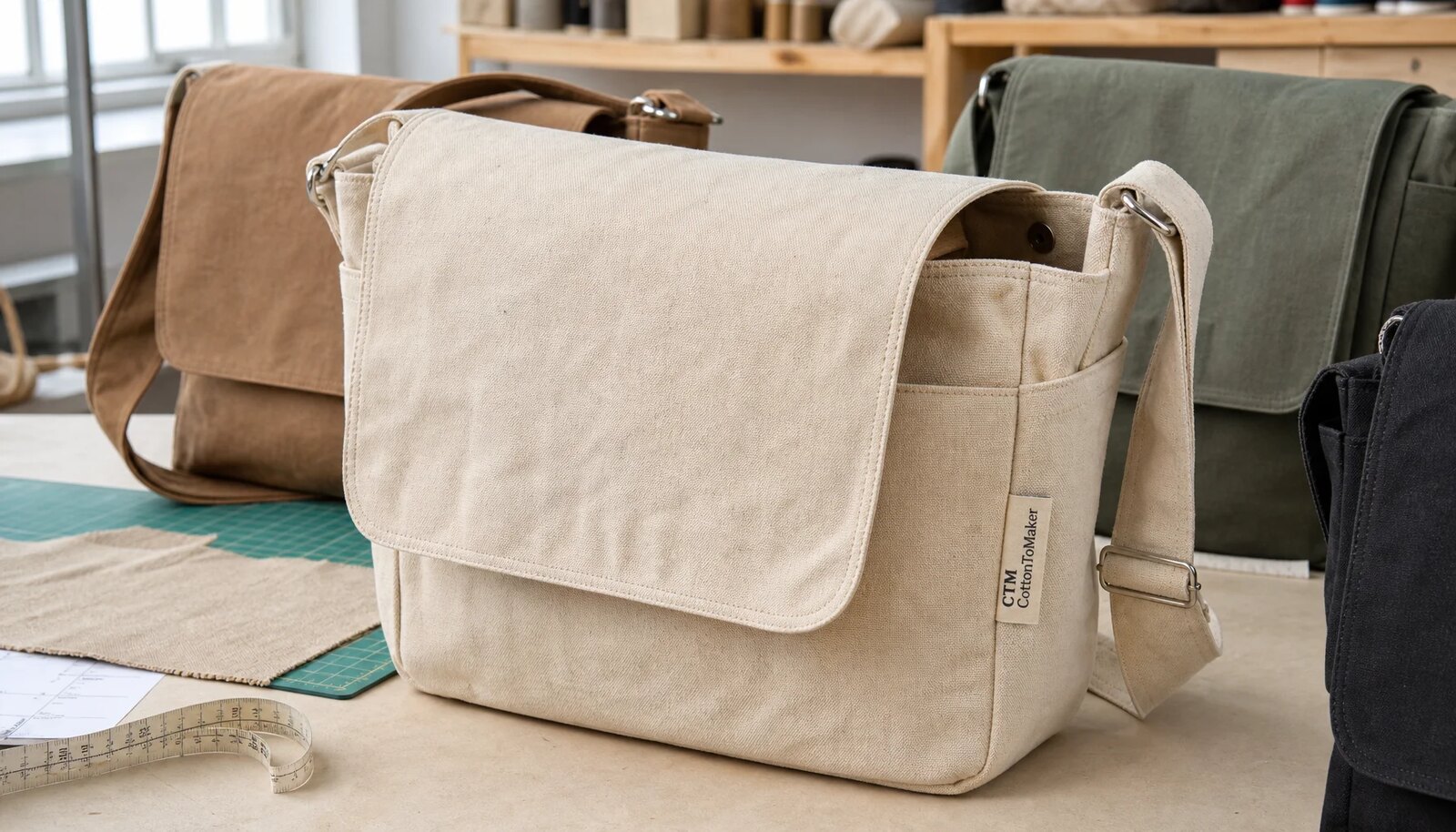
Start with the buying scenario, not a generic bag photo
A strong RFQ for canvas messenger bags for craft fairs starts with the job the bag must do. A messenger silhouette may be perfectly acceptable for one program and completely wrong for another. A low-cost sponsor giveaway, a retail item sold under an artisan label, an exhibitor kit carrier, a wholesale distributor SKU, and an event staff bag all push the factory in different directions. The use case changes the fabric weight, finish, strap comfort, closure strength, print durability, labeling, packing, inspection level, and the amount of defect risk the buyer can tolerate.
That distinction matters even more at craft fairs. Bags may be carried outdoors, stacked on booth tables, packed with irregular goods, photographed for online promotion, and repacked into event kits before they ever reach the end user. A flat promotional bag may be fine for paper inserts, but a gusseted messenger bag with reinforced strap anchors is the better fit when shoppers carry candles, ceramics, yarn, notebooks, prints, tools, or small packaged goods. The RFQ should describe the expected contents by size and estimated load, not only by product name.
Procurement should also explain the business priority. If the order is for resale, buyers may value cleaner stitching, better flap alignment, stronger hardware, attractive labels, and individual retail packing. If the order is an event giveaway, unit cost and fast production may matter more than premium finishing. If the order supports distributor stock, consistent carton marks, barcode labels, and repeat-order stability become central. Suppliers quote more accurately when they understand which outcome matters most and which tradeoffs are acceptable.
- State the use case: resale, giveaway, exhibitor kit, distributor stock, subscription box, staff use, or retail bundle.
- Describe expected contents with dimensions and approximate weight, such as A4 catalog, 11-inch tablet, boxed candle, yarn skeins, or hand tools.
- Identify the selling or handling channel: craft booth, retail shelf, ecommerce bundle, wholesale catalog, welcome desk, or kit assembly line.
- Rank the top procurement priorities: unit cost, retail appearance, delivery date, color accuracy, durability, sustainability requirement, or repeatability.
- Flag non-negotiables early, including plastic-free packing, maximum carton weight, barcode label format, country-of-origin marking, and fixed event arrival date.
Turn the design into measurements the factory can quote
Photos and reference samples help describe style, but they do not create a usable quotation by themselves. Canvas messenger bags can look almost identical and still differ in finished dimensions, gusset depth, flap length, strap width, reinforcement, seam finishing, closure type, pocket layout, and packing method. A procurement RFQ should translate the visual brief into measurements that can be quoted, sampled, inspected, and repeated without guesswork.
Finished size should be written as width x height x gusset, measured after sewing and after any washing if a washed finish is required. Buyers should clarify whether the dimensions refer to the outside body, usable internal space, or flat measurement. For sewn canvas bags, a practical starting tolerance is often ±10 mm for body width and height, with separate tolerances for flap length, gusset, pocket size, strap length, and closure location. If the bag must fit a tablet, notebook, catalog, or boxed craft item, include the item dimensions and the minimum ease required for easy insertion.
Construction details should separate visual preference from load-bearing function. The flap shape affects branding area and closure alignment. The gusset controls usable capacity and how the bag stands when filled. Strap width and adjustment range affect comfort during longer fair visits. Reinforcement determines whether the bag can withstand everyday handling. The RFQ should specify reinforcement at strap anchors, closure points, flap stress areas, and pocket openings because a heavy canvas body does not compensate for weak attachment seams.
- Specify finished dimensions as width x height x gusset, and identify the measurement method used for inspection.
- Define gusset style: side gusset, bottom gusset, boxed corners, flat bottom, expandable side, or no gusset.
- State flap length, flap shape, closure location, pocket layout, and whether the flap should cover the full opening.
- Set strap requirements: width, minimum and maximum adjustable length, material, color, slider type, and hardware finish.
- List seam finishing: bound seams, overlocked seams, folded seams, lined interior, or no exposed raw edges.
- Require reinforcement method at strap anchors, flap corners, magnetic snaps, buckles, D-rings, and pocket openings.
Specify canvas weight, composition, and finish without ambiguity
Fabric is one of the main reasons canvas messenger bag quotes become difficult to compare. A supplier quoting 8 oz canvas and another quoting 12 oz canvas may both describe the product as cotton canvas, but the cost, handfeel, structure, and shipping weight will differ. For craft fair resale, exhibitor kits, and merchandise programs, 10-12 oz cotton canvas, approximately 340-410 GSM before finishing, is often a practical specification range. It gives the bag enough body to feel substantial while staying workable for sewing and packing.
The RFQ should state both ounce weight and GSM because suppliers may use different conventions. It should also define whether the fabric is 100% cotton, cotton blend, recycled cotton, organic cotton, or another composition. If the buyer plans to make a sustainability claim, the RFQ should request documentation and identify any required standard before quotation. Claims that matter for marketing or compliance should not be left until the sample stage.
Finish and color affect MOQ, lead time, and quality risk. Natural canvas is usually simpler to source than custom-dyed fabric. Bleached canvas may create a cleaner print base but can show dirt more easily. Dyed canvas requires shade approval and may involve dye-lot minimums. Washed canvas can feel softer, but it may introduce shrinkage, shade variation, wrinkles, and looser measurement control. Coated or water-resistant finishes can change handfeel and print adhesion. The RFQ should separate these options so buyers are not comparing natural, dyed, washed, and coated fabrics as if they were the same material.
- Use 8 oz canvas, approximately 270 GSM, only where low cost and light carrying needs are more important than structure.
- Use 10 oz canvas, approximately 340 GSM, for basic craft fair bags, event kits, and moderate retail presentation.
- Use 12 oz canvas, approximately 410 GSM, where better structure, perceived value, and durability are required.
- Ask whether quoted GSM is before or after washing, coating, lamination, or other finishing.
- Set fabric tolerance, such as ±5% GSM if acceptable, and request the supplier’s standard if different.
- Request lab dips, swatches, or approved fabric cuts for dyed, bleached, washed, recycled, organic, or coated canvas.
Control branding risk before artwork is approved
Branding is often the most visible value in custom canvas messenger bags, but it is also a common source of disputes. The RFQ should include production artwork, color references, print size, print position, printable area, and placement tolerance. It should identify whether the logo is placed on the flap, lower body, strap, inside pocket, side seam label, hangtag, or carton. Each location carries different risks because seams, folds, closures, and heavy fabric texture can change how the artwork appears in production.
Screen printing is generally suitable for solid logos, line art, and repeat orders where the setup cost can be spread across volume. On textured canvas, very fine lines, small type, and large ink coverage need review. DTF, heat transfer, and digital printing can support multicolor artwork, gradients, and lower-volume SKU variety, but buyers should test adhesion, surface feel, and fold behavior on the final fabric. Embroidery can look premium, but dense stitching may pucker flap panels or distort thin canvas unless backing, stitch count, and placement are controlled.
The RFQ should set measurable print and label expectations. A centered flap logo should have a defined reference point and a placement tolerance, such as ±3-5 mm if the supplier confirms capability. Color should be tied to Pantone, an approved physical swatch, or a signed sample, while recognizing that cotton texture and natural canvas shade can affect perceived color. For large flap artwork, request a strike-off or printed fabric panel before approving the full pre-production sample. That extra step often catches placement and clarity issues before they reach bulk production.
- Use screen print for solid logos, simple color separations, repeat programs, and higher-volume unit economics.
- Use DTF, transfer, or digital print for multicolor artwork, gradients, pilot runs, or SKU variety.
- Use embroidery only after confirming backing, stitch density, puckering risk, and final placement on the actual canvas.
- Use woven labels, printed cotton labels, or side tags for retail branding without large surface print risk.
- Avoid placing fine artwork across flap folds, snap positions, thick seams, pocket edges, and high-abrasion areas.
- Request checks for color match, print opacity, edge clarity, dry rub, wet rub if relevant, fold cracking, heat marks, and adhesion.
Build MOQ and price breaks around the real cost drivers
MOQ for canvas messenger bags is not just a factory preference. It can be driven by fabric sourcing, dye-lot minimums, cutting yield, screen setup, label production, hardware availability, strap color, packing materials, and production scheduling. A natural canvas messenger bag with stock webbing and one-color print may support a lower MOQ than a dyed bag with custom strap color, metal hardware, embroidery, woven labels, and individual retail packing.
Procurement buyers should request multiple quantity tiers instead of a single target quantity whenever possible. Quote breaks at 300, 500, 1000, 3000, and 5000 pieces can show where setup costs flatten and where material purchasing becomes more efficient. They also help the buyer understand pilot economics versus reorder economics. That matters for craft fair programs because first orders often test artwork, event response, and channel demand before larger seasonal reorders are placed.
The quote should separate unit price from tooling and service charges. Screen charges, embroidery setup, woven label setup, sample fees, special packing, barcode application, carton printing, and inland freight can materially change total cost. A unit price that looks low may exclude packing or carton details that later increase landed cost. Procurement should ask for both the unit price and the complete order total at each quantity tier so the comparison is honest.
- Request quote breaks at 300, 500, 1000, 3000, and 5000 pieces when demand is not fixed.
- Ask which component drives MOQ: canvas, dyeing, webbing, hardware, print, label, packing, or production slot.
- Separate unit price from sample fee, screen charge, label setup, embroidery setup, packing upgrade, and inland freight.
- Ask whether pilot pricing can be credited or improved on a reorder using the same approved specification.
- Compare carton quantity, carton cube, gross weight, and packing method together with unit price.
- Confirm whether low MOQ depends on stock fabric, substitute hardware, limited colors, simplified construction, or bulk packing.
Request quote data that supports landed-cost comparison
A complete B2B quote must support more than purchase approval. Importers, distributors, ecommerce brands, and kit assemblers need data to calculate freight, warehouse labor, receiving accuracy, margin, and reorder timing. The RFQ should require a quote sheet listing finished dimensions, fabric specification, print method, strap details, closure, pocket layout, packing method, pieces per carton, carton dimensions, gross weight, MOQ, quantity breaks, sample cost, setup fees, lead time, Incoterms, payment terms, and quote validity.
Landed cost can change significantly because of packing cube and carton loading. Flat bulk packing may reduce freight volume, but it can also create flap creases, hardware impressions, print scuffing, and extra warehouse sorting. Individual polybags or paper bands may improve cleanliness and presentation, but they increase material cost and carton volume. Procurement should ask suppliers to quote base packing and upgraded packing separately so the cost-quality tradeoff is visible before a PO is issued.
Incoterms should be stated with named locations. EXW may look attractive but usually excludes inland pickup, export handling, and local documentation work. FOB is often more practical for buyers controlling international freight, provided the named port and included export services are clear. CIF, DAP, or DDP require stronger assumptions around freight, duties, local delivery, and responsibility transfer. Quote validity should also be stated because fabric, labor, exchange rate, and freight-related costs can change over time.
- Require unit price, total order value, quantity tier, specification summary, setup fees, sample fees, packing cost, and lead time.
- Collect pieces per carton, carton dimensions, gross weight, net weight if required, carton grade, and packing method before estimating freight.
- Ask for named Incoterms such as FOB Shanghai, EXW factory address, or DDP warehouse address, not vague shipping terms.
- Confirm whether export cartons, carton marks, carton liners, desiccants, documents, and inland transport are included or extra.
- Request payment terms, production deposit requirement, balance timing, quote validity date, and assumptions behind the price.
- Use one quote comparison template for all suppliers so procurement compares total landed cost instead of headline unit price.
Approve samples with measurable comments, not general impressions
Sampling should reduce production risk, not create another layer of ambiguity. A showroom sample or photo sample is useful for style direction, but it should not be treated as full approval for a custom craft fair program. The control point is the pre-production sample made with final fabric weight, final color, final strap, final hardware, final closure, final print or label method, and final packing where possible.
If early samples use substitute components, the approval record should state exactly what is not final. A first sample made in natural canvas can approve dimensions and construction, but it cannot approve dyed shade, wash shrinkage, print adhesion, or final handfeel. A sample made with temporary hardware cannot approve closure feel or strap adjustment. Procurement should avoid vague approvals such as “sample approved” if material, print, closure, or packing remain unresolved.
Sample feedback should be written in measurable language. Instead of saying the flap is crooked, specify the center alignment target and tolerance. Instead of saying the strap is too short, state the minimum and maximum adjustable length. Instead of saying the logo is too low, state the distance from the flap edge or center line. Annotated photos, measurement sheets, and a dated approval record create a usable standard for bulk inspection and reduce arguments when production starts.
- Measure body width, height, gusset, flap length, pocket size, strap width, strap adjustment range, and closure position.
- Weigh and review fabric against the agreed oz, GSM, composition, finish, shade, and handfeel.
- Load the sample with target contents and check strap comfort, anchor stability, flap behavior, closure function, and body distortion.
- Review artwork size, color, placement, opacity, edge clarity, rub resistance, fold behavior, and surface feel.
- Confirm labels, hangtags, barcodes, country-of-origin mark, care label, retail packing, carton mark, and SKU identification.
- Record approval date, sample version, substitute components, approved deviations, and photo references in the PO and QC file.
Set inspection standards before bulk cutting begins
Quality control should be defined before fabric is cut. Canvas messenger bag inspections need to cover fabric, dimensions, construction, function, branding, labeling, packing, and carton condition. Common defects include dirty natural canvas, shade variation, holes, severe slubs, uneven flap alignment, twisted straps, skipped stitches, weak anchors, print offset, cracking, wrong label position, unpleasant odor, moisture damage, and cartons packed tightly enough to crease the flap.
Measurement tolerances should be written into the purchase order. For many sewn canvas products, ±10 mm for body width and height is a practical starting point, but retail programs may request tighter tolerances if the supplier confirms capability. Print placement should have its own tolerance because a centered logo can look wrong even when the bag size is acceptable. Closure position, strap length, and gusset depth should also be measured because they directly affect use and customer perception.
If the buyer uses third-party inspection, the RFQ can include AQL levels and defect classification. Even when the supplier performs final QC, defect categories should still be clear. Critical defects include safety, identity, contamination, or severe function failures. Major defects affect saleability or usability. Minor defects are small appearance issues within agreed commercial tolerance. This language helps factory QC teams train operators and gives procurement a consistent response when defects are found.
- Critical defects include wrong material, wrong logo, mold, severe contamination, unsafe hardware, broken strap anchor, unusable closure, or mixed SKU packing.
- Major defects include size outside tolerance, obvious flap misalignment, weak stitching, visible print cracking, wrong label, severe shade variation, or poor carton protection.
- Minor defects include small trimmed thread ends, slight dust, minor canvas slub, or small appearance variation within the approved standard.
- Functional checks should cover loaded handling, strap adjustment, closure alignment, pocket access, zipper operation if used, and hardware movement.
- Appearance checks should cover fabric cleanliness, seam neatness, print color, label position, flap symmetry, thread trimming, and final presentation.
- Inspection records should include PO number, SKU, approved sample reference, quantity checked, defect photos, carton numbers, measurement data, and corrective action.
Define packing, carton, and receiving requirements up front
Packing decisions affect both landed cost and customer experience. Bulk packing is economical, but canvas surfaces can rub together, prints can scuff, and flaps can crease under carton pressure. Individual polybags protect against dust and moisture, but they may conflict with plastic-reduction policies. Paper bands, tissue wrap, recycled polybags, master bags, or interleaving can be quoted as alternatives depending on brand policy, warehouse process, and retail presentation.
Carton loading should match the product structure. Over-compressed cartons may reduce freight cube but cause hard creases in the flap, strap, or printed panel. Under-filled cartons waste space and may collapse during handling. If the bag has metal hardware or a large flap print, the packing plan should prevent hardware marks and print abrasion. For sea freight or humid storage routes, buyers should consider carton liners, desiccants, and dry storage requirements. Moisture risk is especially relevant for natural cotton canvas because odor, mildew, and staining can make goods unsaleable.
Receiving details should be part of the RFQ, not an afterthought. Craft fair programs often feed into tight event kits, distributor routing, or wholesale warehouse schedules. If carton marks are unclear, receiving teams may open cartons to identify color, SKU, quantity, or destination. The RFQ should specify carton marks, barcode labels, SKU stickers, country-of-origin marking, maximum carton weight, and whether cartons must be pallet-friendly.
- Define packing format: bulk packed, individual bag, paper band, tissue wrap, master bag, recycled polybag, or retail-ready pack.
- Specify hangtag, barcode, SKU label, country-of-origin mark, care label, warning label if required, and carton shipping mark.
- Request pieces per carton, carton dimensions, gross weight, carton grade, tape method, liner requirement, and maximum carton weight.
- Use interleaving, controlled orientation, or packing-density limits for large prints, metal hardware, or crease-sensitive flaps.
- Request packing photos, carton photos, and if needed a packing sample before shipment approval.
- Confirm the packing method protects flap shape, printed surfaces, hardware, labels, straps, and receiving identification.
Control lead time around the event calendar
Lead time for canvas messenger bags includes more than sewing. A realistic schedule may include artwork proofing, strike-off printing, fabric sourcing, lab dip approval, dyeing, washing, hardware sourcing, label production, sample making, sample shipping, sample review, bulk cutting, printing, curing, sewing, trimming, final inspection, packing, export documents, freight booking, customs clearance, and domestic delivery. Each custom feature can add a decision point or delay.
Craft fair buyers often work around fixed launch dates, so the RFQ should request timing by stage rather than accepting a single production estimate. A supplier may say 30 days production while excluding sample approval, fabric preparation, final inspection, carton printing, export clearance, or delivery to the buyer’s warehouse. Procurement should work backward from the required arrival date and state the latest sample approval date, latest production finish date, latest ship date, and latest warehouse arrival date.
Change control protects the schedule. If artwork changes after screens are made, if barcodes are added after packing is ordered, or if the buyer switches from natural canvas to dyed canvas after sampling, timing must be recalculated. The RFQ should ask suppliers to identify approval cutoffs and schedule risks. That keeps small late changes from threatening the craft fair season or forcing airfreight that was never planned in the budget.
- Request separate timing for artwork proof, strike-off, lab dip if needed, sample making, sample shipping, material preparation, and bulk production.
- Add lead-time buffer for dyed canvas, washed canvas, custom webbing, embroidery, metal hardware, woven labels, special packing, and split shipments.
- Do not authorize bulk cutting until fabric, construction, artwork placement, closure, labels, and packing details are approved.
- State latest sample approval date, production finish date, ship date, and warehouse arrival date.
- Build buffer for vessel delay, customs clearance, warehouse appointment, distributor routing, kit assembly, and event delivery.
- Ask which buyer approvals are schedule-critical and how delays affect production slot, price, and shipment date.
Specification comparison for buyers
| RFQ item | Procurement-ready specification | Use when | Tolerance or risk to confirm |
|---|---|---|---|
| Main canvas | 10-12 oz cotton canvas, approximately 340-410 GSM before washing, coating, or lamination | Retail craft fair resale, artist merchandise, exhibitor kits, and higher-value event bags | Ask for GSM tolerance, commonly ±5%, plus composition, shrinkage, shade standard, and whether the quoted weight is greige, finished, or after wash |
| Economy fabric option | 8 oz cotton canvas, approximately 270 GSM before finishing | Low-cost giveaways, lightweight brochures, simple event packs, and short-term promotions | May collapse when displayed, show less structure, and compare unfairly against 10-12 oz quotes |
| Finished size | State width x height x gusset in finished dimensions, not cut dimensions | Any RFQ where the bag must hold A4 papers, tablets, boxed craft goods, yarn, tools, or catalogs | Use a practical body tolerance such as ±10 mm unless the supplier confirms tighter control |
| Structure | Flap messenger with side/bottom gusset, reinforced strap anchors, controlled flap alignment, and functional closure | Craft fair bags expected to carry purchases or be resold as merchandise | Flat no-gusset bags can look acceptable in photos but lose capacity and shape when loaded |
| Strap system | Adjustable cotton webbing or matching canvas strap, typically 30-40 mm wide, with metal or plastic slider as specified | Programs where shoppers carry the bag for several hours at indoor or outdoor events | Confirm strap width tolerance, adjustment range, anchor reinforcement, hardware material, and loaded handling test |
| Branding method | Screen print for solid marks; DTF, transfer, or digital print for multicolor short runs; embroidery only after puckering review | Logoed craft fair merchandise, sponsor bags, artist collaborations, and exhibitor kits | Set print placement tolerance, commonly ±3-5 mm for centered logos, and test rub, fold, adhesion, and color match |
| Closure | Magnetic snap for retail feel; hook-and-loop for practical lower-cost use; buckle or metal snap for style-driven designs | Resale, gift kits, catalog carriers, or event merchandise that needs contents secured | Magnetic snaps need backing reinforcement; hook-and-loop collects lint; buckles add labor and inspection points |
| MOQ drivers | Quote MOQ by fabric, dyeing, print setup, label, hardware, strap color, packing, and production slot | Buyers comparing 300, 500, 1000, 3000, and 5000-piece order scenarios | Low MOQ may depend on stock fabric, substitute hardware, limited colors, or bulk packing |
| Sample approval | Pre-production sample using final canvas, final print method, final strap, closure, label, and packing where possible | Retail programs, distributor stock, photography, craft fair season launches, and fixed-date orders | List any substitute components; do not approve color, shrinkage, handfeel, or print adhesion from a non-final sample |
Buyer checklist before sampling
- State the commercial use: craft fair resale, artist merchandise, sponsor giveaway, exhibitor kit, wholesale distributor stock, subscription box, staff bag, or retail bundle.
- Define finished size as width x height x gusset, plus target contents such as A4 catalog, 11-inch tablet, boxed candle, small tools, yarn skeins, notebooks, or packaged crafts.
- Specify canvas weight in oz and GSM, composition, color state, and finish: natural, bleached, dyed, washed, coated, laminated, uncoated, recycled cotton, organic cotton, or blend.
- Set measurable tolerances for finished body size, gusset, flap length, strap length, pocket size, closure position, print placement, and label placement before sample approval.
- List construction requirements: flap shape and length, gusset style, strap width, adjustable range, strap anchor reinforcement, seam finishing, closure type, pocket layout, lining, and binding.
- Send production-ready artwork files with Pantone, CMYK, or approved physical color reference, print size, print position, printable area limits, and acceptable placement tolerance.
- Identify branding and compliance details: woven label, printed label, side tag, care label, hangtag, barcode, SKU label, country-of-origin mark, carton mark, and retail price sticker rules.
- Request price breaks by quantity with sample fee, print setup, label setup, packing cost, carton quantity, carton dimensions, gross weight, net weight if needed, Incoterms, payment terms, and quote validity.
- Ask which items change MOQ or lead time: dyed fabric, washed finish, custom strap color, metal hardware, embroidery, woven labels, retail packing, barcode labels, split shipments, or special carton marks.
- Require a pre-production sample before bulk cutting when the order uses custom color, large flap artwork, final retail packing, strict tolerances, or a fixed craft fair launch date.
Factory quote questions to send
- What exact canvas weight are you quoting in oz and GSM, and is that weight before or after washing, coating, lamination, or other finishing?
- Is the fabric 100% cotton, cotton blend, recycled cotton, organic cotton, or another composition, and what documentation can be provided if a claim is required?
- Is the fabric greige, natural, bleached, dyed, pigment dyed, washed, coated, or laminated, and what tolerances apply to GSM, shade, shrinkage, and handfeel?
- What finished measurement tolerance will you apply for body width, body height, gusset, flap length, pocket size, strap width, strap length, and closure position?
- Is the quoted price based on your own cutting and sewing line, or will dyeing, printing, washing, embroidery, hardware setting, packing, or final QC be outsourced?
- What is the MOQ for natural canvas with standard webbing and one-color print, and how does MOQ change for dyed canvas, custom strap color, metal hardware, woven labels, embroidery, or retail packing?
- Which print method do you recommend for our artwork size, color count, and location, and what setup charge, minimum print run, curing requirement, and placement tolerance apply?
- Can you provide a print strike-off or printed fabric panel before the full sample if the artwork is large, multicolor, color-critical, or placed near the flap edge, snap, or seam?
- Can the pre-production sample use final fabric, final print method, final closure, final label, final strap hardware, and final packing? If not, which parts are substitutes?
- What stitch density, thread type, seam construction, and reinforcement method are you quoting for strap anchors, flap stress points, pocket openings, and closure installation?
Quality-control points to confirm
- Main body canvas should match the approved weight, composition, color, handfeel, and finish, with unacceptable stains, oil marks, mold, holes, severe slub clusters, shade panels, and odor classified before inspection.
- Fabric GSM should be checked against the agreed tolerance, commonly ±5% if not otherwise stated, using the same basis as the quote: greige, finished, washed, or coated fabric.
- Finished dimensions should stay within the agreed tolerance, commonly ±10 mm for body width and height on many sewn canvas bags unless the buyer requires and the supplier accepts tighter retail tolerances.
- Gusset depth, flap length, pocket size, strap width, strap adjustment range, and closure position should match the approved sample and written spec so intended craft fair contents fit without distortion.
- Shoulder strap attachment points should use the approved reinforcement method, such as box stitch, X-stitch, bar tack, or added patch, with no skipped stitches, broken thread, loose anchor threads, or fabric tearing.
- Stitching should be even and secure, with suitable thread, consistent stitch density, back-tacking at stress points, clean trimming, and no open seams, raw fraying edges, or exposed seam allowances unless designed.
- Flap alignment should be centered and stable, with closure points meeting cleanly when the bag is lightly filled and no obvious twisting, sloping, or side-to-side mismatch beyond the agreed tolerance.
- Magnetic snaps, hook-and-loop, zippers, buckles, sliders, and D-rings should function smoothly and be backed or reinforced where needed to prevent fabric tearing, sharp edges, or early loosening.
- Screen print, DTF, transfer, embroidery, woven label, or printed label artwork should match the approved color, size, and position, with no severe cracking, peeling, ink bleeding, scorching, ghosting, puckering, or misregistration.
- Print placement should be measured from defined reference points, such as flap top edge, flap side edge, center line, or pocket edge, rather than judged only by visual impression.