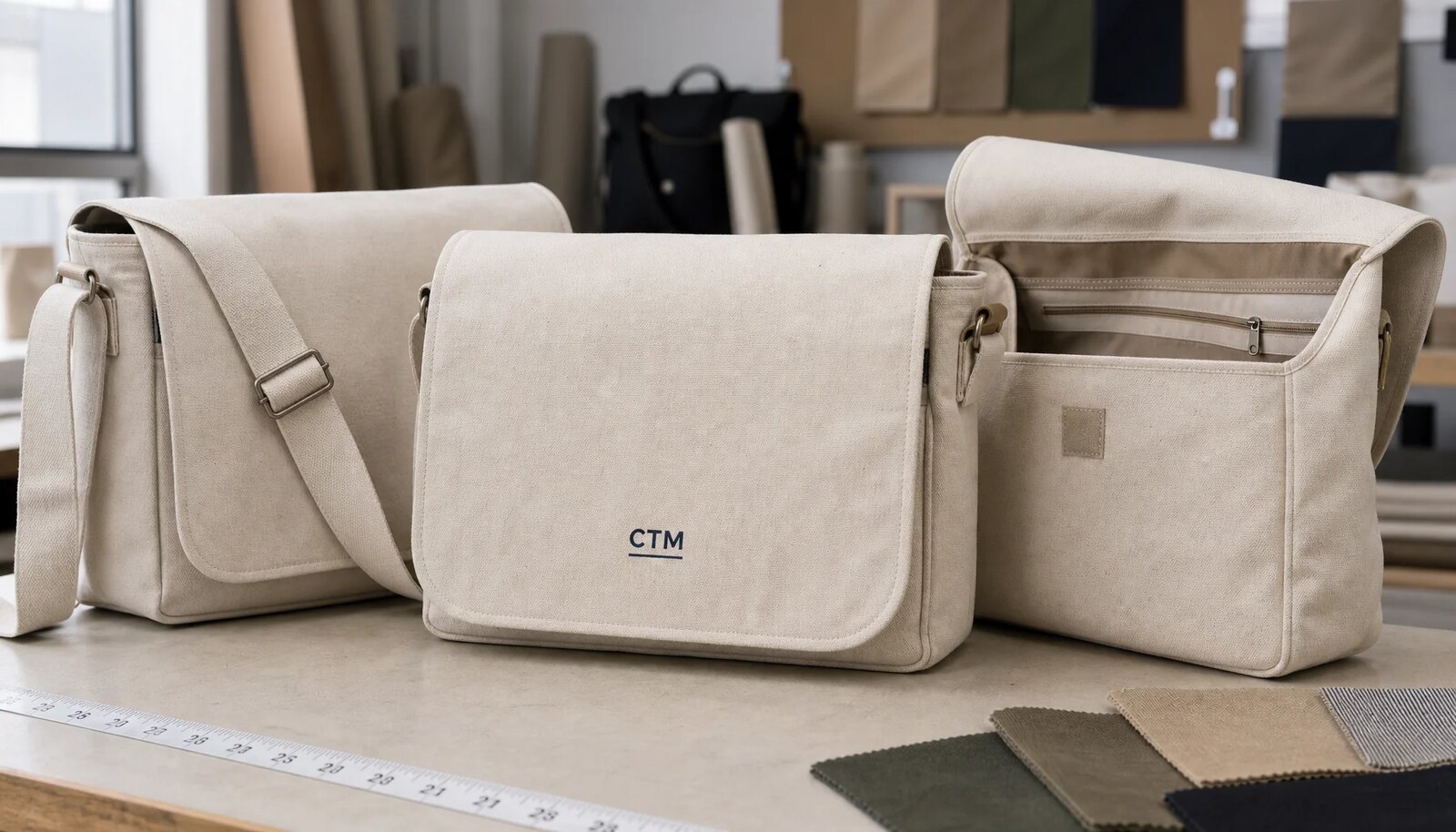
Why MOQ Negotiation Is Different for Craft Fair Messenger Bags
Canvas messenger bags for craft fairs are a more complex sourcing project than flat promotional totes. A messenger bag needs more panels, a flap, gusset, strap webbing, sliders, rings, closures, possible zippers, pockets, reinforcement stitching, and stronger packing. Any one of those components can create a minimum quantity. The sewing factory may be willing to make 300 bags, while the fabric supplier sells by roll, the hardware vendor packs sliders in larger lots, and the printer needs enough pieces to justify screen setup.
For procurement teams, the goal is not simply to chase the lowest number on a quote sheet. The better target is the lowest controlled MOQ: a quantity that still protects material consistency, branding quality, production flow, inspection time, and delivery timing. If a very low MOQ depends on leftover canvas, substitute hardware, hand-cutting, rushed printing, or vague packing instructions, the risk is real. It may show up later as shade variation, crooked flaps, weak strap points, loose snaps, or creased printed panels.
Craft fair programs also have fixed selling windows. Bags may be ordered for seasonal maker markets, holiday pop-ups, museum fairs, artist merchandise launches, wholesale previews, or distributor allocations. A shipment that arrives two weeks late can miss the best selling period. That is why MOQ negotiation should include sample approval timing, material purchasing, bulk production, inspection, packing, freight, and event allocation—not only the purchase quantity.
- Use the first order to validate size, hand-feel, artwork placement, and customer response before adding custom dyeing or complex organizers.
- Ask the supplier to separate MOQ drivers for fabric, print, hardware, sewing, labels, and packing instead of quoting only one blended MOQ.
- Negotiate around standard materials and repeatable construction, then spend customization budget only where customers will notice it.
- Treat the launch order as a controlled production test if the same bag may later move into wholesale, retail, or event replenishment channels.
Start With Use Case, Not Artwork
Many RFQs begin with a logo file, a target price, and a request for low MOQ. That sounds efficient, but it leaves too many decisions open. A canvas messenger bag must be designed around what it carries and how it sells. A craft fair shopper may use it for catalogs, notebooks, a tablet, small packaged goods, a water bottle, or purchases from several booths. Those use cases affect width, gusset depth, strap comfort, flap depth, closure strength, and fabric weight before the artwork is even placed.
A medium craft fair messenger often sits around 34-38 cm wide, 28-32 cm high, and 8-10 cm deep, with a 3.5-4 cm adjustable cotton webbing strap. This is a useful starting range, not a fixed rule. If the buyer needs A4 documents, tablet sleeves, catalogs, or product inserts to fit, the RFQ should state the internal usable size. External measurements alone can mislead because seam allowance, lining, binding, and flap shape reduce usable space.
Function also changes complexity. A boxed bottom helps the bag sit better on a display table. A flat flap gives the printer a cleaner surface than a curved or segmented flap. A magnetic snap is fast for shoppers, while buckles create a rugged look but add hardware alignment checks. A zipper under the flap improves security, yet it also increases sewing time, sample review, and inspection points. For first-order MOQ negotiation, keep the features that support the selling purpose and postpone decorative extras until demand is proven.
- For artist merchandise, keep the flap panel flat and uninterrupted for screen print, label, patch, or embroidery placement.
- For distributor programs, avoid unusual dimensions that reduce cutting efficiency or create oversized cartons with poor freight efficiency.
- For retail resale, state whether the bag must hold A4 papers, tablets, notebooks, catalogs, or product inserts.
- For event sellers, confirm whether the bag should hang neatly on hooks, fold flat in bins, or stand upright on a display table.
Fabric Specs That Shape MOQ and Quality
Canvas weight is one of the fastest ways to change both price and quality. A 10 oz cotton canvas, often around 330-340 GSM depending on construction, can work for lighter price-point programs. A 12 oz canvas, commonly around 390-420 GSM, is a strong default for canvas messenger bags for craft fairs because it gives the flap better structure and feels more retail-ready without becoming too bulky. Heavier 14 oz or 16 oz canvas can look premium, but it increases seam bulk, needle wear, cutting resistance, carton weight, and sewing slowdown. Those factors can push the MOQ or unit cost higher.
Ask for both oz and GSM. Suppliers may describe canvas weight differently by region or fabric convention, and the same casual term can hide very different hand-feel. The RFQ should also state composition, weave, finish, roll width, shrinkage expectation, and whether the canvas is raw, washed, pre-shrunk, coated, pigment dyed, or piece dyed. Shrinkage matters even if the finished bag is not sold as washable. Fabric relaxation can affect cutting, flap alignment, print placement, and finished measurements.
Canvas has a natural texture, so buyers should define what is acceptable before bulk production starts. Small slubs and weave variation may be normal when they match the signed swatch. Oil marks, mildew odor, fabric holes, broken yarns, dampness, heavy shade variation, or excessive loose fibers should not pass. A signed physical swatch and pre-production sample give procurement, factory QC, and third-party inspectors a shared reference that a written GSM number cannot replace.
- Request fabric weight in oz and GSM, plus composition, roll width, finish, shrinkage range, and stock color status.
- Approve a fabric swatch for hand-feel, shade, weave texture, acceptable slub level, and surface cleanliness.
- Ask whether the quote uses factory stock, fabric supplier stock, or a new mill dye lot with a separate minimum.
- Avoid mixing fabric weights in one small order unless the supplier confirms separate cutting, labeling, and inspection controls.
Choose Colors With MOQ in Mind
Color decisions can change the MOQ more than the bag pattern itself. Natural canvas, black, navy, olive, and other supplier-stock colors are usually easier to support at lower quantities. The factory may already have these fabrics in stock or may be able to buy them from a fabric supplier without triggering a full mill run. For a craft fair launch, stock natural canvas with a bold flap print, colored strap detail, woven label, or patch often creates enough brand identity without dye-lot risk.
Custom dyed canvas is a different negotiation. It may require lab dips, shade approval, minimum dye-lot fabric, shrinkage testing, and additional time if the first lab dip is rejected. If the final order is small, leftover fabric can become a hidden cost. Shade variation between sample and bulk may also cause problems when the buyer plans several delivery batches or repeat orders. Procurement should ask whether the supplier can keep the same shade for future runs or whether each run will be controlled within a stated tolerance.
When buyers want multiple colors, they need a color matrix, not a loose total MOQ. A 500-piece order might work as 250 natural and 250 black if both fabrics are stocked. The same 500 pieces may not work as five custom colors at 100 pieces each because each color has its own fabric minimum and approval process. Record minimums per color, per shipment, and per SKU in the purchase order so the supplier does not make assumptions during purchasing.
- Use stocked natural canvas for first orders when artwork, size, and demand are still being validated.
- Ask for the minimum quantity per color, not only total MOQ, especially for black, navy, olive, or seasonal shades.
- Require lab dip approval and bulk shade tolerance if custom dyeing is unavoidable.
- Confirm whether color splits affect price, lead time, packing labels, carton marks, and final inspection sampling.
Price Construction Before You Negotiate Quantity
Canvas messenger bag construction has more failure points than a tote. A clear procurement spec should define panel shape, flap depth, gusset, seam finishing, strap attachment method, closure type, pocket layout, stitch density target, and reinforcement. Without those details, two suppliers may quote products that sound similar but are not comparable. A lower MOQ or lower price may simply mean fewer reinforcements, rougher inside seams, thinner thread, or less stable hardware.
Strap points deserve extra attention because they carry most of the load. The attachment area should use reinforced stitching, box stitch, bar tack, rivet plus stitching, or another approved method that suits the canvas weight and expected use. Buyers should confirm whether the strap is sewn into the side seam, attached with D-rings, or connected through hardware tabs. Each approach changes labor time, durability, appearance, and inspection criteria.
Interior finishing affects perceived retail value. Bound seams look cleaner and feel more premium, though they add material and labor. Overlocked seams may be acceptable for price-point programs if they are secure and neat. Raw edges should be avoided unless the design intentionally uses a controlled raw finish. Craft fair shoppers often open bags, check pockets, and look inside before buying, so messy interior finishing can reduce trust quickly.
- State seam type, seam allowance, thread color, stitch density target, strap reinforcement, and closure placement in the RFQ.
- Specify whether the bag uses magnetic snaps, zippers, buckles, Velcro, buttons, or no closure, and how each area is reinforced.
- Limit first-order interiors to one flat pocket or one zipper pocket unless organizers are essential to the selling proposition.
- Require pocket openings, zipper ends, flap corners, and strap tabs to match the approved pre-production sample.
Control Branding Before Bulk Production
Branding drives craft fair visibility, but it also adds MOQ complexity. Screen printing is often the most practical option for one to three solid colors on cotton canvas. It gives strong booth visibility and reliable repeatability when artwork size, ink color, and print location are stable. On dark canvas, the buyer should ask whether an underbase is needed for opacity. Screen charges, ink mixing, test pieces, and setup waste should be separated in the quote so procurement can compare suppliers fairly.
Heat transfer can handle detailed artwork or gradients, but it should be tested carefully on canvas. Check film edge visibility, hand-feel, adhesion, rub resistance, and bend resistance because the messenger flap folds during use and may rub against clothing. Embroidery can look durable and premium, yet high stitch counts may pucker lighter canvas or require backing that changes the inside appearance. Woven labels and fabric patches are often MOQ-friendly when the buyer wants subtle branding or needs one branding element to work across several body colors.
Artwork placement should be measured, not described casually. The spec should state print size, distance from flap edge or centerline, ink reference, registration tolerance, and acceptable placement tolerance. For many soft canvas bags, plus or minus 5 mm for print placement may be reasonable if agreed in advance. Large centered artwork on a soft flap has more placement risk, so the buyer should use a physical sample, printed panel approval, or clear production marker before bulk printing.
- For screen print, specify artwork size, ink reference, number of colors, underbase requirement, print location, opacity target, and registration tolerance.
- For heat transfer, request bend, rub, edge-lift, and adhesion checks after repeated flap folding.
- For embroidery, approve stitch count, backing, thread color, edge quality, and puckering level before bulk production.
- For woven labels or patches, confirm label MOQ, sewing position, colorfastness, edge finish, and whether one label can serve multiple bag colors.
Build a Quote Matrix That Reveals the Real MOQ
A factory MOQ usually combines several material and process minimums. Fabric may be bought by roll or dye lot. Hardware may arrive in supplier packs. Printing may require screens, setup time, ink mixing, and test pieces. Sewing lines need enough quantity to justify cutting markers, line balancing, inline QC, and packing setup. If procurement asks only for the lowest final MOQ, the supplier may quote a safe number without explaining the constraint.
A quote matrix gives buyers better leverage. Ask for 300, 500, 1000, and 2000 pieces when those tiers match the demand plan. Each tier should show unit price, sample fee, screen fee, label fee, hardware or material surcharge, packing cost, bulk lead time, carton dimensions, pieces per carton, gross weight, net weight, and CBM. This makes setup fees visible and prevents a low unit price from hiding expensive first-order charges or freight-heavy packing.
The same matrix should compare specification scenarios. Scenario A can be the MOQ-friendly version: stocked canvas, standard hardware, one-color flap print, and export carton packing. Scenario B can add one retail upgrade such as a woven label, zipper pocket, paper belly band, or hangtag. Scenario C can show the full preferred specification with custom dyed fabric, upgraded hardware, several logo versions, barcode labels, or retail cartons. The point is not to overcomplicate the RFQ; it is to see which upgrade changes MOQ, cost, lead time, and QC risk.
- Separate one-time setup fees from repeat-order unit price so the first order and reorder economics are clear.
- Ask the supplier to state which cost changes if color splits, logo splits, or delivery batches are added.
- Compare carton CBM and gross weight because messenger bags can be volume-heavy even when unit weight is moderate.
- Mark any unconfirmed quote field as sourcing risk instead of assuming it is included in the price.
Lower MOQ Without Weakening the Bag
The strongest MOQ lever is reducing custom variables. A supplier is more likely to support a lower opening order when the bag uses one fabric family, one hardware finish, one strap type, one print position, one packing method, and a limited number of artwork versions. That gives the factory a repeatable product and reduces setup waste. Asking for a lower MOQ while adding custom dyeing, special zipper pulls, several logos, and retail cartons usually works against the buyer.
Repeatability is also useful. If the first order uses standard components that can be reordered easily, the supplier may be more willing to support a test quantity. Buyers can ask whether screens, cutting patterns, label files, and approved hardware references can be retained for future orders. This is not the same as making unsupported volume promises. It simply shows that the product has been designed for repeat production rather than a one-off experiment.
Controlled splitting can help, but only when the split is simple. Splitting 600 pieces across two stocked colors may be reasonable if the hardware, strap, print position, and packing remain the same. Splitting 600 pieces across six logo designs, three fabric weights, two hardware finishes, and different hangtags creates far more setup work than one 600-piece production run. The PO should state the approved split and the minimum per version.
- Keep one bag body, one fabric weight, one hardware finish, and one packing method for the first order.
- Use stock canvas colors and add brand identity through print, label, patch, or strap detail.
- Limit print versions until sales data confirms which artwork deserves a larger run.
- Ask for price breaks and repeat-order pricing instead of forcing the supplier to bury setup costs in a very small first order.
Approve Samples, Tolerances, and QC Terms Early
The pre-production sample is the buyer's most important control document. It should use the intended bulk canvas, strap webbing, thread, hardware, closure, pocket layout, logo method, and packing style. If the sample uses substitute fabric or hardware, the supplier should disclose that in writing and provide final swatches or a second approval sample before bulk cutting. This matters more on low-MOQ orders because there may be little spare material for correction.
Sample review should be practical, not only visual. Measure width, height, gusset, flap depth, strap width, strap length at shortest and longest settings, pocket dimensions, closure position, and logo placement. Load the sample with realistic contents and hang it to observe strap stress, flap twisting, closure strain, and comfort. Open and close snaps or zippers repeatedly. Rub the printed area with a dry white cloth and a slightly damp white cloth to screen for obvious ink transfer before approving bulk.
Written tolerances reduce arguments later. For soft canvas messenger bags, a common starting point may be plus or minus 1 cm for main dimensions, plus or minus 0.5 cm for smaller features, and plus or minus 5 mm for print placement, but the final tolerance must be agreed by buyer and supplier. Inspection can follow a recognized sampling approach such as ANSI/ASQ Z1.4 or ISO 2859-1 when both parties agree to AQL levels. Critical, major, and minor defect definitions should be listed before production starts.
- Keep one signed sample with the buyer and one sealed reference sample at the factory.
- Classify critical defects as safety or contamination issues, including sharp hardware, severe mildew, or hazardous foreign matter.
- Classify major defects as functional or obvious retail failures, including broken seams, weak strap points, closure failure, wrong logo, stains, or major size deviation.
- Classify minor defects as small cosmetic issues within agreed limits, such as trimable loose threads or slight natural canvas variation.
Plan Packing, Freight, and Event Timing
Packing is often left until the end, but it affects landed cost and booth readiness. Individual recycled polybags protect bags during transport but may conflict with plastic-reduction policies. Paper belly bands or tissue wrap can improve presentation, yet they may tear around hardware and corners. Bulk carton packing reduces material, but it can allow rubbing, flap creasing, and print pressure marks if the folding method is not controlled. The packing method should be sampled and approved before production packing begins.
Carton data belongs in the quote. Ask for pieces per carton, carton dimensions, gross weight, net weight, CBM, carton strength, shipping marks, SKU labels, and barcode label placement. Messenger bags can be bulky even when each unit is not especially heavy, so CBM affects ocean, air, courier, and domestic freight decisions. Oversized cartons can also be hard for distributors, small warehouses, and craft fair sellers to handle.
Lead time should include the full path to the selling table. A realistic schedule covers sample making, sample revision, artwork approval, material purchase, cutting, printing, sewing, inline QC, final inspection, rework, export packing, freight booking, customs clearance, domestic delivery, seller allocation, and booth setup. A production lead time of 25-40 days after sample approval may be reasonable for many non-custom programs, but it does not include buyer-side approval delays or international freight time. Build the calendar backward from the required in-hand date.
- Approve folding method and print protection before bulk packing, especially for large flap artwork.
- Confirm carton marks, barcode labels, hangtags, and SKU labels before cartons are produced or sealed.
- Book final inspection before the final packing day so rework can happen without missing freight cutoff.
- Add schedule buffer for customs clearance, domestic trucking, seller redistribution, and booth merchandising before the craft fair date.
Specification comparison for buyers
| Spec decision | MOQ-friendly specification | Procurement detail to lock | Buyer risk to check |
|---|---|---|---|
| Fabric weight | 10 oz canvas for entry price; 12 oz canvas around 390-420 GSM for balanced structure; 14 oz+ only when premium weight is required | State oz, GSM, composition, weave, finish, roll width, shrinkage expectation, and approved swatch reference | Unclear fabric naming can cause thin hand-feel, shade drift, higher freight weight, or sewing slowdown |
| Fabric color | Factory-stock natural, black, navy, olive, or other confirmed stock colors before custom dyeing | Confirm whether color is factory stock, fabric-supplier stock, or new dye lot; record minimum per color | Custom dyeing can trigger mill MOQ, lab dips, shade-lot variation, leftover fabric charges, and schedule delay |
| Bag size | Medium messenger range such as 34-38 cm width, 28-32 cm height, 8-10 cm gusset when A4/tablet use is intended | Specify finished dimensions, flap depth, gusset, strap width, strap adjustment range, and measurement tolerance | Oversized bags increase canvas consumption, carton CBM, flap creasing, and strap-load risk |
| Construction | Single flap, boxed bottom, finished inner seams, reinforced strap points, stable closure, and one practical inner pocket | Lock seam type, stitch density target, reinforcement method, thread color, closure type, and pocket dimensions | Raw seams, weak bar tacks, crooked flaps, or loose closures become visible retail defects at booths |
| Branding method | 1-3 color screen print for bold flap artwork; woven label or patch for subtle branding and color splits | State artwork size, Pantone or ink reference, placement tolerance, test requirement, and number of logo versions | Large flap prints need opacity, rub, fold, and placement checks because the flap bends and contacts clothing |
| Hardware package | Standard stocked slider, D-ring, snap, zipper, and buckle in antique brass, nickel, matte black, or gunmetal | Confirm finish, dimensions, plating consistency, sharp-edge control, pull strength, and stock status | Non-stock hardware can create a separate MOQ, mismatched finishes, delayed purchasing, or substitution risk |
| Interior features | One flat pocket or one zipper pocket for first orders; add organizers after demand is proven | Specify pocket size, zipper length, pocket opening reinforcement, and whether seams are bound or overlocked | Multiple compartments add sewing time, measurement variance, inspection points, and sample revisions |
| MOQ split | One body style, one fabric weight, one hardware finish, one packing style, limited color or logo splits | Request minimum per color, per print version, and per delivery batch, not only total order MOQ | A reduced total MOQ may still fail if each color, label, zipper, or print version has its own minimum |
| Packing | Individual recycled polybag, paper belly band, tissue wrap, or bulk carton packing with print protection | Confirm pieces per carton, carton dimensions, gross/net weight, CBM, carton strength, folding method, and labels | Over-compression can crease flaps, distort straps, rub ink, and make goods less booth-ready |
Buyer checklist before sampling
- Define the commercial use first: resale, giveaway, artist merchandise, distributor inventory, museum shop, staff bag, or bundled event item; then confirm expected load, display method, and retail presentation standard.
- Specify finished bag width, height, gusset, flap depth, strap width, strap adjustment range, pocket dimensions, closure type, logo position, seam finish, and packing method before asking for MOQ.
- Request fabric data in both oz and GSM, plus composition, weave type, finish, roll width, shrinkage range, stock color status, and whether the canvas is raw, washed, dyed, coated, or pre-shrunk.
- Ask the supplier to name the true MOQ driver: fabric roll, dye lot, cutting setup, sewing line setup, printing setup, label MOQ, zipper MOQ, hardware pack size, or packing material.
- Request comparable quote tiers at 300, 500, 1000, and 2000 pcs where feasible, with unit price, setup fees, sample fees, packing cost, lead time, carton CBM, gross weight, and payment terms separated.
- Clarify whether MOQ can be split across stocked colors, logo versions, or delivery batches, and record the minimum quantity per color, per artwork, and per shipment release.
- Separate must-have specs from negotiable upgrades, especially custom dyed canvas, custom hardware finish, full-color artwork, complex organizers, hangtags, barcode labels, and retail cartons.
- Approve a physical pre-production sample made with intended canvas, strap, thread, hardware, logo method, pocket layout, closure, and folding or packing method before bulk cutting.
- Set written tolerances for dimensions, strap length, flap alignment, print placement, print color, seam strength, hardware function, fabric cleanliness, odor, loose threads, carton weight, and carton compression.
- Use defect classifications before shipment: critical for safety or contamination, major for functional or obvious retail defects, and minor for small cosmetic issues within approved limits.
Factory quote questions to send
- What is the lowest practical MOQ if we use your stocked 12 oz natural cotton canvas, standard cotton webbing strap, standard metal hardware, one flap print, and export carton packing?
- Which part of this specification sets the MOQ: fabric roll purchase, dye lot, print screen setup, sewing line setup, hardware pack size, zipper minimum, label minimum, or packing material?
- Can the MOQ be split across two stocked canvas colors or two logo versions, and what is the minimum quantity per color and per artwork version?
- What fabric GSM, oz weight, composition, weave, finish, shrinkage range, roll width, and stock color options are included in the quotation?
- Is the canvas raw, washed, pre-shrunk, coated, dyed, or pigment dyed, and will the pre-production sample use the same fabric lot or the same approved bulk specification?
- Can you provide fabric swatches, strap swatches, hardware photos, and zipper or snap details before sample making, and will these become part of the approved spec?
- Which logo method do you recommend for our artwork size and flap position, and what rub, bend, wash, adhesion, or colorfastness checks can you perform before bulk?
- What reinforcement will be used at strap attachment points, flap corners, pocket openings, zipper ends, magnetic snap areas, and high-stress seams?
- What stitch density range, seam allowance, thread type, seam finishing method, and bar-tack placement will be used for bulk production?
- What are the exact carton dimensions, pieces per carton, gross weight, net weight, CBM, carton ply strength, packing material, folding method, and compression level?
Quality-control points to confirm
- Fabric weight should match the approved oz and GSM range, with hand-feel, color, weave texture, slub level, and shrinkage checked against the signed swatch and pre-production sample.
- Finished bag dimensions should stay within written tolerance for width, height, gusset, flap depth, strap width, strap adjustment range, pocket size, and closure placement.
- For soft canvas bags, a typical agreed size tolerance may be around plus or minus 1 cm for main dimensions and plus or minus 5 mm for print placement, but the exact tolerance must be written into the PO.
- Strap attachment points should include approved reinforcement stitching or bar tacks, with no skipped stitches, loose threads, needle cutting, weak corners, or fabric tearing under reasonable pull testing.
- Flap print should match approved size, placement, opacity, color, registration, edge quality, and rub resistance, especially along fold lines and high-contact areas.
- Magnetic snaps, sliders, zippers, D-rings, buckles, rivets, and zipper pulls should operate smoothly without sharp edges, plating defects, rust, weak attachment, or misalignment.
- Interior seams should be bound, overlocked, or otherwise finished exactly as approved; raw edges should not appear if the signed sample used binding or clean finishing.
- Canvas bags should be free of oil marks, mildew odor, dampness, heavy creasing, color migration, thread nests, fabric holes, broken yarns, visible weaving defects, and excessive loose fibers.
- Packing should match approved method, piece count, carton size, carton strength, gross weight, shipping marks, barcode labels, folding method, and compression level.
- Inspection should classify critical defects such as unsafe sharp hardware or severe mildew separately from major defects such as broken seams and minor defects such as trimable loose threads.