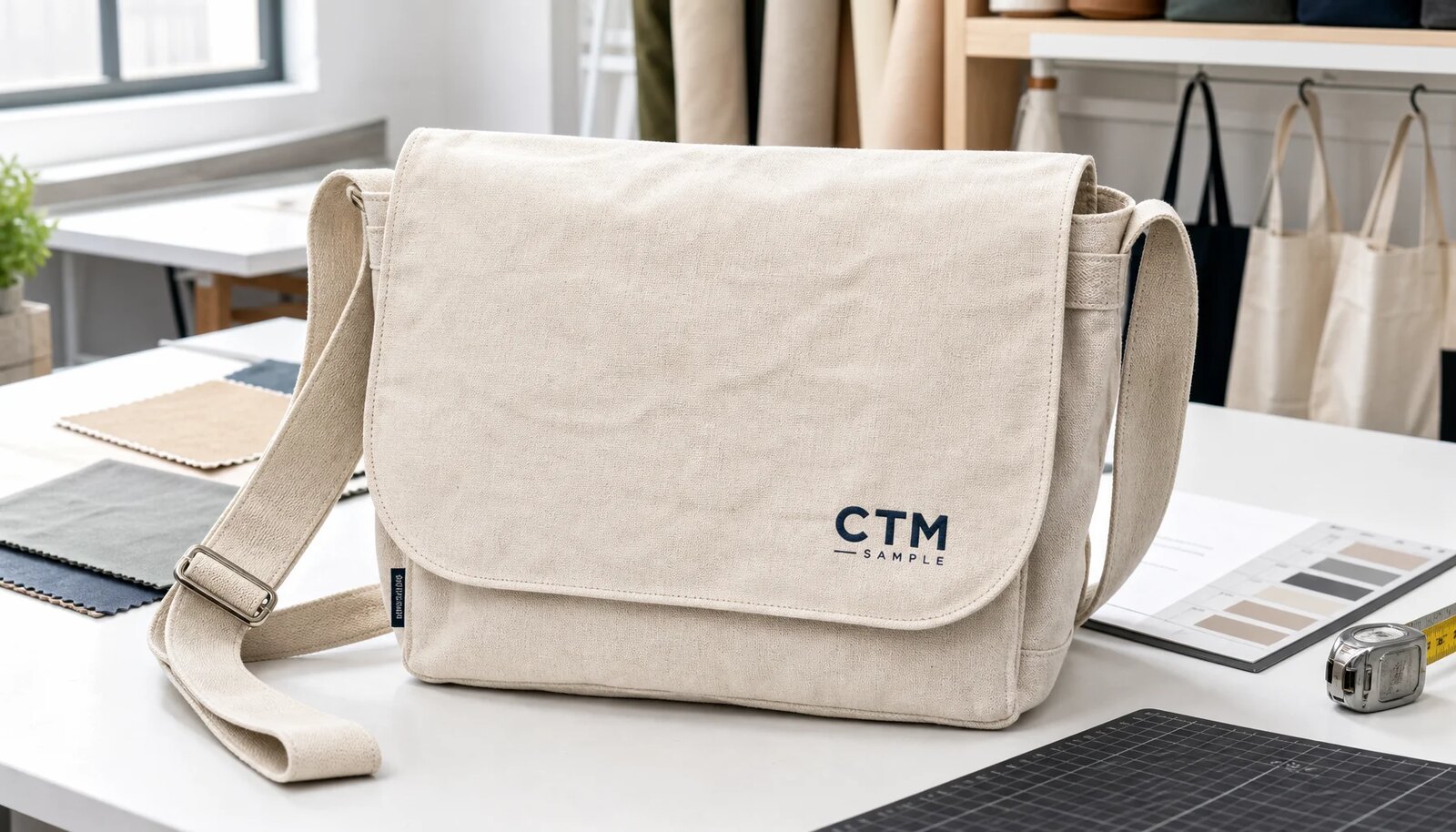
Start With How the Bag Will Be Displayed
Logo placement on canvas messenger bags for craft fairs should not start with a blank dieline. It should start with the way the bag is sold, stacked, hung, carried, and photographed. At craft fairs, the bag may hang on a pegboard, lie flat on a booth table, or sit behind a vendor as part of a branded display. A centered logo that looks correct on a flat artwork proof may sit too low once the flap folds over a packed bag.
For procurement teams and retail buyers, the practical decision is whether the logo must sell the bag from a distance, support the maker’s brand quietly, or carry event artwork. Those are different layouts. A large front flap logo helps recognition. A small side label protects premium appearance. A back panel print can work for giveaways but is weaker for retail visibility because the back panel is often hidden on display.
- For shelf or table display, place the main logo on the front flap where it stays visible when the bag is closed.
- For hanging display, test visibility with the strap pulled upward because the flap angle changes.
- For crossbody use, avoid placing the logo too close to the lower flap edge where the body curve can distort it.
- For premium craft brands, consider a smaller woven label plus a clean front flap rather than a large promotional print.
Choose the Printable Zone Before Fixing the Artwork
The front flap is the most common branding area, but it is not one uninterrupted print field. Seam allowance, topstitching, magnetic snaps, buckles, strap hardware, and the flap curve all reduce the safe zone. A good supplier should mark the printable area on a bag drawing using measurements taken from an actual sample, not only from a pattern file.
A practical safe rule is to keep live artwork at least 20-25 mm away from stitched edges and hardware. For a standard messenger bag around 35 cm wide, a logo width of 120-180 mm usually reads well without fighting the construction. If the logo includes small letters, thin lines, or a registration mark, the usable size may need to increase so the print does not fill in on textured canvas.
- Reference point should be defined, such as center of flap width and 70 mm above the lower flap edge.
- Placement tolerance should be written, such as plus or minus 5 mm on cut-and-sewn canvas.
- Artwork should avoid flap corners because those areas bend, rub, and show alignment variation faster.
- If the flap has a buckle strap, confirm whether the strap crosses the print area when the bag is closed.
Match Canvas Weight to Brand Positioning and Print Result
Canvas messenger bags used for craft fairs usually need more structure than a simple cotton tote. Many buyers compare 10 oz, 12 oz, 14 oz, and 16 oz canvas without realizing that the same logo can look different on each fabric. A 10 oz canvas, often around 300-340 GSM, is easier to sew and lighter to ship, but it may wrinkle more and feel less retail-grade. A 12 oz canvas, around 380-420 GSM, is a common middle point for durability and cost.
Heavier canvas can improve perceived value, but it changes production. Needles, thread, seam folding, bartack density, and carton weight all matter. Heavy 14-16 oz canvas can create thick corners at the flap, making the logo area less flat. If the logo uses a large solid ink area, heavy texture may require stronger ink coverage or a print base layer, especially on dyed canvas.
- 10 oz canvas fits budget craft fair giveaways or light retail bags where freight cost is sensitive.
- 12 oz canvas fits most branded messenger bags needing structure, reuse value, and reasonable export weight.
- 14 oz canvas fits premium bags but should be sampled for fold thickness and print smoothness.
- 16 oz canvas needs careful seam and hardware review because bulky stress points can affect finish quality.
Select Print Method by Artwork, Not by Habit
Screen printing is usually the strongest starting point for canvas messenger bags with one to three solid logo colors. It gives good opacity, predictable cost at volume, and reliable repeatability if the artwork is clean. The buyer should specify Pantone color, print size, logo position, and whether the ink needs a soft hand feel or heavier coverage. On natural canvas, small shade variation is normal, so a physical strike-off is more useful than a screen image.
Heat transfer can handle gradients, multicolor artwork, and short runs, but it can feel less integrated with the fabric and may crease on a bending flap. Embroidery gives a premium look for small logos but is not ideal for large detailed artwork on thin canvas panels because the stitches can pucker the fabric. Woven labels are useful for repeat retail programs when the brand wants a consistent identity across messenger bags, totes, pouches, and backpacks.
- Use screen print for solid brand marks, event logos, and larger front flap graphics.
- Use heat transfer only after testing flap bending, washing expectations, and edge adhesion.
- Use embroidery for small premium marks, but limit stitch density on lighter canvas.
- Use woven labels when the logo must stay consistent across multiple bag shapes and fabric colors.
Understand the Cost Drivers Behind Logo Placement
Logo placement affects cost because it affects production flow. Printing a flat panel before sewing is usually cleaner and more efficient for larger artwork, but it requires accurate cutting and sewing so the logo lands correctly after assembly. Printing after sewing may help small-position jobs, but the raised seams, flap thickness, and hardware can limit screen access and increase rejection risk.
Buyers comparing quotes should not treat all logo costs as one line item. A lower unit price may exclude screen charges, label setup, artwork cleanup, sampling, special ink, or extra packing. MOQ also changes depending on whether the buyer uses stock natural canvas, custom dyed fabric, custom hardware, or branded labels. A realistic quote separates bag body cost, logo cost, setup cost, packing cost, and export carton data.
- Panel printing before sewing can reduce print defects but needs tighter sewing alignment control.
- Finished-bag printing can support small logos but may limit artwork size and increase handling time.
- Custom fabric dyeing often creates a higher MOQ than logo printing on natural canvas.
- Woven labels, metal badges, and custom buckles may have separate tooling charges and longer lead times.
Build the RFQ Around Measurable Quote Data
A useful RFQ for canvas messenger bags should give the supplier enough information to quote the same product another factory would quote. Without size, canvas weight, print area, strap material, hardware color, pocket layout, packing method, and target quantity, the buyer will receive prices that look comparable but are not based on the same construction. This is one reason messenger bag quotes can vary widely even when the photo looks similar.
For craft fair programs, buyers should include the expected selling channel and handling condition. A bag sold as a retail item needs cleaner finishing and stronger packing than a free event giveaway. A distributor selling to multiple makers may need neutral branding, private labels, and carton markings by SKU. These details are not decoration; they affect labor, waste rate, carton count, and lead time.
- Include finished bag dimensions, flap dimensions, gusset depth, strap width, and strap length range.
- State canvas weight in oz and GSM, or request both so suppliers cannot substitute silently.
- Provide artwork file type, Pantone colors, target print size, and preferred placement reference point.
- Request carton size, carton gross weight, pieces per carton, and packing style for freight comparison.
Approve Samples in the Same Conditions as Bulk Production
A messenger bag sample should not be approved only from a front photo. The buyer should review the bag flat, hanging, packed with typical contents, and worn crossbody. The logo may look centered on the table but visually shift when the flap bends. This is especially important when the bag has a gusset, thick front pocket, buckle strap, or magnetic snap that changes the flap tension.
The sample stage should include a print strike-off and a full pre-production sample. The strike-off confirms ink color, opacity, hand feel, and adhesion on the chosen fabric. The pre-production sample confirms placement, construction, stitching, hardware, labels, and packing. If the first sample uses substitute fabric or a different print method, it should be treated as a layout sample only, not a production approval.
- Measure logo position from agreed reference points and record the tolerance on the approval sheet.
- Check the print after bending the flap open and closed several times.
- Compare the logo color under daylight and indoor booth lighting.
- Photograph the approved sample from table display, hanging display, and worn positions.
Set QC Thresholds That Fit Canvas Messenger Bags
Quality control for this product should cover more than print appearance. Canvas messenger bags carry weight on the strap tabs, side seams, flap seam, and bottom corners. Craft fair shoppers may load ceramics, candles, notebooks, jars, or samples into the bag. If the strap attachment is weak, the logo placement will not matter because the product will fail in use.
QC should also address the natural behavior of cotton canvas. Slight slubs and shade variation can be acceptable if agreed in advance, but oil stains, sharp weaving defects, severe shade bands, or print contamination should not pass. For logo placement, the factory should inspect against a sample or measuring jig, not rely only on visual judgment. AQL levels can be negotiated, but the defect definitions need to be clear before production.
- Major defects include wrong logo position beyond tolerance, missing print color, broken strap stitching, and hardware failure.
- Minor defects may include small natural slubs if they do not sit inside the logo or affect function.
- Print adhesion should be tested by rub, tape pull where suitable, and repeated flap bending.
- Strap tabs should be pull-tested with a load appropriate to the buyer’s intended use, not only checked visually.
Plan Packing to Protect the Logo Until the Fair
Many logo problems happen after the print is accepted. If bags are packed while ink is not fully cured, stacked under pressure, or placed buckle-to-print inside the carton, transfer marks can appear before the goods reach the distributor. Canvas texture can also pick up dust during sewing and packing, so clean handling is important for natural and light-colored bags.
For craft fair buyers, packing should support both export shipping and retail handling. Flat packing saves space, but over-compression can crease the flap directly through the logo. Individual polybags protect against moisture and abrasion, while paper bands or tissue may better fit brands trying to reduce plastic. The quote should specify which method is included because packing labor and material cost can change the unit price.
- Use interleaving paper or correct bag orientation if hardware may touch printed areas.
- Avoid over-tight carton packing that creates permanent flap creases through the logo.
- Record pieces per carton, carton dimensions, gross weight, and net weight for landed-cost calculation.
- Use export cartons strong enough for stacking because messenger bags with buckles can create pressure points.
Control Lead Time and Schedule Risk
Lead time for canvas messenger bags depends on more than sewing capacity. Fabric availability, dyeing, washing, print screen setup, custom label production, hardware sourcing, sample revision, and packing material can each become the longest item. A buyer planning for a craft fair season should not place the full schedule risk on the final sewing date. The approval path needs time for artwork review and physical sample delivery.
For a straightforward natural canvas bag with screen print, the schedule is usually shorter than a dyed canvas bag with custom hardware and woven labels. Buyers should build the purchase order around milestones: artwork confirmation, strike-off approval, pre-production sample approval, material booking, bulk production, inline inspection, final inspection, and shipment. If the fair date is fixed, the supplier should identify which options must be simplified to protect delivery.
- Natural canvas and standard hardware usually reduce schedule risk compared with custom dyed fabric.
- Screen print setup is usually faster than custom woven labels or metal badge tooling.
- Sample revisions should be limited by approving placement and construction separately where possible.
- Final inspection should happen before cartons are sealed for shipment, not after goods leave the factory.
Specification comparison for buyers
| Spec decision | Recommended option | When it fits | Buyer risk to check |
|---|---|---|---|
| Main logo position | Centered on front flap, 120-180 mm wide for standard 12-14 inch bags | Best for craft fair retail visibility when bags hang from hooks or sit on display shelves | Flap curve, buckle position, and seam allowance can reduce the printable flat area |
| Secondary branding | Small woven side label or inner label with brand name and care text | Useful when the front flap carries artwork, event graphics, or a seasonal design | Label MOQ and color count may be separate from bag MOQ; confirm label lead time early |
| Canvas weight | 12 oz cotton canvas, roughly 380-420 GSM, with reinforced stress points | Good balance for reusable craft fair bags that need structure without becoming too heavy | Lower GSM may sag on displays; higher GSM may increase freight and needle breakage risk |
| Print method | Screen print for 1-3 solid colors on front flap or back panel | Best for clean logos, strong opacity, repeat orders, and controlled unit cost | Fine lines below 0.3 mm, small reversed text, and heavy ink coverage need strike-off approval |
| Artwork size | Keep live artwork at least 20-25 mm away from seams, buckles, snaps, and flap edge | Prevents distortion during sewing and keeps the logo visible after the flap naturally bends | Artwork approved from a flat dieline may look too low once the bag is packed and worn |
| Bag construction | Flap messenger bag with crossbody strap, internal pocket, and reinforced strap tabs | Suitable for craft fair buyers who want a higher perceived value than a tote bag | Strap attachment must be pull-tested because craft fair shoppers often load catalogs, jars, books, or samples |
| Packing method | Individual polybag or paper band, then flat pack 20-40 pcs per export carton | Protects printed flap surfaces and keeps retail-ready appearance for distributors | Wet ink, rough carton liners, or over-tight packing can cause print transfer or flap creasing |
| MOQ logic | MOQ based on fabric dye status, logo method, hardware color, and label customization | Works for buyers comparing stock natural canvas with custom dyed or branded versions | A quoted MOQ for blank bags may not apply after adding custom fabric color, woven labels, or metal hardware |
Buyer checklist before sampling
- Define the exact bag size, flap size, gusset depth, strap length, and intended load before discussing logo placement.
- Mark the preferred logo location on a flat technical drawing and on a physical reference photo of the bag hanging upright.
- Keep the logo at least 20-25 mm from flap edges, seams, snaps, buckles, leather patches, and heavy fold lines.
- Match canvas weight to use case: 10 oz for lighter giveaways, 12 oz for retail craft fair sales, and 14-16 oz for premium structured bags.
- Choose print method according to artwork: screen print for solid logos, heat transfer for gradients, embroidery for small premium marks, and woven labels for repeat brand identity.
- Request a print strike-off on the same canvas weight and color as bulk production, not on a substitute fabric.
- Approve a pre-production sample with the bag packed flat, hung by the strap, and worn crossbody to judge real logo visibility.
- Set logo tolerance in writing, such as plus or minus 5 mm for placement and plus or minus 3 mm for print size on cut-and-sewn canvas.
- Confirm whether bags are printed before sewing or after sewing because this affects alignment, printable area, and rework options.
- Specify packing that protects the printed flap from abrasion, moisture, pressure marks, and ink transfer during export shipping.
Factory quote questions to send
- What canvas weight and GSM are included in your quote, and is the fabric greige, bleached, dyed, or washed?
- What is the maximum safe print area on the front flap after allowing for seams, flap curve, buckle position, and stitching?
- Will the logo be printed before sewing or after sewing, and how does that affect placement tolerance?
- Which print method are you quoting, how many colors are included, and what artwork limitations apply to fine lines or small text?
- What is the MOQ for the bag body, print setup, custom labels, custom hardware, and fabric dyeing if each has a different minimum?
- Can you provide a digital proof, print strike-off, and full pre-production sample before bulk cutting?
- What tests do you perform on strap attachment, seam strength, colorfastness, rubbing, and print adhesion?
- How many pieces are packed per carton, what is the carton size and gross weight, and can the printed flap be protected from transfer?
- What is the estimated production lead time after sample approval, and which materials could extend the schedule?
- Which quote items are included separately: tooling, screen charge, label mold, sample cost, inland freight, export carton, and documentation?
Quality-control points to confirm
- Logo placement tolerance should be written on the approved sample, commonly plus or minus 5 mm from the agreed reference point.
- Print opacity should be checked under daylight and indoor light because natural canvas texture can make thin ink coverage look uneven.
- Dry and wet rub testing should be applied to dark prints, dyed canvas, and any heat transfer placed on the flap or back panel.
- Strap tab and side seam strength should be tested with a realistic loaded weight, not only visual inspection.
- Flap alignment should be inspected after the bag is packed because a centered logo on a flat panel may shift visually when the flap folds.
- Carton drop and compression checks should confirm that buckles, sliders, and stacked straps do not mark the printed logo area.
- Bulk inspection should compare production bags against the approved pre-production sample for fabric shade, logo scale, stitching, hardware, and packing.