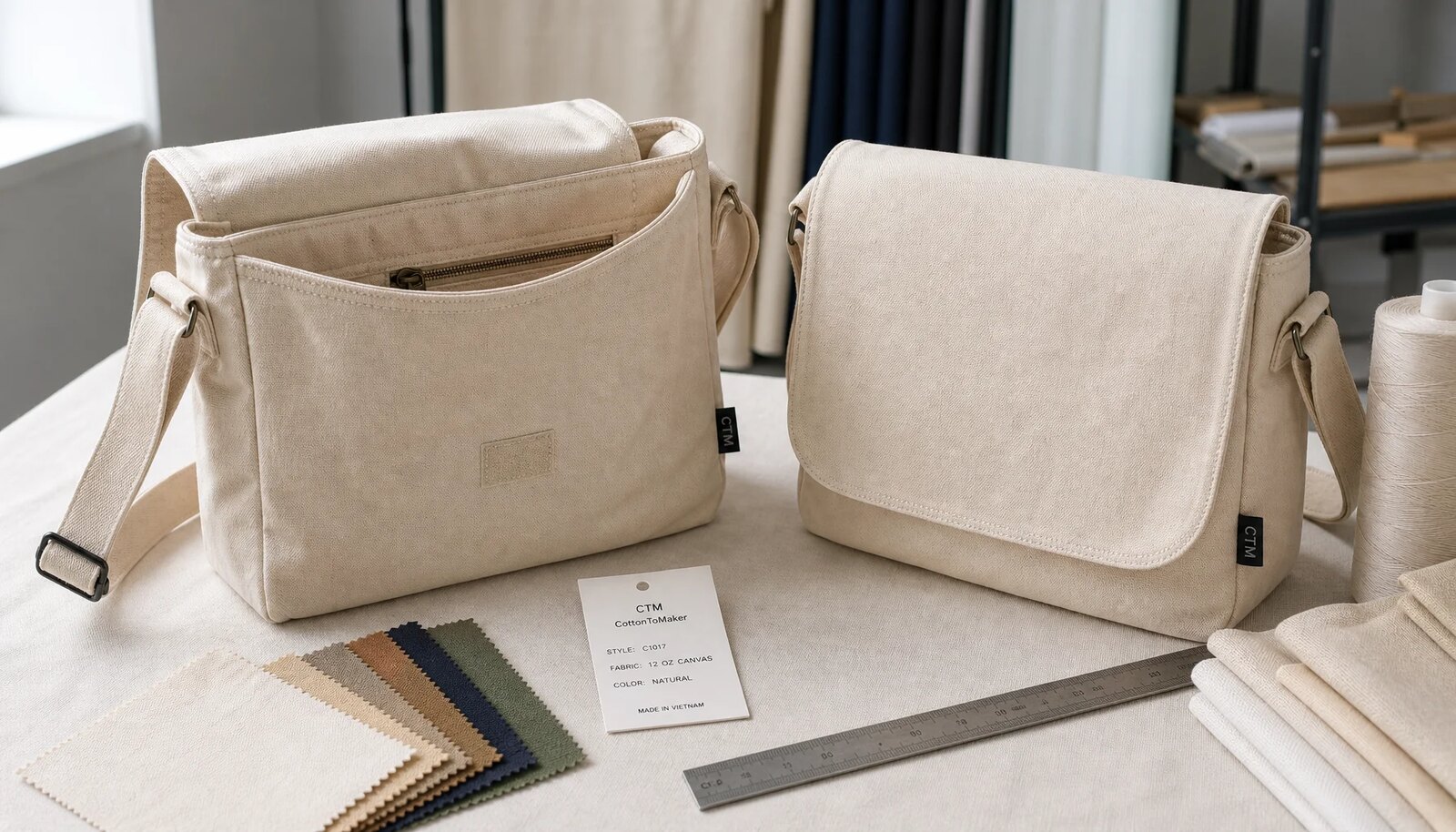
Start With the Real Deadline
For canvas messenger bags used at craft fairs, the event opening day is not the date procurement should plan around. The more useful deadline is earlier: the day the bags must be received, counted, checked, labeled, kit-packed, allocated, and staged for booth setup or multi-location distribution. If the goods arrive on the morning of the fair, they are already late from an operations point of view.
This is why a lead time plan should run backward from the warehouse receiving date. A supplier may quote 30 production days, but that number usually starts after deposit, approved artwork, approved sample, and available materials. It may not include specification questions, sample making, courier transit, buyer comments, lab dips, print strike-offs, inspection, export booking, customs clearance, inland trucking, or your warehouse intake queue.
A conservative sea-freight planning window for custom canvas messenger bags for craft fairs is often 10-14 weeks from locked specification to warehouse receipt. Simple stock natural canvas with one-color screen print can move faster. Dyed fabric, washed canvas, lining, embroidery, metal hardware, woven labels, retail hangtags, or individual polybags can add days or weeks. Air freight may rescue transit time, but it will not fix a skipped sample gate or a late artwork approval.
- Set the warehouse delivery deadline at least 7-10 calendar days before booth setup, kit assembly, or first selling date.
- Add 3-5 days for receiving, carton count, internal QC review, relabeling, allocation, and local distribution.
- Reserve 5-10 days for artwork clarification, sample comments, stakeholder review, and purchase order corrections.
- Check factory holidays, fabric dyeing queues, print-shop capacity, peak season, port congestion risk, and courier cutoff dates.
- Do not release bulk cutting until the PP sample, artwork size, strap length, closure position, tolerance sheet, and packing method are approved in writing.
Turn the RFQ Into a Working Spec
A messenger bag price only means something when the construction is fixed. Two suppliers can both quote a natural canvas messenger bag and still be pricing different products. One may include 12 oz canvas, an inside pocket, metal slider, reinforced bottom, magnetic snap, and woven label. Another may quote 10 oz canvas, no pocket, plastic adjuster, hook-and-loop closure, and bulk packing. The lower price may simply be a thinner specification.
For B2B buying, treat the RFQ as a compact technical pack. Include finished dimensions, a construction drawing or reference sample, canvas weight, fabric finish, strap details, closure type, pocket size, seam finish, decoration method, logo placement, hardware material, label position, packing method, tolerances, and inspection expectations. Use finished-bag dimensions after sewing, not panel dimensions before assembly.
Match the specification to the business use. Resale craft fair merchandise needs clean finishing, consistent flap shape, stable logo placement, and packing that protects presentation. Vendor kit bags need stronger strap attachment, practical pockets, and enough gusset for catalogs, samples, badges, or order forms. Giveaway bags can be simpler, but they still need measurable standards for strap strength, fabric cleanliness, and print quality.
- Basic event bag: 8-10 oz canvas, single compartment, flap, cotton webbing strap, economical closure, and one-color screen print.
- Retail craft bag: 10-12 oz canvas, inside slip pocket, magnetic snap, woven label, controlled seam finish, and optional hangtag.
- Vendor kit bag: 12 oz canvas, reinforced strap ends, bottom panel, wider webbing, secure closure, and pocket sized for forms or badges.
- Premium small-batch bag: dyed canvas, lining, zipper pocket, metal hardware, cotton patch, embroidery, or branded trim.
- RFQ control point: ask every supplier to list assumptions and exclusions in the same quote format.
Be Precise About Canvas
Canvas weight affects cost, structure, sewing difficulty, carton cube, and user perception. Avoid loose descriptions such as thick canvas, heavy cotton, or premium fabric unless they are backed by numbers. Use specifications such as 10 oz/yd² cotton canvas at approximately 340 GSM or 12 oz/yd² cotton canvas at approximately 410 GSM. Because oz-to-GSM conversion can vary by weave and finish, ask the supplier to confirm the actual production fabric.
For many craft fair messenger bag programs, 10-12 oz/yd² is the practical middle ground. It has more body than lightweight promotional cotton while remaining easier to sew, fold, and ship than very heavy canvas. A 14-16 oz/yd² canvas can look more premium, but it also creates thicker seam intersections at the flap, pocket, strap tabs, and bottom corners. Those areas are where skipped stitches, needle marks, bulky folds, and slower production often appear.
Finish deserves the same attention as weight. Natural canvas is usually simpler to source. Bleached canvas gives a cleaner base but shows stains more readily. Dyed canvas needs color approval and may require lab dips or strike-offs. Washed canvas can improve hand feel but may increase dimensional variation. If the bag must fit a tablet, insert card, retail pack, or kit component, ask whether shrinkage has been tested before final dimensions are approved.
- 8 oz/yd² canvas: lightweight promotional use, softer structure, lower material cost, and less load expectation.
- 10 oz/yd² canvas: moderate structure for event bags, sponsor gifts, and simple craft fair merchandise.
- 12 oz/yd² canvas: balanced retail feel for vendor kits, catalogs, light samples, and repeat B2B programs.
- 14-16 oz/yd² canvas: premium appearance but higher sewing difficulty, thicker seams, more carton cube, and longer sample review.
- Dyed or washed canvas: confirm shade standard, shrinkage, hand feel, lead time, and whether shade variation between lots is acceptable.
Design Around Stress Points
Messenger bags tend to fail where force concentrates: strap attachment, flap corners, pocket openings, closure backing, gusset seams, and bottom corners. These details should be defined before quote comparison because they change labor time, material use, sampling risk, and inspection scope. A bag carrying catalogs, small samples, or POS materials needs more reinforcement than a light brochure giveaway.
A practical strap specification for canvas messenger bags is 38-50 mm cotton webbing with an adjustable slider. Do not specify only the strap width. State the full adjustable length range and the intended carry style. Crossbody use usually needs more length than shoulder carry, and the difference is noticeable once the bag is loaded. Strap ends should be secured with box-X stitching, bartacks, or reinforced tabs, and the reinforcement pattern should be visible on sample photos.
Closure choice also changes both cost and customer experience. Magnetic snaps give a clean retail look but need backing patches or washers, consistent placement, and checks for fabric marking on light canvas. Hook-and-loop is economical and easy to use, but it can catch fibers and collect lint. Button-and-loop closure suits craft or handmade positioning, while buckles can look premium but add material cost and assembly time.
- Define strap width, webbing material, slider material, strap length range, strap drop target, and attachment pattern.
- Confirm whether strap hardware is metal, plastic, or acetal, and whether the finish must match snaps, rivets, or zipper pulls.
- Specify closure position from flap edge and body edge so bulk placement is measurable.
- Require reinforcement at magnetic snaps, rivets, strap tabs, pocket openings, flap corners, and bottom corners.
- Ask for a loaded-use check on PP sample and first bulk pieces using realistic contents such as catalogs, forms, or light samples.
Control Artwork Before Production
Decoration can quietly become the longest part of the order. Screen printing is often the most practical method for canvas messenger bags when the logo is simple and the print area is flat. It works well on natural canvas, but fine lines, small text, large solid ink areas, dark fabric, and prints close to seams should be tested early. Send vector artwork, Pantone or brand color references, final print size, and placement dimensions before the supplier finalizes pricing.
Ask the factory whether printing will happen on cut panels before sewing or on finished bags after sewing. Printing on panels gives a flatter surface and better pressure control, but cutting and sewing must preserve final placement. Printing after sewing helps align artwork to the finished bag, but seams, gussets, pockets, flaps, and hardware can stop the print board from sitting flat. The chosen method should be written into the PP sample approval.
For repeat programs, a woven label, cotton patch, or embroidery may be stronger than event-specific print. A woven label supports consistent branding across reorders, but label MOQ and lead time must be counted. Embroidery can look durable, yet it may distort lighter canvas if stitch density is too high. Heat transfers can reproduce complex artwork, but adhesion, hand feel, edge lift, and rub performance should be tested on the actual canvas surface.
- Screen print: best for simple logos, sponsor marks, event names, and larger flat-panel graphics.
- Embroidery: best for smaller logos on heavier canvas; avoid very large filled areas and fine gradients.
- Woven label: best for repeat branding, low color-risk placement, and retail-style detail.
- Cotton patch: useful for craft positioning; approve patch fabric, edge finish, stitch line, and color contrast.
- Placement tolerance: define logo position from fixed edges and use ±5 mm only if the factory confirms it is achievable for the construction.
Build MOQ From Real Inputs
MOQ is not just a number a supplier chooses. It is shaped by fabric availability, dye-lot size, webbing rolls, label MOQ, print screens, embroidery tape, hardware sourcing, cutting efficiency, sewing-line changeover, trimming, inspection, and packing. A factory can sometimes make a very small batch, but the same setup work is then spread across fewer bags, so the unit price rises.
For canvas messenger bags for craft fairs, ask for price breaks at realistic tiers rather than only asking for the lowest possible MOQ. A 300-piece order may be workable with stock natural canvas, stock webbing, no lining, and one-color print. Dyed canvas, custom woven labels, metal hardware, embroidery, or multi-color decoration can push the economical quantity higher. The quote should show the reason, not hide it inside a single number.
Component MOQ can create hidden exposure. The bag factory may accept 500 bags, while the woven label supplier requires 1,000 labels, the webbing supplier sells full rolls, and the dye house requires a minimum fabric lot. If a reorder is likely, ask whether excess labels, webbing, or fabric can be stored, how long they will be held, who owns the material, and what happens if shade or quality changes over time.
- Request price breaks at 300, 500, 1,000, 2,000, and 3,000 pieces when demand may scale.
- Separate sample fees, screen charges, embroidery tapes, label setup, mold charges, and packing add-ons from the unit price.
- Confirm component MOQs for canvas, webbing, labels, snaps, sliders, zipper tape, patches, hangtags, barcode labels, and cartons.
- Ask whether leftover custom materials can be used for reorders and whether storage, aging, shade drift, or loss risk applies.
- Treat very low MOQ offers carefully unless the supplier states material, decoration, packing, and inspection assumptions.
Map Lead Time by Gate
A useful schedule does not say only production: 30 days. It shows the gates: spec lock, artwork approval, first sample, sample transit, buyer comments, PP sample approval, material preparation, cutting, decoration, sewing, inline inspection, final inspection, packing, export documents, freight booking, customs, inland delivery, and warehouse receipt. Once every gate is visible, the real bottleneck is easier to manage.
A typical custom sequence may include 2-4 days for supplier spec review, 5-10 days for prototype or first sample making, 3-7 days for sample courier transit, 2-5 days for buyer comments, and 25-40 days for bulk production after deposit, material readiness, and PP sample approval. Sea freight, destination handling, customs, and inland delivery can add several weeks depending on origin and destination. These are planning ranges, so the supplier quote should state its exact assumptions.
Approval gates protect the buyer and the factory. The spec lock gate freezes construction and tolerances. The artwork gate freezes file version, color, size, and placement. The PP sample gate confirms the product standard. The first bulk piece gate verifies production settings before a defect repeats across the full batch. The shipment gate confirms inspection, packing, carton data, documents, and handover instructions.
- Spec lock gate: dimensions, canvas, pockets, closure, strap, decoration, labels, tolerances, packing, and carton marks confirmed.
- Artwork gate: vector file, print size, placement, Pantone reference, color count, and decoration method approved.
- PP sample gate: physical sample approved for size, workmanship, hand feel, closure, strap comfort, logo, and packing fold.
- First bulk gate: first 20-50 pieces checked before full-speed cutting, printing, sewing, trimming, or packing continues.
- Shipment gate: final inspection, carton count, carton data, booking, commercial documents, and delivery instructions completed.
Use Samples as Controls
A sample should not be approved on a general impression. It is the production reference for material, dimensions, workmanship, logo placement, color, strap length, closure strength, pocket usability, and packing appearance. If the approval note only says approved, the factory may reproduce details the buyer did not notice, including weak reinforcement, poor flap symmetry, or an uncomfortable strap length.
For craft fair orders, the PP sample matters because recovery time is limited. If the logo is too close to the seam, the flap is too short, the inside pocket does not fit order forms, or the strap pulls at an awkward angle, the issue may not be fixable after fabric is cut or panels are printed. A controlled approval sheet should include measurements, close-up photos, and written comments tied to the purchase order.
Sampling can be staged when needed. A prototype can confirm construction using available fabric. A print strike-off can confirm ink color and curing on the actual canvas. A PP sample should represent the final fabric, final hardware, final strap, final label, final decoration method, final measurements, and final packing. If a major item changes after PP approval, require written confirmation or a revised sample before bulk production.
- Measure finished width, height, gusset, flap drop, pocket opening, bottom panel, strap width, and full adjustable strap range.
- Check logo size, color, edge sharpness, placement from fixed edges, ink hand feel, curing, and rub performance.
- Load the sample with intended contents and inspect strap-end distortion, flap alignment, closure function, and wearer comfort.
- Photograph front, back, side, bottom, inside, closure, strap attachment, pocket, logo close-up, label, and packing fold.
- Attach the approved sample sheet, artwork version, and tolerance notes to the purchase order and final inspection instruction.
Compare Landed Cost, Not Only Unit Price
Messenger bags are bulkier than flat pouches and often bulkier than simple totes because of the flap, gusset, strap hardware, and reinforced panels. A low FOB unit price can become expensive if carton cube is high, individual polybags are required, folding creases the print panel, or late approvals force air freight. Procurement should compare delivered cost per usable bag, not only the factory unit price.
Packing style changes cost, presentation, and transit risk. Flat packing protects the flap shape and logo panel, but it can increase carton volume. Folding can reduce cube but may create hard creases across the flap or front print. Individual polybags improve cleanliness for resale and warehouse scanning, but they add material, labor, plastic reporting considerations, and inspection time. For controlled kit assembly, bulk inner packing may be enough.
Ask for carton dimensions, pieces per carton, gross weight, net weight, total carton count, and total CBM before the purchase order is released. Also ask whether the carton data is based on an actual packed sample or an estimate from a similar order. On larger orders, small carton-size differences can affect palletization, storage, local trucking, and the choice between sea, air, courier, or domestic consolidation.
- Request EXW or FOB unit price together with packed carton data before comparing suppliers.
- Calculate landed cost including freight, duty, customs fees, inland delivery, inspection, warehouse handling, and possible rework.
- Confirm whether cartons can be palletized without crushing flaps, bending hardware, or creasing print panels.
- Check whether individual polybags, hangtags, barcode labels, suffocation warnings, carton marks, and pallet labels are included.
- Ask logistics to review total CBM and gross weight before the purchase order is released.
Set Inspection Rules Early
Quality control is easier when acceptance criteria are agreed before sewing starts. Canvas is a natural fabric, so minor slubs and slight texture variation may be acceptable. Stains, oil marks, severe shade mismatch, skipped stitches, weak strap reinforcement, crooked logos, sharp hardware, odor, and wet cartons should not be left to interpretation. Define critical, major, and minor defects in writing.
Inline inspection is usually more valuable than discovering problems after every carton is sealed. The factory should check first pieces from cutting, decoration, sewing, trimming, and packing. If the first 20-50 pieces show crooked logo placement, poor curing, weak strap stitching, or wrong flap length, production should pause before the same defect spreads across the batch.
Final inspection should compare production against the signed PP sample and specification sheet, not against a generic bag checklist alone. The inspector should measure size, review workmanship, test closures and strap attachment, check print quality, count cartons, verify packing, and photograph defects. The report should clearly state pass, fail, or hold, with defect examples and carton references.
- Common size tolerance: ±10 mm for body width and height unless tighter fit requirements are specified.
- Common print placement tolerance: ±5 mm for front-panel logos only when confirmed practical by the factory.
- Major defects: wrong fabric, broken strap stitching, missing closure, wrong logo, severe stain, wrong size, or unusable pocket.
- Minor defects: loose thread, slight seam waviness, small removable mark, or minor canvas slub within approved limits.
- Packing defects: wrong quantity per carton, mixed designs, wet cartons, weak cartons, crushed flaps, missing labels, or incorrect carton marks.
Specification comparison for buyers
| Sourcing decision | Practical B2B specification | Best fit | Quote or QC risk to control |
|---|---|---|---|
| Canvas body fabric | 10-12 oz/yd² cotton canvas, approximately 340-410 GSM depending on weave and finish; specify natural, bleached, dyed, washed, printed, or coated | Most craft fair merchandise, exhibitor kits, vendor welcome bags, staff bags, and sponsor gifts that need a sturdy but shippable product | Do not compare quotes that only say heavy canvas. Ask for oz/yd², GSM, yarn or weave if available, finish, color standard, and whether shrinkage has been tested. |
| Finished dimensions | State finished W x H x gusset, flap length, bottom panel size, pocket opening, strap width, and adjustable strap range; common body tolerance is ±10 mm unless tighter is agreed | Orders that must hold catalogs, tablets, brochures, POS tools, small samples, or retail inserts | Panel measurements before sewing are not a finished-size spec. Confirm measuring points and tolerance on the PP sample and final inspection sheet. |
| Bag structure | Single main compartment, flap, inside slip pocket, reinforced bottom, overlocked or bound internal seams, controlled seam allowance, and reinforced strap points | Balanced construction for 300-3,000 piece craft fair runs where function and retail appearance both matter | Lining, zippers, rivets, extra pockets, and gusset complexity add labor minutes, inspection points, sampling risk, and lead time. |
| Strap construction | 38-50 mm cotton webbing strap, adjustable slider, box-X or bartack reinforcement at strap ends; specify metal or acetal/plastic hardware | Vendor kit bags, resale bags, and bags expected to carry books, samples, catalogs, or booth supplies | Thin self-fabric straps may twist or stretch. Require loaded-use checking and close-up approval of stitch pattern, thread tension, and reinforcement size. |
| Closure method | Magnetic snap, hook-and-loop, button-and-loop, or buckle selected before costing; define position from flap edge and body edge | Magnetic snap for clean retail look; hook-and-loop for economical event use; button-and-loop for craft or handmade positioning | Magnetic snaps can mark light fabric if poorly backed; hook-and-loop can collect lint; buttons and loops need pull and repeated-use checks. |
| Decoration | Screen print for simple graphics; woven label, cotton patch, embroidery, or heat transfer for repeat retail-style branding; define exact placement from fixed edges | Sponsor logos, event artwork, seasonal craft brand programs, exhibitor merchandise, and staff identification | Thin lines, small text under about 6 pt, prints over seams, large solid ink blocks, and unapproved Pantone targets increase reject risk. |
| MOQ planning | Build MOQ from fabric availability, dye lot, label MOQ, screen setup, cutting efficiency, accessory sourcing, and sewing-line changeover | Buyers planning 300, 500, 1,000, 2,000, or 3,000 piece programs and possible reorders | Very low MOQ quotes often exclude setup charges or assume stock materials. Ask what component MOQs apply to canvas, labels, webbing, hardware, and packaging. |
| Packing format | Flat pack 20-50 pieces per export carton; individual polybag only when cleanliness, retail handling, barcode control, or warehouse process requires it | Event kit assembly, distributor receiving, resale programs, and multi-location craft fair distribution | Over-compression can crease flaps and print panels. Polybags add cost, labor, plastic use, carton volume, and inspection time. |
| Approval workflow | Physical PP sample approved for fabric, dimensions, logo color, logo placement, strap length, closure position, packing fold, and workmanship before bulk cutting | Fixed-date craft fairs, sponsor programs, resale launches, vendor kits, and orders where air-freight recovery would be expensive | Skipping PP approval can lock wrong size, wrong logo position, weak reinforcement, or poor packing into bulk production. |
Buyer checklist before sampling
- Lock the craft fair opening date, booth setup date, kit assembly date, warehouse receiving deadline, and latest acceptable supplier handover date before requesting pricing.
- Specify finished bag dimensions as width x height x gusset, plus flap length, strap width, adjustable strap range, pocket size, bottom reinforcement, and measuring points.
- State canvas weight in oz/yd² and GSM, such as 12 oz/yd² cotton canvas at approximately 410 GSM, and identify whether the material is natural, bleached, dyed, washed, printed, or coated.
- List every construction item before quote comparison: lining, seam finish, inside pocket, zipper pocket, magnetic snap, hook-and-loop, slider, rivets, woven label, patch, hangtag, barcode, carton mark, and pallet label.
- Send vector artwork with final print size, placement measured from fixed edges, Pantone or brand color reference, color count, small-text warning, and expected print method.
- Require the supplier to confirm whether decoration is done on cut panels or finished bags, and how placement tolerance will be controlled during bulk production.
- Request sample photos or video showing front, back, side gusset, bottom, inside, flap open and closed, strap attachment, pocket opening, closure hardware, carton packing, and logo close-up.
- Approve a physical PP sample before bulk cutting when the order is for resale, sponsor distribution, vendor kits, or any fixed craft fair deadline where rework time is limited.
- Require the quote to show sample fee, courier fee, screen charge, embroidery tape, label setup, mold charge, unit price, Incoterm, payment terms, quote validity, packing method, carton data, and production lead time.
- Ask for carton dimensions, gross weight, net weight, pieces per carton, carton count, total CBM, palletization assumptions, and whether the flap or print panel is protected from compression marks.
Factory quote questions to send
- What canvas weight in oz/yd² and GSM is included in the quote, what weave or construction is used if known, and is the fabric stock, greige, dyed-to-order, washed, or specially sourced?
- What finished dimensions are quoted, what tolerance will be used for body width, body height, gusset, flap length, pocket opening, strap length, and logo placement, and how will these be measured?
- What is the MOQ for this exact construction at the quoted unit price, and what price breaks apply at 300, 500, 1,000, 2,000, and 3,000 pieces?
- Which costs are excluded from the unit price, including sample fee, courier fee, screen charge, embroidery tape, label setup, hardware mold, inner packing, hangtag, carton mark, pallet label, document fee, and inspection support?
- How many calendar days are required for spec review, artwork review, first sample, sample transit, PP sample approval, fabric preparation, decoration, cutting, sewing, trimming, inspection, packing, and export handover?
- Is logo printing done before sewing or after sewing, and what fixture, measuring method, or inline check will control alignment on the front panel, flap edge, pocket seam, and gusset area?
- What reinforcement is used at strap ends, flap corners, pocket openings, magnetic snaps, rivets, bottom corners, and stress points, and can close-up sample photos be supplied before PP approval?
- What thread type, stitch density, seam allowance, bartack or box-X pattern, needle size, and seam finish will be used for the selected canvas weight?
- What is the estimated carton size, pieces per carton, gross weight, net weight, total cartons, total CBM, and recommended packing method for sea freight versus air or courier shipment?
- What inspection standard does the factory use for size deviation, shade variation, oil marks, weaving slubs, loose threads, skipped stitches, print defects, crooked logos, odor, sharp hardware, and metal accessory scratches?
Quality-control points to confirm
- Finished body size should normally be controlled within ±10 mm for width and height unless retail inserts, tablet fit, or kit components require tighter tolerance.
- Gusset width, flap drop, pocket opening, and strap length range should be measured against agreed points on the PP sample; strap length tolerance should be defined because webbing shrinkage and cutting variation can be visible.
- Logo placement should be measured from fixed edges, not estimated by eye; a common front-panel placement tolerance is ±5 mm, but the buyer and factory must confirm it before screens or fixtures are finalized.
- Strap attachment should use box-X stitching or bartack reinforcement with no skipped stitches, broken thread, loose loops, fabric tearing, or visible distortion after a loaded pull check appropriate to the intended use.
- Canvas panels should be checked for stains, oil marks, dirt, water marks, unacceptable slubs, shade variation between panels, visible needle damage, and hard creases on retail-facing panels.
- Magnetic snaps, sliders, buckles, rivets, buttons, and zipper pulls should be tested for secure setting, sharp edges, plating scratches, correct opening force, and consistent appearance across cartons.
- Flap symmetry, bottom corner alignment, gusset width, pocket opening width, seam allowance, stitch density, and panel matching should be checked at inline inspection before mass packing.
- Screen print should be checked for color match, ink coverage, pinholes, bleeding, cracking, registration, crooked placement, curing, odor, and dry or wet rub performance on the actual production canvas.
- Trimming should remove loose threads without cutting fabric or weakening seams; thread color should match the approved sample unless contrast stitching is intentionally specified.
- Cartons should be checked for correct pieces per carton, dry condition, export strength, readable carton marks, barcode accuracy if required, and protection against crushing the flap, strap hardware, or print area.