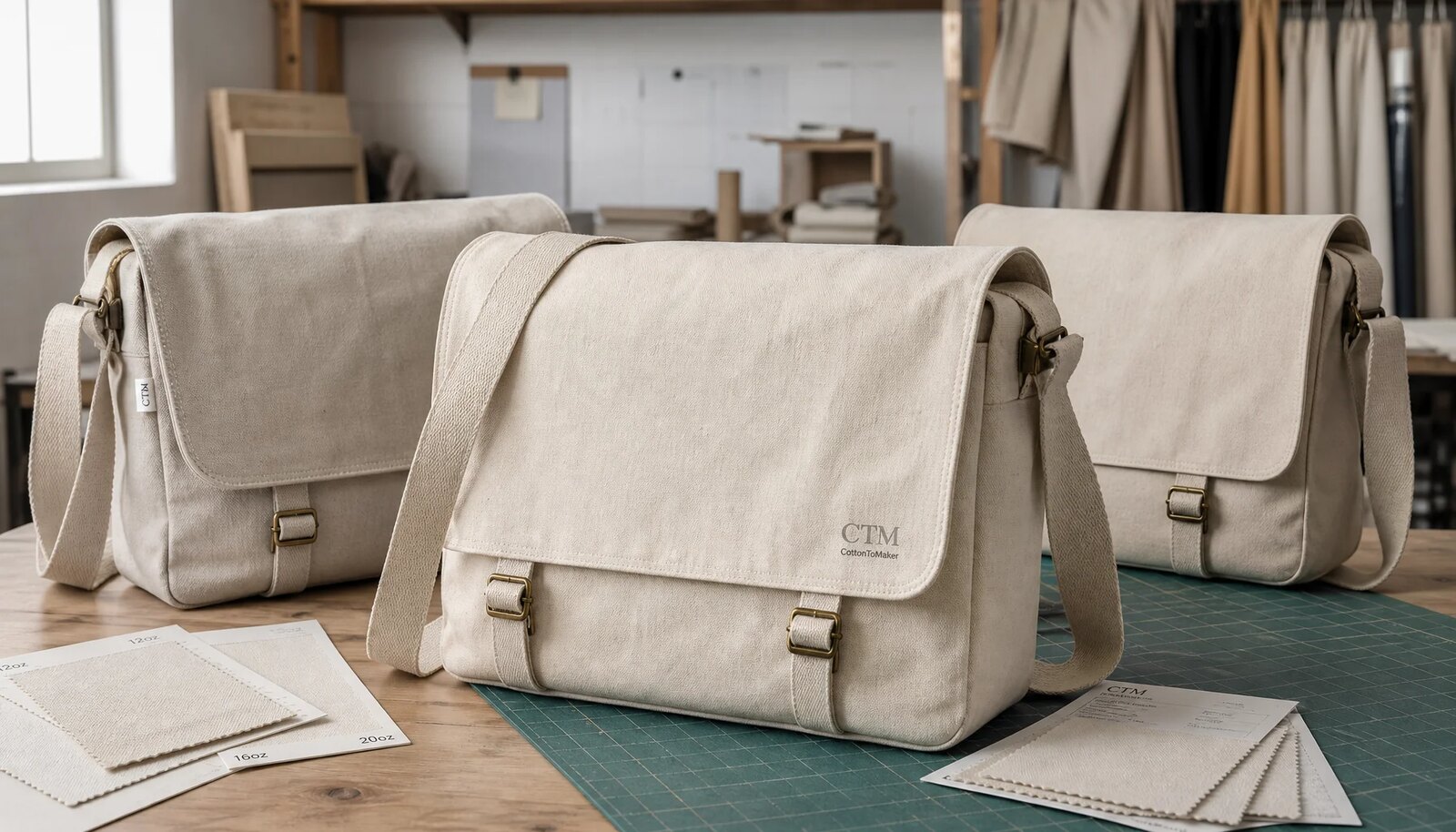
Start With the Craft Fair Use Case
Canvas messenger bags for craft fairs are not the same buying problem as flat totes or zipper portfolios. The bag is carried across aisles, opened repeatedly at booths, placed on the ground, and often used again after the event. That means the fabric must hold a flap shape, support the strap anchors, and take decoration without becoming so heavy that freight and booth handling become inefficient.
For procurement teams, the practical starting point is not the lowest quoted unit price. It is the expected load and resale position. A bag used as a free event giveaway can accept lighter canvas if construction is reinforced. A bag sold by a maker brand, museum shop, or distributor needs better handfeel, cleaner flap alignment, and a fabric weight that feels intentional when the customer touches it.
- For low-load giveaways, start at 10 oz canvas and spend savings on strap reinforcement.
- For general craft fair retail, 12 oz canvas is usually the safest first quotation.
- For premium retail or daily-carry use, test 14 oz canvas before committing because stiffness affects sewing and packing.
- For paper goods, prints, or notebooks, prioritize flap stability and seam cleanliness over oversized capacity.
Fabric Weight Ranges That Matter
Canvas weight is often quoted in ounces, but buyers should also request gsm. Mills, agents, and bag factories may describe canvas differently, and some quotes use greige fabric weight while others use finished fabric weight after dyeing or washing. A 12 oz canvas is commonly around 400 gsm, but the exact number depends on yarn count, weave density, and finish.
In messenger bags, heavier is not automatically better. A 14 oz canvas can look premium, but the seams become bulky where the flap, gusset, lining, and strap reinforcement meet. A 10 oz canvas reduces weight and cost, but it may wrinkle across the flap or show less crisp printing. The best range depends on how much structure the buyer wants and whether the bag is shipped flat or displayed filled.
- 8 oz to 9 oz: too light for most messenger bags unless used as lining or very low-cost promotional product.
- 10 oz: economical for craft fair programs where the load is light and the flap does not need a rigid profile.
- 12 oz: balanced weight for most wholesale canvas messenger bag RFQs.
- 14 oz: premium handfeel, higher unit weight, more sewing complexity, and stronger need for careful sampling.
- 16 oz and above: possible for rugged styles, but often excessive for craft fair distribution and carton efficiency.
How Fabric Weight Changes Bag Structure
A messenger bag has more stress geometry than a simple tote. The flap folds over the front panel, the strap pulls from the side seams, and the gusset must carry volume without twisting. If the canvas is too light, the bag may look tired before it reaches the booth. If the canvas is too heavy, the flap may not sit flat, and sewing operators may compensate by stretching panels during assembly.
Buyers should evaluate fabric weight together with pattern design. A 12 oz unlined canvas with a wide flap can perform better than a 14 oz bag with a narrow strap and weak anchor reinforcement. If the bag needs to carry ceramics, candles, small boxed goods, or printed books, the gusset and strap anchors deserve as much attention as the main panel gsm.
- Request a flap alignment photo with the bag empty and standing naturally.
- Check whether the side gusset collapses inward or twists after light loading.
- Use wider webbing when increasing fabric weight to avoid an unbalanced heavy-body, narrow-strap feel.
- Avoid placing thick seams directly under large print areas because surface unevenness affects decoration quality.
Print Method by Canvas Weight
Screen printing is usually the most stable decoration method for cotton canvas messenger bags when the artwork uses solid colors. It gives good opacity on natural canvas and scales well for distributor orders. The tradeoff is that thick ink on coarse canvas needs proper curing, and large prints across the flap fold can crack or distort if the bag is folded immediately after production.
Heat transfer fits complex artwork or small runs with multiple colors, but it can feel less integrated with the fabric. Embroidery works for small logos, woven-style marks, or premium brand positioning, but it adds needle density and can pucker lighter canvas. For craft fair bags, buyers should match print method to fabric weight, logo size, and the surface where the customer will touch the bag most.
- 10 oz canvas: use lighter ink coverage or smaller prints to avoid stiffness and show-through.
- 12 oz canvas: suitable for most one-color and two-color screen prints on front flap or body panel.
- 14 oz canvas: test ink penetration and edge definition because coarse yarns can reduce fine detail.
- Embroidery: keep logos compact and avoid large filled areas on lighter canvas.
- Heat transfer: request wash, rub, and fold tests before approving large front graphics.
Cost Drivers Behind the Quote
Fabric weight affects cost in more ways than the material line. Heavier canvas increases fabric consumption cost, carton gross weight, sewing time, needle wear, and sometimes rejection risk at bulky seams. If two suppliers quote different prices, the difference may come from actual gsm, fabric width, cutting loss, hardware grade, or packing density, not just margin.
A commercially useful RFQ should force suppliers to price the same bag in several fabric weights. This makes the cost curve visible. A 10 oz version may look attractive until reinforcement, lining, or stronger hardware is added. A 14 oz version may justify a higher retail price, but the buyer should compare landed cost per sellable unit, not just FOB unit cost.
- Material cost: canvas gsm, dyed versus natural, fabric width, shrinkage allowance, and cutting yield.
- Labor cost: flap sewing, zipper insertion, lining attachment, trimming, pressing, and thread cleaning.
- Decoration cost: screens, setup, color count, print area, curing time, and reject allowance.
- Hardware cost: snaps, buckles, sliders, zipper grade, rivets, and plating quality.
- Packing cost: individual polybag, paper wrap, hangtag, carton strength, and anti-crease packing method.
- Logistics cost: carton CBM, gross weight, container loading efficiency, and courier cost for samples.
MOQ Logic for Importers and Distributors
MOQ is not only a factory preference. It is tied to fabric sourcing, dye lot, print setup, cutting efficiency, and line changeover. Natural canvas usually has a lower MOQ because mills and factories keep it more regularly. Dyed canvas, custom Pantone color, custom woven strap, and custom lining can push MOQ higher because the supplier must meet mill minimums or accept leftover material risk.
For craft fair programs, distributors often need several artwork versions or regional logos. The cleaner way to manage MOQ is to keep the same bag body and fabric weight, then split decoration by print run if the factory allows it. Changing fabric color, strap color, lining, or hardware for each design usually turns one manageable order into several small production problems.
- Lowest MOQ route: natural 12 oz canvas, standard webbing, one-color screen print, standard export carton.
- Moderate MOQ route: dyed canvas in factory stock colors with shared bag body and split logo prints.
- Higher MOQ route: custom fabric color, custom webbing, lining print, metal logo parts, or multiple hardware finishes.
- Best distributor strategy: standardize the bag shell and vary only the front print or sewn label.
Sample Approval Before Bulk Cutting
A messenger bag sample should not be approved only because the logo looks correct. Buyers need to check whether the fabric weight, flap shape, strap length, and construction match the intended use. One common mistake is approving a sample made from available fabric while the bulk order uses another canvas. The pre-production sample must use bulk fabric, bulk hardware, bulk strap, and the approved print process.
The sample room can produce a cleaner bag than the production line if the factory is not controlled. Procurement teams should write acceptance criteria that can be inspected at scale. That means tolerances for finished size, strap drop, print position, stitch density, flap skew, and color shade. Photos are useful, but at least one physical sealed sample should remain the reference for production and final inspection.
- Measure finished width, height, gusset, flap depth, strap drop, and pocket position.
- Weigh a defined fabric swatch to verify gsm rather than relying on the sample tag.
- Load the bag with a realistic event weight and hang it for a short stress observation.
- Rub the print with a dry white cloth after curing to detect weak ink adhesion.
- Fold the flap several times to see whether print cracking, puckering, or hardware marks appear.
- Photograph the approved sample from front, back, side, inside, and close-up stress points.
Packing Choices That Prevent Damage
Canvas messenger bags often leave the factory looking acceptable and arrive with avoidable creases, hardware dents, or print transfer marks. The cause is usually packing pressure. A metal snap or buckle can press into the front flap during a long shipment if bags are stacked too tightly. Dark print can also transfer if curing time was short or if printed surfaces rub inside the carton.
Packing should be specified as part of the product, not treated as a warehouse detail. Flat packing is usually best for craft fair distribution because booth teams can store cartons efficiently and the flap shape stays predictable. If the bag is heavy 14 oz canvas with hardware, separators or changed stacking direction may be worth the small packing cost increase.
- Use flat packing when flap appearance is important for retail display.
- Avoid over-compressed cartons that leave hard crease lines across the front panel.
- Separate metal hardware from printed surfaces where possible.
- Specify carton gross weight limits so warehouse staff can handle event replenishment safely.
- Request carton drop-risk review if export cartons are tall, heavy, or loosely filled.
- Confirm whether individual polybags, recycled polybags, paper belly bands, or no inner packing are required by the buyer.
Lead Time and Schedule Risk
Lead time depends on more than sewing capacity. Fabric availability, dyeing, printing screens, sample approval delays, and packing material procurement can all move the ship date. Natural canvas messenger bags with a standard print are usually much faster to schedule than custom dyed 14 oz canvas with lining, metal hardware, and multiple logo versions.
Craft fair deadlines are unforgiving because late bags may miss the selling season completely. Buyers should build the schedule backward from the required warehouse date, then include sample courier time, revision time, production queue time, inspection booking, and vessel or airfreight cutoff. A supplier quote without these milestones is not enough for an event-linked purchase.
- Blank sample: use for size, fabric handfeel, and construction direction before artwork is final.
- Printed sample: use for logo scale, ink behavior, print position, and buyer presentation approval.
- Pre-production sample: must use bulk materials and becomes the inspection reference.
- Bulk production: should not start until fabric, hardware, and print method are locked.
- Final inspection: schedule before balance payment and before goods leave the factory.
- Freight booking: compare carton CBM and gross weight early if the order may shift between sea and air.
Quote Data Needed for Landed Cost
A useful quote for canvas messenger bags should allow the buyer to calculate landed cost and compare suppliers fairly. FOB unit price alone hides too much. Procurement teams need the fabric spec, bag dimensions, print details, packing method, carton data, sample charges, tooling or screen charges, and production lead time. Without carton CBM and gross weight, the logistics team cannot judge the real cost of choosing 14 oz over 12 oz canvas.
When comparing suppliers, align the RFQ line by line. One factory may include individual packing and stronger snaps while another quotes loose bulk packing and basic hardware. One may quote 400 gsm finished canvas while another quotes a lighter fabric described as 12 oz. The best commercial decision comes from normalizing the specification before negotiating price.
- Require unit price by quantity tier, such as 500, 1,000, 3,000, and 5,000 pieces if relevant.
- Request fabric weight in oz and gsm, plus whether the canvas is natural, dyed, washed, or coated.
- List print size, color count, method, setup charge, and artwork file requirement.
- Get carton dimensions, pieces per carton, net weight, gross weight, and CBM per carton.
- Separate optional costs for lining, zipper, inside pocket, hangtag, barcode label, and upgraded carton.
- Record sample charge, courier charge, sample lead time, bulk lead time, payment terms, and quote validity.
Specification comparison for buyers
| Spec decision | Recommended option | When it fits | Buyer risk to check |
|---|---|---|---|
| Main body fabric weight | 12 oz canvas, about 400 gsm, for most craft fair messenger bags | Good balance for retail resale, artist merchandise, welcome kits, and repeat carrying without making freight cost jump too sharply | Confirm whether supplier quotes finished gsm or greige fabric weight, and compare actual handfeel from swatches before approval |
| Budget fabric option | 10 oz canvas, about 330 to 340 gsm, with reinforced stress points | Works for short-event promotions, lower retail price points, lighter inserts, and buyers prioritizing carton count and landed cost | Flap may collapse, corners may wrinkle, and dark prints can look less premium if fabric is too open-weave |
| Premium fabric option | 14 oz canvas, about 450 to 475 gsm, usually with stronger strap hardware | Fits higher perceived value, maker-market retail, laptop-adjacent use, and brands that want a firm structured bag | Higher sewing difficulty, heavier cartons, longer drying after washing, and more needle marks around dense seams |
| Lining decision | Unlined 12 oz for rugged natural look, or 5 oz cotton lining for cleaner interior | Unlined fits craft fair simplicity; lined fits giftable retail programs and bags holding paper goods, ceramics, or apparel | Lining adds labor and can hide inner seam defects, so request inside photos and seam allowance confirmation |
| Print method | Screen print for solid logos; heat transfer only for complex multi-color art; embroidery for small premium marks | Screen print suits most craft fair branding because cotton canvas accepts thick spot colors well and unit cost scales at volume | Heavy ink on coarse 14 oz canvas can crack if overcured or folded too soon; test fold and rub on approved sample |
| Closure and flap | Full flap with magnetic snap or metal snap; zipper under flap for higher security programs | Snap closure is faster and cheaper; zipper plus flap fits travel retail, city markets, and buyers selling as reusable daily bags | Metal parts can stain natural canvas if plating quality is weak; request salt spray or at least supplier hardware history |
| Strap construction | 38 mm cotton webbing shoulder strap with bar-tacked anchors | Appropriate for 12 oz to 14 oz bags carrying brochures, small purchases, notebooks, and event samples | Avoid narrow straps on heavy canvas bags because customer complaints usually appear as shoulder discomfort, not broken fabric |
| Packing method | Flat pack one piece per polybag or paper belly band, then 40 to 80 pcs per export carton based on weight | Flat pack protects flap shape and print surface for retail buyers, distributors, and event organizers handling mixed cartons | Over-compressed cartons can crease the flap and emboss hardware marks into the front panel during sea freight |
Buyer checklist before sampling
- Define the intended load: brochures only, small craft purchases, boxed goods, or tablet-sized daily carry.
- Select a fabric weight range in oz and gsm, not only the word canvas, because supplier interpretation varies by mill.
- State whether the bag must stand with a structured look or fold flat for lower freight and easier booth storage.
- Include finished dimensions, flap depth, gusset width, strap width, strap drop, closure type, and pocket layout in the RFQ.
- Request actual fabric swatches for 10 oz, 12 oz, and 14 oz from the same supplier before finalizing the quotation.
- Confirm print method, ink type, print size, print position tolerance, and whether the logo crosses seams or folds.
- Set sample approval checks for GSM, shrinkage, seam strength, strap bar-tack density, print rub resistance, and carton packing.
- Compare quotes using fabric weight, hardware grade, lining, packing, sample fees, lead time, and carton CBM rather than unit price only.
- Require pre-production sample photos and one sealed physical approval sample before bulk cutting starts.
- Ask for carton dimensions, gross weight, pieces per carton, and loading estimate so landed cost can be calculated before PO.
Factory quote questions to send
- What is the actual gsm and oz of the proposed canvas, and is it measured before or after dyeing, washing, or finishing?
- Can you quote the same bag in 10 oz, 12 oz, and 14 oz canvas using the same dimensions, hardware, print, and packing?
- What fabric width and cutting efficiency are assumed in the quote, and will the bag panels be cut on grain to reduce twisting?
- What is the MOQ for natural, dyed, and custom-color canvas, and does MOQ change when lining or custom webbing is added?
- Which print method do you recommend for our artwork, and what is the maximum print area without distortion over seams or flap curves?
- What sample lead time applies for a blank sample, printed sample, and pre-production sample using bulk materials?
- Which stress points will be reinforced, and can you provide photos of bar-tack positions before production approval?
- What packing method is included in the price, and what are the estimated carton size, gross weight, and CBM per 1,000 pieces?
- What tolerances do you apply for finished size, fabric weight, color shade, print position, and strap length?
- Which quote items are excluded, such as mold charges, print screens, courier fees, inspection costs, labeling, or export carton upgrades?
Quality-control points to confirm
- Fabric weight should be checked by cutting a measured swatch and calculating gsm, not only by reading the supplier tag.
- Finished bag dimensions should stay within agreed tolerance, commonly plus or minus 5 mm for small panels and plus or minus 10 mm for larger body dimensions.
- Strap anchors, flap corners, zipper ends, and pocket openings need reinforced stitching or bar-tacks because these points fail first in event use.
- Print must pass dry rub and light scratch checks after curing, especially on darker canvas and thick screen print ink.
- Needle holes, skipped stitches, loose threads, puckering, and uneven flap alignment should be evaluated on the outside and inside of the bag.
- Metal snaps, buckles, rivets, and zipper sliders should be checked for sharp edges, weak plating, rust marks, and smooth operation.
- Bulk cartons should protect front flaps from hard hardware pressure marks by using flat packing direction and reasonable carton compression.
- AQL inspection should include measurement, appearance, function, print, packing, barcode or label accuracy, and carton drop-risk review.