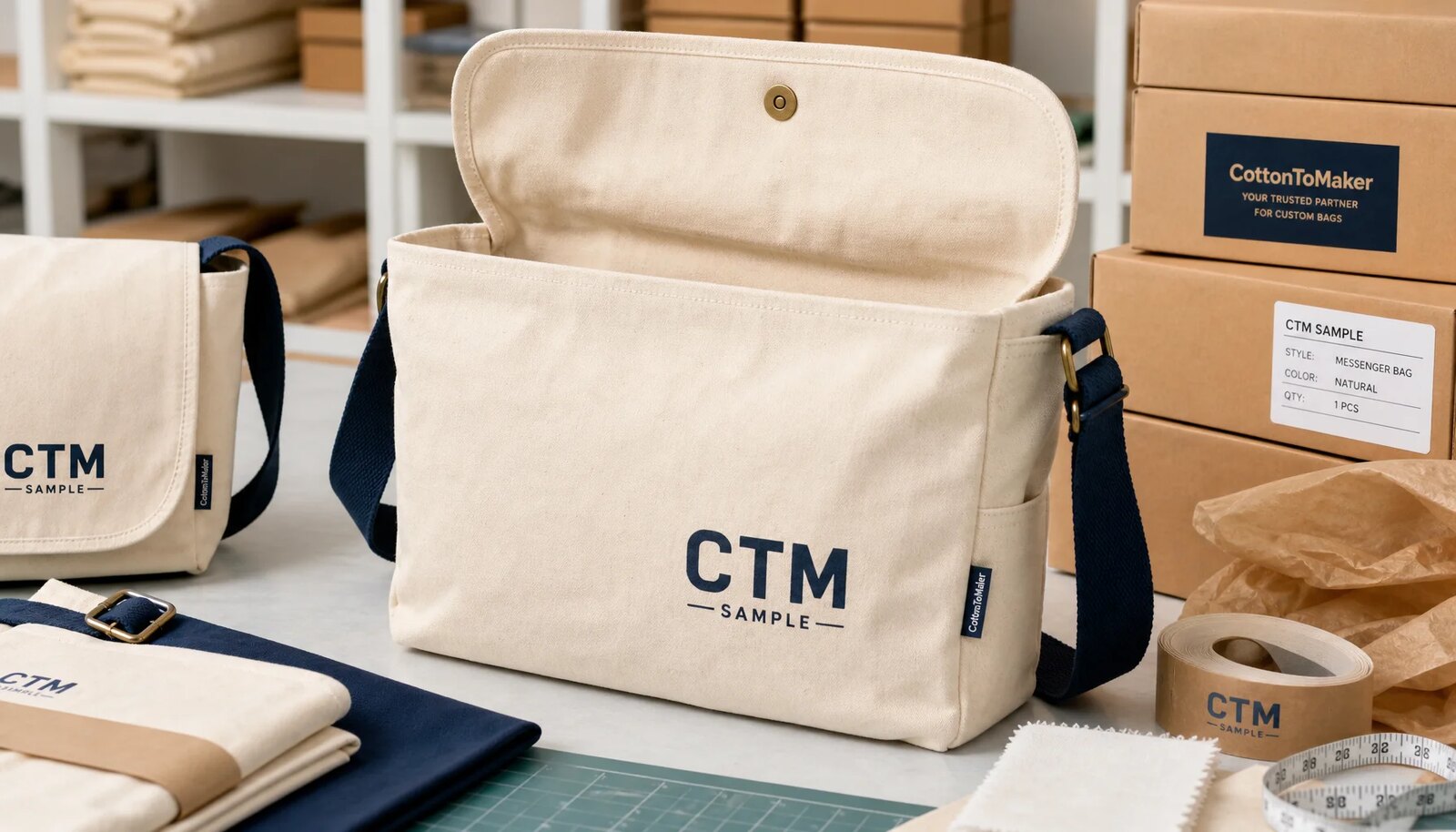
Start With the Distribution Route
Canvas messenger bags for craft fairs rarely travel in a simple line from factory to final user. A B2B order may leave the factory, reach an importer, enter a regional warehouse, split by event location, move again to a fairground, sit in temporary storage, and then be handled by booth staff who are trying to restock quickly. Every handoff creates a chance for flap creasing, hardware pressure marks, print rub, tangled straps, carton crushing, wrong SKU allocation, or slow counting at the venue.
That is why the carton packing plan belongs in the product specification. It should not wait until production is finished. If the RFQ only says "canvas messenger bag with logo," suppliers may make very different assumptions about fabric weight, fold method, tissue protection, carton quantity, carton grade, and label format. The unit prices may look comparable, but they are not. One quote may include safer retail-ready packing, while another may depend on tight bulk compression.
Define the route before the bag is costed. Retail resale needs cleaner presentation than an internal staff kit. Direct-to-artist courier shipment needs better dust protection than a bulk event giveaway. Distributor programs need carton marks, inner bundles, and packing lists that make allocation easy. Good packing protects the bag and also helps receiving teams, warehouse staff, and booth crews work faster.
- Map the route from factory to final user before approving carton quantity or packing material.
- Identify who opens cartons: warehouse teams, distributors, fair staff, retail partners, or end customers.
- Use packing to control flap creases, print rub, hardware dents, strap tangles, carton weight, and count accuracy.
- Separate retail resale standards from internal staff-kit standards because presentation expectations differ.
- Work backward from the event delivery date, including inspection, shipping, customs, domestic transfer, and venue receiving windows.
Define Size, Capacity, and Carry Load
A useful messenger bag specification starts with the real items the bag must carry. Craft fair programs may need room for notebooks, catalogs, POS readers, small handmade purchases, workshop tools, yarn kits, brochures, samples, artist merchandise bundles, or event staff supplies. A reference size of about 34 W x 28 H x 8 D cm works for many light event uses, but it is not automatically right. If the bag must fit A4 folders, 12-inch prints, tablets, boxed candles, or folded apparel, measure those items and add clearance for loading and flap closure.
The gusset is easy to underestimate. A flat body looks tidy in a product photo, but it can be awkward during a busy sale. An 8 cm boxed gusset gives useful capacity without making export cartons too bulky. A 10-12 cm gusset may be better for workshop kits, although it increases fabric use, corner bulk, sewing difficulty, and CBM. Buyers should review the sample while loaded, not only while it lies flat on a table.
Carry load drives the construction. A light souvenir bag may only need moderate reinforcement. A bag meant for catalogs, tools, or craft supplies needs stronger webbing, bartacks, seam allowance, and closure support. State the expected loaded weight in kilograms and ask the supplier to test the PP sample against that use. Without a load target, the factory may optimize for appearance and unit price instead of field performance.
- Measure the largest intended item and add clearance for fabric thickness, hand access, and flap closure.
- Use a measurement chart for body width, body height, gusset depth, flap length, strap length range, pocket width, and pocket depth.
- Define the expected load category: light giveaway, retail resale, staff kit, workshop kit, or heavier daily-use bag.
- Confirm whether the strap must work crossbody over coats for outdoor fairs; this may require a longer adjustable strap range.
- Approve flap coverage with the bag loaded because the flap can look correct when empty but sit short when the gusset is filled.
Specify Canvas by Measurable Fabric Data
For canvas messenger bags for craft fairs, 12 oz cotton canvas is a practical starting point. It gives the bag body and durability without the carton bulk of much heavier fabric. In metric terms, 12 oz per square yard converts to about 407 GSM. Procurement teams should request both the commercial oz and the GSM range, such as 390-425 GSM or the supplier's standard +/-5% tolerance. This keeps a cheaper 10 oz quote from being compared as if it were equal to a true 12 oz construction.
Finish changes both appearance and tolerance. Natural unbleached canvas fits handmade and craft-market branding, but cotton seed specks and minor slubs should be expected. Bleached canvas creates a cleaner print ground, yet it shows dirt, oil, and handling marks more easily. Dyed canvas supports brand colors but needs lab dip approval and shade control. Washed or pigment-dyed canvas gives a softer look, but shrinkage variation can increase, so finished measurements should be checked after the final process.
If sustainability language will appear on hang tags, product pages, or retail displays, ask for documents before approving the claim. Recycled, organic, or other certified canvas should be supported by supplier documents relevant to the claim and sales market. Keep marketing language out of the specification until the purchasing team has the paperwork needed for compliance review.
- 10 oz canvas: lower cost and lighter cartons, but less structure and more wrinkle risk after compression.
- 12 oz canvas: balanced option for many craft fair messenger bags and event merchandise programs.
- 14-16 oz canvas: stronger hand feel and premium display, but higher sewing difficulty, carton weight, CBM, and freight cost.
- Natural canvas: accept agreed seed specks and slubs, but reject oil marks, mildew, holes, heavy contamination, and obvious shade bands.
- Dyed or washed canvas: approve lab dip, shade band, shrinkage, and post-finish measurement tolerance before bulk cutting.
Lock Construction Before Price Comparison
Construction choices affect cost, durability, sample timing, and carton volume. A full flap creates the classic messenger profile and gives the buyer a large branding area. It also creates the main crease-risk zone. A shorter flap saves material and packs flatter, but it may look less secure when the bag is filled. A boxed gusset improves capacity and table presentation, while folded gusset corners add bulk inside the carton. A turned seam can look clean; bound or overlocked seams may suit the factory line and target price better.
Strap construction needs close control because strap failure is a serious field defect. Cotton webbing in the 32-38 mm range is practical for craft fair use because it balances comfort, strength, and packability. If the strap is adjustable, quote the slider and adjuster material, finish, and width compatibility. Specify box stitching plus bartacks at stress points. Also confirm that the webbing has enough insertion and seam allowance so it does not pull out under load.
Closures should be chosen before print placement and packing are finalized. Magnetic snaps need backing reinforcement so the magnet does not tear through the canvas. Snap buttons can suit the craft aesthetic, but cap shape, plating, and closing force must be consistent. Zippers add security, although they increase sewing time, inspection points, and bulk. Changing hardware after PP sample approval can shift flap alignment, create pressure marks, and change the carton quantity.
- Define seam finish: overlocked, bound, turned, double-stitched, French-seamed, or raw-edge by design.
- Specify approximate stitch density where needed; heavy canvas often uses fewer stitches per inch than light fabric to avoid perforation.
- Add bartacks or reinforcement patches at strap joins, flap corners, pocket corners, and closure points.
- Define inner pocket style: none, open slip pocket, divided pocket, zipper pocket, or label pocket.
- Control hardware by material, size, finish, plating color, backing washer, corrosion expectation, and placement tolerance.
Choose Branding for Canvas Texture
Screen printing is usually the most practical option for one to three solid colors on canvas messenger bags. It works well for fair names, sponsor marks, distributor logos, and retail branding when the artwork is not too fine. Send vector artwork, Pantone references, final print dimensions, and placement from fixed points such as the flap edge, side seam, top seam, or centerline. Review the artwork with the flap closed because the visible position changes when the bag is folded and loaded.
Canvas texture softens print edges. Thin lines, small serif text, halftones, and dense sponsor logo blocks may fill in or look uneven. A strike-off on actual bulk canvas is more reliable than a digital mockup or a print on smoother substitute fabric. If the artwork uses dark ink on natural canvas, request dry-rub and offset checks after curing. If the print sits on the flap, test it after folding because the flap takes most of the bending and carton pressure.
Heat transfer can reproduce gradients and full-color graphics, but it is not automatically safer. The film must bond to textured canvas and survive folding, rubbing, and carton compression. Embroidery can give a premium handmade look, though dense stitching may pucker the flap and add backing bulk. Woven labels and hang tags are useful when there are many event versions because they can reduce print setup complexity.
- Screen print: confirm ink type, curing method, print hand feel, minimum line width, and dry-rub acceptance.
- Heat transfer: check edge lifting, cracking over folds, bubbling, adhesion, and surface feel after carton compression.
- Embroidery: check puckering, backing visibility, thread color, stitch density, and whether the flap hangs flat.
- Woven label: define size, fold type, sewing position, color count, and whether label edges must be sealed.
- Hang tag or barcode label: define attachment method, tag placement, retail barcode standard, and packing orientation.
Build MOQ Around SKU Complexity
MOQ is not only a factory preference. It reflects fabric availability, dye lot size, cutting efficiency, print setup, sewing-line changeovers, hardware purchasing, label preparation, packing versions, and carton-label control. A standard natural canvas bag with one body color and one screen print may support a lower MOQ than a dyed, washed, multi-logo, multi-destination program. Quote each SKU clearly instead of giving suppliers only the total program quantity.
A 2,000 pc order in one natural canvas body, one strap color, one hardware finish, and one logo is fairly simple. The same 2,000 pcs split across four dyed body colors, five artist logos, two closure finishes, and three destinations is a very different production job. Small splits add setup time, waste allowance, inspection points, shade-control issues, packing-list complexity, and carton-mark risk.
When the marketing team wants event-level identity, separate fixed and variable elements where possible. Use one common bag body and vary the hang tag, belly band, removable patch, carton label, or small woven label. This keeps the craft fair story while making cutting, sewing, and quality control more manageable. If multiple printed versions are required, ask the supplier to show screen charges, setup time, sample cost, and packing method by SKU.
- Lowest complexity: one body color, one strap color, one logo, one closure, one carton mark, and one destination.
- Moderate complexity: common bag body with two or three print versions and shared hardware.
- High complexity: multiple dyed fabrics, custom straps, different closures, unique labels, and destination-specific carton marks.
- Hidden cost trigger: small distributor splits that require separate cartons, barcode labels, packing lists, and routing labels.
- Practical compromise: common blank bag with variable hang tag, paper band, or removable label for different craft fairs.
Create the Carton Packing Plan Early
Approve the carton packing plan before production starts. It affects cost, CBM, defect risk, and warehouse labor. For a 12 oz canvas messenger bag around 34 x 28 x 8 cm, flat packing 40-50 pcs per export carton is a reasonable starting point. Confirm the final number through sample packing because strap bulk, flap length, hardware height, tissue use, and carton size can all change the result. The goal is not the highest possible quantity per carton. The goal is safe packing at a practical handling weight.
Flat packing is usually safer than rolling. Rolling can distort the flap, twist the strap, and create uneven pressure on snaps or magnets. For printed flaps, avoid face-to-face print contact unless interleaving is used. Tissue or kraft interleaving can reduce ink transfer and hardware marks. Individual polybags improve dust protection and retail picking, but they add cost, volume, labor, and plastic compliance questions. Paper bands or bundle wrapping may suit plastic-reduction programs, provided the packing trial confirms that rubbing, dust, and creasing remain acceptable.
Carton design must match the logistics route. A 5-ply export carton is usually preferred for ocean freight, heavy cartons, pallet stacking, or domestic redistribution through multiple warehouses. Keep gross weight practical for receiving teams and event staff; many buyers prefer cartons around 18-20 kg or lower, but the exact limit should follow the buyer's operation and carrier rules. If goods will be palletized, confirm carton footprint, stacking pattern, pallet height, and label visibility before bulk packing.
- Define fold direction so flap edges, snaps, magnets, and strap adjusters are not pressed into visible fabric.
- Use inner bundles of 5 or 10 pcs when cartons will be opened at venues and split across booths.
- Require tissue or interleaving between printed flaps when screen print, transfer print, or dark ink could rub.
- Record pieces per carton, carton dimensions, net weight, gross weight, carton grade, and CBM per 1,000 pcs.
- Approve carton marks with PO number, SKU, color, print version, quantity, carton number, destination, gross weight, net weight, and barcode if needed.
Compare Quotes by Landed Cost Inputs
A low unit price can hide a higher landed cost. One supplier may quote 40 pcs per carton with tissue, 5-ply export cartons, and safe flap protection. Another may quote a lower FOB price by packing 80 pcs tightly into thinner cartons without interleaving. The cheaper quote can become expensive if cartons arrive crushed, prints offset, bags need repacking, or event staff cannot move the cartons efficiently.
A complete B2B quote should show both product cost and packing assumptions. Ask for fabric specification, print method, hardware specification, sample charges, screen charges, packing materials, pieces per inner bundle, pieces per carton, carton dimensions, gross weight, net weight, carton grade, Incoterm, lead time, and estimated CBM per 1,000 pcs. CBM matters for sea freight, warehouse receiving, pallet planning, domestic linehaul, and final delivery to fair venues.
Normalize quotes before selecting a supplier. If one quote uses 10 oz canvas and another uses 12 oz, the lower price is not a saving unless the lighter fabric is acceptable. If one quote includes individual polybags and another includes bulk packing, adjust the comparison. If a supplier cannot provide carton dimensions at RFQ stage, ask for an estimated calculation based on the target size and require final confirmation after PP sample packing.
- Compare price per approved usable piece, not only FOB unit price.
- Compare CBM per 1,000 pcs because freight and warehouse costs can change the real ranking.
- Compare carton gross weight for receiving teams, palletizing, courier limits, and event handling.
- Compare included packing materials: tissue, polybags, paper bands, barcode labels, hang tags, and inner bundles.
- List exclusions clearly, including inspection fees, palletization, retailer labels, destination labels, and extra carton marks.
Approve Samples and Packing Trials
Sample approval should cover the whole product, not only the logo. Review fabric hand feel, body size, gusset shape, flap coverage, strap comfort, pocket access, print color, print position, closure function, stitching, label placement, and packing method. Photos help early communication, but physical samples matter for a product that will be sold, worn, or handled in person at craft fairs.
The pre-production sample should use actual bulk fabric or approved bulk-equivalent fabric, the actual print method, actual strap, actual hardware, actual thread, actual labels, and proposed packing materials. If a sample uses substitute fabric or temporary hardware, label it as a fit sample or development sample only. Do not release mass production until the substituted components are replaced and approved.
A packed-carton trial is especially useful for messenger bags because many defects appear only after compression. Pack samples in the proposed fold direction, bundle count, tissue position, and carton quantity. Let the carton sit compressed long enough to reveal obvious pressure marks where practical, then inspect flap corners, printed surfaces, hardware areas, gussets, and straps. For multi-SKU orders, verify that carton marks and packing lists match the actual contents.
- Measure body, gusset, flap, strap, pocket, and print placement against the approved measurement chart.
- Load the sample with realistic event contents and check strap joins, seam slippage, closure alignment, and comfort.
- Rub printed areas with a dry white cloth after curing and check for color transfer, tackiness, cracking, or offset.
- Open and close snaps or magnets repeatedly to check alignment, reinforcement, and fabric tearing risk.
- Keep one signed approval sample with the buyer and one with the factory for final inspection reference.
Write QC Standards Before Inspection
Craft fair buyers need clear visible-quality standards because the bags are handled face-to-face. Stains, crooked logos, off-center flaps, loose threads, crushed corners, hardware dents, and wrong carton labels can create immediate complaints. AQL 2.5 for major defects and 4.0 for minor defects is a common starting point for many sewn bag orders, but AQL only helps when defect classes are defined before inspection.
Major defects should include broken straps, failed closures, open seams, wrong artwork, wrong fabric color, missing labels, unsafe hardware, sharp edges, mildew, wet cartons, severe stains, incorrect quantity, and unapproved mixed SKUs. Minor defects may include small loose threads, slight natural seed specks on unbleached canvas, minor print texture variation that matches the approved strike-off, or measurements within the agreed tolerance. Natural canvas should not be judged like coated synthetic fabric; separate acceptable character from rejectable defects.
Inspection should include product-level and carton-level checks. Inspectors should measure a sample of bags, compare fabric shade, check print placement, inspect seams, test closures, perform a simple loaded strap check, rub printed areas, and open packed cartons. Carton checks are essential because a bag can pass sewing-line inspection and still be damaged by poor folding or over-compression. For multi-destination programs, carton marks and packing lists should be verified before release.
- Measurement standard: width, height, gusset, flap, strap, pocket, and print placement checked against written tolerances.
- Stitching standard: no open seams, broken bartacks, skipped stitches at load points, major puckering, or exposed unintended raw edges.
- Hardware standard: no sharp edges, rust, loose magnets, misaligned snaps, plating mismatch, or visible pressure marks.
- Fabric standard: accept agreed seed specks, but reject oil marks, dirt, mildew, holes, heavy slubs, shade bands, and weaving defects.
- Packing standard: correct count, dry cartons, readable marks, correct SKU separation, no crushed cartons, and no missing inner protection.
Specification comparison for buyers
| Spec decision | Recommended option | When it fits | Buyer risk to check |
|---|---|---|---|
| Body fabric weight | 12 oz cotton canvas, approximately 407 GSM by oz/sq yd conversion; quote an acceptable bulk range such as 390-425 GSM or supplier standard +/-5% | Balanced choice for craft fair resale, staff kits, booth display, event merchandise, and repeated light-to-medium handling | Do not compare a 10 oz quote with a 12 oz quote as equal; verify GSM test method, finish, shrinkage, and whether the fabric is loomstate, dyed, washed, or pre-shrunk |
| Finished bag size | Reference size 34 W x 28 H x 8 D cm, with flap length 22-24 cm and a tolerance chart for each measurement point | Fits notebooks, POS accessories, small handmade purchases, brochures, samples, catalogs, and light workshop kits | Oversized dimensions increase CBM quickly; shallow gussets reduce usable capacity; washed bags may need wider measurement tolerance than non-washed bags |
| Canvas finish | Natural unbleached canvas for a craft-market look; bleached or dyed canvas only with approved swatch, lab dip, and shade tolerance | Best when the buyer wants a handmade aesthetic, simple branding, and manageable MOQ | Natural seed specks are normal; oil marks, mildew, weaving holes, heavy slubs, shade bands, and dark contamination should be defined as rejectable |
| Print method | Screen print for 1-3 solid colors; heat transfer only after adhesion, rub, and fold testing on actual canvas | Works for fair names, sponsor logos, resale branding, and distributor programs | Thick ink may crack or offset; fine artwork may fill in on canvas texture; placement must be measured from flap edge, seam, or centerline |
| Closure choice | Magnetic snap or antique brass snap with backing washer/reinforcement patch; zipper only when security is required | Creates a retail look without the cost and bulk of a fully zipped messenger bag | Weak magnets can detach; snap backs can mark fabric; hardware height can create pressure dents when cartons are over-compressed |
| Strap construction | Cotton webbing 32-38 mm wide, adjustable where needed, box-stitched and bartacked at load points | Suitable for crossbody event use, staff wear, light retail use, and flat carton packing | Narrow straps, low-density webbing, weak bartacks, short seam allowance, or plastic sliders may fail under loaded wear |
| Stitching standard | Heavy-duty lockstitch with approximately 7-9 SPI where appropriate, reinforced at strap joins, pocket corners, flap corners, and closure points | Useful for bags expected to carry catalogs, craft supplies, tools, or several small purchases | High SPI can perforate heavy canvas; low SPI can look rough and reduce seam strength; inconsistent thread tension causes puckering |
| Carton pack method | Flat pack 40-50 pcs per export carton as a starting point, with tissue/interleaving on printed flaps and inner bundles of 5 or 10 pcs | Protects shape and simplifies warehouse counts, event allocation, and booth restocking | Rolling, over-compression, or face-to-face printed flaps can create creases, ink transfer, hardware marks, and tangled straps |
| Carton specification | 5-ply corrugated export carton for ocean freight or redistribution; define carton size, gross weight, net weight, and CBM per 1,000 pcs | Good for importers, distributors, and event operators moving cartons through several handling points | Thin or oversized cartons crush during stacking; heavy cartons slow event teams and may exceed courier or warehouse handling preferences |
Buyer checklist before sampling
- Define finished width, height, gusset depth, flap length, flap overlap, strap length range, pocket dimensions, and print placement with tolerances in millimeters or centimeters.
- Specify canvas in oz/sq yd and GSM, including acceptable GSM tolerance, fabric finish, shrinkage expectation, color standard, and whether any certification claim must be supported by documents.
- State the intended load: light promotional use, retail resale, staff event kit, workshop kit, or heavier daily use; request sample load testing that matches that use.
- Confirm whether the bag must stand on a craft fair table, hang from a rack, fit into booth storage bins, ship in bulk cartons, or ship as individual ecommerce units.
- Lock flap shape, gusset construction, seam finish, strap width, adjuster type, closure type, reinforcement method, thread color, and internal pocket design before requesting final pricing.
- Send vector artwork with Pantone references, print dimensions, placement from fixed edges, minimum line thickness, and a note that color will be approved on actual canvas rather than coated paper.
- Ask suppliers to quote by SKU when the program includes multiple body colors, logo versions, artist names, hang tags, destinations, carton marks, or packing methods.
- Require a packing drawing showing fold direction, flap orientation, strap placement, tissue or interleaving position, polybag or paper-band use, inner bundle quantity, carton quantity, and carton marks.
- Confirm carton dimensions, gross weight, net weight, carton grade, pieces per carton, pallet compatibility, and CBM per 1,000 pcs before comparing FOB or EXW prices.
- Approve a pre-production sample made with actual bulk fabric, print method, strap, hardware, thread, labels, and intended packing materials before mass production release.
Factory quote questions to send
- What canvas weight is included in the quote, stated in oz/sq yd and GSM, and what bulk GSM tolerance will you commit to?
- Which fabric finish is quoted: natural, bleached, dyed, washed, pigment-dyed, recycled, organic, or certified, and what documents can support any claim used on labels or product pages?
- What shrinkage should be expected after finishing or washing, and are finished measurements taken before or after washing?
- What is the MOQ by body fabric color, print design, strap color, hardware finish, label version, hang tag version, and packing version?
- Which print method is quoted, what ink or transfer type is used, what curing process is used, and what is the maximum recommended printable area on the flap and body?
- Are screen charges, artwork adjustment, strike-off samples, lab dips, PP samples, packing trials, courier fees, and extra revisions included or itemized separately?
- What finished size tolerance, print placement tolerance, flap alignment tolerance, strap length tolerance, and pocket tolerance will be written into the production file?
- What strap width, webbing weight or thickness, adjuster material, hardware plating, snap or magnet grade, backing reinforcement, and bartack construction are included?
- How are seams finished: overlocked, bound, turned, double-stitched, French-seamed, or raw-edge by design, and which seams receive bartacks?
- What loaded strap test can be performed on the PP sample and during QC, and what load, duration, and acceptance criteria do you recommend for the intended use?
Quality-control points to confirm
- Finished size tolerance should be written by measurement point. A practical target for non-washed bags is often +/-1 cm for body width and height, +/-0.5 cm for gusset, +/-1 cm for flap length, and +/-2 cm for strap length unless the design requires tighter control.
- Fabric GSM should be checked against the approved specification using a recognized internal or lab method; do not rely only on the commercial oz label because finish and moisture can affect weight.
- Shrinkage should be checked when the bag is washed, pigment-dyed, garment-dyed, or made from non-pre-shrunk canvas; finished measurements must match the approved post-finish standard.
- Fabric shade should be compared with the approved swatch or lab dip under consistent lighting, especially for dyed canvas, bleached canvas, replenishment orders, and multi-lot deliveries.
- Natural canvas should be graded with agreed limits: small seed specks and minor slubs may be acceptable, while oil marks, mildew, holes, heavy contamination, shade bands, and weaving defects are rejectable.
- Print placement tolerance should be defined on the artwork sheet, commonly +/-3 mm for small logos and +/-5 mm for larger flap prints when measured from a stable edge or centerline.
- Print color should be checked against approved strike-off or Pantone reference on actual canvas; buyers should allow normal texture softness while rejecting wrong color, heavy bleeding, poor curing, or visible offset.
- Printed areas should pass dry-rub checks after curing; heat transfers should be checked for edge lifting, cracking at flap folds, bubbling, and poor adhesion on textured canvas.
- Strap attachment should pass a loaded check aligned to the intended use, such as an 8-10 kg static load for light event use or a higher agreed load for workshop-kit use, with no seam slippage, broken stitches, or tearing.
- Closure hardware should open and close smoothly through repeated cycles without loosening, tearing the flap, scraping the print, leaving sharp edges, rusting, or creating visible pressure marks.