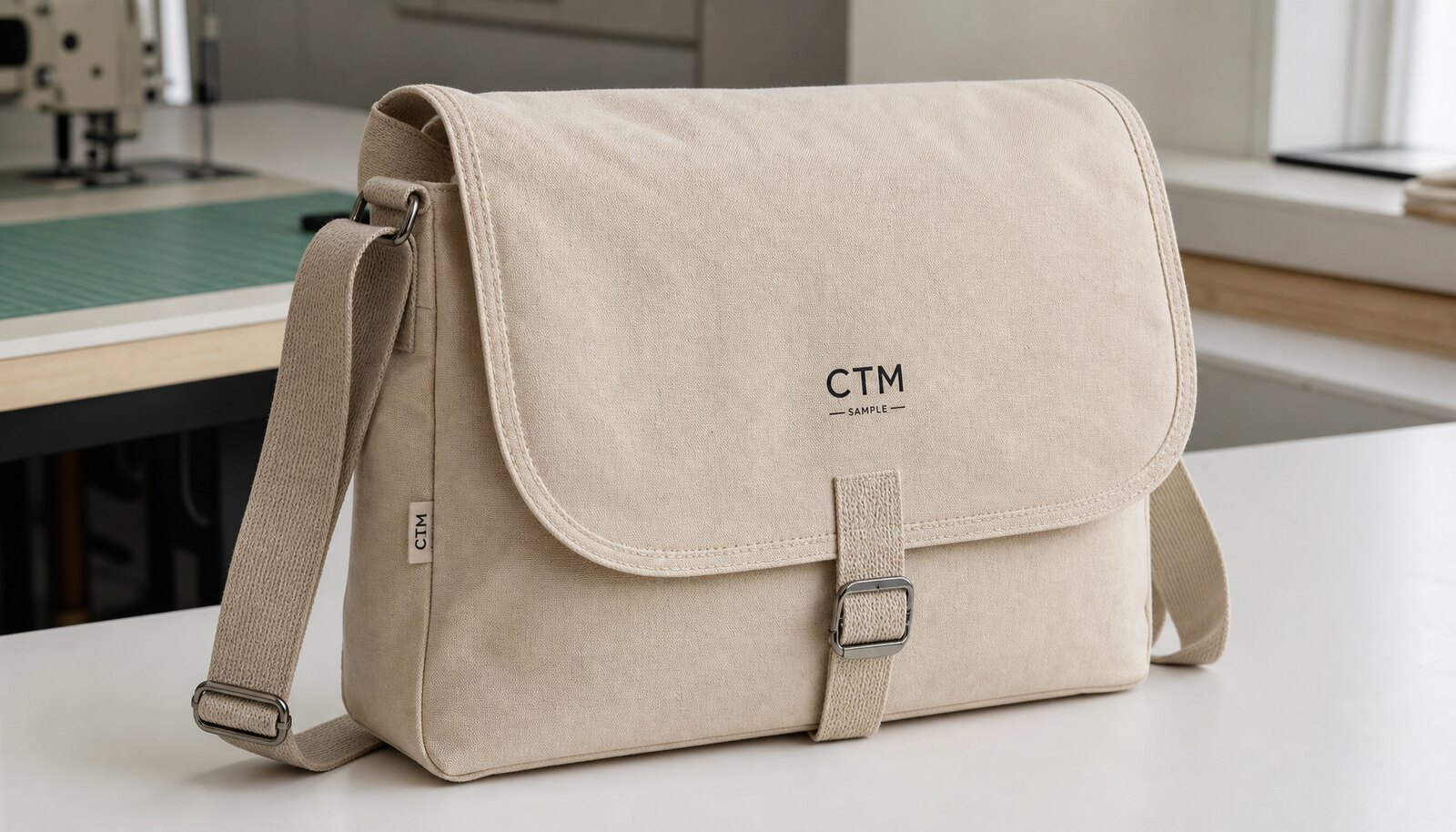
Why logo placement changes the economics of a canvas messenger bag
For corporate gifting, the logo is not just decoration. On a canvas messenger bag, placement affects print method, visible brand value, sewing complexity, and the chance that the artwork will be damaged by seams, folds, or hardware. A logo positioned on a flat front panel is usually cheaper and easier to control than a logo that crosses a flap edge, pocket seam, or curved gusset. That difference shows up directly in quote comparisons because the supplier may need a different printing jig, a larger panel, or a second setup step.
Buyers often focus only on bag size and fabric color, but the real sourcing risk is whether the chosen logo position works with the bag structure. If the logo sits where the flap bends sharply, screen print can crack earlier, embroidery can pucker, and heat transfer can lift at the corners. A good spec starts with the bag shape, then chooses the logo location that stays visible after daily use.
- Flat front panel: lowest risk for most logo methods.
- Flap center: strong visibility, but verify fold line and closure hardware clearance.
- Front pocket area: useful for secondary branding, but avoid heavy seam intersections.
- Side label or woven tab: best for subtle branding, not ideal for main corporate message.
Choose the right bag structure before you choose the print position
The most common corporate gifting messenger bag is a single-compartment canvas body with a flap closure, adjustable strap, and one front pocket. That design gives the logo a large front canvas area and usually keeps sewing cost under control. If you add multiple compartments, internal padding, or a reinforced laptop sleeve, the panel layout changes and the print zone may shrink or move. In procurement terms, a more complex build can make a clean logo placement more expensive than upgrading the canvas weight itself.
For branded gifting, 12 oz to 16 oz canvas is the practical middle ground. Twelve oz canvas is suitable when the bag is meant for light documents, event kits, or low-cost internal gifting. Fourteen to sixteen oz gives better body for screen printing and holds the flap shape more consistently. Eighteen oz feels more premium and handles embroidery or structured branding better, but it increases unit cost, sewing difficulty, and carton weight.
- 12 oz canvas: lower cost, softer drape, good for event giveaways.
- 14 oz canvas: balanced choice for most corporate gift programs.
- 16 oz canvas: better structure, cleaner front panel for branding.
- 18 oz canvas: premium feel, more stable for embroidery or heavy usage.
Logo placement options that actually work in production
Front flap center is the most common choice because it gives the largest visual area and is easy for the end user to see in transit, meetings, and office use. It suits one-color logos, simple icons, and short taglines. The buyer should make sure the artwork sits far enough from the top fold, buckle, and edge stitch so the printer has a flat working field. If the logo is too close to the fold, the first few months of use can create visible wear marks.
Upper front panel is the safer alternative when the flap has hardware, curve, or a folded edge that breaks the artwork. It often gives a cleaner print on mass production because the panel is flatter before assembly. Front pocket branding can work for a smaller secondary logo, but it is not the best place for detailed messages. Side label branding is usually a finishing touch for premium corporate gifts, not the main branding surface.
- Use front flap center when the logo is simple and the bag is visually front-facing.
- Use upper front panel when hardware or fold lines disturb the flap surface.
- Use front pocket branding only if the pocket is large and panel seams do not cut through the mark.
- Use side labels for subtle brand identity or co-branding support.
Print method choice: screen print, embroidery, or transfer
Screen print is usually the most economical option for one- or two-color logos at higher quantities. It gives strong color coverage on canvas and handles large logo areas well. The buyer should specify ink type, color reference, and print size, because different inks behave differently on natural canvas versus dyed canvas. A low-cost quote may look attractive, but if the supplier uses a thinner ink layer, the logo can appear washed out on woven texture.
Embroidery is often chosen for executive gifting or premium internal programs, especially when the logo is small and the buyer wants a more tactile finish. It looks durable but adds needle time, stabilizer use, and risk of puckering on lighter canvas. Heat transfer or digital transfer is useful for multicolor artwork, gradients, or fine detail, but the buyer should make sure the artwork will not peel at the corners after folding and repeated handling. For messenger bags, transfer is usually the best route only when the logo is too complex for clean screen printing.
- Screen print: best for cost control and simple branding.
- Embroidery: best for premium feel, but needs fabric support and controlled stitch density.
- Heat transfer: best for complex art, but requires adhesion testing and abrasion checks.
How to compare quotes without missing hidden production costs
A proper quote should separate fabric, printing, sewing, hardware, packing, and freight-ready carton work. If the supplier gives you a single number without stating canvas weight, print method, and packing format, the comparison is not reliable. In many RFQs, the cheapest quote is cheap because it assumes a lighter canvas, simpler logo placement, or bulk packing that is not acceptable for gifting distribution. Buyers should compare like for like: same canvas weight, same print size, same logo position, same closure, same packing, and same inspection standard.
For example, a factory quote for a 14 oz natural canvas messenger bag with one-color screen print, flap center logo, individual polybag, and export carton packing will usually sit differently from a quote for a 12 oz bag with side print only and loose bulk packing. If your program needs branded kits or retail-ready units, packing alone can move the landed cost significantly. Always ask whether the quote includes printing setup, screen charges, embroidery digitizing, and carton labels.
- Compare the same canvas weight and construction details.
- Separate one-time setup costs from unit price.
- Confirm whether packing is retail-ready or bulk-only.
- Check if the supplier priced the exact logo location you want.
Supplier routes: direct factory, trading company, or domestic decorator
For repeated corporate gifting programs, direct factory sourcing is usually the strongest route because it gives the best control over fabric sourcing, print alignment, and sewing consistency. A direct factory can also hold the same canvas roll for repeat orders, which matters when the buyer wants matching color and hand feel across multiple campaigns. The tradeoff is that factories usually need clearer artwork, clearer MOQ, and a more disciplined approval process.
A trading company can help when you need mixed product sourcing, lower communication load, or a small first order with several branding options. The risk is that the quote can hide the true base spec, and the product may be sourced from different workshops between orders. A local decorator is useful for very urgent domestic runs or last-mile personalization, but the fabric range may not match your preferred canvas weight or structural spec. For importers and distributors, the cleanest route is usually direct factory for the bag and print, with a local partner only if the delivery schedule is compressed.
- Direct factory: best for repeatability and cost control.
- Trading company: best for sourcing flexibility and smaller mixed programs.
- Domestic decorator: best for urgent domestic personalization, not always for factory-level spec control.
A comparison of sourcing routes for logoed canvas messenger bags
The table below compares practical sourcing routes rather than just product specs, because corporate gifting buyers usually need to balance cost, repeatability, and control over logo placement. The right route depends on volume, urgency, and how much risk you can tolerate on the first shipment.
If the artwork is sensitive, the brand standards are strict, or the order will repeat, favor the route that gives you the cleanest approval trail and the fewest handoffs between quoting and production.
- Write decisions in measurable language, not only descriptive wording.
- Ask for sample photos plus one physical approval sample for important orders.
- Keep quotation, sample approval, and inspection notes tied to the same spec version.
Sample approval: what to look at before bulk production
A pre-production sample should use final fabric weight, final print method, final logo size, final strap webbing, and final hardware. A common mistake is approving a sample made from the wrong canvas or a temporary print process and then discovering that the bulk version looks different on the real production line. The sample must show the exact placement relative to seams, buckles, and folds, not just a similar-looking logo in a similar area.
When reviewing the sample, place it on a flat surface, close the flap, and inspect the logo from a normal viewing distance. The mark should remain centered and clear when the bag is opened and closed. If the logo sits on a moving part of the bag, test whether the fold line breaks the design. For embroidery, turn the bag inside out if possible and inspect backing clean-up so the inside does not snag documents or clothing.
- Compare sample fabric handfeel against the intended bulk spec.
- Inspect print registration, edge sharpness, and color density.
- Open and close the bag several times to check logo distortion on folds.
- Confirm that the sample includes the correct carton mark and packing method.
Packing, carton loading, and transit damage prevention
Canvas messenger bags are not fragile, but the printed area is vulnerable to scuffing if the bags are packed loosely. For corporate gifting, individual polybags are usually the safest choice, especially if the bags will be distributed in kits or stored in warehouse conditions before handover. If the design includes a printed front flap, the supplier should prevent direct friction between printed faces by using tissue paper, inner inserts, or a fold direction that keeps the logo surface protected.
Carton packing should reflect the finished use case. Retail-ready or gift-ready units often need a cleaner carton mark and more controlled count per carton. Bulk import cartons can be more efficient, but the buyer needs to specify compression limits and stacking expectations. If the bags contain a metal buckle or hardware, the carton should be loaded so pressure does not create permanent crease lines in the front panel. This becomes more important with 16 oz and 18 oz canvas because the fabric remembers fold points.
- Use individual polybags when bags will move through multiple handling stages.
- Keep logo faces separated with tissue or folded orientation.
- Specify carton count based on warehouse handling, not just factory convenience.
- Mark cartons clearly with SKU, color, logo version, and pack quantity.
Lead time planning and the schedule risks buyers usually miss
Typical lead time depends on fabric booking, sample sign-off, print setup, sewing, and final inspection. For a standard canvas messenger bag order, the factory may need several days to source the correct canvas roll, then time for sample approval before moving to bulk production. If the logo has multiple colors, the artwork prep and print alignment can add time. Buyers who approve artwork late often compress the schedule in the wrong place and end up forcing shortcuts in packing or QC instead of shortening the real bottleneck.
The most common delay is not sewing; it is artwork confirmation. Another frequent issue is hardware substitution, such as changing the buckle finish or strap adjuster after the sample stage. That change can require a new sample or at least a revised production photo approval. Build a realistic buffer around the internal approval process and keep the logo file, panel placement, and packing instructions frozen before production starts.
- Freeze artwork before sample approval.
- Avoid moving the logo after the first sample unless you are willing to reset tooling or print setup.
- Allow buffer time for carton artwork and barcodes.
- Treat hardware changes as schedule-impacting changes.
Specification comparison for buyers
| Spec decision | Recommended option | When it fits | Buyer risk to check |
|---|---|---|---|
| Direct factory vs trading company | Direct factory for repeat programs; trading company for mixed or small runs | Repeat corporate gifting, annual onboarding kits, or distributor programs | Hidden spec drift, inconsistent fabric source, or unclear setup charges |
| Logo placement | Front flap center or upper front panel | When the bag is meant to be used visibly in office and travel settings | Artwork crossing seams, folds, or hardware |
| Print method | Screen print for simple logos; embroidery for premium; transfer for complex art | Depends on logo color count, size, and budget | Small text loss, peeling, puckering, or faded ink on textured canvas |
| Canvas weight | 14 oz to 16 oz as the core choice | Balanced cost and structure for most gifting programs | Too light feels cheap; too heavy raises cost and carton weight |
| MOQ approach | One style, one color, one logo version to start | When controlling first-run cost and keeping approvals simple | Every variation can create a new setup charge or minimum |
| Packing route | Individual polybag plus export carton | Gift kits, warehouse distribution, and retail-ready intake | Print abrasion, folding marks, and carton compression |
| Sampling scope | Final material, final hardware, final print location | First order, new design, or premium brand delivery | Counter samples that do not reflect bulk production |
| Lead time control | Freeze artwork and hardware before bulk production | Fixed event dates and timed internal distribution | Late changes trigger schedule slips and rush freight |
| Inspection priority | Print alignment, seam strength, and carton protection | All corporate gifting orders, especially volume runs | Good-looking sample but weak bulk consistency |
Buyer checklist before sampling
- Final artwork supplied as vector file with logo size, exact placement, and one-color or multi-color print method noted.
- Fabric spec defined in oz or GSM, including whether you want natural, dyed, washed, or coated canvas.
- Bag dimensions, strap length, flap style, pocket count, and closure type approved before sampling.
- Sample request states the final print location, thread color, lining choice, and hardware finish.
- Packing requirement includes polybag use, carton pack count, carton test expectations, and shipping marks.
- Target lead time includes sample approval window and buffer for print correction or carton artwork changes.
- Acceptance criteria cover print sharpness, stitch density, seam strength, and acceptable color variation.
Factory quote questions to send
- What canvas weight are you quoting in oz or GSM, and is that the finished fabric weight or greige base weight?
- Which logo placement is included in the quoted price, and what is the setup charge for moving the logo to another panel?
- Which print method is included, and what is the minimum line thickness or smallest text size you can reproduce clearly?
- Does the quote include one pre-production sample made with final material, final hardware, and final logo position?
- What is the MOQ by color, by print method, and by logo variation?
- What packing is included: individual polybag, silica gel, insert card, carton count, and carton marking?
- What is the normal production lead time after sample approval, and what steps create the biggest delay?
- What QC standard do you use for print alignment, stitch quality, and carton drop or compression tolerance?
Quality-control points to confirm
- Logo placement tolerance: keep the printed or embroidered mark within the approved artwork window, typically within 0.5 to 1.0 cm depending on bag size.
- Print edge quality: no heavy bleeding, cracking, ghosting, or banding; small text should remain readable at arm’s length.
- Stitch security: stress points at strap joins, flap corners, and side seams should show no skipped stitches or loose ends.
- Fabric consistency: shade variation across panels should stay within an agreed tolerance, especially for dyed canvas.
- Hardware function: buckles, snaps, zippers, and sliders must cycle smoothly and stay aligned after packing and transit.
- Packing integrity: each carton must protect the print surface from abrasion and keep handles, straps, and flap edges from creasing.
- Sample-to-bulk match: approved sample fabric, print density, and thread color should be the reference for bulk inspection.