Plan cartons before final pricing
A canvas messenger bags carton packing plan for university bookstores should be part of the RFQ, not an afterthought left to the warehouse. The carton plan changes FOB price, freight cost, receiving labor, damage risk, barcode scanning, and how quickly staff can move goods to shelves or fulfillment bins. Messenger bags are less predictable than flat totes because the flap, gusset, strap, buckle, closure, hangtag, and logo placement all create uneven thickness when folded.
If suppliers quote only a unit bag price, each factory may assume a different fabric weight, fold method, inner pack, carton board, and label process. The quotes may look comparable while hiding different landed costs. Standardize the request: finished bag size, canvas weight, decoration method, units per carton, packed carton dimensions, net weight, gross weight, CBM, carton board, barcode position, and case mark format. Then ask whether those figures come from a physical trial, prior production, or an estimate.
- Treat the bag, inner pack, barcode, and export carton as one logistics system.
- Request carton data at each quantity break, such as 500, 1,000, 3,000, or the forecast quantity.
- Mark desk-estimated carton dimensions as provisional until a packed sample or pilot carton confirms them.
- Define the receiving route before approving barcode placement and unit packing.
- Do not release mass packing until packing photos or a pilot carton are approved.
Write measurable bag specifications
Useful supplier quotes start with specs that can be measured. Avoid vague terms such as medium size, heavy canvas, or bookstore quality. A stronger RFQ states finished width, height, gusset depth, flap drop, strap width, strap length range, closure type, reinforcement method, logo size, and tolerance. A common retail range is about 36-40 cm wide, 28-32 cm high, and 8-12 cm deep, but the final size should match the bookstore's actual product use: notebooks, apparel, course packs, tablets, or bundled merchandise.
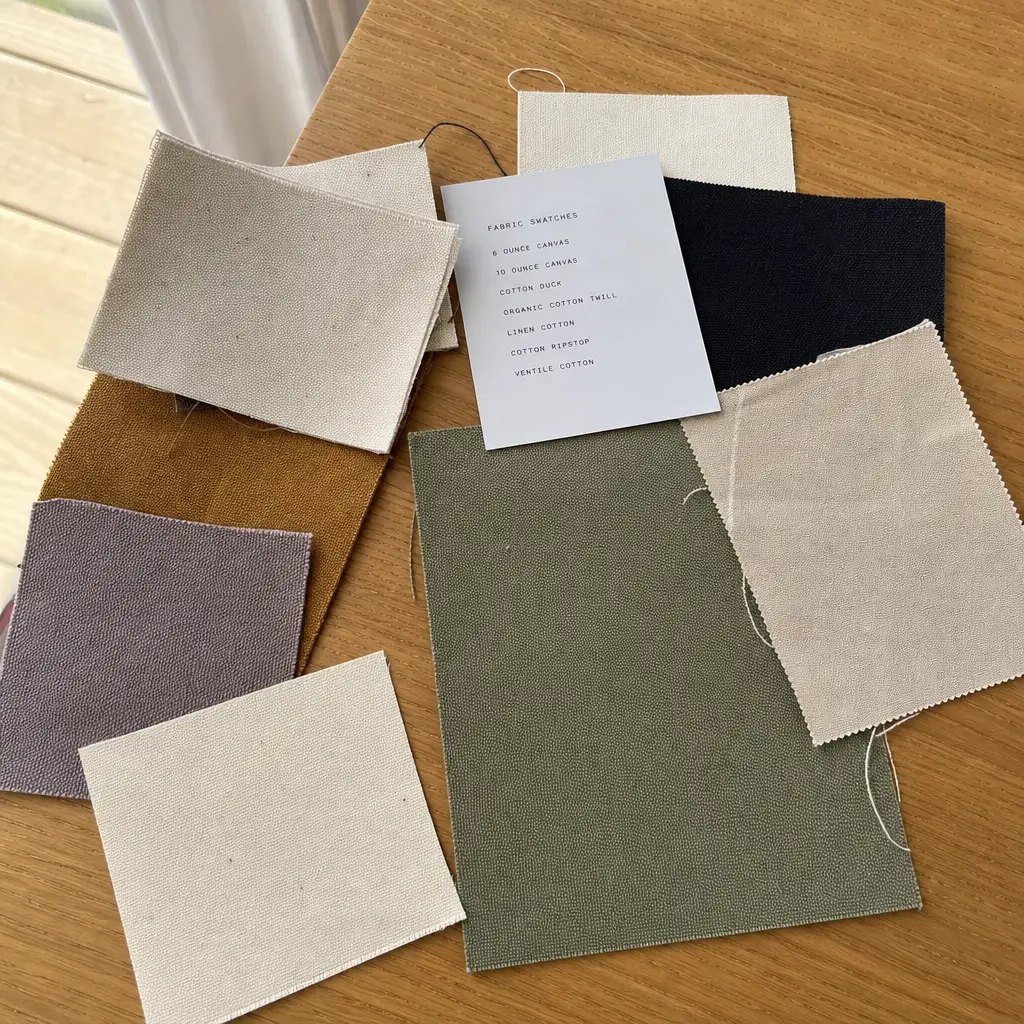
State fabric weight in both ounces and GSM. As reference points, 10 oz canvas is about 339 GSM, 12 oz is about 407 GSM, and 14 oz is about 475 GSM. Lighter canvas can suit orientation giveaways; 12 oz often gives a stronger retail handfeel; heavier canvas may support premium programs but increases carton weight and crease risk. If the canvas is dyed, washed, softened, or enzyme washed, confirm the final weight and shrinkage after finishing, not only the greige fabric weight.
- State oz and GSM so suppliers quote the same fabric class.
- Name the measurement point: after sewing, washing, pressing, or final finishing.
- Define tolerances for main dimensions, strap length, flap alignment, and logo placement in the PO.
- Confirm whether the gusset folds flat because non-folding structure reduces carton efficiency.
- Avoid rigid bottom boards unless display or laptop-support needs justify higher CBM.
Select decoration for packed condition
Most campus logos work well with screen printing when the design uses one to three solid colors. The RFQ should include Pantone references, artwork file format, print size, placement from bag edges, acceptable registration tolerance, ink type, and curing process. Large flap prints need extra attention because they sit under carton pressure during shipping and storage. Poorly cured ink can block, transfer, crack, or become tacky after compression.
Other logo methods can be appropriate, but they change packing risk. Heat transfers reproduce detail but may stiffen the flap or show edge lift after folding. Embroidery gives a premium look but backing can press into the opposite panel. Woven patches are durable, yet patch placement should not interfere with fold lines or barcode labels. Hardware also matters: buckles, adjusters, snaps, and zipper pulls must not rest against printed canvas inside the carton.
- Lock Pantone, print area, placement tolerance, opacity, and curing requirements.
- Review dry rub, wet rub, adhesion, and compression behavior for large flap prints.
- Check heat-transfer edge lift, surface tack, cracking, and pressure marks after folding.
- Approve embroidery backing and confirm it does not emboss the opposite panel.
- Require a fold plan that keeps metal or plastic hardware away from printed areas.
Separate MOQ drivers from price breaks
MOQ is rarely one number. It can be driven by fabric purchasing, dye lot minimums, washing batch size, webbing color, lining, hardware finish, print setup, woven label order quantity, hangtag printing, barcode labels, carton printing, and sewing-line efficiency. A natural canvas bag with stock webbing and one-color print may support a low trial quantity. The same bag with custom dyed canvas, special buckle finish, private label, and printed cartons may need a much higher minimum.
Ask suppliers to explain which component controls the MOQ. That turns negotiation into value engineering. If custom dyed fabric drives the minimum, the buyer may choose natural canvas with a stronger print. If woven labels are the constraint, a hangtag or printed label may be practical for the first run. Price breaks should include the same carton data, because a lower unit price can disappear if carton count and CBM rise.
- Ask for MOQ by fabric, trim, label, decoration, barcode, and carton.
- Confirm whether multiple colors share an MOQ or each color requires its own lot.
- Separate screen charges, strike-offs, label setup, and carton printing from unit price.
- Request units per carton and total CBM at every quantity break.
- Avoid mixed-SKU cartons unless assortment labels and receiving rules are approved.
Balance carton weight and volume
The best carton is not the box that holds the maximum possible number of bags. Bookstore receiving teams need cartons that stay square, lift safely, open cleanly, scan quickly, and protect printed areas. The buyer should set the gross-weight limit based on its own receiving rule. An 18 kg target is only a buyer-controlled example sometimes used for manual handling; it should not be treated as a universal standard.
Volume must be measured from the packed, closed carton. Empty-carton dimensions or theoretical calculations are unreliable for messenger bags because straps and hardware create uneven bulk. A carton can look efficient by CBM while hiding crushed hangtags, bent flaps, or buckles pressed into the logo. Compare freight per bag using total CBM and gross weight, but reject plans that depend on bulging sides, tape strain, or excessive compression.
- Set maximum carton gross weight before confirming units per carton.
- Require packed-carton dimensions, not empty-carton measurements.
- Use 5-ply export cartons for ocean freight, distributor routing, or long warehouse handling.
- Calculate total cartons, total CBM, total gross weight, and freight per bag.
- Check that closed cartons remain square with no bulging, soft corners, or strained tape.
Design inner packing around receiving
Inner packing should follow how the bookstore will use the bag. Individual polybags help protect canvas from dust, handling marks, moisture exposure, and ink transfer. They also create a flat surface for barcode labels and support e-commerce fulfillment. Paper bands or kraft sleeves can reduce plastic where handling is controlled. Unwrapped units can reduce material cost for event distribution, but they increase strap tangling, scuffing, and counting risk.
Barcode workflow is a high-impact detail. If staff scan units at receiving, the barcode must be visible without opening the pack. If the bag is displayed on a shelf or peg, the hangtag should stay flat after carton compression. If the order includes several campus logos, departments, or colors, single-SKU cartons are usually safer unless the buyer approves a mixed-assortment plan with clear labels and inner separation.
- Use individual polybags when cleanliness, unit scanning, or online fulfillment matters.
- Use paper bands when plastic reduction is required and transit conditions are controlled.
- Fold straps inside the bag body in one consistent direction.
- Keep buckles, adjusters, and snaps away from printed panels.
- Place SKU and barcode labels where staff can scan without opening the unit pack.
Approve packing evidence, not just samples
A neat pre-production sample does not prove that bulk goods will arrive in sellable condition. Sample approval should include the bag body, fabric swatch, print strike-off, trim, labels, fold method, inner pack, carton layer arrangement, carton label, case mark, and packed carton dimensions. If the packing method is not approved, the factory may change the fold during production to save space or labor.
A pilot carton is the strongest proof when timing allows. It should use the same bag size, canvas weight, closure, hardware, hangtag, barcode, and inner packing planned for bulk. If a shipped pilot carton is not practical, request a photo set showing the flat bag, strap fold, hardware location, packed unit, barcode location, layer count, scale weight, carton measurements, closed carton, and case marks.
- Retain approved fabric swatch, print strike-off, trim sample, and packed-unit photos.
- Measure finished dimensions after sewing, finishing, and pressing.
- Review logo position after the bag is folded, not only when flat.
- Confirm hardware does not leave dents or pressure marks after stacking.
- Keep approved packing photos in the inspection file for comparison.
Inspect product and carton together
Quality control should separate product defects from packing defects while treating both as shipment risks. Product defects include wrong fabric weight, shade variation, skewed flap, weak bartacks, loose threads, poor print registration, stains, broken hardware, wrong labels, and weak closures. Packing defects include wrong unit count, missing warning labels, unreadable case marks, mixed SKUs, crushed cartons, barcode errors, and packing list mismatches.
A visual AQL inspection is useful, but bookstore messenger bags also need functional and logistics checks. Inspectors should test strap anchors, bartacks, side seams, closures, and hardware according to the agreed method. They should open random cartons, count units, scan barcodes where required, compare case marks to the PO, measure packed cartons, and record gross weight. A shipment can pass appearance inspection and still fail receiving if carton data is wrong.
- Use AQL for visual defects and add functional checks for straps, seams, closures, and hardware.
- Classify wrong SKU, wrong logo, missing barcode, wrong COO label, and wrong carton count as major defects.
- Treat mold, oil stains, sharp hardware, severe print peeling, broken strap anchors, and incorrect artwork as critical issues.
- Measure carton dimensions and gross weight during inspection against quote and freight data.
- Require document updates if carton count, CBM, weight, or SKU allocation changes.
Control calendar and approval risk
Bookstore calendars are fixed around orientation, back-to-school, graduation, homecoming, alumni events, and department launches. Delays often come from late artwork files, unclear Pantone references, missing barcode data, late case mark approval, custom color revisions, or packaging changes after materials are purchased. The production schedule should list buyer approval deadlines as clearly as factory production dates.
Ask the supplier to break lead time into artwork proof, strike-off, material purchase, cutting, sewing, finishing, packing, inspection, and document preparation. Packing can create late-stage delays: goods may sit unpacked if barcode labels are missing, cartons may need relabeling if case marks are wrong, and freight documents may need revision if carton counts change after booking.
- Reserve time for artwork proofing, Pantone confirmation, and print strike-off approval.
- Add buffer for dyed, washed, or softened canvas because shade and shrinkage approval can take longer.
- Confirm barcode files, hangtags, care labels, COO labels, and case marks before mass packing.
- Schedule inspection after final packing so carton data can be verified.
- Avoid carton-count changes after freight booking unless documents can be revised.
Compare quotes by landed cost
Two suppliers can quote similar canvas messenger bags with different total cost. One may offer a low unit price with bulky folding, weak cartons, missing barcode application, and more cartons. Another may quote slightly higher but pack safely, reduce total CBM, apply labels correctly, and provide cleaner receiving data. Freight, inspection, relabeling, damage, repacking, and receiving labor belong in the buying decision.
A complete quote sheet should show bag unit price, sample charges, decoration setup, label setup, inner packing cost, carton cost, units per carton, carton size, carton gross weight, total cartons, total CBM, production lead time, inspection readiness date, and document update process. For repeat programs, keep the approved carton plan in the master product file so future reorders use the same fabric reference, fold method, labels, carton data, case marks, and QC checklist.
- Calculate freight per bag using total CBM and gross weight.
- Compare carton strength, label application, hardware protection, and barcode workflow between suppliers.
- Include hangtagging, barcode application, case marks, and compliance labeling in cost comparison.
- Ask whether the supplier can repeat the same carton plan for future reorders.
- Choose the quote that protects landed cost, receiving accuracy, and campus delivery timing.
Specification comparison for buyers
| Packing or supplier option | Best use case | Buyer advantage | Risk to control in RFQ and QC |
|---|---|---|---|
| Individually polybagged, 5-ply export carton | Retail shelf stock, online fulfillment, distributor DC, long ocean or warehouse routing | Clean unit handling, visible barcode surface, reduced dust and moisture exposure, easier receiving count | Confirm polybag thickness, warning language if required, barcode location, fold direction, units per carton, packed carton GW, and no hardware contact with print |
| Paper band or kraft sleeve, 5-ply export carton | Plastic-reduction programs where handling is controlled and cartons move quickly to store stockrooms | Lower plastic use while keeping units organized and presentable | Test whether bands tear, hide SKU labels, bend hangtags, or allow strap tangling during carton compression |
| Unwrapped units, separated by tissue or layer sheets | Low-cost event giveaways or internal campus distribution with short transit and simple receiving | Lowest packing material cost and faster unpacking for bulk handout programs | Higher dust, strap tangling, scuffing, and counting risk; approve layer method and require carton opening checks |
| Mixed-SKU assortment cartons | Pre-agreed department, color, or campus logo bundles packed for one destination | Can reduce carton count and simplify downstream kit building | Only use with approved assortment label, inner separation, packing list format, and barcode process |
| Single-SKU cartons by logo or color | Bookstore retail, replenishment, multi-campus distribution, and inventory-controlled programs | Cleaner receiving, fewer picking errors, simpler cycle counts, stronger barcode workflow | May increase carton count; compare freight impact against receiving accuracy |
| Supplier quote with physical packed carton data | Repeat style, approved sample ready, or enough time for packing trial | More reliable CBM, gross weight, freight estimate, and receiving plan | Require photos of fold, layers, scale weight, carton measurement, case marks, and closed carton condition |
| Supplier quote based on desk estimate | Early costing before sample approval or when quantity is still tentative | Fast first comparison across suppliers | Treat carton count, CBM, and freight as provisional until a pilot carton or packed photo set confirms data |
Buyer checklist before sampling
- Define finished bag width, height, gusset depth, flap drop, strap width, strap length range, closure type, hardware material, reinforcement method, and measurement tolerance before requesting prices.
- State canvas weight in oz and GSM, plus whether weight is measured before or after dyeing, washing, softening, enzyme washing, pressing, or other finishing.
- Identify the operating route: bookstore shelf stock, e-commerce fulfillment, orientation kit, graduation merchandise, alumni store, department event, distributor DC, or multi-campus replenishment.
- Set buyer-controlled carton limits, including maximum acceptable gross weight, carton size restrictions, pallet needs if any, and whether cartons must be safe for one-person manual handling.
- Require every quote to show units per carton, packed carton dimensions, net weight, gross weight, CBM per carton, total carton count, total CBM, carton board type, tape method, and case mark approach.
- Ask whether carton figures come from a physical packed sample, pilot carton, prior production of the same construction, or desk estimate; mark estimates as provisional.
- Approve packing evidence before mass packing: fold direction, strap placement, hardware protection, layer count, unit packing, barcode position, carton label, case mark, and closed-carton condition.
- Specify unit-level retail data: barcode, SKU sticker, hangtag, care label, fiber content if applicable, country of origin label, campus price ticket, recycling mark, and suffocation warning if required.
- Translate sustainability rules into exact packing instructions: recyclable polybag, recycled-content claim, paper band, kraft sleeve, plastic-free option, label material, warning language, and whether individual unit packing is mandatory.
- Compare suppliers using identical assumptions for bag size, canvas weight, decoration, trim, labels, inner pack, carton board, carton weight limit, inspection scope, and quote quantity.
Factory quote questions to send
- What canvas weight are you quoting in oz and GSM, and is that weight before or after dyeing, washing, softening, enzyme washing, pressing, or other finishing?
- What are the finished bag dimensions: width, height, gusset depth, flap drop, strap width, maximum strap length, closure position, and agreed measurement tolerance?
- Which decoration method is included, how many colors, what Pantone references, what print area, what curing process, and what rub, adhesion, or packed-compression checks will be performed?
- How are the shoulder strap, adjuster, buckle, snap, hook-and-loop, or zipper pull folded inside the unit pack so hardware does not touch printed canvas?
- What MOQ applies separately to canvas, dye lot, webbing color, lining if any, hardware finish, print setup, woven label, hangtag, barcode label, and printed carton?
- How many pieces fit per export carton, and what are the packed carton dimensions, net weight, gross weight, CBM per carton, total carton count, and total CBM at each quantity break?
- Are the carton figures based on a physical packed sample, a pilot carton, prior production with the same construction, or a desk estimate before sample approval?
- Can you provide a packing photo set showing the flat bag, fold direction, strap placement, hardware position, inner pack, layer arrangement, closed carton, carton scale weight, carton measurement, and case mark?
- What carton specification is included: 5-ply or 3-ply, kraft or white outer, board grade if known, tape method, moisture protection, pallet recommendation if any, and maximum stack guidance?
- If carton count, carton size, or gross weight changes after packing, who updates the packing list, invoice, case marks, freight booking data, and inspection report?
Quality-control points to confirm
- Canvas weight should match the approved reference within the buyer-approved tolerance; a +/-5% range may be used as a starting example, but the PO should state the actual rule.
- Dyed, washed, or softened canvas should be checked for shade consistency across panels, flaps, straps, gussets, and production lots, especially when multiple SKUs ship together.
- Finished dimensions should be measured on a flat bag after sewing, finishing, and pressing, with attention to width, height, gusset, flap drop, strap width, strap length, and closure alignment.
- Flap alignment, gusset symmetry, side seam straightness, and strap anchor position should match the approved sample within the agreed tolerance; buyers may use +/-1 cm for main dimensions only if suitable for the style.
- Screen print should show correct Pantone direction, opacity, registration, placement, curing, and clean edges, with no obvious tackiness, cracking, pinholes, bleeding, or transfer after agreed dry and wet rub checks.
- Stress points at strap anchors, flap corners, closure points, and side seams should have reinforced stitching or bartacks consistent with the approved sample and free from skipped stitches or loose threads.
- A practical strap pull or load check should be agreed before production for bags intended to carry books, laptops, or daily items; the method and load should not be invented during inspection.
- Hardware should be rust-free, smooth-edged, securely fixed, consistent in finish, and positioned so it does not scratch printed panels or dent canvas during carton compression.
- Inner packing should protect the printed flap, prevent strap tangling, hold hangtags flat, and keep metal or plastic hardware away from pressure-sensitive print areas.
- Hangtags, barcodes, country of origin labels, SKU stickers, and compliance labels should be correctly placed, legible, and scannable without opening the unit pack unless internal labels were approved.