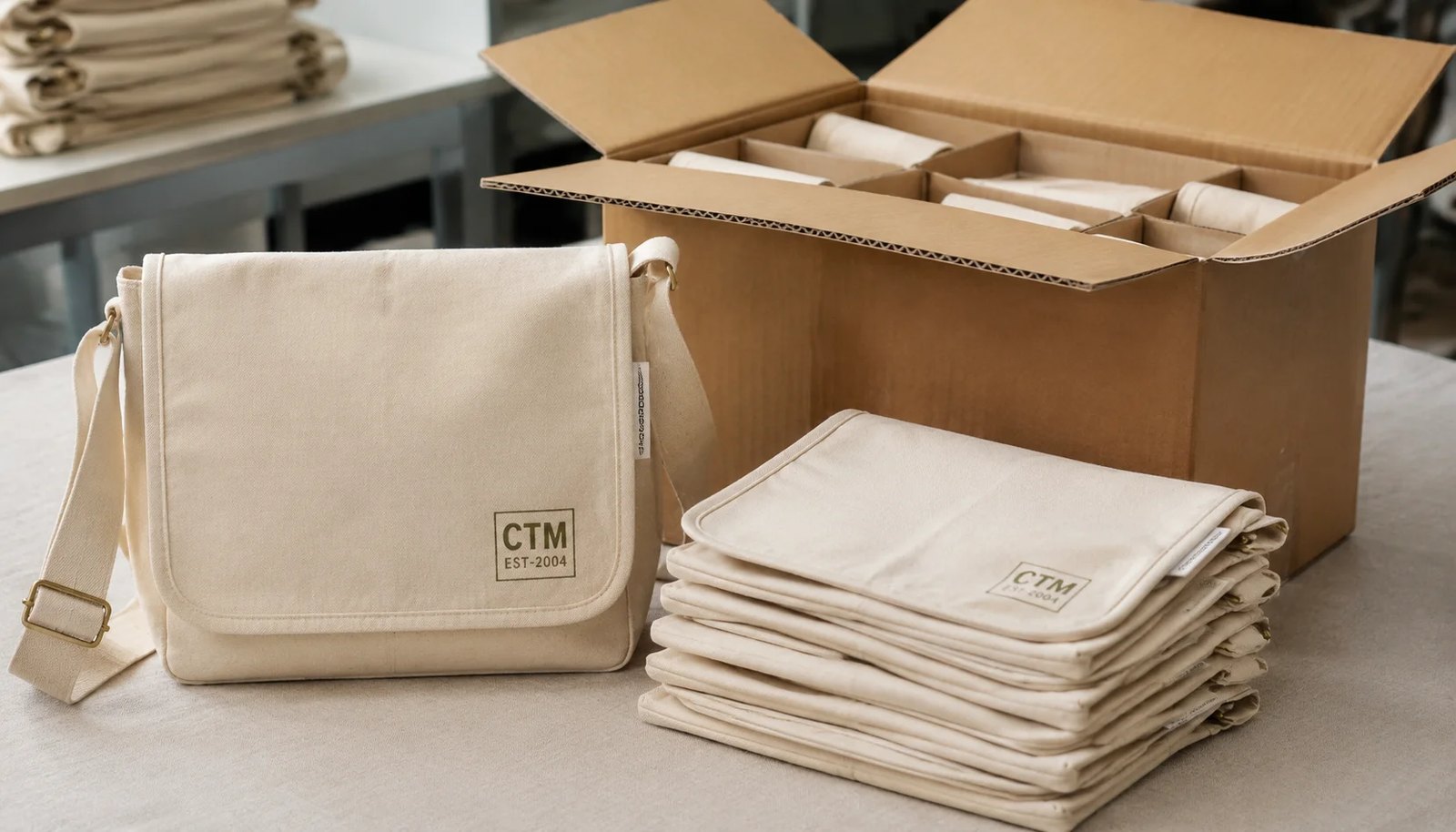
Why Packing Plan Comes Before Final Price
For canvas messenger bags sold into natural grocery channels, carton packing is not a warehouse afterthought. It affects freight CBM, carton damage rate, store receiving time, shelf presentation, and the buyer's ability to compare supplier quotes. A supplier can make the unit price look attractive by packing too many bags into each carton, using a weak carton, or folding the flap aggressively. The problem appears later as creased front panels, crushed hardware, or cartons that fail during distribution.
Procurement teams should treat the carton packing plan as part of the product specification. The RFQ should ask for pieces per carton, carton dimensions, gross weight, net weight, folding method, carton board grade, carton label data, and any plastic-free inner packing option. Without those details, two quotes for the same canvas messenger bag are not really comparable. One offer may be cheaper ex-works but more expensive after ocean freight, pallet inefficiency, repacking labor, or DC chargebacks.
- Use carton CBM to compare freight impact per bag, not only supplier unit price.
- Set a carton gross weight limit before quotation so suppliers cannot solve CBM by overpacking.
- Require a packing photo or packing sample before bulk packing starts.
- Include carton label content in the PO so receiving data matches the packing list.
Bag Specification That Drives Carton Size
A messenger bag with the same face size can pack very differently depending on gusset depth, flap stiffness, strap width, buckle type, and whether the canvas is washed or unwashed. A flat 35 x 28 cm document bag may fit 40 pieces per carton, while a 35 x 28 x 10 cm gusseted messenger bag with an adjustable strap may be safer at 20 to 30 pieces. If the bag has metal adjusters, magnetic snaps, or a thick front pocket, the carton plan must prevent hardware pressure marks on the natural canvas.
For Natural Grocers style programs, buyers often prefer practical natural canvas, visible stitching, and a moderate structure instead of a fashion handbag build. A useful RFQ describes finished size, gusset, flap coverage, internal pocket, strap width, reinforcement points, and expected load. The carton quantity should be calculated from the finished packed shape, not from a flat paper drawing. Suppliers should confirm the folded dimensions of one finished bag after strap placement.
- Typical retail-friendly messenger size: about 35 x 28 x 8 to 10 cm for documents, sampling kits, or employee programs.
- Strap width: 3.0 to 4.0 cm for comfort and acceptable carton control.
- Front flap: avoid overly stiff interlining if the bag must be flat packed without permanent creasing.
- Hardware: plastic adjusters reduce rust risk; metal adjusters give a stronger look but need tissue separation on natural canvas.
Fabric Weight And Finish Choices
Fabric weight is one of the first cost and packing drivers. For canvas messenger bags, 10 oz cotton canvas may be enough for light promotional use, but it can look soft and collapse after packing. A 12 oz canvas, roughly around 400 GSM depending on weave and finishing, is a common balance for grocery retail programs. Heavier 14 oz or 16 oz canvas gives more structure, but it increases sewing time, carton volume, gross weight, and freight cost. It can also make flap fold marks more visible.
Natural canvas is not a single standard. It may be unbleached, bleached, dyed, enzyme washed, pre-shrunk, or laminated. Each finish changes handfeel and packing behavior. Unwashed natural canvas can show crease lines after tight carton packing. Washed canvas feels softer and packs more naturally, but size tolerance and shade variation need tighter approval. For quote comparison, request oz, GSM, fabric width, shrinkage, color standard, and whether the quoted fabric is stock fabric or made to order.
- Light duty: 10 oz canvas for low-cost events or short-use campaigns.
- Balanced retail choice: 12 oz canvas for reusable messenger bags with good print surface.
- Premium structured choice: 14 oz canvas when durability matters more than carton density.
- Acceptance point: fabric weight should be tested from bulk fabric, not only stated on invoice.
Print Method And Logo Placement
The front flap is usually the main branding area, so print method affects both appearance and packing. Water-based screen printing works well on natural cotton canvas when the artwork is simple and the buyer wants a soft handfeel. Pigment or plastisol-style inks can give stronger opacity but may feel heavier and crack if the flap is folded tightly. Heat transfer is useful for detailed artwork but may look less natural on a grocery-focused canvas product. Woven labels are practical for small runs, multiple store versions, or when the buyer wants to avoid large screen setup.
Logo placement must be specified from stable sewing reference points. A drawing that says centered on flap is not enough when flap shape changes during sewing. Use measurements from the top flap seam, side seam, or flap edge. For example, print centerline aligned to flap center within plus or minus 3 mm, and print top edge 6 cm below flap seam within plus or minus 5 mm. The packing plan should also protect the printed area, because fresh or raised ink can mark adjacent bags if bulk packed too quickly.
- Best for simple one or two color grocery branding: water-based screen print.
- Best for small batch or multiple artwork versions: woven side label or sewn patch.
- Best for detailed color artwork: transfer print, with fold and wash resistance tested.
- Packing point: printed flaps should be fully cured before folding into export cartons.
Carton Quantity And Folding Method
A practical carton plan starts with the finished folded bag, not with a theoretical carton target. The safest method for a canvas messenger bag is usually flat fold, strap tucked inside the main compartment, flap laid in its natural direction, and hardware positioned away from the front print. If the strap is wrapped around the bag, it can leave pressure lines. If the flap is sharply folded backward, the front panel may show a crease that does not recover before retail distribution.
For standard canvas messenger bags around 35 x 28 x 10 cm, a common export carton range is 20 to 30 pieces. The final quantity depends on fabric thickness, whether the bag has a padded panel, the buckle height, and maximum carton gross weight. Buyers should not approve a carton plan based only on pieces per carton. The approval should include carton dimensions, gross weight, packing layer layout, inner protection, and photos of the carton after closure. After unpacking, inspect several bags after 24 hours to see whether folds recover.
- Use 20 pieces per carton for heavier canvas, structured flaps, or metal hardware.
- Use 25 to 30 pieces per carton for moderate 12 oz canvas with simple strap hardware.
- Avoid high compression packing if the bag front flap carries the retail logo.
- Request one open-carton photo and one closed-carton photo with carton marks visible.
Plastic-Free Inner Packing Options
Natural grocer buyers often prefer reduced plastic packaging, but removing every inner protection layer can create new quality problems. Natural canvas picks up dust, hardware marks, and carton fiber transfer more easily than dark dyed fabric. A good compromise is bulk packing with paper interleaving where hardware touches fabric, or a paper belly band around each folded bag if retail handling requires a neat unit. Individual polybags should be used only when routing, moisture risk, or retail shelf conditions make them necessary.
When requesting plastic-free packing, specify the actual protection method. A supplier may interpret no polybag as loose bags directly into the carton. That can work for simple flat totes, but messenger bags have straps, buckles, flaps, and sometimes pockets. The RFQ should state whether tissue paper, kraft divider sheets, silica gel, master liner bag, or paper band is included. For sea freight, a master carton liner may protect against moisture while still avoiding individual polybags.
- Lowest packaging: bulk pack directly in export carton, suitable only for simple low-risk designs.
- Balanced option: paper sheet between layers and hardware-facing surfaces.
- Retail handling option: paper belly band with SKU barcode if the bag is sold or issued individually.
- Moisture risk option: carton liner plus desiccant, especially for long sea transit.
MOQ Logic For Grocery Programs
MOQ should be built from production constraints, not from a round number in the supplier's catalog. For canvas messenger bags, the real MOQ is affected by fabric availability, dyeing requirement, print setup, label weaving, hardware color, and packing configuration. A natural canvas bag using stock fabric and one-color screen print may have a lower practical MOQ than a dyed canvas bag with custom metal hardware and multiple store logos.
For grocery programs, buyers often split orders by region, store opening date, or campaign artwork. That is workable if the RFQ separates total order quantity from MOQ by SKU. A supplier may accept 1,000 pieces total, but only if all units share the same fabric, strap, hardware, and carton packing. If every 200 pieces needs a different flap print and carton mark, screen setup, packing control, and inspection time increase. The quote should show unit price, setup charges, sample fees, and mixed-SKU packing charges separately.
- Low complexity MOQ: stock natural canvas, standard strap, one print design, one carton mark.
- Medium complexity MOQ: same bag body with several print designs or store versions.
- High complexity MOQ: custom dyed fabric, custom hardware, multiple prints, and retail-ready packing.
- Quote requirement: show MOQ by fabric color, print design, label, and carton configuration.
Lead Time And Schedule Risk
A reliable schedule separates sampling, material purchasing, cutting, printing, sewing, inspection, packing, and export handover. A short lead time may be realistic for stock natural canvas and a simple logo, but not for custom dyed fabric, woven labels, or hardware that must be sourced separately. The carton packing plan also consumes time because the factory needs to test folding, carton strength, and label layout before mass packing.
For planning purposes, buyers can treat the pre-production sample as the gate before bulk materials are committed. A realistic timeline may include 5 to 10 days for sample making, several days for sample review and corrections, then 20 to 35 days for bulk production depending on order size and factory capacity. These are planning examples, not delivery promises. The important point is to make the supplier state which days are counted from artwork approval, sample approval, deposit, material arrival, or final PO confirmation.
- Schedule risk: artwork approval delayed because print position is not defined on a measured drawing.
- Schedule risk: carton size changes after bulk packing trial, requiring new carton purchase.
- Schedule risk: natural canvas shade differs from sample because bulk fabric lot was not approved.
- Schedule risk: retail DC label format arrives after cartons are already packed.
Quote Data Needed For Landed Cost
The buyer's landed cost model needs more than FOB or ex-works unit price. Canvas messenger bags are bulky compared with small pouches, so carton dimensions can change ocean freight and warehouse cost noticeably. A quote with lower unit price but larger cartons may lose the advantage after CBM is calculated. For distributor programs, carton count also affects receiving labor, pallet positions, and allocation to stores.
Request a quote sheet that includes item spec, fabric details, print method, packaging method, pieces per carton, carton size, gross weight, net weight, CBM, estimated cartons per order, HS code reference if available, sample cost, tooling or screen charges, and lead time. If the supplier cannot provide carton data before sampling, they should at least provide a preliminary estimate and then update it after the pre-production sample packing test. The final packing list should match the approved quote assumptions.
- Compare cost per bag plus estimated freight per bag.
- Compare carton count and warehouse handling impact per PO.
- Compare setup charges separately from unit price for repeat-order clarity.
- Compare supplier assumptions for fabric weight, print coverage, and inner packing.
Sample Approval And Inspection Criteria
A correct sample approval package includes more than a nice looking messenger bag. It should include final fabric or a clearly marked substitute, final logo method, final strap and hardware, finished measurements, seam reinforcement, and the proposed packing method. For natural canvas, the buyer should also review fabric shade, slub level, odor, handfeel, crease recovery, and whether the print remains clean after folding.
Before shipment, inspection should cover both product quality and carton packing quality. Product inspection should verify dimensions, stitching, strap strength, print placement, color, hardware function, and pocket construction. Packing inspection should verify pieces per carton, carton dimensions, weight, carton marks, layer arrangement, protection between hardware and fabric, and carton condition after closure. AQL inspection can catch sewing defects, but it will miss commercial problems if the inspector is not instructed to open cartons and evaluate fold marks.
- Approve a sealed reference sample and keep one at the factory for production comparison.
- Measure print placement from flap seam and side edges, not by eye only.
- Test one packed carton by leaving it closed for at least 24 hours, then inspect crease recovery.
- Include carton label proof approval before mass cartons are printed or labeled.
Specification comparison for buyers
| Spec decision | Recommended option | When it fits | Buyer risk to check |
|---|---|---|---|
| Main fabric weight | 12 oz cotton canvas, about 400 GSM, pre-shrunk if washing is required | Good balance for grocery retail messenger bags carrying catalogs, loyalty kits, tablets, or sampling materials | Some quotes may use 10 oz fabric but describe it as heavy canvas; request GSM, oz, and finished fabric thickness |
| Carton quantity | 20 to 30 pieces per export carton depending on bag size, flap structure, and strap hardware | Works for standard messenger bags around 35 x 28 x 10 cm without crushing the flap or bending buckles | Overpacked cartons reduce freight cost per piece but cause creased flaps, distorted gussets, and failed retail presentation |
| Bag folding method | Flat fold with strap tucked inside the main compartment and flap laid naturally | Best for natural canvas where sharp fold marks are visible and the buyer wants shelf-ready unpacking | Supplier may roll or compress the bag to hit a carton target; approve a packing photo before bulk packing |
| Logo decoration | Water-based screen print for simple CTM or grocery brand artwork; woven label for small repeat orders | Screen print fits large front flap logos and natural canvas texture, while woven labels reduce setup risk on mixed SKUs | Ink migration, poor opacity, and crooked flap placement are common if print position is not measured from seam references |
| Inner packing | No individual polybag unless retail routing requires it; use paper belly band or master carton bulk pack | Useful for natural grocers with plastic reduction targets and direct-to-store or DC unpacking | Skipping inner protection can transfer hardware marks to fabric; use tissue sheet or divider where buckles contact the flap |
| Carton strength | Five-layer export carton with edge protection when cartons exceed 13 to 15 kg gross weight | Recommended for sea shipment, pallet stacking, and warehouse handling before store allocation | Weak cartons collapse during container loading; require burst strength or ECT data instead of accepting a generic carton description |
| MOQ planning | Start MOQ by fabric color, print color count, and carton packing unit, not only total order quantity | Fits grocery buyers ordering several store regions, seasonal artwork, or multiple flap logo versions | A low quoted MOQ can hide fabric dye surcharge, screen setup charges, or mixed-carton complexity |
| Carton label data | SKU, PO number, item description, color, quantity, gross/net weight, carton size, and carton number sequence | Needed for distributors, retail DC receiving, and importer customs document matching | Missing carton marks cause receiving delays and manual relabeling; provide label layout before production |
Buyer checklist before sampling
- Define finished bag size, gusset depth, flap coverage, strap width, hardware type, and target carrying load before requesting carton data.
- Specify fabric by oz and GSM, including whether the canvas is natural, bleached, dyed, washed, or laminated.
- State the preferred packing method: bulk pack, paper band, individual polybag, tissue divider, or retail-ready inner carton.
- Set maximum carton gross weight and maximum carton dimensions based on warehouse handling and pallet rules.
- Require supplier to quote pieces per carton, carton CBM, gross weight, net weight, carton material, and pallet loading estimate.
- Approve a folded packing sample or photo before mass packing begins, not only the finished bag sample.
- Confirm logo method, print size, Pantone target, print placement tolerance, and whether print is tested after folding.
- Request pre-production sample with final fabric, final hardware, final print, and proposed packing method.
- Include carton drop, compression, and moisture protection expectations when goods move by sea freight.
- Compare landed cost per usable bag, not only ex-works unit price, because carton size and packing density can change freight cost materially.
Factory quote questions to send
- What fabric oz, GSM, yarn count, and shrinkage level are included in this quote?
- What is the finished bag size tolerance after sewing and pressing?
- How many pieces are packed per carton, and what are the carton length, width, height, gross weight, net weight, and CBM?
- Will the bags be flat folded, half folded, rolled, or compressed, and where will the strap and hardware sit inside the carton?
- What carton board grade, ply count, and edge protection are included for export packing?
- Is individual polybag packing included, optional, or excluded, and what plastic-free alternative can be used?
- What print method is quoted, how many colors are included, and what is the print placement tolerance on the flap?
- What is the MOQ by fabric color, print design, and packing configuration?
- How many days are needed for sampling, material purchasing, bulk sewing, printing, inspection, and packing after approval?
- Which sample, inspection report, packing photo, and carton label proof will be provided before shipment?
Quality-control points to confirm
- Fabric weight must match approved range, for example 12 oz canvas near 400 GSM within agreed tolerance.
- Finished bag dimensions should stay within agreed tolerance, commonly plus or minus 1 cm for main body and gusset.
- Strap attachment must pass a practical pull test based on intended load, with no seam cracking or bar tack failure.
- Flap logo must be centered to agreed seam reference points, with no visible ink bleeding, pinholes, or color mismatch beyond approved sample.
- Metal or plastic hardware must open and adjust smoothly without sharp edges, rust marks, or color transfer to natural canvas.
- Carton quantity must match the approved packing plan, with no mixed SKU cartons unless authorized in writing.
- Carton gross weight should remain within warehouse handling limit, often under 15 kg unless palletized handling is confirmed.
- Fold marks, compression dents, and hardware impressions on the front flap should be assessed after 24 hours out of carton.
- Carton labels must match PO, SKU, quantity, country of origin, and carton sequence data used on packing list.
- Random inspection should include both unpacked bag quality and carton packing condition, not only sewing defects.