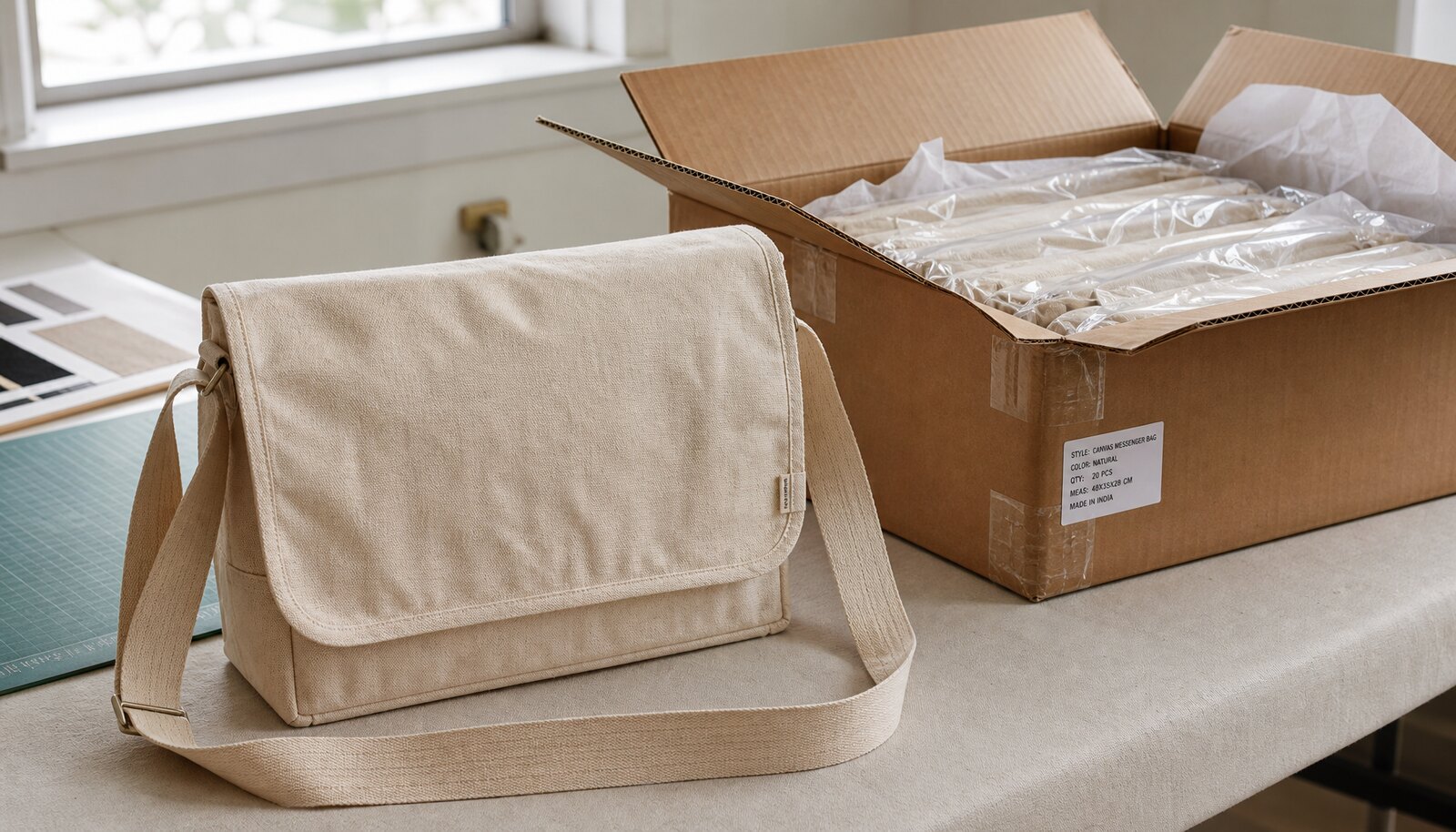
Why carton packing matters more than most gift shop buyers expect
For canvas messenger bags sold through gift shops, packaging is not a warehouse afterthought. It affects damage rate, retail presentation, receiving speed, and freight cost at the same time. A bag can pass sewing inspection and still be a poor retail item if it arrives with strap creases, flattened panels, rub marks, or mixed cartons that slow down receiving. That is why the packing plan should be written alongside the product specification, not after the sample is approved.
Gift shop buyers usually need a carton plan that is easy to unpack, easy to count, and easy to replenish in store backrooms or distribution centers. If the supplier cannot tell you the exact folded size, pieces per carton, carton dimensions, and gross weight, the quote is incomplete. You may think you are buying a bag, but you are actually buying a packed unit that must survive the route from sewing table to shelf.
A usable carton plan also helps when the assortment includes seasonal graphics or multiple SKUs. Retail teams do not want to separate loose bags, repack mixed counts, or handle cartons that are too heavy for one person to move safely. The more clearly the pack-out is defined, the fewer disputes you will see at receiving.
- Packing affects landed cost, shelf appearance, and return risk.
- Gift shop programs need clean carton counts and fast receiving.
- The packing plan should be approved before bulk production starts.
Start with the bag build: fabric, size, strap, and closure
Before you compare carton quotes, confirm the bag itself. For many gift shop programs, 12oz canvas is the value entry point and 14oz canvas is the safer choice when the bag needs better shape retention. If the bag is printed heavily, carries books or souvenirs, or must look structured on shelf, 14oz usually photographs and displays better. For very light promo programs, 10oz can work, but it is more likely to sag once printed and packed.
Use ounces or GSM consistently, but do not let the supplier hide key details behind a number alone. Ask whether the canvas is raw, bleached, pre-shrunk, enzyme washed, or surface treated. Pre-shrunk fabric reduces size drift, which matters when the sample is measured but the bulk lot arrives slightly different after finishing. If the buyer accepts a narrow size tolerance, the factory needs to know that before cutting begins.
The closure also changes how the bag packs. An open-top tote folds differently from a zip-top messenger or a flap bag with a magnetic snap. A zipper track or magnetic component can add bulk and create pressure points if the carton is too tight. Strap width matters too: narrow webbing is easier to tuck flat, while wide webbing resists tight folding and may need a dedicated fold sequence.
- 12oz: lower cost, lighter handfeel, suitable for basic retail promos.
- 14oz: better structure, better shelf presence, lower sag risk.
- Pre-shrunk fabric reduces size drift and approval disputes.
- Zippers and magnets need extra packing clearance and protection.
Choose the fold method before you choose the carton size
Messenger bags do not pack like flat pouches. Their straps, flaps, buckles, and gussets create bulk in places that can permanently crease the body if the fold method is not controlled. The carton plan should define exactly how the bag is folded, where the strap sits, whether the flap is folded inward or outward, and whether a tissue sheet or insert board is required. If the factory is left to decide this on the line, bulk cartons will vary from one operator to another.
A practical fold method for many medium messenger bags is a two-step fold: first flatten the body so the front and back panels sit flush, then fold the strap flat along the body or tuck it inside the main compartment. The objective is to avoid a hard bend at the print area or a sharp strap crease against the face panel. For thicker bags, a paper insert board can help hold the flat profile without overcompressing the canvas.
The best carton size is the one that fits the folded bag with a little clearance, not a loose box that lets the bag slide around. As a working rule, leave roughly 1.5–2.5 cm of clearance on critical sides, then test a packed sample. If the bag rebounds after unpacking or shows a visible fold line, the carton is too tight or the fold is too aggressive. If the bag shifts too much, you need more internal restraint, not just a larger carton.
- Write the fold sequence into the packing instruction sheet.
- Tuck straps flat, do not bunch them into a knot or tight loop.
- Use insert boards or tissue when the front panel must remain flat.
- Test one packed sample before locking carton dimensions.
A practical carton packing matrix for common gift shop scenarios
The right carton plan depends on bag size, structure, and destination handling. A flat promotional messenger bag can usually be packed more densely than a structured zip-top bag with lining and hardware. The table below gives usable starting points for procurement discussions. Treat the numbers as planning ranges, then confirm the final carton fit with a packed sample and the supplier's actual materials.
The important point is not to chase the biggest carton count. The best packing ratio is the one that protects print, controls freight cube, and stays within a safe lift weight for warehouse staff. For retail buyers, clean receiving often matters more than saving a few cents on carton volume. If the bag arrives with damaged corners, the cheaper cube becomes expensive very quickly.
- Use lower piece counts for structured or hardware-heavy bags.
- Confirm gross weight per carton before final approval.
- If a carton exceeds safe manual handling weight, reduce the count even if freight cube rises.
Inner pack choices: polybag, tissue, insert board, or dust cover
The inner pack is where many packing plans succeed or fail. A plain polybag is enough for many value items, but gift shop merchandise often needs a cleaner presentation. Tissue paper can reduce scuffing and make the bag look more retail-ready when the carton is opened. A paper insert board helps hold a flat panel in place and protects the logo from folding pressure. A dust cover or cotton drawstring bag is less common for mass gift shop orders, but it can be appropriate for premium lines or boxed sets.
The right choice depends on the selling channel. If the bags are going to a chain gift shop with fast shelf replenishment, a simple polybag and insert board may be enough. If the item is positioned as a premium accessory, a better presentation may justify the extra pack labor. The quote should state whether the inner pack is priced per bag or treated as a separate charge, because this affects real unit cost more than many buyers expect.
Two warnings matter here. First, avoid overly tight polybags that press directly into printed surfaces. Second, do not let the insert board extend so far that it creates a hard fold line at the gusset or flap. The goal is protection, not compression. Ask the supplier for photos of the packed item from front, side, and top before signing off.
- Polybag is the baseline; tissue and boards improve presentation and shape control.
- Premium retail may justify a dust cover or better inner presentation.
- Verify that inner packs do not press on prints or hardware.
- Ask whether inner-pack labor is included in the unit price.
Comparison guide: factory direct, trading company, or local consolidator
Procurement buyers often compare quotes by unit price only, but the supplier route matters just as much. Factory direct sourcing is usually best when you need full control over fabric, sewing, print, and pack-out. Trading companies can help if you need multiple products consolidated or if you prefer one contact for communication and shipment planning. Local consolidators are useful when you need cross-factory grouping, but they can make quality tracing harder if the packing work is done in multiple places.
The real question is not who gives the cheapest quote. It is who can show you the actual packing discipline. If two prices are close, ask which route can provide sample-room photos, a packed pre-production sample, carton specification, and final pack-out records. The supplier that can answer those questions clearly is usually the lower-risk partner for a gift shop rollout.
Below is a practical comparison for sourcing decisions. Use it to decide whether a quote is strong enough to move to sample approval or whether you need more verification before PO placement.
- Never compare quotes without comparing packing responsibility.
- Ask who owns pack-out if the goods move between multiple sites.
- Verify the final carton photos, not only the bag samples.
Supplier audit questions that expose weak packing capability
Good procurement questions force the supplier to explain how they actually work. Start with the basics: where is cutting done, where is sewing done, and where is final packing done? If the answer is vague, the packing plan is probably not controlled. Ask whether the same line that produces the bags also packs them, because switching operators late in the process often creates inconsistent folds and counts.
Then ask about records. A supplier with a real packing system should be able to show carton labels, pack lists, packed-carton photos, and a sample of the carton mark format. If they say these details are finalized only after bulk starts, treat that as a red flag. Packing should be locked before production, not invented during shipment week.
Good audit questions also uncover hidden charges. Does the quote include carton printing, label application, tape, manual counting, or extra rework if the pack is short? Are polybags included? Is there a fee for changing carton dimensions after sample approval? These are the kinds of details that separate a clean procurement order from a messy one.
- Where is final packing done, and who supervises it?
- Can you show a packed pre-production sample from this exact SKU?
- What pack-out records do you keep for carton count and shipment marks?
- What extra charges apply if carton size, label position, or packing ratio changes?
- Who signs off on the final carton before loading?
QC standards that are measurable, not vague
Many quality claims sound fine until you try to inspect the shipment. For buyer control, the inspection standard must be measurable. Fabric weight should have a tolerance band. Finished dimensions should have a tolerance band. Print placement should be checked against a sample or template, not judged by eye alone. If the order uses a logo, the buyer should define which minor defects are acceptable and which are not.
A simple buyer-friendly approach is to divide QC into appearance, construction, and packing. Appearance covers shade, stains, print clarity, and alignment. Construction covers stitch density, seam strength, strap attachment, and closure function. Packing covers fold accuracy, count accuracy, carton strength, and label correctness. Each area needs a pass/fail rule or the supplier will argue that a visible defect is only a “small variation.”
For larger orders, use an AQL-style inspection mindset even if the contract does not quote a formal AQL number. That means sampling enough cartons from different parts of the lot, checking multiple bags per carton, and recording defects by type. If you find repeated print rub, the issue may be overpacking. If you find repeated size drift, the issue may be fabric shrinkage or inconsistent cutting. The point is to trace the cause before the goods leave the factory.
- Require measurable tolerances, not general wording.
- Separate appearance, construction, and packing checks.
- Use sample cartons from different positions in the lot.
- Hold shipment if defects repeat across multiple cartons.
A practical approval flow for bulk ordering
A strong approval flow prevents most packing disputes. First, approve the bag specification: size, fabric, strap, closure, and print placement. Second, approve the loose sample to verify workmanship. Third, approve the packed sample to verify fold method, inner pack, carton count, and carton dimensions. Only after those three gates should the factory start mass production.
During approval, document the exact version you approved. Save photos of the front, back, side, folded form, open carton, closed carton, shipping mark, and label placement. If the supplier later says the carton changed because of a “small adjustment,” you need the original signed-off record. This matters even more for gift shop assortments that repeat season after season, because buyers often reorder the same style with minor artwork changes.
If the sample and bulk plan diverge, stop and reset the approval. Do not let the factory “match it as closely as possible” unless the difference is genuinely acceptable. The cost of a delayed PO is usually lower than the cost of a bad receiving batch, especially when the order is tied to a launch window or holiday selling period.
- Approve in three gates: spec, loose sample, packed sample.
- Save photos of the packed carton from multiple angles.
- Do not allow quiet changes to carton size or fold method after approval.
Lead time risks usually start with packing materials, not sewing
Many buyers watch sewing capacity closely and overlook packaging lead time. Cartons, polybags, labels, insert boards, and carton prints can all become critical-path items. If carton artwork must be changed after sample approval, the factory may need a new die or a new carton print run. That can slow shipment even when the bags themselves are finished on time.
The safest schedule separates material arrival, sewing, finishing, pack-out, and final inspection. For custom gift shop orders, packaging materials should already be on site before the production line reaches the final stage. Otherwise, bags sit in the workshop waiting for cartons, which increases dust exposure and creates congestion on the line. This is also when mixed counts happen, because operators rush to finish cartons at the end of the day.
If you are buying seasonal merchandise, ask the supplier which packaging items are long lead-time. Printed cartons, special-size polybags, and custom hangtags are the usual suspects. Lock those items first if the shipment date is fixed.
- Confirm packaging lead times before confirming the production schedule.
- Lock carton artwork and barcode placement early.
- Do not let finished bags wait uncased in the workshop.
- Treat polybags and labels as time-sensitive materials.
Specification comparison for buyers
| Spec decision | Recommended option | When it fits | Buyer risk to check |
|---|---|---|---|
| Body fabric weight | 12oz canvas for value lines; 14oz canvas for premium retail feel | Use 12oz when the bag is light-duty, flat-packed, and price-sensitive; use 14oz when the bag must hold shape on shelf or survive longer distribution | Ask for fabric weight tolerance and finished shrinkage; underweight canvas can sag after print and create a low-end shelf look |
| Finished bag size | Typical gift shop range: 35 x 30 x 10 cm or 38 x 32 x 12 cm | Use medium messenger proportions for books, journals, souvenirs, and travel accessories | Bags larger than the carton interior can force overfolding; confirm folded size before approving production |
| Lining | Unlined for low-cost promotions; 210D polyester lining for structured retail goods | Use lining when the bag needs inner pockets, smoother interior, or a cleaner premium handfeel | Lining adds sewing time, carton bulk, and inspection points; verify whether the quote includes lining seam reinforcement |
| Closure | Open top with flap, zipper top, or flap plus magnetic snap | Use zipper or magnetic closure for gift shops selling higher-value items or travel accessories | Closure hardware can scratch print surfaces if packed poorly; confirm protective tissue or divider use |
| Print method | 1-color or 2-color screen print for repeat SKUs; heat transfer only for short runs or complex art | Use screen print for stable retail volumes and simple artwork | Heat transfer can crack or lift if folding pressure is too high or if cartons are overfilled |
| Pack format | 1 bag per polybag, then 20–30 pcs per carton for medium sizes; 12–20 pcs for larger structured bags | Use lower counts when bags have stiff boards, zippers, or bulky flaps | Too many pcs per carton causes strap creasing, print rub, and carton bulge |
| Carton grade | 5-ply export carton for standard routes; 7-ply if cartons stack high or ship long distance | Use 7-ply when cartons are heavy, tall, or likely to be pallet-stacked | Request burst strength or edge crush values; weak cartons crush at corners under stack load |
| Carton dimensions | Fit the folded bag plus 1.5–2.5 cm clearance on each critical side | Use a carton that limits movement without compressing seams or print areas | A carton that is too tight increases pressure marks; too loose increases shifting and abrasion |
| Labeling route | Woven side label on bag plus master carton mark and barcode label | Use this when shelf identity matters but you want limited print coverage on the bag face | Misplaced labels can look careless at retail; request label-placement photos before bulk approval |
Buyer checklist before sampling
- Confirm finished bag size, gusset depth, handle drop, strap width, and usable loading weight before quoting.
- Specify canvas weight in oz or GSM, whether the fabric is pre-shrunk, and the acceptable shade range.
- Send vector artwork, Pantone references, print size, and exact logo placement with a measured mockup.
- Approve a physical pre-production sample packed exactly as bulk will be packed, not just a loose bag sample.
- Lock polybag size, tissue or insert-board requirement, carton dimensions, and pieces per carton before mass production.
- Request the supplier's carton specification, including grade, burst or ECT rating, and stacking limit.
- Set inspection gates for stitching, print rub, closure function, carton count, and carton condition before shipment release.
Factory quote questions to send
- What exact canvas weight do you source, and what tolerance do you allow on the finished fabric batch?
- Is the fabric pre-shrunk or washed before cutting, and what shrinkage level should we expect after finishing?
- What is the folded size of one packed bag, and how many pieces per carton fit without pressure on the print or seams?
- What carton size, carton grade, and stacking limit do you recommend for this bag size and weight?
- Does your unit price include screen setup, label application, closure hardware, polybagging, tissue, inserts, and carton marking?
- Where is the packing done, and is it done by your own line or by a subcontractor?
- Can you share a packing list template with SKU, carton count, net weight, gross weight, and carton dimensions?
- What is your sample approval flow for fabric shade, strap length, stitch density, print alignment, and packed-carton condition?
- What happens if a carton is short, mixed, or damaged during pack-out—do you rework it before shipment or ship as-is?
- Can you provide carton photos, pack-out photos, and one finished sample carton before mass production starts?
Quality-control points to confirm
- Fabric weight should stay within an agreed tolerance, typically around +/- 5% versus the approved sample standard.
- Finished dimensions should stay within an agreed tolerance, commonly +/- 0.5 cm for small bags and +/- 1.0 cm for larger messenger bags, unless your buyer spec says otherwise.
- Print registration should stay visually centered and generally within 2 mm for designs that depend on clean alignment.
- Screen print rub testing should show no obvious transfer after repeated dry rubbing on the approved sample surface.
- Seam strength, strap attachment, and handle points should be tested on load-bearing samples with no thread break or stitch opening under expected use.
- Closure function should pass repeated opening and closing without snagging, misalignment, or hardware pulling away from the fabric.
- Carton compression should not cause visible edge crush, flap failure, or permanent deformation after sample stack testing.
- Carton counts should match the approved packing ratio, with no mixed SKUs unless the buyer authorizes a mixed-pack plan in writing.
- Polybag warning text, barcode, and SKU label placement should be readable and scannable at receiving.
- Outer cartons should be clean, dry, and free from stains, punctures, broken tape, or weakened corners before loading.