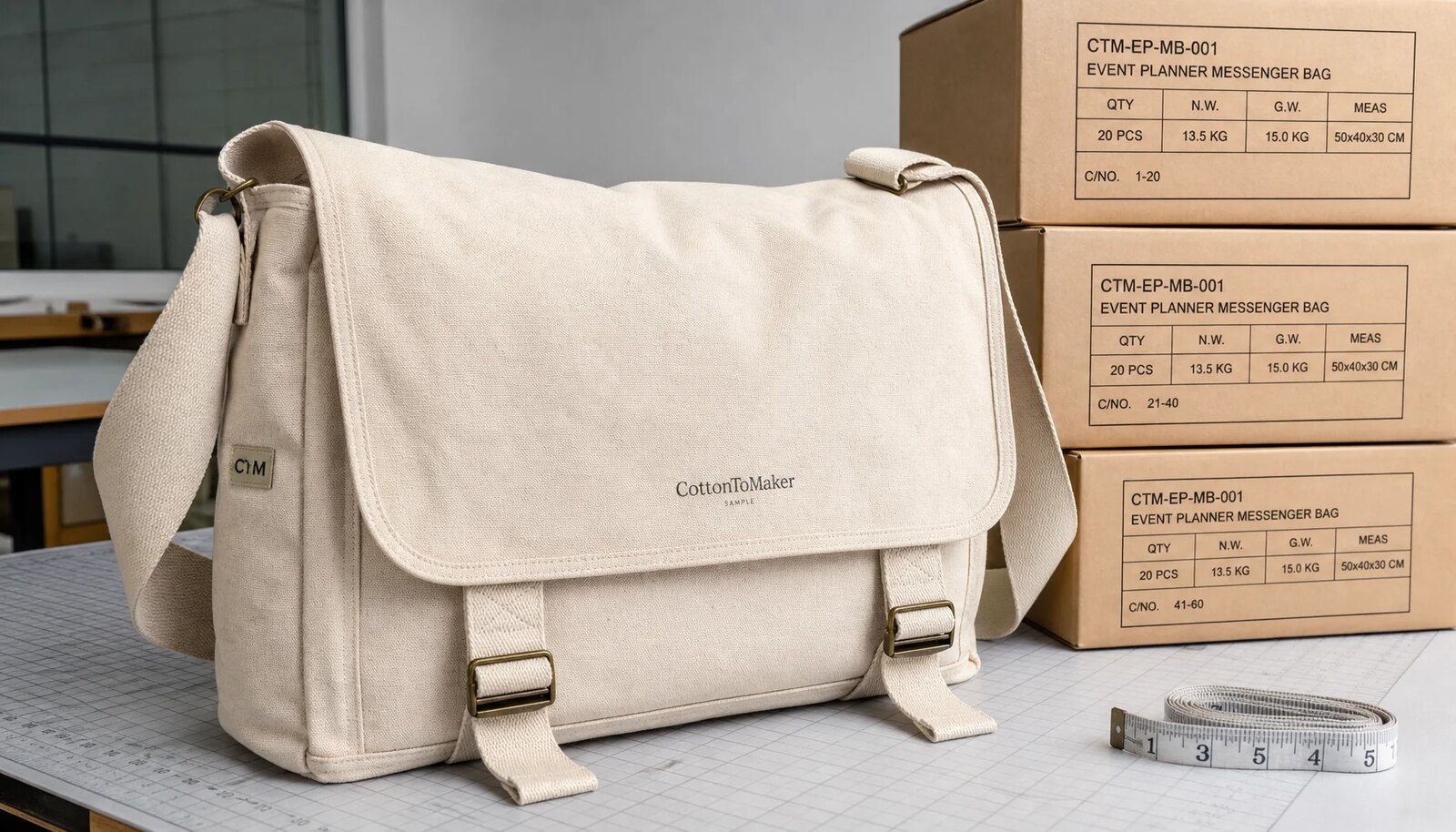
Start with receiving, not the product photo
Event orders rarely fail because the sample looked bad. They fail when the live shipment lands at a hotel dock, decorator warehouse, agency office, or registration build room and nobody can quickly tell what is inside each carton. Canvas messenger bags may be well sewn and correctly branded, yet still create trouble if cartons are too heavy, labels are vague, counts vary by box, or the logo surface is scuffed by the way the bags were folded.
That is why a canvas messenger bags carton packing plan for event planners belongs in the product specification. It is not a loose warehouse preference. Event teams work around install dates, dock appointments, temporary labor, show cutoffs, security rules, and limited storage. If cartons arrive one day late or need to be opened and sorted by hand, the unit price saving disappears fast.
A messenger bag is also harder to pack than a flat cotton tote. The flap, gusset, strap, buckle, zipper pull, lining, internal pocket, and reinforcement points all change how the bag folds. A supplier may assume a tight carton count during quoting, then discover during packing that buckles mark the flap or that the strap adds too much height. Procurement should ask what will arrive, how it will be counted, and how the receiving team will identify it without opening every box.
- Put the carton plan in the RFQ and purchase order, not only in email notes.
- Request folded dimensions, pieces per carton, gross weight, net weight, carton size, and CBM before comparing quotes.
- Treat packing approval with the same seriousness as artwork approval.
- Share venue receiving rules, dock windows, allocation codes, and storage limits before the supplier finalizes carton data.
Freeze the bag before doing carton math
Carton quantity is only meaningful after the bag specification is stable. A 12 oz canvas messenger bag, roughly 407 GSM, packs differently from a 16 oz canvas bag, roughly 542 to 546 GSM depending on conversion and supplier standard. A lined style packs differently from an unlined one. Magnetic snaps, metal buckles, padded straps, woven patches, and internal dividers can all add thickness. One small late change can move a carton from 25 pieces to 20, or push the gross weight above the receiving limit.
The specification should show the bag in two states: finished and packed. The finished spec covers dimensions, flap shape, strap length, strap width, pockets, lining, closures, color, logo position, stitching, and reinforcement. The packed spec covers fold direction, strap position, tissue, insert card, hangtag, barcode label, desiccant, polybag, and whether the logo faces inward or outward. Both views matter because freight, presentation, and QC depend on the packed version.
Avoid phrases such as heavy canvas or premium cotton unless they are supported by measurable details. State ounces and GSM, fabric composition where available, and whether the fabric is natural, dyed, washed, enzyme washed, coated, waxed, or uncoated. If attendees will carry catalogs, notebooks, tablets, samples, or sales literature, tell the supplier. That expected use helps them quote strap anchors, seam allowance, hardware, and reinforcement with fewer assumptions.
- State finished dimensions and folded dimensions separately, using millimeters or centimeters.
- List thickness drivers: lining, padding, pockets, zippers, buckles, magnets, patches, labels, and strap adjusters.
- Define tolerances for finished size, fabric GSM, shade, logo placement, and carton quantity.
- Do not approve pieces per carton until final fabric, hardware, logo method, and inner packing are known.
- Ask the factory to update the carton plan whenever a late insert, tag, or packaging material is added.
Match the supplier path to the packing workload
The right sourcing route depends on how much operational control the event needs. A direct canvas bag factory is often cleanest for a single-style order because production, logo application, folding, carton loading, sealing, and carton marking can sit inside one workflow. That reduces handoffs and makes responsibility clearer if counts, labels, or folds are wrong. Still, buyers should verify export packing discipline. A factory can sew well and still use weak cartons or incomplete marks.
A third-party consolidator makes sense when the bag becomes part of a larger kit. If each messenger bag needs a badge holder, sponsor card, catalog, lanyard, flyer, bottle, or regional insert, the work may outgrow standard factory packing. Decide early whether the bag factory inserts those materials, a packer kits everything after production, or the destination warehouse handles final build-out. Each choice changes lead time, freight volume, damage risk, and accountability.
Domestic distributors and stockholders are useful for urgent top-ups or low-customization programs. They are less useful when pack counts, carton labels, colors, and allocation codes must be tightly controlled. Ready stock may ship quickly, but the cartons may already be fixed. For a multi-city conference or sponsor-specific distribution plan, speed alone is not enough.
- Use a direct factory when one team can control sewing, branding, folding, carton sealing, and export marks.
- Use a consolidator when kitting, barcode labeling, multi-SKU sorting, or destination allocation is central.
- Use domestic stock for speed, while confirming fixed pack counts and carton marks before promising internal distribution.
- Ask who owns damage claims if bags are removed from factory cartons and repacked elsewhere.
- Assign one master packing-list owner even when several suppliers or packers are involved.
Build the carton calculation from a real packed unit
A practical carton plan starts with a folded production-style unit, not a generic promise such as 20 pieces per carton. The supplier should fold the approved sample using the intended method, add the tissue, insert, hangtag, barcode label, desiccant, and polybag if required, then measure the packed unit. Those measurements drive inner pack count, master carton count, gross weight, net weight, and CBM.
Ask the factory to show the calculation in plain terms: finished bag size, folded unit size, pieces per carton, carton length, carton width, carton height, net weight, gross weight, and CBM per carton. CBM is carton length x width x height in meters. A 60 x 40 x 35 cm carton is 0.084 CBM. Multiply by the carton count to estimate total shipment volume before freight booking. For airfreight, check dimensional weight as well, because volume can affect cost even when actual weight is moderate.
Set a gross weight ceiling before packing begins. Many event teams prefer cartons in a manageable manual-handling range, often around 12 to 15 kg, but the right limit depends on courier rules, warehouse policy, pallet use, carton strength, and labor conditions. A heavier carton may reduce carton count on paper while increasing damage, strain, or receiving time.
- Measure folded dimensions after final inner packaging, not before.
- Request carton size, pieces per carton, gross weight, net weight, and CBM in the quote.
- Set a maximum gross weight per carton based on the receiving method and shipping route.
- Check whether carton count changes by color, logo method, lining, or insert version.
- Require written approval before the factory changes carton size or pieces per carton.
- Ask for photos of the packed unit, opened carton, sealed carton, and carton marks.
Choose inner packing by presentation risk
Not every event shipment needs retail-style inner packing. A budget conference giveaway may only need clean bulk folding and strong carton protection. A sponsor gift, VIP meeting bag, resale item, or registration kit may need individual sleeves, tissue, hangtags, barcode labels, or a controlled presentation fold. The key is to price the desired unpacking experience instead of discovering the labor after the goods arrive.
Individual polybags can protect canvas from dirt, carton dust, moisture exposure, and abrasion. They also support barcode labels and warehouse scanning. The tradeoff is material cost, labor, disposal, and sometimes extra carton volume. If polybags are required, specify whether they must be recyclable, vented, warning-printed, adhesive-sealed, barcode-labeled, or plain. If the buyer wants lower plastic use, protected bulk packing with tissue, paper bands, or separator sheets may work, but it should be tested against the logo method and fabric color.
Tissue and separator sheets should solve a defined problem. A large flap print may need protection from transfer or pressure marks. Embroidery may need backing control so threads do not rub the next bag. A patch may need protection if a buckle or strap adjuster sits on top of it in the carton. Desiccant may be helpful for humid routes or long storage, but it should be specified by carton or by inner pack rather than assumed.
- Define the inner packing level as loose bulk, protected bulk, individually packed, retail-ready, or kit-ready.
- State whether polybags are required, prohibited, recyclable, vented, warning-printed, or barcode-labeled.
- Use tissue or separators when prints, embroidery backs, patches, or hardware may rub during transit.
- Confirm where inserts, sponsor materials, and hangtags are applied: factory, consolidator, or destination warehouse.
- Approve one packed-unit photo before approving the master carton plan.
- Include inner packing materials and labor in the quote so supplier comparisons are fair.
Protect branding after approval
Logo approval does not end when the open sample looks correct. The logo must survive curing, folding, stacking, carton pressure, humidity, and repeated handling. Screen printing often works well for event messenger bags because it suits flat canvas panels and adds little thickness. Embroidery can feel more dimensional, but it adds backing, bulk, and possible puckering. Woven labels and patches reduce direct print exposure, yet they bring their own stitching, placement, edge, and thickness tolerances.
Review the logo in open, closed, folded, and packed states. A flap print may look centered on a flat sample but sit too close to a fold line after closure. A side label may look good in a product photo and then disappear when bags are stacked. A large print may pass color approval but fail if packed before curing or placed directly against buckles, adjusters, or another printed face.
The RFQ should ask for branding method, color count, setup charge, production tolerance, curing or drying time, and packing protection. For B2B inspection, logo placement should be measurable. Use millimeter tolerances for horizontal and vertical position, and add rotation tolerance when the artwork is large or geometric. Centered is not an inspection standard unless the supplier and buyer define what centered means.
- Approve artwork on production canvas, not only on a digital mockup or paper proof.
- Set logo placement tolerance in millimeters for horizontal position, vertical position, and rotation where relevant.
- Check the logo with the flap open, flap closed, bag folded, and bag stacked.
- Ask whether print curing or embroidery finishing affects the packing schedule.
- Keep buckles, adjusters, snaps, zipper pulls, and strap hardware away from fresh print inside the carton.
- Keep one signed sample and one packing reference photo for final inspection comparison.
Specify cartons for the actual route
The outer carton has to match the journey. A carton that survives a short truck move may fail during export handling, pallet stacking, courier transfers, humid storage, or venue receiving. Canvas bags are soft, but messenger bag hardware and folded edges create pressure points. If carton walls collapse, the bags can arrive with dirty canvas, rubbed logos, bent corners, or distorted flaps even though the sewing is correct.
A useful carton specification includes dimensions, board type or strength requirement, sealing method, maximum gross weight, pieces per carton, and any moisture or corner protection. Suppliers may describe cartons by ply, burst strength, edge crush test, or export carton quality. Buyers do not need to over-engineer every order, but unspecified cartons are risky for fixed-date event shipments. If the supplier cannot state carton size and gross weight before production, freight planning is weak.
Decide on palletization before final freight quotes. Pallets can reduce handling damage and make warehouse receiving cleaner, but they add cost and volume. Loose cartons can be cheaper and more flexible for some venues, but they need readable marks, strong sealing, and manageable weights. If pallets are used, the packing list should connect pallet number, carton range, SKU, quantity, destination, and allocation code.
- Specify master carton dimensions and carton strength instead of accepting an undefined export carton.
- Set a gross weight ceiling compatible with manual handling, courier rules, and warehouse policy.
- Use moisture protection for humid routes, ocean freight, or long storage periods.
- Decide whether cartons ship loose or palletized before freight booking.
- Require sealing photos for large, multi-destination, or high-value orders.
- Check carton dimensions against the planned pallet pattern if pallets are required.
Make labels work for event allocation
Carton labels matter most when the receiving team has very little time. Staff may need to locate bags for a sponsor booth, registration desk, city team, hotel drop, or reserve stock without opening every carton. At minimum, the mark should show PO number, item name, SKU or style code, color, quantity, carton number, total cartons, gross weight, net weight, carton dimensions, country of origin, and destination. Event programs often need more: venue, hall, booth, sponsor, city, date, department, or internal project code.
When one order ships to several places, carton-level allocation is essential. A packing list that says 1,000 canvas messenger bags is not enough if 300 go to one city, 250 to another, 200 to a sponsor warehouse, and 250 to reserve. Require a carton-by-carton packing list showing contents and destination for each box. If cartons are palletized, pallet labels should repeat the same allocation logic so a warehouse team can identify the shipment before breaking down the pallet.
Be cautious with mixed cartons. Mixing colors, logo versions, insert versions, or destination allocations may reduce carton count, but it increases sorting risk. For tight event windows, single-SKU and single-destination cartons are easier to receive and audit. If mixed cartons are unavoidable, add a clear mixed-carton mark outside and a printed contents list inside.
- Use sequential carton numbering such as carton 1 of 80, carton 2 of 80, and so on.
- Add venue, booth, city, sponsor, or allocation code when goods are split by event destination.
- Avoid mixed cartons unless the receiving team has approved the sorting method.
- Require the final carton-level packing list before shipment release.
- Ask for photos of carton marks from actual packed cartons, especially on first orders.
- Match carton labels to invoice, packing list, freight booking, and allocation plan.
Inspect the bag and the packed carton
Quality control should cover both the loose bag and the finished carton. Bag inspection should include fabric weight, shade, finished dimensions, folded dimensions, stitching, strap attachment, hardware function, logo placement, print quality, embroidery or patch quality, loose threads, stains, odor, and overall appearance. Carton inspection should include piece count, fold method, inner packing, carton condition, label accuracy, sealing, gross weight, and allocation.
Many buyers use an AQL-style inspection framework for finished goods, then add product-specific checks. That can work well when defect definitions are concrete. Major defects may include broken zippers, open seams, wrong logo color, wrong carton allocation, incorrect quantity, or visible stains on the front panel. Minor defects may include small loose threads or slight cosmetic variation within the approved standard. Critical defects should include safety issues, contamination, severe odor, or labeling errors that make distribution or compliance impossible.
Timing matters. Inline inspection can catch stitching, fabric, and logo problems before the full lot is finished. Final random inspection can verify completed goods. Packing inspection confirms the approved fold, inner protection, carton count, carton marks, and allocation list. For event deadlines, waiting until local arrival to discover wrong labels or varying counts is too late.
- Check fabric GSM against the approved swatch and agreed tolerance.
- Measure finished dimensions and folded dimensions from production units.
- Inspect strap anchors, bartacks, seam allowance, zipper function, closure alignment, and hardware finish.
- Verify logo size, color, placement, rotation, curing, embroidery backing, patch stitching, and label position.
- Open sampled cartons to confirm piece count, fold method, inner packing, and carton condition.
- Compare carton labels against the carton-level packing list before shipment release.
- Document defects with photos and agree rework, replacement, or acceptance terms before goods move.
Compare quotes by landed and handling cost
A low unit price is not always the best event order price. Procurement needs enough quote data to estimate freight, receiving labor, repacking risk, and event readiness. A cheap bag with vague packing can become expensive if CBM is higher than expected, cartons are too heavy, labels are unusable, polybags were excluded, or the warehouse has to open and sort every carton. A slightly higher product price may be stronger if it includes accurate carton planning, logo protection, allocation labels, packing photos, and inspection support.
Ask each supplier for the same data set: canvas weight, finished dimensions, folded dimensions, logo method, inner packing, pieces per carton, carton dimensions, gross weight, net weight, CBM, sample lead time, production lead time, packing lead time, inspection support, and shipment handoff terms. Normalize the offers before choosing. If one supplier quotes 20 pieces per carton and another quotes 30, ask what construction, fold method, carton size, and compression level each assumed.
Write change rules into the PO. If production bags are thicker than the approved sample, who updates carton count and freight data? If the buyer adds a hangtag, insert card, or barcode after approval, who pays for added labor and volume? If the factory changes carton size, who confirms the new data with the forwarder and receiving warehouse? These questions keep the packing plan alive as the project moves instead of letting it break in the final week.
- Separate product cost, branding cost, packing cost, carton cost, kitting cost, inspection cost, and export handling where possible.
- Normalize quotes by CBM, gross weight, pieces per carton, and inner packing level, not only by unit price.
- Ask suppliers to list assumptions that would change carton count, lead time, or freight volume.
- Include repacking responsibility in the PO if carton counts, labels, or packing method fail approval.
- Compare better factory packing against the cost of local warehouse repacking.
- Attach the final carton plan to the approved quote so finance, logistics, and the event team work from the same data.
Specification comparison for buyers
| Packing or sourcing decision | Recommended option | When it fits | Buyer risk to check |
|---|---|---|---|
| Direct canvas bag factory with export packing line | Use one factory for cutting, sewing, logo application, folding, inner packing, carton loading, carton sealing, and carton marking. | Single-style event orders with fixed artwork, defined delivery dates, and one master carton plan. | The sewing price may be firm while carton strength, gross weight, CBM, and pack count are still estimates. Require carton data in the quote and PO. |
| Factory plus third-party consolidator | Let the factory make and brand the bags, then use a packer for kitting, inserts, barcode labels, venue sorting, or carton relabeling. | Orders with sponsor flyers, badges, catalogs, bottle inserts, regional materials, or multi-SKU event kits. | Double handling can cause logo abrasion, count errors, missing inserts, unclear damage ownership, and added labor fees unless the handoff spec is written. |
| Trading company managing multiple factories | Use one commercial manager for several bag styles, logo methods, accessories, and export documents. | Programs with multiple canvas messenger bag models, mixed fabrics, or buyers who need fewer supplier conversations. | Carton data may be averaged. Ask for factory-level carton dimensions, packed-unit photos, gross weight, and carton mark samples. |
| Domestic distributor or stockholder | Use ready stock for top-up quantities, emergency deadlines, or low-customization event merchandise. | Small runs, local replenishment, or deadlines where speed matters more than unit cost and full packing control. | Pack counts, colors, logo areas, carton marks, and inner packing are often fixed. Landed cost can rise quickly on larger orders. |
| Retail-ready packer with barcode service | Use when each bag needs a hangtag, barcode, individual label, carton barcode, or store-ready intake format. | Sponsor stores, merchandise resale, warehouse scanning, or post-event retail distribution. | Barcode setup, label printing, SKU segregation, scan testing, and relabeling fees must be itemized before approval. |
| Manufacturer with allocation packing | Use carton-level allocation so each carton maps to a venue, booth, sponsor, city, date, department, or project code. | Multi-site conferences, roadshows, trade show booths, agency rollouts, distributor events, and hotel deliveries. | Carton mix-ups are likely if the packing list is only order-level. Require SKU-level, carton-level, and pallet-level allocation data. |
| Development supplier or sample maker | Use for prototype approval before authorizing bulk production at the chosen production factory. | Design sign-off for size, flap shape, strap length, logo method, closure, folded presentation, and carton trial. | A good prototype does not prove bulk packing capability. Repeat packing validation with the actual production factory. |
| Loose bulk carton quote | Accept only when the receiving warehouse will repack locally or when presentation at unpacking is not important. | Price-sensitive orders where the event team controls final kitting, labeling, or distribution after import. | Higher risk of dirty canvas, creased flaps, logo transfer, inaccurate counts, mixed colors, and receiving labor surprises. |
| Compression-focused carton plan | Use only after testing folded recovery, logo transfer, hardware pressure, carton strength, and unpacked appearance. | Airfreight or high-volume sea freight programs where lower CBM has measurable freight value. | Over-compression can deform flaps, mark canvas, bend buckles, flatten padding, crack prints, or create attendee-facing creases. |
Buyer checklist before sampling
- Confirm finished bag dimensions, usable internal capacity, flap dimensions, strap length range, and folded dimensions after lining, hardware, inserts, hangtags, and inner packaging are included.
- Specify canvas weight in ounces and GSM, fabric composition, color or dye method, lining material, strap width, webbing quality, zipper or closure grade, buckle material, reinforcement points, and seam construction.
- Set measurable tolerances: finished dimension tolerance, fabric GSM tolerance, logo placement tolerance, color tolerance or approved shade standard, carton count tolerance, and acceptable defect limits.
- Define the logo method, artwork file format, print colors, embroidery thread colors, patch or woven label position, curing or drying time, and whether any logo surface may contact another bag during packing.
- State inner pack requirements: individual polybag or no polybag, recyclable or vented bag requirement, tissue placement, separator sheet, desiccant, hangtag, barcode label, insert card, strap tie, and closure method.
- Approve the folding method with photos: strap inside or outside, flap direction, buckle protection, logo facing direction, tissue location, stack orientation, and maximum compression allowed.
- Set master carton size, board specification or strength requirement, pieces per carton, gross weight ceiling, net weight, CBM, sealing tape method, pallet requirement, and pallet label format if used.
- Require carton marks with PO number, item name, SKU, color, quantity, carton number, total cartons, gross weight, net weight, carton dimensions, country of origin, destination, and allocation code when needed.
- Map shipment by receiving point: venue, hotel, show decorator, agency warehouse, distributor, 3PL, or multiple event sites, including dock appointment rules, delivery window, and receiving restrictions.
- Request a blank prototype, branded pre-production sample, production material swatch, packed-unit photo, carton trial photo, and written approval path before bulk packing starts.
Factory quote questions to send
- What finished bag dimensions, folded dimensions, and packed-unit dimensions did you use to calculate pieces per carton, gross weight, and CBM?
- Are folded dimensions measured after final strap position, closure hardware, tissue, inserts, hangtag, barcode label, desiccant, and polybag are included?
- Which canvas weight is included in the quote, stated in both ounces and GSM, and what fabric GSM tolerance will you allow across the production lot?
- Is the fabric natural, dyed, washed, enzyme washed, coated, waxed, or uncoated, and can that treatment affect shrinkage, odor, moisture absorption, or packing pressure?
- What lining, padding, zipper, webbing, buckle, slider, snap, magnetic closure, hook-and-loop tape, or reinforcement material is included in the quoted construction?
- Which logo method is included: screen print, heat transfer, embroidery, woven label, leather patch, cotton patch, or another process, and how many colors, screens, molds, or setup steps are priced?
- What logo placement tolerance will you accept in millimeters, and will you inspect horizontal position, vertical position, rotation, color, curing, and abrasion after folding?
- Are inner polybags, tissue, separator sheets, desiccant, hangtags, barcode labels, printed inserts, carton marks, pallet labels, and allocation labels included or quoted separately?
- What exact master carton size, carton board type, ply or strength specification, sealing method, gross weight limit, net weight, and pieces per carton are you planning to use?
- Will carton count vary by color, logo method, lining, or insert version, and how will you report those differences on the packing list?
Quality-control points to confirm
- Fabric weight matches the approved swatch within the agreed GSM tolerance and does not drift between rolls, colors, replacement lots, or subcontracted production batches.
- Canvas surface is free from oil marks, mildew odor, unacceptable slubs, heavy stains, dye streaks, visible shade differences, loose threads, and dirt transferred during packing.
- Finished dimensions, flap alignment, gusset depth, strap length, folded dimensions, and packed-unit dimensions are checked from production pieces, not only from the development sample.
- Stitch density, seam allowance, backstitching, bartacks, and reinforcement are consistent at strap anchors, flap corners, zipper ends, side seams, pocket openings, and bottom stress points.
- Strap width, strap length range, slider position, webbing thickness, buckle fit, and attachment strength match the approved sample and intended event use.
- Logo size, print color, thread color, patch shape, woven label position, and placement tolerance match the signed sample and approved artwork file.
- Ink, heat transfer film, embroidery backing, patches, labels, and hardware do not transfer, crack, peel, pucker, stain, or mark adjacent bags under the approved folding and carton pressure.
- Zippers, snaps, buckles, magnets, hook-and-loop closures, sliders, and adjusters operate smoothly and do not scratch the printed face during folding or transit.
- Inner packing matches the PO: polybag type, tissue, separator sheet, desiccant, insert, hangtag, barcode label, strap tie, and fold direction are correct.
- Piece count per inner pack and master carton matches the packing specification, with no mixed colors, logo versions, or allocation codes unless approved.