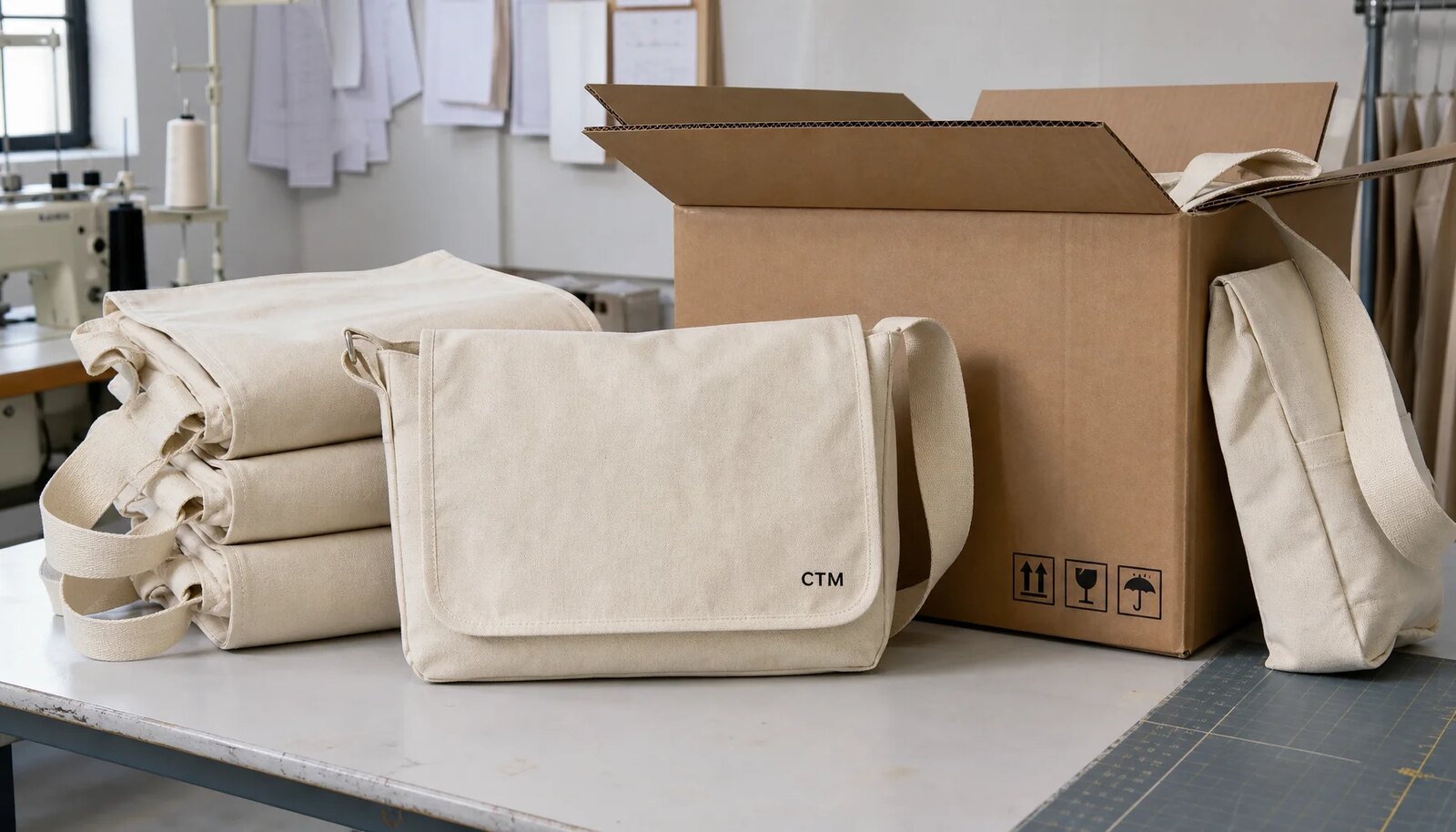
Start With The Carton Brief
For craft fair programs, carton packing is not an afterthought. Canvas messenger bags may be unloaded from a van, carried through narrow venue aisles, opened beside a booth, counted by temporary staff, stored under tables, and repacked after the event. A carton can be acceptable for export but still fail the buyer if it is too heavy, poorly marked, difficult to count, or packed tightly enough to crease the selling face of the bag.
Put the carton assumptions into the RFQ before suppliers price the order. “Standard export packing” is not enough. One factory may quote 20 pieces per carton with individual recyclable polybags. Another may quote 40 pieces in bulk stacks. A third may mix colors to simplify production. Those are different commercial offers even if the unit price looks close.
A useful carton brief includes target pieces per carton, maximum gross weight, carton dimensions, CBM, carton board construction, inner pack, color allocation, carton marks, and whether goods are going to one warehouse or several fair locations. For many craft fair teams, a 12-18 kg gross carton is easier to handle than a heavy export carton near 25 kg, but the buyer should confirm this against the actual receiving process.
- Set a starting range such as 20-35 pieces per carton for many standard 10-14 oz canvas messenger bags.
- State maximum gross weight before the supplier optimizes only for carton count.
- Require carton dimensions, net weight, gross weight, CBM, and board construction in the first quote.
- Keep color and SKU counts consistent when cartons ship directly to craft fair locations.
- Ask for first-carton photos before mass packing so packing drift can still be corrected.
Lock Fabric Specs Before Pricing
Fabric weight drives product cost, display shape, sewing difficulty, carton cube, and fold memory. Many craft fair messenger bag programs use 10 oz to 14 oz cotton canvas, roughly 340-475 GSM depending on yarn count, weave density, and finishing. A 12 oz canvas, approximately 380-420 GSM, is a practical starting point for standard resale: firm enough to display well, but not so heavy that cartons become bulky and hard to handle.
Lighter 8 oz to 10 oz canvas can suit giveaways or cost-sensitive event merchandise, but the empty bag may look softer and wrinkle more after carton storage. Heavier 14 oz to 16 oz canvas can feel premium, yet it adds sewing resistance, needle wear, freight cube, and stronger fold memory. Do not rely on ounces alone; ask for both oz and GSM, then agree a measurable tolerance.
A common starting tolerance is GSM within +/-5% of the approved standard, but the supplier should confirm what the mill can control. Finished measurements also need written limits. Many basic messenger bags can start with width and height +/-5 mm, gusset +/-3 mm, flap depth +/-5 mm, logo position +/-3 mm, and strap length range +/-20 mm. Tighten these if bags must fit a display fixture, insert, belly band, or pre-set carton layout.
Finish language should be practical. Natural canvas may show seed flecks, yarn tone variation, and small slubs; that is different from oil spots, dirty fingerprints, mildew, water marks, or a stained front flap. Dyed canvas needs a color standard and shade-lot rule. Washed or garment-dyed canvas needs shrinkage and panel-variation limits before cutting starts.
- Specify fabric in both oz and GSM, with tolerance written on the purchase order.
- Use 12 oz, about 380-420 GSM, as a balanced starting point for standard craft fair resale.
- Use heavier canvas only when premium handfeel justifies extra carton cube and freight.
- Define acceptable natural cotton characteristics separately from rejectable stains and dirty handling.
- Ask whether fabric is stock, stock dyed, custom dyed, or custom woven before accepting MOQ.
Design For Repeatable Folding
A carton plan only works if packing operators can fold every bag the same way. A flat body, single flap, modest 3-6 cm gusset, inside slip pocket, adjustable cotton webbing strap, and bartacked stress points are easier to pack consistently than padded organizers with bulky compartments. Large zipper pulls, magnetic snaps, thick sliders, and oversized buckles may look useful on a sample but can mark the flap under carton load.
Craft fair buyers often need the same bag to look good hanging from a rack and stacked on a table. The flap edge should be straight, side seams should align, and strap length should not make the display look random. Because the front flap is the main selling surface, skew, stains, creases, and off-center print placement should be treated more seriously than minor hidden defects.
Control the strap as a packing component. Define width, finished length range, adjustment method, buckle material, attachment style, and packing position. Cotton webbing usually folds flatter than padded straps. Removable straps reduce bulk but add matching and count risk. Metal sliders should be positioned away from the logo and front flap during packing.
- Keep artwork at least 20 mm from seam ridges and 30 mm from planned fold lines where design allows.
- Specify whether straps are tucked, tied, paper-banded, detached, or packed loose inside the inner pack.
- Use bartacks or reinforced stitching at strap ends, D-rings, flap corners, and load-bearing seams.
- Avoid bulky hardware unless the supplier tests the final carton fold with production components.
- Require buyer approval for any change to hardware, strap, pocket layout, padding, or fold direction.
Choose Decoration For Packed Pressure
Decoration must survive folding, stacking, rubbing, and pressure. Screen printing is often the most predictable option for wholesale canvas messenger bags with one to three solid colors. It can be printed on flat panels before sewing and keeps the surface relatively thin. The critical question is not only how the fresh sample looks, but whether the print remains clean after packed storage.
Define print method, ink type where relevant, Pantone or LAB target, print size, placement, registration tolerance, opacity, and acceptable handfeel. For simple logos, +/-1-2 mm registration is a common starting point. Detailed artwork may need tighter control. Dark canvas may need a white underbase, which affects cost, texture, and curing time.
Heat transfer can work for detailed graphics or many-color short runs, but canvas texture makes adhesion testing important. Large film areas can show edge lines, gloss change, cracking, or poor contact with the weave. Embroidery, woven patches, and labels can look premium, but they add thickness and may emboss the next bag in the stack unless protected.
Use a packed sample check. Let the printed bag rest in the approved fold for at least 24 hours when schedule allows. Open it and inspect gloss change, cracking, transfer lifting, print offset, strap marks, and hardware pressure. A dry rub with a clean white cloth is a basic screen; formal lab testing should be requested when the buyer has strict colorfastness requirements.
- Use screen print for simple craft fair logos and solid-color artwork.
- Run packed pressure checks for heat transfers and raised decoration.
- Avoid decoration over snaps, sliders, seam ridges, thick pockets, or fold points.
- Confirm curing or resting time before folding and sealing printed bags into cartons.
- Add tissue, sleeve, or print-facing rules when decorated surfaces touch other bags.
Connect MOQ To Variant Logic
MOQ is usually driven by fabric roll length, dye minimum, cutting efficiency, print setup, strap webbing, hardware purchase, labels, and carton allocation. A supplier may support a low MOQ with stock natural canvas and standard hardware. The same bag can require a higher minimum if it uses custom-dyed fabric, special strap colors, antique hardware, private-label woven labels, or several artwork versions.
Craft fair orders often have moderate quantities across many colors or designs. Quote by color, artwork, strap color, hardware finish, and label version, not only by total order quantity. If one SKU is screen printed, another embroidered, and another uses different webbing, each variation may need separate setup, QC approval, and packing records.
MOQ also affects carton planning. If one carton holds 30 bags and stock is allocated to six fair locations, full cartons by SKU can reduce domestic sorting time. Mixed cartons can support smaller programs, but they increase packing labor and count-error risk. If mixed cartons are necessary, require an inner count sheet and external carton mark showing SKU, color, and quantity breakdown.
- Ask which MOQ driver is fixed and which can be adjusted with a surcharge or stock component.
- State order quantity by color, artwork, strap color, hardware finish, and label version.
- Confirm whether print setup is charged by artwork, print color, or colorway.
- Align production quantities with full cartons when shipping directly to events or stores.
- Avoid mixed cartons unless carton-level SKU breakdowns and count sheets are included.
Set Inner Pack And Carton Marks
Inner packing affects cleanliness, retail readiness, sustainability positioning, counting speed, and defect risk. Individual recyclable polybags protect light canvas from dust, moisture, dirty handling, and strap abrasion. They also simplify redistribution. If the brand wants lower plastic, specify recycled paper sleeves, tissue wraps, paper bands, or controlled bulk stacks. The less protection used, the stronger the cleanliness and rub controls must be.
For many canvas messenger bags, 20-35 pieces per carton is a practical working range. Smaller lightweight styles may reach 40 pieces if straps and hardware lie flat and gross weight remains manageable. Larger 14-16 oz bags with gussets, patches, padding, or heavy hardware may need 15-25 pieces. A sealed carton should not bulge, and the top layer should not require force that crushes the flap.
Carton construction should match the route. A 5-ply corrugated export carton, often double-wall, is safer for sea freight, LCL consolidation, pallet handling, or multiple domestic deliveries. Courier redistribution may favor smaller cartons even if packaging cost rises. Ask for carton dimensions in centimeters, gross weight, net weight, pieces per carton, and CBM so freight can be compared accurately.
Carton marks should be simple and complete: buyer item code, short description, color, quantity, carton number, total cartons, gross weight, net weight, and destination code if cartons are allocated by fair or store. Mixed cartons need clear outside marking plus an inner count sheet.
- Define inner pack material and whether barcodes, hangtags, silica gel, or warning text are required.
- Choose carton count by gross weight, compression risk, and event handling, not only freight efficiency.
- Specify carton board construction, tape method, packing orientation, and palletization if needed.
- Use destination or event codes when cartons are pre-allocated for craft fairs.
- Validate carton dimensions and gross weight with a packed sample or first carton.
Approve Samples In The Final Fold
A loose sample is useful but incomplete. A canvas messenger bag may look excellent when photographed flat and still fail after being folded under carton pressure. Approve the product and the packing method together: fabric, finish, print, strap, hardware, pocket layout, label, hangtag, inner pack, fold direction, layer arrangement, and carton marks.
Document sample approval with measurements and photos. Record finished width, height, gusset, flap depth, pocket size, strap width, strap adjustable range, logo size, logo position, proposed carton count, carton dimensions, net weight, and gross weight. The approved sample sheet should match the purchase order and inspection checklist.
If timing allows, let the packed sample rest in the approved fold for at least 24 hours. Then inspect the flap, printed surface, corners, strap contact points, hardware contact points, and inner pack marks. If a full sample carton is impractical, request a first-carton photo set during production: empty carton, first layer, strap arrangement, middle layer, top layer, inner count sheet, sealed carton, carton marks, and carton on a scale.
- Measure the sample before and after resting in the approved fold.
- Confirm flap creases do not cross or distort the logo.
- Check whether straps twist, tangle, or mark light canvas panels.
- Rub printed areas with a clean white cloth after packed pressure exposure.
- Save approved fold photos for the packing line and third-party inspection file.
Use QC Rules That Match Selling Risk
Quality control should cover both the sewn bag and the packed carton. Common product defects include dirty canvas, skewed flaps, uneven strap lengths, loose threads, skipped stitches, weak bartacks, seam puckering, print misregistration, transfer lifting, scratched hardware, rust, and inconsistent shade. Defects on the front flap deserve stricter treatment because that panel sells the product at a booth or table.
AQL-style inspection is useful when buyer and supplier agree severity before production. A common soft-goods starting point is critical 0, major 2.5, and minor 4.0, but the buyer should adjust this to channel risk. Mold, sharp metal burrs, broken buckles, or severe contamination may be critical. Oil stains on the flap, weak strap bartacks, incorrect color, missing barcode, or visible print offset are often major. A small loose thread inside an internal pocket may be minor if it does not affect use or presentation.
Carton execution needs separate checks. Inspectors should verify piece count, color count, fold direction, strap placement, inner pack, carton marks, gross weight, and packing-list consistency. When possible, open cartons from different stack positions, including top, middle, and lower cartons, to catch compression damage or packing drift.
- Classify front-panel stains, logo damage, major flap skew, and visible print offset as major defects.
- Treat mold, sharp hardware, broken sliders, rust, and unsafe burrs as critical or major based on risk.
- Verify GSM, finished measurements, strap range, bartack strength, and hardware placement across samples.
- Open cartons from different pallet positions to check compression, count errors, and fold consistency.
- Match inspection terms to the approved sample, packing photos, defect sheet, and purchase order.
Plan Lead Time Around Production Gates
Lead time should start after complete approvals, not after the first inquiry. The practical clock begins once deposit, artwork, fabric, pre-production sample, and packing method are approved. A realistic workflow includes fabric booking, dyeing or washing if needed, fabric inspection, cutting, panel printing, curing, sewing, trimming, final inspection, inner packing, carton sealing, export documents, and delivery to the forwarder.
Printing and curing are common hidden bottlenecks. Printed panels should not move into folding or carton packing before the ink or transfer is stable. Rushing this step can cause blocking, offset, gloss change, or cracking after cartons are stacked. Multiple artworks or colorways may also slow production if they run one by one.
Craft fairs have fixed dates, so build buffer for sample revisions, packed sample approval, first-carton review, inspection, export transit, customs clearance, domestic redistribution, and booth preparation. If cartons ship to several locations, approve destination labels and allocation instructions before packing starts.
- Do not approve mass packing until print curing, fold testing, and first-carton review are complete.
- Reserve time for carton mark approval when goods ship to multiple events, stores, or fulfillment points.
- Request production photos at fabric inspection, cutting, printing, sewing, trimming, and first-carton stages.
- Add buffer for customs clearance, domestic courier delivery, and event setup.
- Compare air freight by carton cube, urgency, landed cost, and missed-event risk before upgrading transit.
Compare Quotes By Landed Carton Cost
The lowest unit price is not always the best result for craft fair messenger bags. Canvas bags are bulkier than small accessories, so carton dimensions, pieces per carton, inner packing, board construction, and gross weight can materially change landed cost. A quote with 40 pieces per carton may reduce carton count but create handling complaints, flap creases, or repacking labor.
Use a landed carton worksheet instead of a unit-price-only comparison. Include FOB or EXW unit price, print setup, sample charge, inner packing cost, carton cost, pieces per carton, carton dimensions, CBM, gross weight, pallet count, inspection cost, freight, duty basis, customs fees, and domestic redistribution. This makes it clear whether a low quote depends on weak cartons, no individual protection, mixed cartons, or a risky fold.
CBM per 1,000 bags is a useful comparison figure. One supplier may pack fewer bags per carton but use a better-fitted carton, narrowing the freight gap. Another may save cube by compression while increasing defect risk. Validate quoted carton data with a packed sample or first-carton measurement before booking freight or repeating the order.
- Compare CBM per 1,000 bags alongside unit price and gross weight per carton.
- Separate reusable product upgrades from one-time setup, sampling, and artwork charges.
- Record whether the carton is export grade, courier grade, or domestic-only grade.
- Use receiving feedback to improve carton count, inner pack, and marks on reorders.
- Keep a packing specification sheet for supplier comparison, inspection briefing, and repeat orders.
Specification comparison for buyers
| Packing option | Typical carton result | Best fit | Tradeoff to validate |
|---|---|---|---|
| Individual recyclable polybag | 20-35 pcs/carton for many 10-14 oz bags; usually cleaner counts and easier redistribution | Natural canvas, printed flaps, long transit, direct-to-event delivery, retail-ready resale | Adds material cost and plastic-policy questions; confirm bag ventilation, warning text, barcode placement, and local compliance |
| Recycled paper sleeve or tissue wrap | Similar piece count to polybag, sometimes slightly higher carton cube if wraps are bulky | Brands reducing plastic while still protecting light canvas and printed faces | Less moisture protection than polybag; validate rub control, dust control, and whether paper fibers mark dark fabric |
| Paper band with controlled stack | Can improve speed and reduce material, but requires neat strap control and clean factory handling | Low-plastic programs with simple screen print and short domestic handling after import | Higher risk of dirty edges, strap tangling, print rub, and mixed counts if operators are not trained |
| Bulk stack without individual inner pack | May allow lower packing cost and simpler unpacking when bags are undecorated or dark colored | Low-cost internal-use bags, undecorated stock, or very short transit with buyer-approved cleanliness risk | Not recommended for light natural canvas or printed flaps unless packed sample and rub checks pass |
| Higher carton count, compressed pack | 35-40 pcs/carton only when bag size, strap, and hardware lie flat and gross weight stays practical | Small lightweight styles where freight cube is a major cost driver | Can cause flap creases, carton bulge, strap pressure lines, and heavier cartons than event teams want |
| Lower carton count, safer pack | 15-25 pcs/carton for heavier 14-16 oz canvas, gussets, patches, padding, or bulky hardware | Premium bags, raised decoration, heavier hardware, courier redistribution, or strict retail presentation | More cartons and possibly higher freight, but fewer pressure defects and easier craft fair handling |
Buyer checklist before sampling
- Define finished width, height, gusset, flap depth, pocket layout, strap width, adjustable range, hardware type, and measurement tolerance before requesting price.
- State fabric weight in oz and GSM, agreed GSM tolerance, finish, color standard, shrinkage target, and whether the canvas is natural, dyed, washed, organic, recycled, or stock fabric.
- Separate acceptable natural cotton seed flecks and small slubs from rejectable oil marks, mildew, water stains, dirty handling, panel shade mismatch, and visible weaving defects on the front flap.
- Provide artwork with print size, Pantone or LAB target, method preference, placement, seam clearance, registration tolerance, and whether the artwork may cross any fold line.
- Ask for pieces per carton, carton dimensions, CBM, net weight, gross weight, board construction, packing orientation, carton marks, pallet pattern, and maximum stack height in the first quote.
- Choose inner packing rules: recyclable polybag, recycled paper sleeve, tissue interleaving, paper band, hangtag position, barcode label, warning text, silica gel if justified, or controlled bulk pack.
- Approve a pre-production sample packed in the final fold for at least 24 hours when timing allows, not only a loose sample photographed flat.
- Request first-carton photos showing layer arrangement, strap position, print protection, inner count sheet, carton closing, carton marks, gross weight, and carton condition before mass packing continues.
- Set acceptance criteria for GSM, measurements, print curing, packed rub, stains, flap crease lines, strap twisting, hardware marks, carton compression, count shortage, and carton mark errors.
- Match carton quantity and gross weight to the receiving workflow: craft fair booth team, retail store, distributor warehouse, courier route, or domestic fulfillment point.
Factory quote questions to send
- What canvas weight in oz and GSM, finish, shrinkage range, and color tolerance are included in this quote?
- Is the fabric stock canvas, stock-dyed fabric, custom dyed, or custom woven, and can the same lot or standard be repeated for reorders?
- What tolerances are quoted for finished width, height, gusset, flap depth, pocket size, strap width, strap length range, and logo position?
- How many pieces fit per carton under the proposed fold, and what are the carton dimensions, net weight, gross weight, CBM, and gross weight tolerance?
- Which inner pack is priced: polybag, recycled paper sleeve, tissue, paper band, or bulk stack, and what protection is used between printed faces and hardware?
- What carton board construction is quoted, and is it suitable for sea freight, LCL consolidation, pallet stacking, courier delivery, or only domestic movement?
- How is the strap packed: tucked inside the body, folded under the flap, paper-banded, placed in a pocket, detached, or left loose inside the inner pack?
- Which MOQ drivers are fixed: fabric roll minimum, dye lot, print setup, hardware purchase, strap webbing, label production, cutting efficiency, or full-carton allocation?
- Can you provide a packed pre-production sample, first-carton photo set, or one sealed sample carton before mass packing starts?
- Which defects are treated as major or critical: dirty flap, skewed flap, weak bartack, print offset, transfer lifting, hardware burr, rust, carton shortage, or carton damage?
Quality-control points to confirm
- Fabric GSM should match the approved specification within the agreed tolerance, often +/-5% as a starting point, unless the supplier validates a different measurable range.
- Finished width, height, gusset, flap depth, pocket size, strap width, strap length range, and logo position should stay within the written tolerance on the approved sample sheet.
- Natural canvas should be checked under consistent clean light for oil spots, water marks, mildew, dirty edges, excessive slubs, broken yarns, and unacceptable panel variation.
- Dyed canvas should be checked against the approved color standard, with clear rules for shade variation between body, flap, strap, binding, and pocket panels.
- Print color, position, opacity, registration, handfeel, and curing should match the approved sample, with no visible offset after dry rub and packed pressure checks.
- Screen print registration should follow the agreed tolerance, commonly +/-1-2 mm for simple logos, unless artwork detail requires tighter written control.
- Heat transfers should be checked for edge lifting, cracking, yellowing, poor adhesion on canvas texture, and visible press marks around the artwork.
- Stress points at strap ends, flap corners, pocket seams, side seams, and D-ring or buckle attachments should use the approved bartack or reinforced stitch method.
- Hardware should be free from rust, sharp burrs, weak plating, loose sliders, broken buckles, inconsistent color lots, and contact marks on visible canvas panels.
- Carton inspection should verify inner count, color count, fold direction, strap placement, carton marks, gross weight, carton compression, and packing-list consistency.