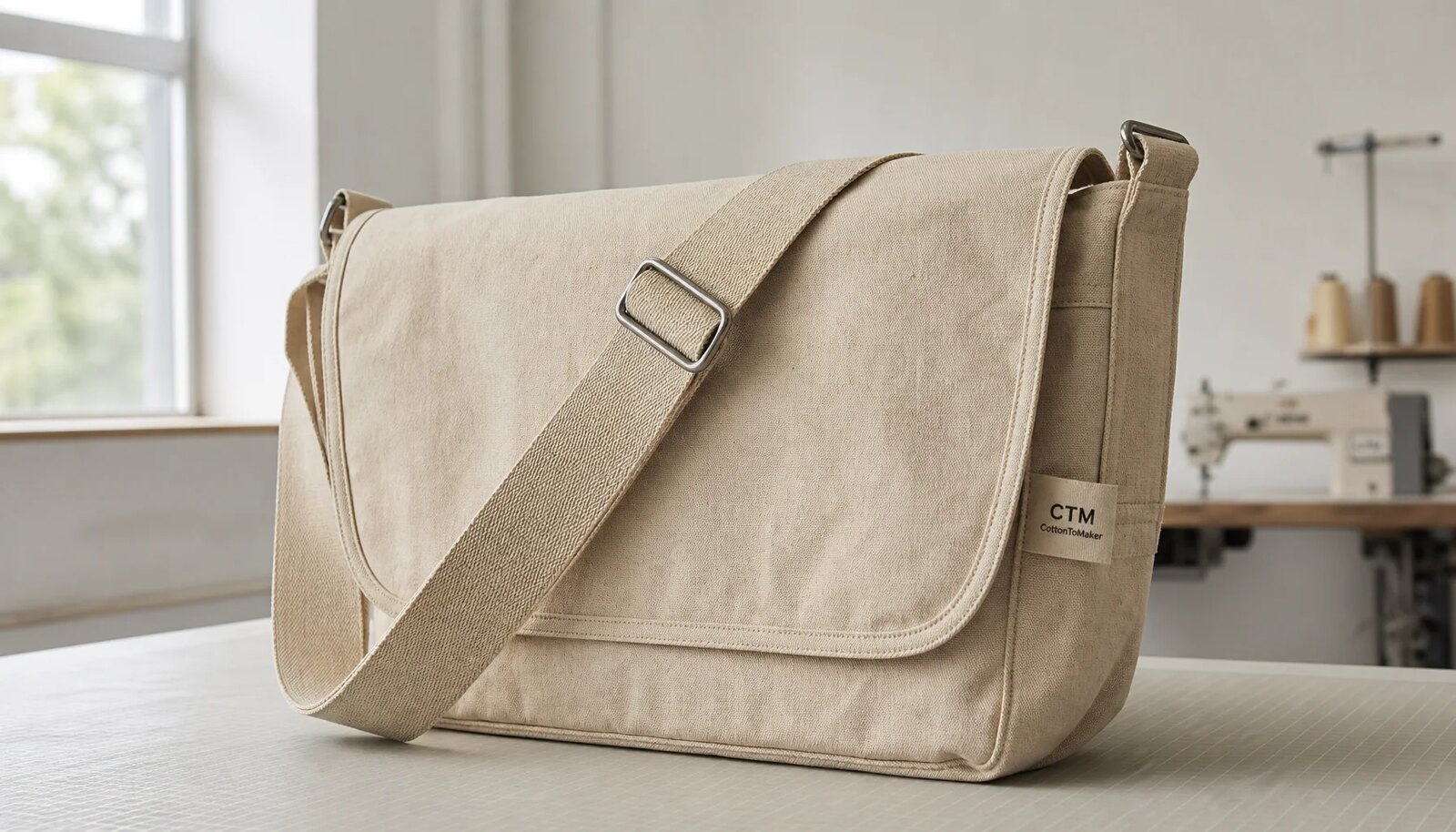
Start with the commercial job, not the bag name
A useful canvas messenger bags bulk pricing plan for eco apparel brands begins with a plain question: what does this bag need to do for the business? A paid retail accessory, wholesale add-on, ecommerce bundle, employee kit, campus merch item, trade show giveaway, and gift-with-purchase can all be described as canvas messenger bags. They should not be priced as though they are the same product.
For procurement teams, the first target is landed cost by channel. Factory unit price matters, but it is only one line in the total. Samples, artwork setup, fabric minimums, dyeing or washing, decoration, custom labels, packing labor, inspection, inland freight, international freight, duty, warehousing, and possible relabeling all affect the final number. A low FOB quote can become expensive if the carton volume is high, the bags arrive without scannable labels, or the first shipment misses the launch window.
Eco apparel brands also need the messenger bag to sit comfortably beside the rest of the range. If the brand sells organic cotton tees, fleece, or responsibly positioned basics, a thin bag with weak strap stitching can feel out of place. That does not mean every order needs 16 oz canvas, metal hardware, lining, and retail packaging. It means the sourcing brief should say whether the bag is a low-cost carrier, a credible reusable accessory, or a retail product expected to stand on its own.
Before asking suppliers for numbers, assign the program type and margin target. A retail SKU usually needs tighter tolerances, cleaner finishing, SKU-level labeling, and more disciplined inspection. A gift-with-purchase may accept simpler construction but still needs correct print placement, reliable folding, and accurate pack counts. A wholesale program may care most about carton marks, barcode accuracy, and repeat reorder consistency.
- Name the channel: retail, wholesale, ecommerce bundle, event, employee kit, subscription insert, campus program, or gift-with-purchase.
- Set target landed cost and target retail or program budget before adding construction upgrades.
- Decide whether the order is optimizing for cost, speed, plastic reduction, brand finish, durability, or repeat-order consistency.
- Separate non-negotiables from optional upgrades so suppliers can price the base bag cleanly.
Turn the idea into measurable specifications
The phrase canvas messenger bag is too broad for reliable bulk pricing. A quote-ready spec should describe the finished product in measurable terms: width, height, gusset depth, flap length, flap overlap, strap width, strap length range, closure type, pocket count, and usable opening width. Ask whether the supplier measures flat, filled, pressed, or finished after sewing. Soft goods move, and two honest suppliers can measure the same sample differently if the method is not agreed.
Fabric weight is one of the largest cost and quality drivers. For many B2B canvas bag programs, 10 oz to 12 oz cotton canvas is a practical middle range because it gives the bag a credible hand feel without making sewing, folding, and freight unnecessarily heavy. An 8 oz to 10 oz canvas can work for light promotional use. A 14 oz to 16 oz canvas can support a more structured premium product, especially if the strap anchors and stress points are reinforced.
Weight needs careful wording. The quote should state whether the number is ounces per square yard, GSM, finished fabric weight, or greige fabric weight before finishing. If the buyer expects finished 12 oz canvas and the supplier quotes a shorthand mill weight, the difference may not show up until the pre-production sample feels too soft or the bulk bags fail the buyer's hand-feel standard.
Composition also affects price and claims. Conventional cotton canvas, organic cotton canvas, recycled cotton blend canvas, cotton-poly blend canvas, and undyed natural canvas behave differently. Natural canvas may show flecks and slubs. Recycled blends may have more shade variation. Dyed canvas needs lab dips and shade control. Washed canvas can shrink and soften, so dimensions should be approved after the same finish planned for bulk.
- Use finished dimensions and include acceptable tolerances in centimeters or inches.
- State fabric weight in oz and GSM when possible, and require the supplier to identify the measurement basis.
- Define fabric composition, color, weave, finish, and certification need in the RFQ.
- Specify lining, pocket, closure, strap, hardware, binding, and reinforcement details before asking for decoration prices.
Build an RFQ suppliers can price without guessing
A strong RFQ lets suppliers quote the same bag instead of filling in blanks with their own assumptions. Include a product sketch or reference photo, measurement sheet, fabric specification, construction notes, decoration artwork, packing method, quantity tiers, trade term, target delivery date, and inspection expectation. If the brief only says 12 oz canvas messenger bag with logo, one supplier may include lining and reinforced hardware while another quotes a minimal unlined style.
Use base and alternate pricing to make tradeoffs visible. The base spec might be 12 oz natural cotton canvas, flap closure, adjustable cotton webbing strap, one internal pocket, one-color screen print, and bulk carton packing. Alternates can include organic cotton documentation, recycled cotton blend, metal buckle, zipper top, woven label, individual barcode packing, or paper band packing. This keeps the conversation practical. The buyer sees what each decision costs without losing control of the core product.
Ask for tiered pricing using the same specification. Useful tiers are often 300, 500, 1,000, 2,000, and 3,000 pieces. Request setup charges separately: screen charges, embroidery digitizing, woven label development, patch mold, sample fee, courier fee, lab dip cost, special carton marks, and packing materials. A supplier with a higher unit price but included setup may be stronger for a small first run. Another supplier may win on repeat orders once development charges are absorbed.
The RFQ should also state the trade term and delivery point. EXW, FOB, FCA, CIF, and DDP prices carry different responsibilities. Comparing an EXW factory price with a DDP delivered price creates false savings. For international sourcing, FOB port plus estimated freight and duty is often a clean comparison point, but the right method is the one your logistics team actually uses.
- Attach artwork in production format and state final size, print location, and color reference.
- Ask suppliers to identify which costs are included and which are separate.
- Require the same spec at each price tier unless alternates are clearly labeled.
- State the requested trade term and port or delivery point so landed cost can be compared correctly.
Read MOQ as a cost map
MOQ is not just a number to push lower. For canvas messenger bags, the minimum order quantity reflects fabric purchasing, dye lot size, cutting efficiency, decoration setup, label minimums, hardware sourcing, packing labor, and sewing line planning. A supplier may accept 300 pieces, but the unit price will usually be higher because fixed costs are spread over fewer bags. At 1,000 or 3,000 pieces, the factory can often use fabric more efficiently and spread setup time across a larger run.
The key MOQ question is whether the minimum applies to the total order or to each variable. A 1,000-piece order in one natural canvas body color is very different from 1,000 pieces split across four dyed body colors, two strap colors, three lining colors, and five artwork versions. Each variable can create separate material control, shade control, decoration setup, packing segregation, and inspection work.
Eco apparel brands often want seasonal colors, account-specific logos, or limited edition labels. Those ideas may be commercially useful, especially for capsules and wholesale accounts, but they should be added after the base economics are clear. For a first order, fewer colors and fewer artwork versions usually produce cleaner execution. Once sell-through or program demand is proven, the buyer can expand the SKU mix with better leverage.
When a supplier offers a lower tier price, ask what changed. A price break should come from efficiency, not hidden substitutions. If the 3,000-piece price assumes lighter canvas, no lining, cheaper hardware, fewer bartacks, or bulk packing instead of retail packing, it is an alternate spec. Treat it that way in the comparison.
- Ask for MOQ per total order, body color, artwork, lining, strap color, label, and packing style.
- Limit first-order SKU complexity when demand is not yet proven.
- Ask how overruns, underruns, unused fabric, and extra custom labels are handled.
- Do not accept a price tier unless the supplier confirms the specification is unchanged.
Compare supplier routes by control and risk
Direct bag factories are often the best fit for repeat programs, custom dimensions, and orders where construction control matters. A factory that regularly sews messenger bags can answer specific questions about flap setting, strap anchoring, binding, seam finishing, lining, and cartonization. This route works best when the buyer has a clear spec and enough time for sample revision, pre-production approval, and production follow-up.
Trading companies can be useful when a brand is sourcing bags alongside apparel, pouches, socks, trims, or packaging. They may simplify communication, export coordination, and shipment consolidation. The risk is opacity. Procurement should ask which factory is sewing the bags, who buys the fabric, who approves the print vendor, who performs inline inspection, and who is accountable if the order fails final QC.
Domestic decorators using imported blanks can be appropriate for urgent events, small tests, or simple logo programs where exact construction is not important. The buyer can often approve a blank quickly and decorate closer to the selling market. The tradeoff is reduced control over canvas weight, dimensions, shade, hardware, and repeatability. Blank suppliers may change lots or styles between orders, which makes long-term programs harder to standardize.
Dual sourcing sounds reassuring, but it only works when both suppliers can match the approved specification. A backup supplier with a different flap shape, canvas texture, strap width, or logo tolerance is not a true backup for a retail order. If dual sourcing is required, approve matched samples, use the same inspection checklist, and decide in advance whether shade differences between factories are acceptable.
- Use direct factories for custom builds, repeat orders, and tighter technical control.
- Use trading companies when consolidation and coordination justify the added layer.
- Use domestic decoration for urgent, simple, low-volume programs.
- Use dual sourcing only after matched samples and shared tolerances are approved.
Keep decoration from distorting the price
Decoration can change both margin and production risk. One-color screen printing is often the most efficient choice for canvas messenger bags with clean logos or simple artwork. It is repeatable on natural canvas and keeps setup manageable. More colors, larger print areas, wraparound placement, embroidery, sewn patches, or multiple logo positions increase approval steps, labor, and inspection requirements.
Screen print quality depends on more than the artwork file. Ask about ink type, color matching method, curing process, print size, placement guide, and dry rub expectation. If printing is outsourced, the production schedule must include decoration lead time before sewing or packing. For flap printing, placement should be measured from a stable reference point such as the flap edge, seam, or centerline. Estimating by eye is not enough for branded goods.
Embroidery can add perceived value, but dense stitching on lighter canvas may pucker or distort the flap. Pricing often depends on stitch count and digitizing. Woven labels and sewn patches can be a strong option for eco apparel brands that want consistent identity across multiple bag colors and other accessories. Labels reduce large ink areas, but they create their own MOQ, lead time, color approval, sewing placement, and edge-finish checks.
Heat transfer may work for detailed artwork or small text, but adhesion should be tested on the exact canvas finish. Washing, rough weave texture, coatings, and waxy treatments can affect transfer performance. For any decoration method, approve a strike-off or decorated pre-production sample using production-equivalent fabric before releasing bulk.
- Use screen print for simple spot-color logos and cost-controlled repeat programs.
- Use woven labels or patches when consistency across multiple colorways matters.
- Use embroidery only after checking puckering risk, backing, and stitch-count cost.
- Set placement tolerance in writing, such as plus or minus 5 mm or 10 mm depending on logo size and construction.
- Require decoration approval on actual or production-equivalent canvas.
Make sustainability language specific
Eco apparel buyers need sourcing language that can support real product claims. Eco canvas is not a material specification. It may refer to conventional cotton canvas, organic cotton, recycled cotton blend, undyed natural canvas, low-impact dyeing, reduced-plastic packing, or simply a reusable product. Procurement should replace broad language with exact composition, finish, and documentation requirements.
If the brand intends to claim organic cotton, recycled content, or a certified supply chain, ask what documentation is available and what it covers. A certificate may apply to a fabric mill, yarn, factory scope, product category, or transaction. Those are not interchangeable. Also confirm whether certification costs or transaction documents are included in the quote. Asking late can delay production or reveal that the quoted material does not support the intended claim.
Natural undyed canvas is often a good fit for eco-positioned programs, but it should be approved with realistic expectations. Seed flecks, small slubs, and slight shade variation may be normal. Bleached canvas looks cleaner but changes the finish and story. Custom dyed canvas can support brand palettes, yet it usually requires lab dips, dye lot control, minimum fabric quantities, and shade approval under consistent lighting.
Packaging language deserves the same precision. Plastic-free packing can reduce single-use plastic, but it may expose light canvas to dirt or moisture if the shipping route and warehouse handling are rough. Paper bands, kraft sleeves, recycled polybags, and bulk packing can each be right depending on channel. The best packing spec protects the product while matching the brand's environmental priorities.
- Replace vague eco terms with exact fabric composition and finish.
- Ask whether certificates cover the material, factory, shipment, or transaction claim.
- Approve natural canvas shade, flecks, and slub limits before bulk production.
- Match plastic reduction goals to warehouse, retail, ecommerce, and transit realities.
Approve samples as production evidence
A digital mockup can confirm layout, but it cannot approve canvas weight, hand feel, sewing quality, strap strength, hardware function, or print cure. For first-time suppliers or new constructions, the physical pre-production sample should use the same fabric, trim, decoration, and packing planned for bulk. If a substitute component is used, mark the sample as partial approval only.
Sample review should be measured, not judged only from photos. Check body width, height, gusset, flap length, flap overlap, strap width, strap length range, pocket size, logo size, and logo placement. Compare the fabric against the approved swatch. Load the bag with realistic contents if the intended use includes notebooks, folded apparel, or light devices. Open and close hardware repeatedly, then inspect strap anchors from both inside and outside the bag.
Decoration needs handling review. Lightly rub the print after cure. Check whether ink edges are sharp, opacity is even, registration is clean, and the logo is straight relative to seams or the flap. For embroidery, check puckering, thread trimming, and backing. For labels and patches, confirm orientation, stitch line, edge quality, and placement.
Document approval with dated photos, measurements, comments, and any concessions. The factory should keep one approved reference sample, and the buyer should keep one when possible. This shared reference makes final inspection more objective and reduces disputes over whether bulk goods match the approved standard.
- Approve fabric swatch, decoration strike-off, full pre-production sample, and packed sample when risk justifies it.
- Record measurements and tolerances before releasing bulk production.
- Do not approve a sample with substitute fabric or hardware as final production approval for those components.
- Keep the approved sample available for inspection comparison.
Write QC terms into the purchase order
Quality control should be agreed before deposit. Canvas messenger bags have predictable risk points: wrong fabric weight, shade mismatch, stains, loose threads, skipped stitches, weak strap anchors, crooked flaps, print misplacement, poor ink cure, rough hardware, zipper snagging, odor, wrong barcode, and inaccurate carton counts. Written criteria keep these issues from becoming subjective arguments after production.
Defect classification helps inspection teams make consistent decisions. Critical defects may include mold, sharp hardware, unsafe metal edges, strong chemical odor, or structural failure that makes the bag unusable. Major defects may include wrong material, broken stitches, strap anchor failure, incorrect logo, severe stains, peeling print, nonfunctioning closure, wrong barcode, or incorrect SKU assortment. Minor defects may include small loose threads, slight natural slub variation within the approved standard, or minor cosmetic marks that do not affect saleability.
Measurement tolerances should be realistic for sewn canvas goods. A buyer may set tighter tolerances for logo placement and looser tolerances for soft body dimensions, depending on the design. The supplier should confirm tolerances before cutting bulk fabric. If the tolerance is too tight for the construction, resolve it during sampling rather than during final inspection.
For larger or retail-critical orders, consider third-party final inspection using AQL or a buyer checklist. Even when using factory self-inspection, request inline photos during cutting, sewing, decoration, and packing. Strap anchors, flap alignment, print placement, hardware function, and carton labels are especially useful photo checkpoints.
- Define critical, major, and minor defects in the PO or quality manual.
- Set tolerances for dimensions, shade, logo placement, stitch quality, hardware, and packing.
- Ask for inline checks, not only final carton inspection.
- Clarify rework, sorting, reinspection, and chargeback responsibility before shipment.
Plan packing and cartonization early
Packing is a cost driver, not an afterthought. A bulk-packed messenger bag may only need folding and master cartons. A retail-ready program may need an individual bag, paper band, recycled polybag, hangtag, barcode sticker, insert card, silica gel, SKU sticker, inner carton, and master carton marks. Each step adds material, labor, time, and inspection points.
Cartonization affects freight and receiving. Canvas bags are flexible, but heavier canvas, metal hardware, structured flaps, padded sections, and careful folding can reduce units per carton. Freight may be charged by actual weight, dimensional weight, or container space. Ask for units per carton, carton dimensions, gross weight, net weight, and total carton count for each SKU before comparing landed cost.
Label accuracy is especially important for wholesale, marketplace, and ecommerce operations. If barcodes are wrong or mixed SKUs are not separated, the receiving problem can cost more than the packing savings. For multi-color or multi-logo orders, request a packing matrix that shows SKU sequence, units per inner pack, units per master carton, carton numbering, and carton mark format.
Plastic reduction goals should be tested against actual handling conditions. Paper bands can look clean and reduce plastic, but they may not protect light canvas from moisture, dirt, or abrasion in every shipping lane. Bulk packing may work for internal kitting but not for retailer delivery. The right choice is the lowest-waste method that still delivers clean, scannable, saleable goods.
- Specify individual packing, bulk packing, paper band, recycled polybag, or retail hangtag requirements in the RFQ.
- Request carton dimensions, gross weight, net weight, and units per carton before freight comparison.
- Approve barcode and carton label photos before mass packing.
- Protect hardware and printed areas from pressure marks, transfer, and abrasion during transit.
Specification comparison for buyers
| Spec decision | Recommended option | When it fits | Buyer risk to check |
|---|---|---|---|
| Supplier route | Direct bag factory with messenger bag experience | Repeat programs, private label builds, custom dimensions, fabric control, and orders where scale makes unit cost important | Confirm the factory sews messenger bags in-house, including flap setting, strap anchoring, binding, lining, and final inspection; tote-only factories may underestimate labor |
| Supplier route | Trading company managing multiple factories | Buyers consolidating bags, apparel, trims, packaging, and accessories in one export shipment or needing bilingual production coordination | Ask for the actual sewing factory name, audit status if needed, who buys fabric, who controls decoration, and who signs off on QC claims |
| Supplier route | Domestic decorator using imported blanks | Urgent events, small market tests, basic logo programs, and orders where speed matters more than custom construction | Blank dimensions, canvas shade, fabric weight, and strap hardware may change by batch; retail packing can erase the apparent savings |
| Fabric weight | 8 oz to 10 oz cotton canvas | Lightweight promotional programs, event bags, low-load use, or compact shipping targets | Confirm load expectation and hand feel; thin canvas can look underbuilt beside premium eco apparel |
| Fabric weight | 10 oz to 12 oz cotton canvas | Most eco apparel retail add-ons, gift-with-purchase programs, and reusable daily bags with balanced cost and feel | Clarify whether the quote uses finished fabric weight, greige weight, or supplier shorthand; ask for GSM equivalent and tolerance |
| Fabric weight | 14 oz to 16 oz canvas with reinforcement | Premium accessory SKUs, heavier daily use, laptop-adjacent positioning, or structured retail presentation | Heavier fabric raises sewing difficulty, needle breakage risk, carton volume, gross weight, and folding bulk |
| Decoration | One to three color screen print | Clean logos, limited-color artwork, repeatable placement, and cost-controlled branding on natural or dyed canvas | Ask for ink type, curing method, print size, color matching basis, dry rub expectation, and placement tolerance from edge or seam |
| Decoration | Woven label, sewn patch, or small embroidery | Durable identity across multiple colorways or when large ink areas are not desired | Confirm label MOQ, label lead time, backing, stitch placement tolerance, edge finish, and whether the label is included in the unit price |
| Construction | Unlined flap messenger with adjustable cotton webbing strap | Efficient bulk programs, gifting, bundles, and simpler reusable carry where low complication matters | Define flap overlap, strap width, slider material, reinforcement method, seam finish, and whether inside seams are bound or overlocked |
Buyer checklist before sampling
- Define the commercial use first: retail SKU, wholesale add-on, ecommerce bundle, employee kit, gift-with-purchase, subscription insert, campus program, or event giveaway.
- Confirm finished bag width, height, gusset depth, flap length, flap overlap, strap width, strap length range, pocket size, closure type, and usable opening width.
- Specify fabric by composition, weight, weave, color, finish, and certification need: for example 12 oz 100% cotton canvas, undyed natural, plain weave, no water-repellent coating.
- State whether fabric weight is required in oz per square yard, GSM, or both; ask the supplier to identify whether weight is measured before or after finishing.
- Define lining fabric, lining color, pocket count, zipper size, zipper tape color, binding, seam finish, bartack positions, reinforcement patches, and bottom gusset construction.
- State decoration method, artwork size, artwork file format, color count, Pantone or physical color reference, print location, label location, and maximum placement tolerance.
- Ask for MOQ by total order, body color, fabric shade, artwork version, lining color, strap color, label version, and packing configuration.
- Request tiered pricing at consistent specifications, such as 300, 500, 1,000, 2,000, and 3,000 pieces, with sample fees, setup charges, label charges, and packing charges separated.
- Ask suppliers to separate material, cutting, sewing, decoration, hardware, label, packing, inspection support, and inland freight to port when practical.
- Request material swatches, hardware photos, stitch closeups, print strike-offs, label proofs, and a physical pre-production sample before bulk approval.
Factory quote questions to send
- What exact fabric composition, canvas weight, weave, finish, color, and shrinkage allowance are included in this quote?
- Are you quoting finished fabric weight, greige fabric weight, or an internal supplier standard, and what weight tolerance will you accept in bulk production?
- What is the MOQ per total order, body color, artwork version, label version, lining color, strap color, and packing style?
- Which operations are completed in-house and which are outsourced, including dyeing, washing, cutting, sewing, screen printing, embroidery, woven labels, metal hardware, and final packing?
- What construction is included in the unit price: lining, internal pocket, zipper, binding, bartacks, reinforcement patches, bottom gusset, adjustable strap hardware, and closure?
- What decoration method is quoted, how many colors are included, and which setup, screen, digitizing, strike-off, label mold, or patch development charges are separate?
- Can you quote the same specification at 300, 500, 1,000, 2,000, and 3,000 pieces, and state what changes at each tier if any component is different?
- What sample types can you provide before bulk approval: fabric swatch, lab dip, print strike-off, size sample, counter sample, full pre-production sample, and packed sample?
- What measurement tolerances do you recommend for body width, height, gusset, flap overlap, strap length, pocket placement, and logo placement?
- What QC standard do you use for stitch density, seam strength, strap anchoring, shade tolerance, print cure, rub resistance, hardware function, odor, and carton labeling?
Quality-control points to confirm
- Fabric weight should match the approved specification within the written tolerance; many buyers use a practical tolerance of about plus or minus 5% for canvas weight unless a stricter agreement is stated.
- Canvas shade should be compared against the approved swatch or lab dip under consistent lighting; slubs and seed flecks may be acceptable for natural canvas, but oil marks, stains, mold, and severe shade panels should be treated as defects.
- Finished measurements should be checked after sewing and finishing, not only from pattern pieces; set tolerances for width, height, gusset, flap length, flap overlap, strap length, and pocket size.
- Stitching should be straight and secure with no skipped stitches, broken stitches, loose thread nests, needle cuts, open seams, or seam slippage at flap edges, strap anchors, pocket corners, and gusset corners.
- Strap anchors should use the approved reinforcement method, such as bartack, box stitch, cross stitch, or reinforcement patch; anchors should not twist, pucker severely, or pull away during agreed load checks.
- Flap alignment should be centered with consistent overlap, clean edge finishing, and closure placement that functions without pulling the bag body out of shape.
- Print placement should remain within the approved tolerance from seams, flap edges, pocket edges, and the bag centerline; registration, opacity, and edge definition should match the approved strike-off.
- Ink cure should resist light dry rub testing after the proper curing period and should not crack, flake, smear, block, or transfer during normal folding and packing.
- Woven labels, patches, embroidery, and hangtags should match approved size, color, orientation, stitch position, backing, and edge finish, with no upside-down labels or frayed edges unless approved.
- Hardware should be free of rust, burrs, sharp edges, weak spring action, plating inconsistency, and rough contact points; sliders, D-rings, snaps, buckles, and magnetic closures should function smoothly.