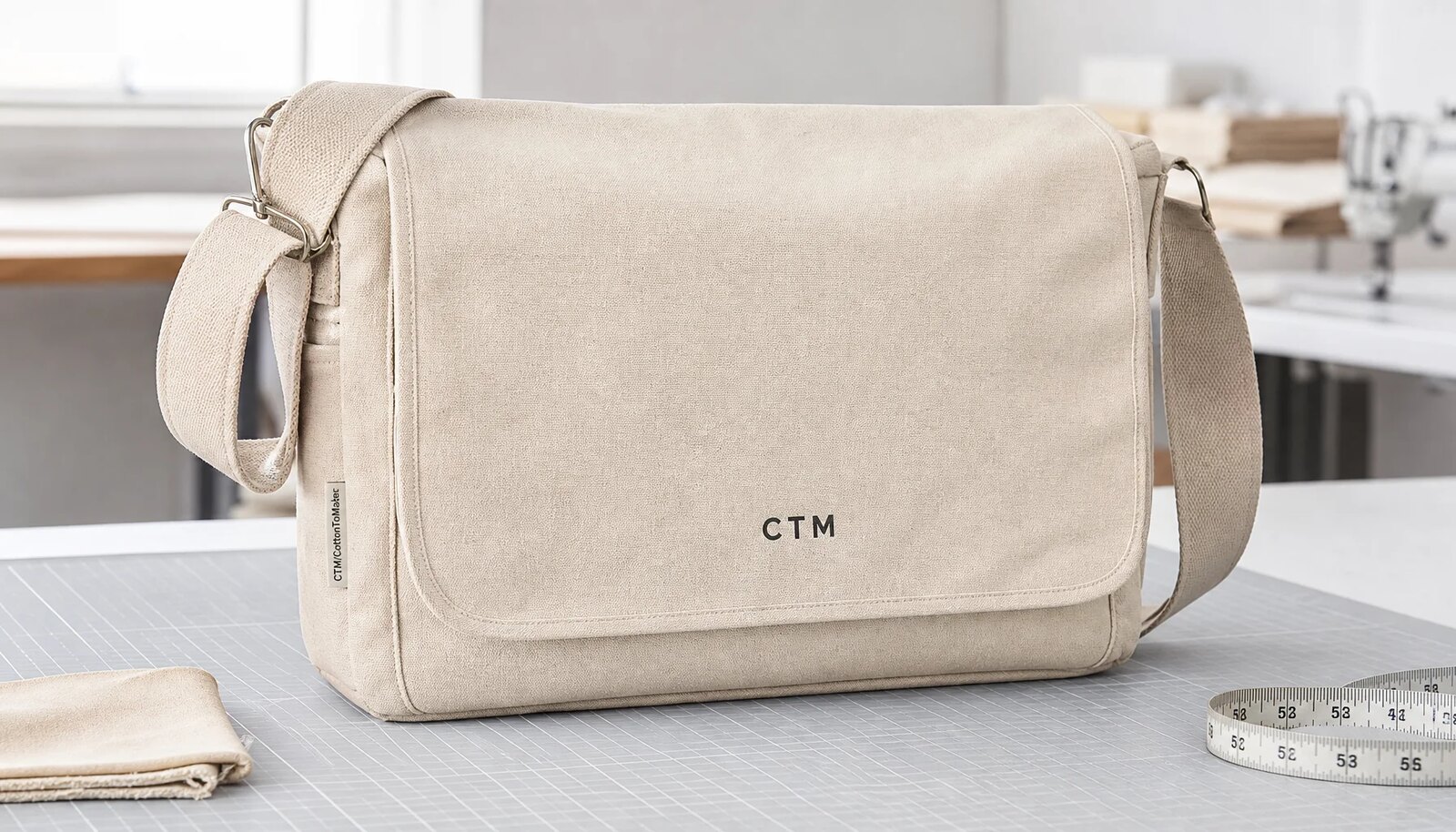
Start with use case before price
Bulk pricing for canvas messenger bags starts with the commercial job of the bag. A retail accessory, staff issue, conference kit, wholesale sample carrier, and apparel pack-in may look similar in a product photo, but they need different construction, packing, inspection, and defect standards. Procurement should define the use case before asking suppliers for a unit price.
Retail resale needs cleaner sewing, a balanced flap, consistent logo placement, and packing that protects presentation. A staff bag may prioritize strap strength and daily comfort. A one-day event kit may need predictable carton loading and fast unpacking. An apparel pack-in needs lint, odor, and print-transfer control because the bag may sit next to garments in storage or transit.
This early framing prevents false savings. One supplier may quote a light canvas body with narrow webbing and bulk packing. Another may quote 12 oz canvas, reinforced strap anchors, a woven side label, individual bags, and carton marks. The cheaper number is not automatically a better price; it may be a different product.
- Define the channel: retail resale, wholesale add-on, staff issue, event kit, sample carrier, ecommerce kit, or apparel pack-in.
- List expected contents, such as folded garments, catalogs, notebooks, light devices, or event materials.
- Compare prices only after construction, decoration, packing, and inspection assumptions match.
Set canvas weight and finish
Fabric is the first major cost driver and the most common source of quote drift. Ask for canvas weight in both oz/yd2 and GSM. For many eco apparel brand programs, 12 oz canvas, about 407 GSM, is a sensible baseline because it provides retail-friendly body while keeping sewing difficulty, carton weight, and unit cost under control.
Move to 14 oz canvas, about 475 GSM, when the bag needs a firmer hand, a more premium shelf feel, or stronger support for regular carry. The tradeoff is higher material cost, heavier freight, thicker seam stacks, and more pressure on sewing at corners and strap anchors. Ask whether the factory has already run that weight in the same construction, not just on flat totes.
Finish also changes behavior. Raw natural canvas has an appealing undyed look, but seed flecks, slubs, neps, and shade variation are normal unless restricted by an approved swatch. Bleached, washed, pigment-dyed, and piece-dyed canvas need shade control and rubbing checks. If the bag will touch light garments, ask for dry and wet crocking results before bulk approval.
- Use 12 oz/about 407 GSM as the baseline and quote 14 oz/about 475 GSM as the upgrade option.
- Ask whether fabric weight is measured before washing, after finishing, or from bulk production rolls.
- Approve the finish, shade range, hand feel, and acceptable natural variation on a physical swatch.
Control sustainability claim language
Eco apparel buyers need material claims to be as controlled as garment claims. Words such as organic, recycled, undyed, low-impact, plastic-free, and sustainable should not be added to product pages, hangtags, invoices, or retailer line sheets unless the documentation supports the exact claim. Supplier email wording is not enough.
The quote should state fiber composition by percentage and identify which claims are supported. For organic cotton, ask for GOTS or OCS documentation where applicable, including a valid scope certificate and transaction certificate for the order if a certified claim will be made. For recycled content, ask for GRS or RCS scope certificates and transaction certificates where applicable. Check company names, product categories, validity dates, and whether the bag supplier, fabric mill, or converter is actually in scope.
If documentation is not available, the product can still be sourced responsibly, but the public claim should be limited. For example, conventional cotton canvas in a natural color may be described by material and color without implying certification. Procurement, marketing, and compliance should agree on claim wording before packaging, labels, or PDP copy are printed.
- Request composition by percentage, not broad wording such as eco canvas or natural cotton blend.
- Name the documents required for organic or recycled claims before the PO is issued.
- Keep claim wording off hangtags and packaging until documents are reviewed and matched to the order.
Build the construction spec
A messenger bag has more decision points than a flat tote. The written spec should cover body width, height, gusset depth, flap drop, seam allowance, pocket size, pocket placement, strap width, strap length range, closure type, label size, label position, hardware finish, and lining if used. A reference photo helps, but it cannot replace dimensions and tolerances.
Soft canvas bags need realistic tolerances. Common starting points are plus/minus 10 mm for body width and height, plus/minus 5 mm for pocket or label placement, and plus/minus 15 mm for strap length. Tighter requirements may be appropriate for premium retail, set matching, or barcode placement, but they should be agreed before pricing because they can increase rejection rates and handling time.
The strap is a durability driver. A 38-40 mm cotton or cotton-rich webbing strap is a common range for everyday messenger bags. Specify webbing material, width, overlap into the seam, bartack count, stitch box, thread, and reinforcement. Strap ends often need at least 25-30 mm of secure overlap at the anchor point. If the bag will carry catalogs, devices, or multiple garments, ask how the factory validates strap strength.
- Separate body, flap, gusset, pocket, strap, closure, hardware, label, and lining details in the RFQ.
- Write measurement tolerances into the spec before the supplier quotes final production.
- Require bartacks or reinforced stitching at strap anchors and other load points.
Match decoration to repeatability
Decoration affects cost, lead time, and rejection risk. For many bulk canvas messenger bag programs, one-color screen print on a flat front panel is the simplest repeatable choice. It keeps setup visible, works well for reorder programs, and matches the clean branding style many apparel companies prefer.
Water-based screen print can feel integrated with cotton canvas, but opacity depends on canvas shade, ink system, and artwork coverage. Plastisol or transfer methods may provide sharper detail or stronger opacity, though the surface may feel less natural. Heat transfer can work for detailed short-run graphics, but it should be checked for edge lift, cracking, hand feel, and adhesion. Embroidery can look premium, but it may pucker lighter canvas and adds digitizing, thread, and machine time.
Artwork should be positioned from the bag pattern, not by eye. State print size, center line, distance from flap edge or top edge, clearance from seams, and clearance from snaps, pockets, gussets, or labels. For simple logos, plus/minus 3-5 mm placement tolerance is often reasonable. For complex layouts, ask for a marked print template and strike-off before bulk printing.
- Quote screen print, transfer, embroidery, patch, or label options separately when the artwork is not final.
- Approve print color and coverage on the selected canvas, not only on paper or a white fabric test panel.
- Separate screen charges, strike-off fees, color matching, per-piece print cost, and reorder setup in the quote.
Use MOQ tiers as a pricing tool
MOQ reflects fabric purchasing, cutting efficiency, print setup, trim sourcing, line changeovers, carton preparation, and administration. A supplier may accept a low minimum, but the cost usually appears as a higher unit price, setup charge, sample fee, mixed-color surcharge, or longer lead time. A good bulk pricing plan asks how MOQ is calculated, not only how low it can go.
Request tiers at practical buying points: 300, 500, 1,000, and 2,000 pieces per design. Ask for the same construction at each tier, with 12 oz and 14 oz options if both are being considered. Keep setup fees separate from unit price so the cost curve is visible. A 300-piece test buy may be useful, but only if screen charges, label fees, and packing costs are not hidden inside an unclear line item.
Variation count matters as much as total quantity. Three body colors, two artwork versions, two label versions, and two packing methods can create many production changes. For a first accessory program, one body color and one logo treatment usually produce cleaner pricing and easier QC. Add variations after sell-through data supports them.
- Quote 300, 500, 1,000, and 2,000 pieces per design, not only one total order quantity.
- Separate MOQ by body color, artwork, print color count, label, trim, hardware finish, and packing format.
- Choose the tier where savings justify inventory risk rather than automatically buying the largest quantity.
Compare quote completeness
A useful quote should read like a production summary. It should include fabric weight, composition, finish, dimensions, tolerances, strap construction, closure, pockets, labels, decoration, sample stages, lead time, MOQ rules, packing, carton dimensions, payment terms, Incoterms, and inspection responsibility. A lower quote with missing information is often incomplete, not more competitive.
Direct factories and trading companies can both be appropriate. A direct factory may suit repeat canvas messenger bag programs where the buyer has a clear spec and forecast. A trading company may help consolidate bags, apparel, labels, trims, and packaging. The key is visibility: who buys the fabric, who controls print, who performs QC, who manages corrective action, and whether subcontracting is involved.
Lead-time language should also be precise. Ask whether production time begins from deposit, artwork approval, fabric approval, or pre-production sample approval. Ask whether the quoted lead time includes material procurement, printing, finishing, final inspection, packing, and export document preparation. This prevents late surprises when launch dates are tied to retail drops or events.
- Send every supplier the same dated spec sheet, artwork file, packing instruction, quantity tier, and destination.
- Score quotes for material, construction, print, MOQ, sample, QC, packing, freight data, Incoterms, and payment terms.
- Treat vague terms such as heavy, premium, eco, strong, and standard packing as open assumptions until defined.
Approve samples in stages
Sample approval should prove production readiness, not just appearance. A messenger bag sample should confirm fabric hand feel, body structure, flap alignment, strap balance, pocket placement, stitching, hardware function, label position, print color, and print placement. The main risk is approving a good-looking sample made from substitute fabric, hand-cut panels, different webbing, or a sample-room decoration method.
Use staged approvals for new programs. First, approve the fabric swatch for weight, shade, texture, finish, and acceptable variation. Second, approve the print strike-off for ink color, line clarity, coverage, and behavior on the selected canvas. Third, approve the pre-production sample using the same canvas, thread, webbing, hardware, label, closure, and print method planned for bulk.
Sample feedback should be measurable. Instead of saying the logo is too low, state that it should move 20 mm higher from the flap edge. Instead of saying the strap feels weak, specify a wider webbing, longer seam overlap, added bartacks, or a different reinforcement stitch. Every approved revision should be added to the final spec and referenced on the purchase order.
- Approve swatch, strike-off, and pre-production sample before bulk cutting for new suppliers or new designs.
- Ask which sample inputs are identical to production and which are substitutes.
- Seal or digitally archive the approved sample, swatch, print strike-off, and final dated spec sheet.
Write QC before production
Quality control works best when expectations are written before production starts. The PO should define measurement tolerances, visible defect standards, functional checks, and inspection evidence. If the buyer only asks for good quality, the factory will use its own standard, which may not match retail expectations.
Inspection should cover fabric shade, stains, oil marks, slubs outside the approved range, distorted logos, print placement, print durability, uneven flaps, crooked pockets, exposed raw edges where not intended, loose threads, strap anchors, bartacks, seam security, zipper or snap function, buckle adjustment, and carton labeling. A small hidden dimension deviation may be acceptable; a crooked front logo or twisted strap usually is not.
For larger or higher-risk orders, use an agreed sampling plan such as ANSI/ASQ Z1.4 or ISO 2859-1 AQL inspection. AQL supports sampling discipline, but it does not replace a defect list. Define critical, major, and minor defects in plain product terms so inspectors know what the brand will reject.
- Classify defects before production: critical safety or contamination issues, major visible or functional defects, and minor cosmetic issues.
- Request photos with rulers for body dimensions, print position, strap anchors, hardware, carton marks, and packed cartons.
- Use third-party inspection when order value, launch timing, or supplier history justifies the added cost.
Plan packing and freight early
Canvas messenger bags can take more space than expected because of flaps, gussets, straps, buckles, hangtags, and individual packing. Ask for quantity per carton, carton dimensions, gross weight, net weight, and cubic meters before PO approval. Freight estimates should consider both actual weight and dimensional weight, especially for air shipments.
Packing should match the channel. Retail resale may require individual recycled polybags or paper bands, hangtags, barcode stickers, silica gel where appropriate, and controlled folding. Wholesale replenishment may use bulk packing with inner protection. Ecommerce kitting may need scannable SKU labels and carton marks. Apparel pack-ins need packing that prevents lint, odor, print transfer, and moisture from affecting garments.
Moisture control is important with cotton canvas. Washed fabric, humid production rooms, ocean routes, and poor warehouse storage can create odor or mildew risk. Ask whether printed or washed bags are fully dried before packing, how cartons are stored, and whether moisture checks are performed before sealing. Plastic reduction is useful only when the product still arrives clean, dry, and saleable.
- Request carton quantity, carton size, gross weight, net weight, and CBM with each bulk quote.
- Choose packing by channel rather than accepting undefined standard export packing.
- Confirm moisture, odor, dust, creasing, print abrasion, and transfer controls before production packing starts.
Specification comparison for buyers
| Buyer decision | Practical buying option | Best fit | Commercial risk to verify |
|---|---|---|---|
| Fabric weight | 12 oz cotton canvas, about 407 GSM, as the baseline; 14 oz, about 475 GSM, for a firmer retail body | Retail accessories, staff bags, event kits, apparel pack-ins, wholesale sample carriers | A quote using 8-10 oz canvas may reduce unit cost but can create a limp body, weaker corners, more print show-through, and lower perceived value |
| Fiber and claim route | Conventional cotton with no claim, certified organic cotton, recycled cotton blend, or cotton-rich blend with percentages stated | Eco apparel brands that need accurate PDP, hangtag, invoice, and retailer line-sheet language | Unsupported wording such as eco, sustainable, organic, or recycled can create claim risk if documents are missing or outside scope |
| Canvas finish | Raw natural for an undyed look; bleached, washed, pigment dyed, or piece dyed only with shade and colorfastness controls | Brands matching garment palettes, store displays, capsule collections, or seasonal campaigns | Raw canvas has slubs, seed flecks, and shade variation; dyed canvas may create rubbing, crocking, and lot-to-lot shade issues |
| Construction level | Flap messenger with gusset, 38-40 mm webbing strap, reinforced anchors, optional pocket, and channel-appropriate closure | Bags expected to carry folded garments, notebooks, catalogs, tablets, or retail inserts | Closures, pockets, hardware, lining, and adjustable straps add sewing time, trim MOQ, inspection points, and replacement risk |
| Decoration | One-color screen print for repeat bulk orders; water-based ink, transfer, embroidery, or patch only when tested on the selected canvas | Simple logos, wholesale programs, staff bags, retail merch, and replenishment orders | Complex artwork increases setup cost, registration risk, placement rejects, ink coverage problems, and reorder matching work |
| MOQ structure | Quote 300, 500, 1,000, and 2,000 pieces per design, with setup charges separated from unit price | Buyers comparing test buys, retail drops, regional graphics, and repeatable core SKUs | A low total MOQ can hide high per-variation costs for color, artwork, label, trim, hardware, or packing changes |
| Sample path | Fabric swatch, print strike-off, then pre-production sample made with production inputs | New suppliers, new artwork, new canvas weights, new trims, or first retail accessory programs | A nice sample made from substitute fabric or sample-room printing may not represent bulk production |
| QC standard | Written tolerances plus AQL inspection where order size and risk justify it | Retail resale, ecommerce, wholesale, and apparel pack-in programs with visible logo and construction requirements | If defect classes are not defined, disputes over crooked logos, shade variation, loose threads, and weak bartacks become subjective |
| Packing and freight | Carton quantity, dimensions, gross weight, net weight, CBM, inner packing, barcode needs, and moisture control quoted before PO | Ocean, air, distributor, ecommerce, retail, and apparel-kitting shipments | Freight can shift sharply if gussets, straps, buckles, individual bags, hangtags, or carton cube are priced late |
Buyer checklist before sampling
- Confirm canvas weight in both oz/yd2 and GSM. Use 12 oz/about 407 GSM and 14 oz/about 475 GSM as comparison points, and ask whether weight is measured before washing, after finishing, or on production fabric rolls.
- State fiber composition by percentage. Separate conventional cotton, certified organic cotton, recycled cotton blend, cotton-rich blend, and no-claim options so marketing language does not outrun documentation.
- Ask for named claim documents where relevant: GOTS or OCS scope certificate and transaction certificate for organic claims; GRS or RCS scope certificate and transaction certificate for recycled-content claims. Confirm the supplier, mill, and product category are within scope.
- Define canvas finish and shade: raw natural, bleached, washed, pigment dyed, piece dyed, softened, or undyed. Approve a physical swatch showing acceptable slubs, seed flecks, neps, shade bars, and hand feel.
- Specify finished width, height, gusset depth, flap drop, pocket size, strap width, strap length range, closure type, seam allowance, label location, and print position in millimeters or centimeters.
- Set measurement tolerances before PO. Common starting points are plus/minus 10 mm for body dimensions, plus/minus 5 mm for pocket or label placement, plus/minus 15 mm for strap length, and plus/minus 3-5 mm for simple logo placement.
- Lock artwork size, color count, Pantone or brand color target, print method, clearance from seams and hardware, and allowed placement deviation before requesting final production pricing.
- Ask suppliers to quote 300, 500, 1,000, and 2,000 pieces per design, with unit price, sample charges, screen charges, label charges, setup fees, packing costs, and carton data separated.
- Separate MOQ by body color, artwork, print color count, woven label, hangtag, trim color, hardware finish, and packing format so the real cost driver is visible.
- Approve a fabric swatch, print strike-off, and pre-production sample made with the same canvas, thread, webbing, hardware, label, closure, and decoration process planned for bulk.
Factory quote questions to send
- What is the exact canvas weight in oz/yd2 and GSM, and is it measured before washing, after finishing, or on the finished production fabric?
- What is the fabric composition by percentage, and is the cotton conventional, certified organic, recycled, or blended with polyester or another fiber?
- For organic or recycled claims, can you provide GOTS, OCS, GRS, or RCS scope certificates and transaction certificates where applicable? Which company names and product categories are covered?
- Is the canvas raw natural, bleached, washed, pigment dyed, piece dyed, softened, or otherwise treated, and what lot-to-lot shade variation should we expect?
- Can you quote the same bag in 12 oz/about 407 GSM and 14 oz/about 475 GSM canvas, including unit cost, carton cube, gross weight, and lead-time differences?
- What finished dimensions and tolerances are you quoting for body width, height, gusset, flap drop, pocket size, strap width, strap length, label placement, and print placement?
- What print method are you quoting, and what screen charges, strike-off charges, color matching charges, artwork charges, setup charges, and reorder charges apply?
- What is the maximum recommended print size on the selected panel without seam interference, flap distortion, registration problems, ink coverage issues, or high rejection risk?
- Which print durability checks can you run on this canvas, such as dry rub, wet rub, tape adhesion, flexing, or wash/rinse testing? Can you reference AATCC or ISO methods where available?
- What is the MOQ per total order, body color, artwork, print color count, woven label, hangtag, trim color, hardware finish, and packing method?
Quality-control points to confirm
- Fabric weight should be checked against the approved specification in oz/yd2 and GSM, with an agreed tolerance before PO confirmation. A common commercial tolerance is about plus/minus 5 percent unless the buyer sets a tighter standard.
- Fabric shade should be compared with the approved swatch or lab dip under consistent lighting, such as D65 or buyer-specified light source. Raw canvas slubs, seed flecks, neps, and shade bars should be classified as acceptable or rejectable before bulk cutting.
- Finished body width, height, flap drop, gusset depth, pocket size, strap width, strap length, and label placement should be measured against the approved spec sheet and sealed pre-production sample.
- For many soft canvas bags, plus/minus 10 mm on body dimensions and plus/minus 5 mm on smaller placement details is practical. Critical retail displays, barcode placement, or matching set programs may require tighter controls agreed before PO.
- Print placement should be measured from a fixed reference point such as center line, flap edge, top edge, pocket seam, snap, or label. Simple front logos often need a plus/minus 3-5 mm placement tolerance.
- Print color should match the approved strike-off or Pantone target as closely as the canvas base allows, with no heavy bleeding, ghosting, pinholes, cracking, peeling, patchy coverage, or visible registration shift beyond the approved limit.
- Print performance should be checked by the agreed method, such as dry rub, wet rub, tape pull, flexing, or wash/rinse testing when the selling claim, packing method, or use case requires it.
- Strap anchors must have secure bartacks or reinforcement stitching, with no skipped stitches, thread breaks, loose overlap, twisted webbing, weak seam bite, or needle cutting at stress points.
- Stitch density and sewing appearance should be consistent at flap edges, side seams, gussets, pocket openings, bottom corners, and label attachment. Loose threads should be trimmed before packing.
- Hardware should open, close, slide, snap, zip, or adjust smoothly, with no sharp edges, loose attachment, rust, plating discoloration, mismatched finish, magnet exposure, or zipper tape distortion.