Start With the Bakery Use Case
Canvas messenger bags for artisan bakeries should be specified around the job they must perform. A resale bag at the counter needs clean presentation, consistent folding, barcode planning, and a finish that feels worth buying. A staff bag for farmers markets needs comfort, reinforced strap points, and a closure that works with daily handling. A bread subscription bag must fit the actual box, pastry carton, coffee pouch, jam jar, or insert card without forcing the flap open.
MOQ negotiation improves when the buyer explains this use case before asking for the lowest quantity. A factory may support a smaller pilot if the order uses an existing messenger pattern, stock natural canvas, standard webbing, stock hardware, and one simple print. The same quantity becomes harder when the buyer adds dyed fabric, lining, special buckles, multiple logo versions, or retailer-specific packing.
For multi-location bakery groups, the most useful negotiation angle is often standardization. Several branch logos may share one body construction, one canvas lot, one strap, one hardware finish, and one carton plan. The factory can then quote separate setup charges for each print or label version instead of treating every location as a completely different bag.
- Pilot order: use stock natural canvas, existing pattern, standard hardware, one print position, and simple export packing.
- Retail resale: control hand feel, print placement, hangtag or barcode accuracy, folding method, and shelf presentation.
- Staff use: define strap width, adjustable length, reinforcement method, closure type, and approval load.
- Gift bundles: test the actual box, jar, coffee pouch, card, or insert before finalizing size.
- Multi-location order: ask whether one construction run can be split across logo versions with separate setup charges.
Convert the Bag Photo Into Numbers
A reference photo is not a specification. Two suppliers can quote the same image and assume different canvas weights, gussets, pockets, linings, straps, hardware, thread colors, print methods, and packing. The lowest quote may be based on a lighter or simpler bag. A procurement-ready RFQ replaces visual adjectives with measurable requirements.
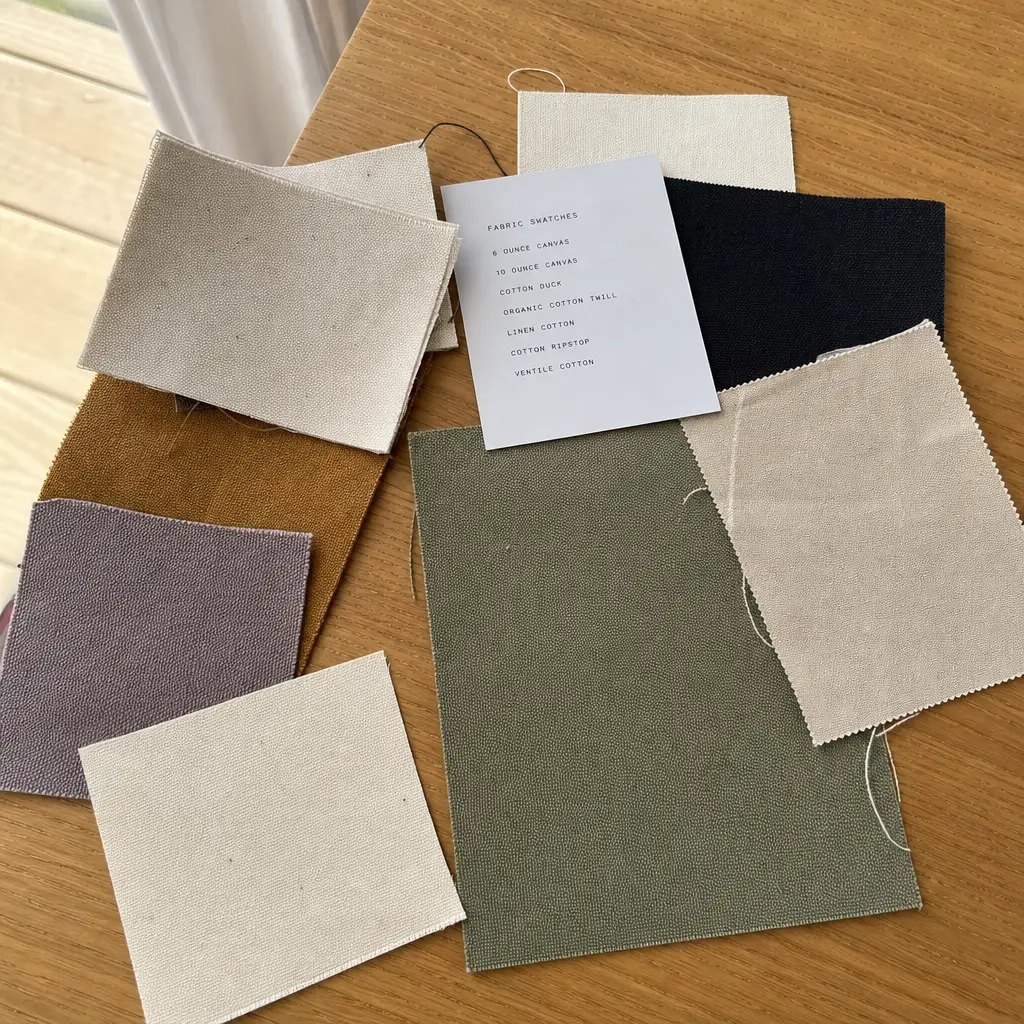
For many bakery programs, natural 12oz cotton canvas at about 380-410 GSM after finishing is a strong starting point. It has more structure than light promotional canvas while remaining practical to cut, sew, fold, and ship. A 10oz canvas around 300-340 GSM can work for lighter gifting. A 14oz canvas around 450-480 GSM can feel more premium, but it may raise sewing cost, carton weight, and lead time. The best choice depends on load, retail positioning, and budget.
Finished dimensions should come from the bakery’s real packaging. Measure the largest bread box or pastry carton, then allow clearance for fabric thickness, gusset expansion, and flap closure. If the bag will carry staff tools or mixed retail goods, specify a practical load test. For example, 3 kg may suit light gifting, while 5 kg is more appropriate for daily staff use.
- Record dimensions in centimeters: width, height, gusset, flap depth, pocket size, strap width, strap range, and hardware position.
- State fabric by ounce and GSM range, and clarify whether GSM is measured before or after finishing.
- Choose 38-50 mm webbing when comfort matters; narrow promotional straps can make the bag feel cheaper.
- Define the closure: magnetic snap, metal snap, buckle, hook-and-loop, zipper, or no closure.
- Avoid vague terms such as thick canvas, premium hardware, strong strap, eco fabric, or standard packing unless each term is defined.
Identify the Real MOQ Driver
MOQ is not always controlled by sewing capacity. A messenger bag involves fabric purchasing, cutting, printing or embroidery, strap preparation, hardware setting, sewing, trimming, inspection, and packing. The limiting factor may be the least flexible component, not the factory’s ability to assemble the bag.
Separate the body MOQ from component MOQs. Stock natural canvas is easier than custom-dyed canvas. Standard cotton webbing is easier than dyed-to-match webbing. Stock snaps and sliders are easier than special plating or logo hardware. A standard woven label is easier than several location-specific labels. Even packing can create MOQ pressure if the order needs printed cartons, belly bands, barcode stickers, or destination labels in small version quantities.
When a supplier rejects the target MOQ, ask what creates the constraint. If the issue is fabric dyeing, keep the pilot natural. If it is hardware, select a stock finish. If it is too many branch logos, group the body construction and quote version setup separately. This turns negotiation from price pressure into a practical sourcing discussion.
- Fabric drivers: custom color, uncommon weight, organic claim, recycled-content claim, coating, washing, or special weave.
- Decoration drivers: print screens, embroidery setup, heat-transfer minimums, print colors, print positions, and artwork versions.
- Hardware drivers: custom plating, logo embossing, non-standard buckle width, special magnet, or molded part.
- Label drivers: woven labels, care labels, hangtags, barcode stickers, language versions, and retailer data.
- Packing drivers: printed cartons, belly bands, sleeves, gift boxes, destination labels, and carton assortment rules.
Negotiate Without Weakening the Bag
If the target MOQ is difficult, avoid demanding the same specification at a lower quantity without changing anything. That can invite silent downgrades: lighter canvas, narrower webbing, weaker snaps, rough trimming, lower stitch density, or less careful packing. A better approach is to protect performance details and simplify upgrades that do not affect the bag’s core use.
For most bakery buyers, the protected details are fabric hand feel, correct dimensions, strap comfort, reinforced attachments, clean logo reproduction, and controlled packing. Features that can often wait include lining, zipper compartments, custom-dyed straps, branded metal hardware, printed cartons, multiple woven labels, and complex retail packaging. The pilot order should prove demand and confirm fit; the repeat order can carry more brand customization.
Ask suppliers for three versions: the target specification at the buyer’s desired quantity, the same specification at the factory’s efficient production quantity, and an MOQ-friendly version using stock materials. This shows the cost of each customization and helps internal stakeholders choose between price, quantity, and feature complexity.
- Protect: canvas GSM, finished size, strap width, reinforcement method, logo clarity, and approved packing.
- Simplify: lining, pocket count, zipper additions, hardware finish, label versions, and print color count.
- Postpone: custom-dyed canvas, jacquard strap, embossed hardware, printed lining, and retail gift boxes.
- Compare: pilot price, efficient-MOQ price, and reorder price after sample approval.
- Document: every accepted tradeoff in the purchase order and approved sample record.
Select Decoration That Fits Woven Canvas
Screen printing is often the practical choice for bakery messenger bags. It works well for solid logos, simple wheat marks, one-color slogans, branch names, and seasonal messages. Canvas is woven fabric, not coated paper, so fine serif text, thin line art, flour-dust textures, gradients, and tight registration can lose clarity. Before sampling, ask the factory to review minimum line thickness, minimum text height, registration tolerance, and ink opacity on the selected canvas.
Print placement needs the same care as artwork. The flap may look like the best branding area, but snaps, buckles, seams, curves, and folds can reduce the usable flat zone. Printing panels before sewing may improve pressure and access, but sewing alignment must be controlled. Printing finished bags can simplify versioning, but seams and hardware may restrict size and accuracy.
Other methods can work if they match the design. Embroidery feels premium for a small mark, but large filled embroidery can pucker canvas. Heat transfer can reproduce detail, though it may feel less natural on a bakery lifestyle product. A woven side label gives a clean retail finish, but it has separate label MOQ, color approval, and placement checks. For a first order, one main print plus one standard label is easier to control than several decoration methods.
- Send vector artwork with Pantone references, print dimensions, and placement measured from panel edges.
- Ask for artwork simplification if lines, negative spaces, or text are too fine for canvas.
- Request a strike-off or printed panel when color, opacity, edge clarity, or ink hand feel is important.
- Confirm whether panels are printed before sewing or finished bags are printed after sewing.
- Define print defects: no heavy bleeding, double image, tackiness, smearing, poor opacity, or obvious registration shift.
Build a Quote Sheet Suppliers Can Price
A low unit price is not useful if it excludes charges the buyer will later need. Canvas messenger bag quotes often differ because one supplier includes screen setup, sampling, label sewing, carton marks, and export packing while another quotes only the plain sewn bag. To compare suppliers fairly, send one measurable specification and ask each factory to state what is included, optional, or subject to separate MOQ.
Ask for price tiers that match the bakery plan. For a pilot and rollout, useful tiers may be 300, 500, 1000, and 2000 pieces. If the price drops sharply at a higher tier, the buyer can decide whether the larger order, simpler specification, or pilot premium makes more sense. If the price barely changes, the MOQ pressure may come from a component minimum rather than sewing efficiency.
Commercial terms should be requested in the RFQ, not discovered after sample approval. Ask for incoterm, currency, quote validity, payment terms, sample fee, screen fee, tooling cost, inspection cost, packing cost, production lead time after approval, port or handover point, and version-control charges. For retailer or distributor programs, include barcode stickers, carton marks, routing labels, and destination splits from the start.
- Commercial fields: MOQ, unit price, tiers, currency, incoterm, payment terms, quote validity, sample fee, screen fee, tooling, and handover point.
- Product fields: size, canvas GSM, strap width, hardware finish, pocket layout, label type, print method, print size, and thread color.
- Packing fields: fold method, polybag use, carton quantity, carton size, gross weight, net weight, carton mark, and pallet option if needed.
- Assortment fields: logo versions, fabric colors, hardware colors, label languages, carton splits, and destination quantities.
- Risk fields: stock items, special-order items, separate component MOQs, and specifications that may extend lead time.
Treat Samples as Production Evidence
Sampling should prove more than appearance. A photo cannot confirm fabric weight, strap comfort, hardware feel, ink curing, odor, carton behavior, or fit with bakery contents. For final approval, request a pre-production sample made with the intended canvas, strap, hardware, thread, label, decoration method, and packing style. If the first prototype uses substitute materials, label it as a prototype and do not let it become the production reference.
Sample comments should be measurable. If the flap is too shallow, state the revised flap depth. If the print is too close to the snap, state the minimum distance from the hardware or panel edge. If the strap feels narrow, specify the new webbing width. If the pocket does not fit a receipt book or staff item, revise the pocket measurement before bulk cutting.
Test the sample in the real bakery scenario. Pack the bread box, pastry carton, coffee pouch, jam jar, notebook, gift card, or insert that the bag will carry. Check whether the flap closes, the sides distort, the strap twists, and the loaded bag still looks presentable. If it will be sold as merchandise, fold it, tag it, and place it on a shelf or counter display before approving.
- Measure: width, height, gusset, flap depth, pocket size, strap width, strap range, and hardware position.
- Inspect: fabric hand feel, shade, odor, surface defects, seam allowance, stitch density, and thread trimming.
- Print check: logo size, position, color target, edge clarity, opacity, curing, and rub risk on canvas.
- Load check: pack realistic contents and review flap closure, strap comfort, seam deformation, and hardware function.
- Approval file: keep photos, measurement sheet, artwork, Pantone target, swatch, hardware reference, and written tolerance notes together.
Set QC Standards Before Cutting
Quality standards should be agreed before bulk fabric is cut. Canvas messenger bags are sewn products, so small variation is normal. The important question is whether both sides understand the acceptable range. Key inspection points include finished dimensions, fabric shade, fabric defects, print quality, stitch workmanship, strap attachment, hardware function, label placement, cleanliness, odor, and packing accuracy.
For many sewn canvas bags, a main-dimension tolerance around plus or minus 1 cm is practical. For simple centered artwork on a stable panel, print placement may often target plus or minus 5 mm if the factory confirms the process can hold it. These targets must be validated during sampling because washing, canvas weight, panel shape, and decoration method affect what is realistic.
If third-party inspection is planned, define the standard in the purchase order. Many importers use an AQL-style approach, such as general inspection level II with agreed critical, major, and minor limits, but the exact plan should match order size and risk. Defect definitions matter more than terminology. A wrong logo, mold, sharp hardware edge, or unusable closure is not the same as a loose thread.
- Critical defects: wrong logo, wrong material, mold, sharp unsafe hardware, unusable closure, severe contamination, or carton shortage.
- Major defects: broken stitch at stress point, weak strap attachment, fabric hole, obvious print shift, heavy stain, wrong label, or incorrect packing version.
- Minor defects: small loose thread, slight crease, approved-level slub, small non-functional mark, or slight shade variation within standard.
- Functional checks: open and close hardware, pull strap attachment, inspect pockets, check seam stress, and compare loaded bag to the approved sample.
- Measurement checks: record size, gusset, flap, pocket, strap range, print position, and label placement across random samples.
Control Packing, Moisture, and Freight Cube
Packing affects landed cost and brand presentation. Fold a messenger bag too tightly and the printed flap may crease, corners may distort, or straps may leave pressure marks on natural canvas. Pack cartons too loosely and freight cube increases while the bags rub in transit. For bakery groups and distributors, carton labeling and assortment control can be as important as sewing quality because errors create sorting labor and store-level shortages.
Individual polybags protect natural canvas from dust and handling marks, but not every bakery brand wants plastic packaging. If polybags are removed, the packing specification needs stronger controls: clean carton liners, dry cartons, dust protection, careful handling, and moisture management before sealing. Natural cotton canvas can absorb odor and moisture more readily than many synthetic materials, so storage conditions matter.
Freight planning should begin before production is packed. Request carton dimensions, gross weight, net weight, pieces per carton, and total carton count before booking. Oversized cartons raise dimensional weight; overloaded cartons create crushing and handling risk. For retail resale, decide whether hangtags, barcode stickers, belly bands, price labels, and care cards are applied at the factory or after arrival.
- Approve fold method: flat packed, half folded, flap protected, strap tucked, or another tested method.
- Set carton quantity so cartons remain liftable and do not waste cube through excess air space.
- Use carton marks with item number, logo version, color, quantity, gross weight, net weight, carton number, and destination when required.
- For no-polybag programs, require clean liners, dry cartons, dust protection, moisture control, and clean handling before sealing.
- Request carton dimensions and gross weight before freight booking, not after all goods are packed.
Plan Lead Time Around Approval Gates
The production clock usually starts after artwork is approved, sample details are confirmed, payment terms or deposit are settled, and materials are available. A stock natural canvas messenger bag with one-color print can move much faster than a custom-dyed, lined, multi-pocket bag with branded hardware and retailer packing. Procurement teams should map approval gates before committing to a bakery launch date.
Bakery programs often work toward fixed deadlines: holiday gift sets, farmers market openings, franchise launches, corporate gifting, subscription campaigns, or wholesale promotions. Common delays include unclear print size, late Pantone changes, canvas-weight revisions, missing barcode data, slow label approval, and packing changes after unit price is agreed.
A practical schedule includes supplier review, artwork proofing, prototype or pre-production sample, sample shipping, buyer review, material booking, production, in-line checks, final inspection, carton measurement, export booking, and destination delivery. Low-MOQ orders may also need to fit around larger factory runs. If the launch date is fixed, simplify the specification early instead of compressing inspection or shipping time at the end.
- Artwork gate: confirm vector file, Pantone target, print size, print position, and simplified details before sampling.
- Sample gate: separate prototype approval from final pre-production sample approval using bulk-intended materials.
- Material gate: confirm canvas, strap, hardware, label, ink, thread, and packing before announcing launch dates.
- Production gate: allow time for cutting, printing, curing, sewing, trimming, in-line checks, inspection, and packing.
- Shipping gate: include carton measurement, booking, export documents, routing labels, and distributor delivery windows.
Specification comparison for buyers
| Decision area | MOQ-friendly choice | Best use case | Buyer check before approval |
|---|---|---|---|
| Canvas weight | 12oz cotton canvas, about 380-410 GSM after finishing, approved by swatch | Bakery resale, staff carry, bread subscriptions, farmers markets, gifting | Confirm GSM basis, finishing state, shade tolerance, and no unapproved fabric substitution |
| Bag size | Fixed width, height, gusset, flap depth, and pocket size in centimeters | Programs built around bread boxes, pastry cartons, coffee bags, jars, or inserts | Test real contents; reference photos can produce attractive bags that do not close correctly |
| MOQ route | Existing messenger pattern with stock natural canvas, stock strap, stock hardware, and one print | 300-800 piece pilots or first retail tests | Custom size, dyed fabric, lining, special hardware, or many logo versions may reset MOQ |
| Logo method | One-color screen print on a flat flap or pocket panel with vector artwork | Simple bakery logos, wheat marks, branch names, subscription slogans | Check line thickness, text height, ink opacity, and placement tolerance on woven canvas |
| Strap construction | 38-50 mm cotton webbing strap with adjustable slider and reinforced box/cross stitch or bartack | Daily carry of bread, coffee, jars, notebooks, staff tools, and retail goods | Narrow webbing and single-row stitching reduce cost but raise comfort and durability complaints |
| Hardware | Factory-stock magnetic snap, metal snap, slider, buckle, or nickel-free finish | Retail value without tooling or long component lead time | Custom logo hardware, uncommon plating, and non-standard widths can carry separate MOQ |
| Interior layout | Unlined body with one slip pocket or front patch pocket | First orders where cost, inspection, and lead time matter | Lining, zipper compartments, padded sleeves, and dividers add measurement and sewing variables |
| Labeling | Main print plus optional standard woven side label, care label, hangtag, and barcode sticker | Retail resale, distributor routing, multi-location bakery programs | Label artwork, language, barcode data, placement, and version counts need separate approval |
| Packing | Approved fold method, strap placement, carton quantity, carton size, and carton marks | Freight cube control and clean presentation at arrival | Over-folding can crease prints; loose cartons increase abrasion and dimensional freight cost |
Buyer checklist before sampling
- Define the commercial use: resale merchandise, staff bag, subscription packaging, wholesale account gift, farmers market bag, distributor promotion, or seasonal bundle.
- List the expected contents with dimensions and weight: bread box, pastry carton, coffee pouch, jam jar, receipt book, notebook, tablet, insert card, or mixed retail items.
- Specify finished width, height, gusset, flap depth, strap width, adjustable strap range, pocket size, closure position, and print position in centimeters.
- State the practical approval load, such as 3 kg for light gifting or 5 kg for staff and daily-use programs, then ask whether the proposed construction supports it.
- Specify canvas by ounce and approximate GSM, and ask whether the weight is measured greige, dyed, washed, coated, or after finishing.
- Ask which materials are stock: canvas color, webbing width, thread color, snap, slider, buckle, label size, ink system, carton, and packing materials.
- Keep the first order close to a standard pattern if MOQ is the priority; delay custom-dyed canvas, lining, branded hardware, and complex pockets until reorder demand is proven.
- Separate mandatory features from optional upgrades such as zipper pocket, printed lining, dyed strap, branded snap, woven label, hangtag, belly band, barcode sticker, and printed carton.
- Send vector artwork with Pantone references, maximum print size, placement from panel edges, and minimum readable text height requirements.
- Ask whether MOQ is calculated per style, size, fabric color, logo design, print color, hardware finish, label version, packing version, or delivery destination.
Factory quote questions to send
- What is your lowest workable MOQ if we use your existing messenger pattern, stock natural canvas, stock 38-50 mm strap, stock hardware, and one-color screen print?
- Is the MOQ calculated per style, finished size, fabric color, logo design, print color, hardware finish, label version, packing version, or destination?
- Can you quote our target quantity and your most efficient production quantity using the same specification so we can compare the cost impact of MOQ?
- Which cotton canvas weights are regularly available, and what are their approximate GSM values after finishing?
- Is the canvas natural, bleached, dyed, washed, coated, recycled-content, or organic-certified, and what documentation is available for any material claim?
- Is the canvas pre-shrunk or washed, and what dimensional shrinkage or shade variation should we expect between approved swatch and bulk rolls?
- Which strap widths, adjusters, snaps, buckles, sliders, thread colors, and hardware finishes are in stock, and which require separate component MOQ?
- What reinforcement do you recommend at the strap attachment: box stitch, cross stitch, bartack, rivet plus stitch, or another method?
- What print method do you recommend for our artwork on 12oz canvas, and what minimum line thickness, text height, and registration tolerance should we use?
- Will you print panels before sewing or print finished bags after sewing, and how will you control print placement on the flap or pocket?
Quality-control points to confirm
- Finished bag size tolerance should be agreed before production; for sewn canvas bags, main dimensions are commonly controlled around plus or minus 1 cm unless tighter tolerances are sampled and priced.
- Gusset depth, flap coverage, pocket opening, and strap length range should be measured against the approved sample because small changes affect fit for bread boxes and retail bundles.
- Canvas weight should match the approved swatch and quoted GSM range, with no mixed fabric lots, shade jumps, coating changes, or substitute rolls unless approved in writing.
- Fabric inspection before cutting should check oil marks, stains, weaving slubs beyond the approved standard, holes, odor, mildew, heavy creasing, and obvious shade panel differences.
- Print position on the flap, front pocket, or back panel should stay within the agreed tolerance; plus or minus 5 mm is a practical target for simple centered artwork on stable panels when confirmed by the factory.
- Logo quality should be checked for edge clarity, ink bleeding, pinholes, double image, poor opacity, registration shift, smearing, tackiness, and mismatch from the approved color target.
- Strap attachment should use the approved reinforcement method and pass the agreed practical load check without broken stitches, seam slippage, fabric tearing, or hardware distortion.
- Stitching should be inspected for skipped stitches, broken threads, loose thread nests, uneven seam allowance, open seams, incorrect thread color, and untrimmed thread clusters.
- Hardware should open and close smoothly with no sharp edges, weak magnetic pull, plating scratches, rust marks, loose rivets, misalignment, or staining onto natural canvas.
- Labels, hangtags, barcode stickers, care labels, and language versions should match the approved artwork, placement, assortment plan, and destination requirement.