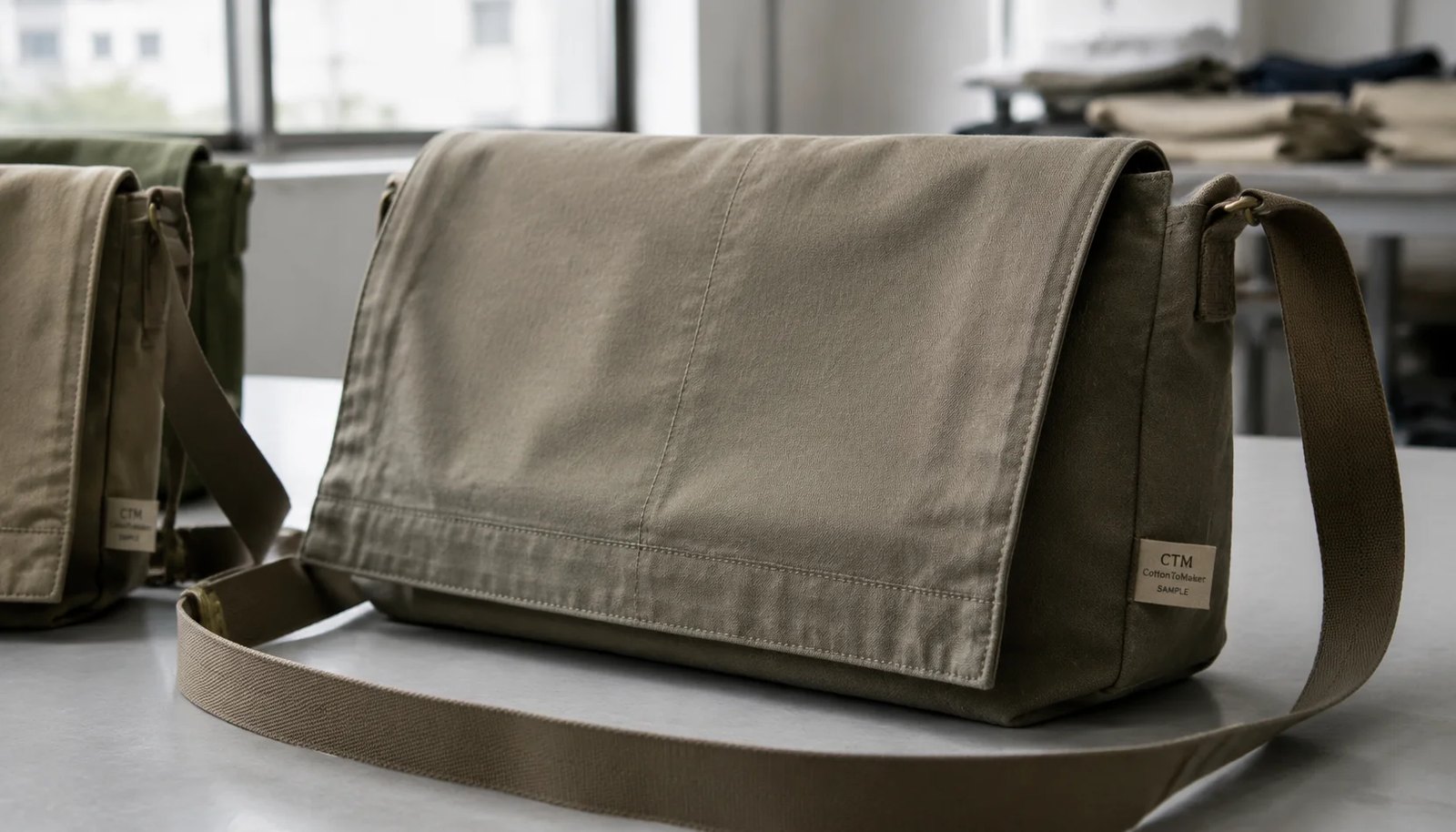
What museum shops actually need from a canvas messenger bag
Museum shop buyers usually need a messenger bag that sits between a souvenir tote and a true daily carry bag. It has to feel substantial enough to justify retail shelf space, but not so technical or bulky that it loses impulse appeal. In practice, that means the sourcing brief should be built around shopper behavior, average basket size, and the products the bag is expected to carry, not around a generic fashion sample.
The best-performing museum shop messenger bags are usually simple in silhouette, easy to brand, and durable enough to survive repeated handling by visitors who may be carrying guidebooks, postcards, sketchbooks, membership materials, or small exhibition purchases. A clean front panel matters because that is where the museum’s brand, exhibition identity, or retail logo lands. The construction should support that branding without making the product feel overdesigned.
There is also a merchandising issue. The bag must look good folded, hung, and stacked. If it collapses into a shapeless pile, it is harder to display and harder to sell at a counter or on a fixture. A little body structure, a clear flap or opening line, and consistent strap management all help the bag look like a deliberate retail item rather than a generic promo giveaway.
- Typical use case: museum retail, exhibition shops, member stores, cultural attractions, campus museums, and temporary show merchandise.
- Typical fill: paper goods, books, catalogs, notebooks, pens, small gifts, and flat souvenir items.
- Typical buying mistake: specifying a commuter messenger with too much hardware, too much depth, or too much internal complexity for a shop SKU.
- Typical retail requirement: the bag must display cleanly, photograph well, and keep its shape after folding or hanging.
Set the spec around the shelf, not just the sample
The first sourcing decision is canvas weight, because it affects handfeel, print quality, structure, and price all at once. For most museum shop programs, 12 oz to 14 oz canvas is the practical range. That weight normally gives enough body for shelf presence and better print clarity than a very light cloth, while still staying within a reasonable retail price point. Lower weights can work for entry-price or promotional items, but the buyer should expect more attention on reinforcement and a greater risk that the bag will feel thin after handling.
The second decision is finished size. Museum shop buyers often need a bag that can carry A4 documents, exhibition notes, or a slim catalog without being too large for casual retail purchase. A useful starting point is a body around 33 to 38 cm wide and 28 to 32 cm high, with a gusset that fits the product mix without making the bag boxy. If the bag is meant for books or heavier merchandise, a wider base and stronger strap anchors matter more than adding decorative details.
The third decision is structure. A messenger bag can be open-top, flap-closure, zip-top, or a simplified hybrid. For museum shops, the most important thing is how the opening behaves in use and in display. If the bag is too soft, it can collapse on a shelf. If it is too rigid, it starts to feel like a hard utility bag rather than a retail accessory. The right middle ground usually comes from the lining, interfacing, seam allowances, and strap layout, not from adding random hardware.
When the artwork includes a museum logo, exhibition name, or a graphic derived from a collection item, the canvas surface should match the design intent. Fine lines and small text need a smoother surface and controlled print, while heavy ink coverage can look harsh on a rough cloth. The supplier should understand this before sampling starts, because the wrong canvas finish can turn a strong design into a muddy one.
For repeat programs, keep the base bag stable and change only the artwork or a narrow trim detail. That gives the buyer more control over sell-through and reorders, and it helps the supplier repeat the same body construction without introducing hidden spec drift.
- If the artwork is detailed, choose a tighter weave or a smoother finished canvas so the print stays legible.
- If the bag will carry books or heavier retail items, specify wider webbing and test the strap pull at the anchor points.
- If the line is seasonal, keep the bag color neutral and let the print carry the variation.
- If the bag needs to fit a museum publication or catalog, verify the internal dimensions after sewing, not just the cut size.
How to compare supplier options without getting lost in price
A direct sewing factory usually gives the clearest view of how the bag is actually made. That matters because the difference between two canvas messenger bags often shows up in small construction choices: seam allowance, stitch density, reinforcement at the strap, the way the flap folds, and how the print behaves over the seam line. If the buyer wants dependable repeat orders and sample-to-bulk consistency, that visibility is valuable.
Trading companies can be useful when a museum shop needs a broader service package, mixed product consolidation, or more support on export logistics. The tradeoff is that the real production source can become harder to inspect, and responsibility for QC decisions may be split. A buyer comparing quotes should be careful not to treat a trade quote as equivalent to a factory quote unless the factory, spec owner, and inspection process are fully disclosed.
Specialized bag workshops are often the best fit when the retailer cares about bag geometry, strap comfort, pocket layout, and the way the opening behaves in store use. General low-price suppliers can sometimes meet a simple promotional brief, but their advantage can disappear quickly if the order needs precise print registration, reinforcement, or retail-ready packing. The buyer should compare the route, not just the unit cost.
The cleanest way to compare offers is to break each quote into the same cost buckets. Ask for fabric, sewing, print, trim, packaging, and handling separately. That reveals whether one supplier is cheaper because they are using a lower weight canvas, a simplified stitch path, a lower-quality buckle, or a packing method that creates rework on receipt. A quote that looks lower on paper may be less competitive once the buyer accounts for inspection failures, repacking labor, or later complaint handling.
- Ask whether the bag is fully cut-and-sewn or built from a simplified blank construction with added trim.
- Confirm whether the quoted fabric weight refers to the finished bag fabric or the base cloth before washing, dyeing, or printing.
- Check whether labels, barcode stickers, hangtags, and carton marks are included or charged separately.
- Ask who owns final QC decisions when the order is split between sample room, print shop, and sewing line.
Comparison of sourcing routes for museum shop buyers
The right sourcing route depends on how much risk the museum shop wants to hold internally. If the order is a core retail item with a recurring forecast, the buyer usually benefits from tighter factory control and a clearer spec chain. If the order is a one-off exhibition item, flexibility may matter more than perfect optimization. In either case, the supplier route should be chosen because it matches the order pattern, not because it happened to quote the lowest number.
Direct factories are usually stronger on repeatability and detailed construction control. They are the best option when the buyer expects to reorder the same bag across seasons, exhibitions, or store locations. Trading companies can help when the buyer needs coordination across several items or needs help with shipment consolidation, but the buyer should verify how much technical control the trader actually has. Specialized bag workshops sit between the two: often very capable on bag-making details, but sometimes more limited on throughput and export services.
The table in this guide is meant to help procurement teams ask sharper questions before they request samples. The aim is not to choose a route on theory alone. It is to check whether the route can actually support the museum store’s use case, visual standard, packing requirements, and replenishment schedule.
For a museum shop buyer, a common failure is comparing suppliers only on price and lead time. That misses the operational cost of poor receiving, damaged retail presentation, or a sample that cannot be repeated in bulk. The better approach is to score each supplier on sample quality, spec clarity, QC transparency, communication speed, and the ability to produce the same bag again without hidden changes.
- Write decisions in measurable language, not only descriptive wording.
- Ask for a physical approved sample plus clear photos of the first-piece or pre-production stage.
- Keep quotation, sample approval, and inspection notes tied to the same spec version.
- Use the same evaluation sheet for every supplier so the comparison is defensible internally.
MOQ logic, lead time, and why small changes raise cost fast
MOQ on a canvas messenger bag is usually driven by fabric cutting efficiency, print setup, color matching, and packing labor. Once a buyer introduces multiple colors, more than one artwork, or several trim changes, the order stops behaving like a single run and starts behaving like a set of smaller jobs. That pushes up waste, setup time, and the chance that the factory will quote an artificial minimum to protect its production schedule.
For museum shops, the most economical launch pattern is usually one bag size, one canvas color, one print position, and one packing method. That gives the buyer a clean baseline for sell-through and reordering. If the program performs well, a second colorway, a different strap detail, or a seasonal exhibition graphic can be added later. This staged approach also helps the buyer avoid tying up cash in speculative variants before the retail response is known.
Lead time should be read as a sequence, not as one number. Sample time, strike-off or print approval time, bulk fabric readiness, sewing slot availability, and packing time all affect the ex-factory date. A supplier that promises a fast ship date but has not checked fabric inventory or print capacity may still slip later. Buyers should ask for the earliest realistic ex-factory date after sample approval, not a marketing-style turnaround estimate.
Small design changes often create large cost movements. A top flap, magnetic closure, or sewn lining may sound minor in a product review, but each one adds labor and inspection risk. Likewise, a wider strap or better buckle can be worth the cost if the bag carries books, but unnecessary hardware can inflate price without improving the retail experience. The procurement team should ask whether a feature improves user value or simply makes the sample look more substantial.
A good supplier will explain the cost drivers clearly. If the quote rises because of tighter print alignment, reinforced strap anchors, or retail-ready folding instructions, that is understandable. If the quote changes without a clear reason, the buyer should push for a line-item explanation before approving the purchase order.
- Lower MOQ usually means higher unit cost because setup is spread over fewer pieces.
- Complex prints can require strike-off, extra drying or curing time, and more review cycles.
- Flap closures and lined interiors usually extend lead time versus open-top bodies.
- Variant-heavy orders should be priced as separate SKUs, not as one blended line item.
Print method choices that hold up in retail
For museum shop branding, screen print is usually the most reliable method for one to three solid colors. On canvas, it gives strong coverage and generally holds up well under repeated handling if the ink is properly cured. It is a good fit for logos, exhibition titles, institutional marks, and simple artwork that needs crisp edges. Where the graphic is more photographic, layered, or gradient-heavy, another print method may be necessary, but it should be treated as a technical exception rather than the default.
The substrate matters as much as the print process. A rough or inconsistent canvas can distort fine lines, reduce edge clarity, and make a carefully approved logo look heavier than expected. That is why the supplier should test the actual artwork on the actual canvas color before bulk. A proof on paper or a digital file alone does not tell the buyer how the final product will read from a retail shelf.
Artwork adaptation is part of procurement discipline. Thin lines, small type, and tight knockouts often need to be simplified for canvas. The supplier should be able to tell the buyer where the design may fail: across a seam, on a fold, near the edge of a flap, or over textured weave. If the supplier does not raise those issues during sampling, the buyer may not discover them until after bulk production starts.
When comparing print quotes, ask what is included in the print method. The cost can differ based on number of colors, screen setup, minimum coverage area, curing method, and whether the supplier is also responsible for art adjustment. If the museum shop needs a repeatable program, the supplier should keep the print reference, color standard, and placement reference tied to one approved master sample.
- Use screen print for simple logos and limited-color artwork when durability matters.
- Approve a strike-off on the actual fabric color, not only a paper proof or digital mockup.
- Set a minimum line width for text and logo outlines so small details do not close up in production.
- Require the supplier to show print placement relative to seams, folds, and strap anchors before approval.
- If the graphic is highly detailed, ask the supplier to explain the expected wear profile and whether a clearer simplification is possible.
Sample approval: what to measure before bulk release
A sample should function as a control point, not a ceremonial step. The buyer needs enough detail in the sample review to know whether the bulk order will match the approved version in size, feel, print quality, and handling. That starts with measurement: body width, body height, gusset depth, opening width, strap length, strap drop, and any flap overlap or closure alignment should be checked against the spec. If the sample is approved by sight alone, the buyer has too little evidence to control the bulk run.
Construction details matter because museum shop bags are handled by customers in a retail setting before they ever leave the store. Loose thread tails, uneven strap stitching, crooked labels, and seam waviness are visible immediately and can make a bag feel cheap even when the material itself is acceptable. The sample stage is the right time to lock those details because correction after sewing begins is far more expensive.
The buyer should also test the bag in a basic use scenario. Put in a book, a notebook, a folded exhibition flyer, or a small catalog and check how the opening behaves. See whether the flap closes cleanly, whether the bag hangs straight, and whether the strap length is comfortable. A sample that works as a flat object can still perform badly once it is loaded. For museum retail, that is a real risk because customers expect the bag to be usable immediately.
Durability checks do not need to be laboratory-level to be useful. Rub the print after curing to see whether the ink sheds or cracks. Pull the strap and inspect the anchor points. Open and close any snaps or zippers several times. Check whether the bag keeps its shape after a short load test. These practical checks will catch more sourcing mistakes than a vague approval note ever will.
- Measure width, height, and depth with a tape measure, not by eye.
- Check that both straps match in length and are sewn at the same angle.
- Rub the printed area after curing to see whether the ink sheds, smears, or cracks.
- Test the bag with a realistic retail load, not just an empty shell.
- Record the approved sample with photos and a written revision date so later disputes have a reference.
Packing, labeling, and carton logic for museum distribution
Museum shops often need both retail-friendly presentation and warehouse-friendly outer packaging. That means the supplier has to quote more than a bag. It has to quote how the bag is folded, whether it sits in a polybag, how many units go into a carton, what the carton dimensions are, and where the SKU or barcode appears. If the order is shipping to several stores or museum sites, carton marks and packing logic become part of the operating cost.
Canvas messenger bags crease easily around printed panels, flaps, and folds. Poor packing can damage the appearance before the product ever reaches the sales floor. Flat, repeatable folding instructions are usually better than loose stuffing, especially when the bag has a branded front panel the shop wants to keep clean. If the bag must arrive shelf-ready, the buyer should make that expectation explicit in the RFQ and sample approval process.
Label placement is another point that gets underestimated. A barcode hidden under a flap or buried inside a carton can slow receiving and inventory work. A museum retail team often needs the product to be scannable, identifiable, and easy to sort on arrival. The supplier should know whether size stickers, SKU labels, or hangtags go on the bag, the polybag, or the master carton. If the order is for multiple site distribution, pallet arrangement and carton stacking also matter.
The buyer should define carton constraints in practical terms. Carton count should fit the receiving workflow. Carton size should balance protection against volumetric shipping cost. Outer marks should be readable and consistent. If the supplier can support a carton drop or handling expectation, that may be helpful, but it should not substitute for a clear pack spec. Receiving teams do not care that the carton passed an internal promise; they care that the bags inside arrive clean, counted, and easy to process.
- Choose carton counts that match receiving workflow, not only the factory's packing habit.
- Specify whether bags must be individually folded to a template.
- Use size stickers and SKU labels that are readable before the carton is opened.
- Ask for carton dimensions and gross weight in the quote, not just the bag unit price.
- If multiple sites will receive the order, ask how carton marks and pallet patterns are controlled.
Landed cost is where the real decision lives
Unit price matters, but landed cost decides whether the program works for the museum store. A bag that looks inexpensive at the factory can become less attractive after print setup, special folding, extra cartons, retail labeling, inland handling, and the shipping profile of a bulky messenger format are all counted. Procurement teams should treat the factory price as only one line in a broader cost picture.
The right way to review a quote is to split it into fabric, sewing, print, trim, packaging, and handling. That makes it possible to see where value engineering is safe and where it is not. Reducing fabric weight slightly might be acceptable if the bag still holds shape and print quality. Dropping reinforcement at strap anchors or simplifying packaging to the point that the product arrives wrinkled is not a real saving.
Shipping and receiving are easy to overlook. Messenger bags are not as compact as flat pouches, and poorly folded or overstuffed cartons can raise volumetric weight. If the supplier quotes without thinking about fold method or carton efficiency, the buyer may pay later in freight or labor. For museum shops, which often operate within fixed margin expectations, those hidden costs can matter more than a small factory discount.
A practical procurement decision is to balance retail appearance against operational cost. Sometimes the slightly higher quote is the better choice because it includes stable packing, clearer labeling, and less inbound work. The buyer should judge the quote by how much friction it removes from the supply chain, not just by how low the ex-factory number looks on paper.
- Watch volumetric weight if the bag ships partially stuffed or poorly folded.
- Compare quote terms on the same carton count and same pack method.
- Do not accept a low unit price if the supplier cannot explain the revision history of the artwork or packing spec.
- Ask for separate pricing on cartonization, labeling, and special fold instructions if those items matter to your warehouse.
- Compare suppliers on landed cost plus receiving effort, not landed cost alone.
A supplier scorecard museum buyers can actually use
Procurement teams work better when they reduce a crowded quote to a few measurable criteria. For canvas messenger bags, the core question is not which supplier is cheapest on one line item. It is which supplier can deliver the right bag, with the right print and packing, at the right time, with the fewest surprises. A scorecard makes that judgment visible and easier to defend internally.
Start by scoring spec clarity, sample quality, production control, packing competence, and communication speed. Then add any museum-specific needs such as retail barcode support, multi-site delivery, or label placement. A supplier that responds quickly but cannot explain its seam reinforcement is not stronger than a slower factory that produces a repeatable, well-documented sample. The scorecard should weight what actually reduces risk.
It also helps to assign thresholds before you request quotes. For example, require physical samples for any order with custom artwork, require first-piece photos before bulk continues, and require written approval for any deviation from the signed sample. Once those rules are set up front, the supplier knows what a complete response looks like, and the buyer spends less time chasing missing information.
If the museum shop plans to reorder, keep the scorecard with the sample reference and the approved spec version. That makes the next season faster and reduces the risk that a different staff member approves a changed product by mistake. Stable records matter in institutional retail because product continuity is part of the customer experience.
- Score each supplier on sample match, QC transparency, packing readiness, and response time.
- Require a physical sample and written spec sheet for any custom printed order.
- Keep one approved reference sample for future reorders and archive the version date.
- Ask who owns deviation approval so small changes do not slip into bulk unnoticed.
Specification comparison for buyers
| Supplier option | What to verify | Commercial advantage | Buyer risk to control |
|---|---|---|---|
| Direct sewing factory | hardware trim card, strap-load photo, lining close-up, approved flap sample, and first-piece production photos | Better sample-to-bulk control and faster production feedback | May be weaker on export paperwork or branded packing unless checked early |
| Trading company | Factory name, production photos, trim-source proof, and who owns QC decisions | Can coordinate small mixed orders and extra services | Markup can hide real factory capability and slow defect decisions |
| Specialized bag workshop | flap shape, strap webbing, buckle, D-ring, inner pocket, zipper pocket, seam allowance, and load path | More practical for detailed construction, trims, and repeat programs | Capacity may be limited during peak seasons |
| Low-price general supplier | 10-16 oz canvas, washed canvas, rPET canvas, lining fabric, interfacing, and hardware finish | Useful for simple promotional runs with loose specs | Material downgrades, weak packing, and vague inspection scope can erase savings |
| Retail-ready supplier | shape support, strap folding, hardware protection, individual bag, carton drop expectation, and retailer hangtag placement | Can handle labels, SKU separation, carton marks, and receiving rules | Higher unit cost must be compared against reduced warehouse work |
| Compliance-focused supplier | Fabric records, labeling review, test plan, and production traceability | Safer for retail programs and repeat brand orders | Documentation claims need evidence, not only sales language |
| Local sample room plus bulk factory | Signed sample, bulk factory handoff, first-piece photos, and deviation owner | Good for complex branding before large production | Sample room quality may not match bulk line unless handoff is controlled |
Buyer checklist before sampling
- Confirm the exact bag use case: retail merchandise, member gift, exhibition promo, everyday carry, or book-carrying utility, because that choice drives size, closure, strap width, and reinforcement.
- Lock the fabric weight in GSM or oz and state whether that weight applies to greige cloth, washed cloth, or finished cloth after printing and sewing.
- Specify the target body size, gusset depth, strap drop, and whether the bag must fit A4, catalogs, tablets, or standard museum publications.
- State artwork count, print placement, acceptable color tolerance, and whether Pantone matching, spot color control, or proof-to-bulk comparison is required.
- Define the packing method, carton count, barcode format, master carton mark, and whether individual polybags are allowed or prohibited for retail presentation.
- Request sample approval on fabric handfeel, stitching density, print registration, strap length, seam reinforcement, and closure function before bulk release.
- Ask the supplier to quote landed cost components separately: fabric, sewing, print, trim, packaging, cartonization, and inland handling.
- Confirm whether the supplier can support replacement parts or revision changes for repeat orders, especially if the bag becomes a permanent museum-store SKU.
Factory quote questions to send
- What is the finished fabric weight in GSM or oz, and what shrinkage allowance do you build into cutting and sewing?
- Is the quoted price based on full cut-and-sew construction, a simplified blank build, or a pre-made body with added trim?
- What print method are you quoting, how many colors are included, and what is the per-color setup charge or screen charge?
- What is your MOQ by size, print design, colorway, and packaging format, and can you combine variants in one order?
- What are the sample lead time, bulk lead time, and the earliest ex-factory date after sample approval?
- What carton size, pack count, and outer carton test standard do you quote, and is retail labeling included in that price?
- Which seam areas are double-stitched or bartacked, and what stitch density do you use at the strap anchors and stress points?
- What defects are counted as critical, major, and minor in your final inspection standard, and who makes the final call?
- Can you provide first-piece photos or in-process photos before bulk continues if we are buying this for a museum retail program?
- What revision control do you use for artwork, trims, labels, and packing, so the bulk order matches the approved sample?
Quality-control points to confirm
- Fabric weight must stay within the agreed range, with no visible thin spots, weak slubs that break print, or shade banding across the roll.
- The fabric surface should be suitable for the chosen print method; rough or uneven cloth can blur small type, fine line art, and logo edges.
- Print registration should stay within the approved tolerance, with no cracking, over-inking, color bleed, or muddy edges on small text and tight shapes.
- Main seams, side seams, strap anchors, and bottom stress points must be double-stitched or bartacked where specified, with no skipped stitches or loose tension.
- Strap length and strap drop should match the approved sample within tolerance, and both straps must be cut and sewn evenly.
- Hardware, if used, must cycle cleanly and show no rust, sharp edges, loose rivets, or finish flaking during handling and transit.
- Closure elements such as snaps, zippers, and magnetic tabs must open and close consistently and should not distort the bag body.
- Bag dimensions should hold within the agreed tolerance after pressing and packing, especially width, body height, gusset depth, and opening alignment.
- Thread tails, label placement, and binding edges should be trimmed cleanly; visible sloppiness here usually signals weak line control.
- Packing count, carton marks, and barcode labels must match the purchase order exactly, with no mixed SKUs in master cartons unless approved in writing.