RFQ Scope for Grocery Use
A useful canvas messenger bag RFQ starts with the retail job the bag must perform. Natural grocery buyers often need a bag that can carry recipe cards, staff documents, supplier samples, farmers market materials, or small customer purchases without looking like a disposable promotion. That use case changes the fabric weight, pocket layout, closure, and packing standard.
Do not send only a photo and target price. A factory can quote a visually similar bag in several ways: thin cotton drill, mid-weight canvas, heavy canvas, lined or unlined, reinforced or not reinforced. The quote may look attractive until the sample collapses, the strap twists, or the print looks muddy on natural fabric.
- State whether the bag is for retail resale, staff issue, promotional gift, event kit, or wholesale distributor program.
- Give a target load, such as 3 kg for light merchandising or 5 kg for heavier store and market use.
- Identify the receiving channel: single DC, store-by-store allocation, event shipment, or mixed SKU export carton.
- Include any brand restrictions such as plastic-free packaging, recycled content preference, vegan material policy, or natural dye limitations.
Bag Dimensions and Capacity
Messenger bags are easy to under-spec because the front view hides the actual carrying volume. For grocery merchandising, a flat document bag may be enough for catalogs and loyalty materials, while a gusseted messenger is better for products, aprons, recipe binders, or local vendor kits. The gusset and flap depth should be dimensioned in the RFQ, not left to the supplier's sample room.
A practical starting size is around 36-40 cm wide, 28-32 cm high, and 8-12 cm gusset for a medium canvas messenger bag. If the bag must fit A4 papers or US letter folders, state the required insert size and whether the closure must still work after loading. If the bag will sit on retail shelving, carton and folded size matter as much as body size.
- Required finished size: width x height x gusset, measured seam to seam after sewing.
- Flap coverage: full flap, half flap, or short decorative flap, with closure position marked.
- Strap range: minimum and maximum length after adjustment, plus webbing width.
- Pocket details: external slip pocket, internal phone pocket, pen slot, divider, or no pocket.
- Tolerance: usually plus or minus 1 cm for body size and plus or minus 2 cm for strap length unless retail fixtures require tighter control.
Canvas Weight and Hand Feel
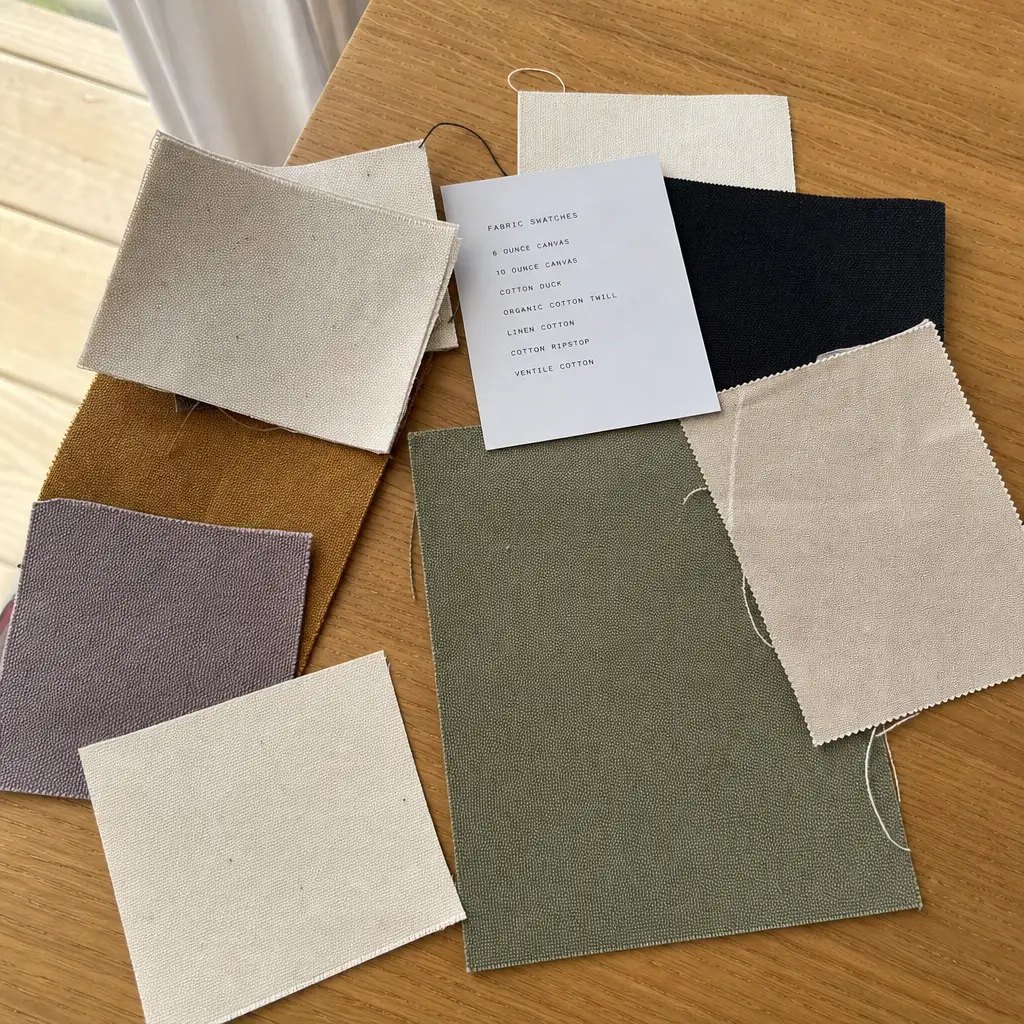
Canvas weight is one of the main cost drivers, but the RFQ should describe both GSM and hand feel. A 10 oz canvas may be acceptable for a light promotional bag, while 12 oz is a common middle ground for natural grocery retail programs. Heavy 16 oz canvas gives more structure but raises fabric cost, sewing difficulty, carton weight, and freight volume.
Natural canvas can vary by shade, seed specks, stiffness, and shrinkage. Some buyers like an unbleached natural look because it matches organic and low-waste brand positioning. Others need a cleaner surface for crisp logo printing. The factory should send fabric swatches before sample approval when color tone and texture affect retail acceptance.
- 8-10 oz or about 270-340 GSM: light, lower cost, less structure, better for simple giveaways.
- 12 oz or about 380-410 GSM: balanced option for reusable messenger bags with moderate load.
- 14-16 oz or about 450-540 GSM: premium hand feel and better body, but more expensive and slower to sew.
- Washed canvas: softer hand feel but may shrink, wrinkle, and vary more by batch.
- Dyed canvas: better brand color control, but higher MOQ and more colorfastness responsibility.
Print and Branding Choices
For natural grocers, branding usually needs to look clean rather than loud. Water-based screen printing is often the best fit for simple CTM-style sample logos, store names, earthy line art, and one to three solid colors. It sinks into the canvas more naturally than thick ink, but color brightness will be affected by the fabric base shade.
Detailed gradients, tiny text, or full-color artwork may require heat transfer or digital print panels, but these methods should be tested for feel, cracking, and edge durability. If the bag is sold as a reusable item, buyers should not approve a print only from a flat artwork proof. A physical strike-off on the actual canvas is the only reliable way to judge ink absorption and color.
- Provide vector artwork in AI, PDF, or EPS format with fonts outlined.
- State print size in centimeters and distance from flap edges or seam lines.
- Use Pantone references but allow a realistic tolerance on natural canvas.
- Request a print strike-off when color accuracy or line detail matters.
- For woven labels, specify label size, fold type, placement, background color, and stitch color.
Construction Details That Change Cost
Two messenger bags with the same outside dimensions can have very different labor cost. A simple unlined flap bag with cotton webbing strap is quick to sew. Add lining, piping, inside divider, metal adjuster, reinforced strap tabs, zipper pocket, and custom label, and the sewing minutes rise quickly. The RFQ should separate must-have features from optional upgrades so suppliers can quote clear alternatives.
The strap attachment deserves special attention because it is the common failure point. A light cross-stitch may look acceptable in photos but fail under repeated load. For grocery retail use, strap tabs should be reinforced with box stitching or bar tacks, and the webbing width should match the expected load and comfort requirement.
- Strap: cotton webbing for natural feel, polyester webbing for strength and color consistency.
- Adjuster: metal adjuster for premium look, plastic adjuster for lower weight and cost.
- Closure: snap button, magnetic snap, zipper, buckle, cotton tie, or hook-and-loop.
- Reinforcement: box stitch, bar tack, double layer fabric, or binding at stress points.
- Lining: no lining for simple inspection, cotton lining for retail finish, polyester lining for easier cleaning.
MOQ and Price Logic
MOQ is not a single number. It changes by fabric sourcing, dyeing, print setup, trim buying, packing, and factory line efficiency. A natural canvas messenger bag with one-color screen print may be possible at a lower MOQ than a custom dyed bag with metal hardware and several labels. Buyers get better quotes when they show annual potential but request the first order quantity separately.
When comparing prices, separate the base bag from changeable items. A supplier may quote a lower unit price but charge separately for screen setup, sample courier, custom carton labels, or fabric dye lot minimums. Another supplier may include more services in the unit price. The RFQ should force each quote into the same cost buckets.
- Base bag cost: fabric, cutting, sewing, normal trimming, and standard inspection.
- Branding cost: screens, print labor, ink, labels, embroidery, or transfer films.
- Development cost: pattern, sample, strike-off, courier, and revisions.
- Packing cost: individual bag, belly band, hangtag, barcode, carton divider, or store pack.
- Commercial terms: EXW, FOB, CIF, DDP estimate, payment terms, and validity date.
Sample Approval Workflow
Sampling should prove the specification, not just create a nice photo. Start with a material swatch if the canvas shade or weight is important. Then approve a proto sample for size and construction. Before bulk production, approve a pre-production sample made with actual fabric, actual print, actual hardware, actual label, and representative packing.
Write comments on the sample in measurable terms. 'Make it stronger' is not useful for the sewing floor. Better comments are 'increase strap webbing from 3 cm to 3.8 cm,' 'move print 2 cm lower,' or 'add bar tack at both strap anchor ends.' The approved sample should be sealed or photographed with measurements so the inspection team has a standard.
- Material swatch approval: fabric weight, shade, hand feel, shrinkage, and print surface.
- Print strike-off approval: color, sharpness, rub resistance, and placement method.
- Proto approval: capacity, dimensions, construction, closure, and comfort.
- Pre-production approval: final materials, final print, final labels, final packing.
- Bulk reference: keep one approved sample at buyer office and one at factory QC table.
Packing and Retail Handling
Packing is often treated as a final detail, but it affects freight cost, receiving labor, and product condition. Canvas can pick up dust and odor during storage, and printed flaps can rub against each other if bags are packed too tightly. For natural grocery retail programs, a recycled polybag, glassine-style paper bag where feasible, or paper belly band may be specified depending on the store's packaging policy.
Carton planning should support the buyer's distribution model. A distributor may want bulk cartons with 50 pieces per carton. A retail chain may need store packs by location, barcode labels, or mixed designs separated clearly. If cartons are too heavy, warehouse teams may reject or repack them, adding hidden cost.
- Define inner packing: no inner bag, individual bag, paper band, hangtag, barcode sticker, or retail sleeve.
- Limit carton gross weight to a practical handling range, commonly under 15-18 kg unless your warehouse allows more.
- Request carton dimensions for freight estimation before placing the order.
- Specify carton marks: PO number, SKU, color, quantity, carton number, country of origin, and destination if needed.
- For store allocation, provide a packing matrix before production starts, not after cartons are sealed.
Lead Time and Schedule Risk
The lead time clock should start after pre-production sample approval and deposit, not after the first email. For standard natural canvas with simple print, production may be much faster than a custom dyed, lined, multi-pocket messenger bag. The buyer should build time for artwork clarification, swatch shipping, sample revision, bulk production, inspection, export booking, and customs documents.
Schedule risk usually comes from late decisions rather than sewing speed. Changing the print size after screens are made, adding a barcode label after packing materials are ordered, or revising carton allocation after packing begins can push delivery. The RFQ should request the factory's production calendar and the last safe date for artwork, packing, and sample approval.
- RFQ clarification: 2-5 working days depending on missing artwork and spec detail.
- Sampling: commonly 7-15 working days after artwork and material confirmation.
- Bulk production: often 25-45 days after approval for standard canvas programs.
- Inspection and booking: reserve time before vessel cutoff or air shipment deadline.
- Risk buffer: add extra days before seasonal resets, trade shows, Earth Month, or store openings.
Quote Comparison and Landed Cost
The lowest FOB price is not always the lowest landed cost. A bag with thinner fabric may create customer complaints. A carton that is too large may increase freight volume. Loose packing may cause print abrasion and repacking. Poor dimension control may make the product hard to merchandise on standard fixtures. Compare quotes by usable bag delivered to the intended warehouse or store program.
A clean quote comparison sheet should include unit price, MOQ, sample charges, setup charges, carton size, gross weight, production time, payment terms, inspection assumptions, and validity period. If one quote is much lower, identify the missing specification before using it as negotiation pressure. The lower price may be based on lighter GSM, fewer stitches per inch, cheaper trim, no inner packing, or a shorter strap.
- Compare fabric weight and construction first, then compare price.
- Calculate freight by carton CBM and gross weight, not only by piece count.
- Add inspection, testing, repacking, duty, brokerage, and domestic delivery where relevant.
- Review payment terms because deposit and balance timing affect cash flow.
- Use a quote validity date when cotton fabric or ocean freight costs are unstable.
Specification comparison for buyers
| Spec decision | Recommended option | When it fits | Buyer risk to check |
|---|---|---|---|
| Main fabric weight | 12 oz cotton canvas around 380-410 GSM for general grocery merchandising | Good balance for reusable retail bags, staff kits, market events, and mid-weight gift-with-purchase programs | Do not compare only by ounce; request GSM, yarn count if available, and a physical swatch because soft-washed and stiff canvas can quote differently |
| Bag structure | Flap messenger with gusseted base, internal divider, and adjustable cotton webbing strap | Useful when natural grocers want a bag that carries catalogs, produce guides, staff materials, or customer loyalty packs | Flat envelope styles quote cheaper but may fail capacity tests once loaded with jars, books, or boxed items |
| Print method | Water-based screen print for 1-3 solid colors; heat transfer only for detailed artwork or tight gradients | Screen print fits earthy brand graphics and keeps the bag washable and retail-appropriate | Low-cost plastisol-like prints may feel heavy on natural canvas; require crocking and wash/rub checks before approval |
| Closure | Metal snap or cotton tie depending on brand positioning and use case | Snap closure suits retail sale or staff bags; tie closure suits softer, plastic-free brand stories | Magnets can affect cost and compliance review; weak snaps create returns, while heavy snaps may tear lighter fabric |
| MOQ logic | 500-1,000 pcs for custom fabric color or multi-color print; lower MOQ possible for natural canvas with simple print | Natural grocery campaigns often start with pilot store quantities before rolling into regional distribution | Quotes below standard MOQ may hide higher print setup, local fabric buying cost, or limited color matching control |
| Lining and pockets | Unlined for low cost and easy inspection; cotton lining for premium retail; internal slip pocket when function matters | Unlined bags fit promotional distribution; lined bags fit paid merchandise or staff programs | Lining adds labor and inspection points; pocket size must be dimensioned or factories may use a token pocket too small for phones or receipt books |
| Packing method | Individual recycled polybag or paper belly band, then export carton with carton marks by SKU and store allocation | Works for grocery retail receiving teams that need clean handling and easy store dispatch | Loose bulk packing lowers cost but can cause dust, creasing, print abrasion, and receiving count disputes |
| Lead time basis | Pre-production sample approval plus 25-45 days production for common canvas specifications | Reasonable for standard natural canvas, simple color print, and normal export packing | Do not approve a schedule without fabric availability, print strike-off timing, packaging artwork, inspection date, and vessel or air cutoff assumptions |
Buyer checklist before sampling
- Define the end use: paid retail item, staff bag, loyalty gift, event giveaway, or supplier co-branded program.
- State finished bag dimensions with width, height, gusset, flap depth, strap length range, and tolerance.
- Specify canvas weight by GSM and ounce, not only by descriptive terms such as heavy duty or premium.
- Attach artwork as vector files and state print size, Pantone targets, print placement, and whether color matching is required on natural fabric.
- Choose closure, lining, pocket, strap, label, and carton packing before requesting final price.
- Request a quote that separates bag cost, print setup, sample charge, packing, testing, inland freight, and export terms.
- Require pre-production sample approval with fabric, print, stitching, hardware, label, and packing all represented.
- Set inspection criteria for dimensions, print adhesion, seam strength, strap attachment, carton marks, and packing count.
- Confirm lead time from sample approval, not from inquiry date, and reserve time for artwork correction and sample shipping.
- Compare landed cost per usable bag, including rejects, repacking, duties, freight volume, and retail distribution handling.
Factory quote questions to send
- What exact canvas GSM, ounce rating, yarn construction, and shrinkage range are included in this quote?
- Is the fabric greige, bleached, dyed, washed, or coated, and is the quoted color from stock or custom dyeing?
- What is the minimum order quantity for this bag body, this print method, and this packaging method separately?
- Which print method is quoted, how many colors are included, and what are the setup or screen charges?
- Can you quote two options: unlined natural canvas and lined canvas with one internal pocket, using the same dimensions?
- What tolerance do you apply to finished dimensions, strap length, print placement, GSM, and carton weight?
- What sample stages are included: material swatch, print strike-off, proto sample, and pre-production sample?
- What is the production lead time after pre-production sample approval, and what assumptions could extend it?
- How many pieces per carton, what carton dimensions, what gross weight, and what packing protection are included?
- Which quality tests can you perform in-house, and which must be sent to a third-party lab at buyer cost?
Quality-control points to confirm
- Finished size within agreed tolerance, normally plus or minus 1 cm for body dimensions unless tighter retail packaging requires otherwise.
- Canvas GSM within agreed range and consistent hand feel between approved sample and bulk production.
- Print placement centered and within agreed tolerance, with no pinholes, heavy ink edges, cracking, ghosting, or obvious color drift.
- Seams straight with secure backstitching at stress points, especially strap anchors, flap corners, gusset ends, and pocket openings.
- Strap length, adjuster function, and shoulder comfort checked with a realistic load, not only visual inspection on an empty bag.
- Closure hardware aligned, secure, and free from sharp edges, rust marks, weak magnetic pull, or fabric tearing around the attachment.
- No unacceptable stains, oil marks, loose threads, broken needles, odor, mildew, or mixed shade panels in the same carton.
- Carton quantity, carton marks, barcode labels, inner packing, and store allocation match the approved packing instruction.