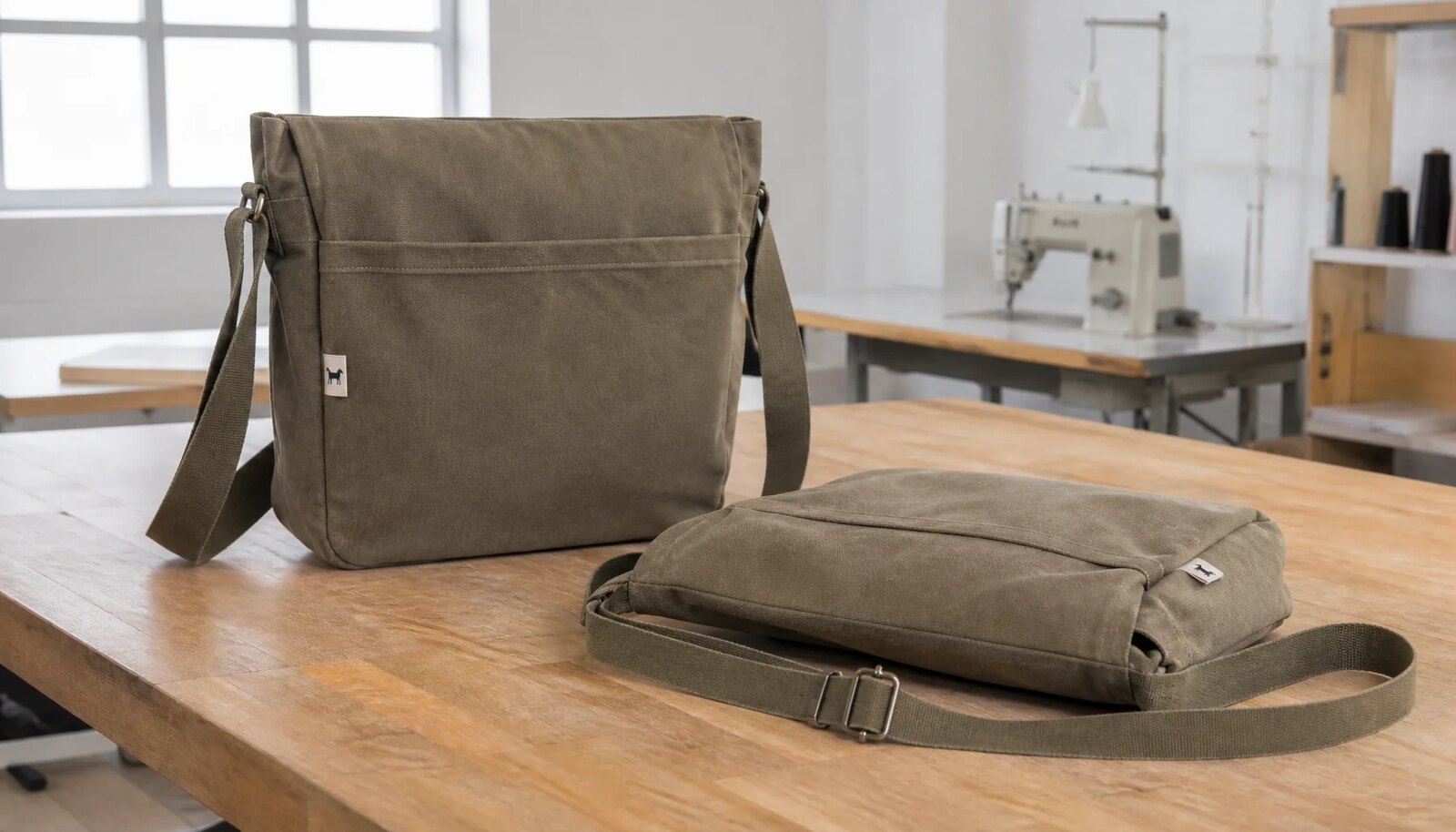
Start With The Market Use Case Before You Discuss The Logo
Print proofing for canvas messenger bags for farmers market vendors should begin with the operating environment, not with the logo file. A market vendor bag is handled repeatedly: loaded before dawn, carried from a vehicle to a stall, placed on folding tables, opened with dusty or damp hands, and packed again at the end of the day. It may hold a card reader, cash pouch, receipt book, phone, pens, product labels, seed packets, sample jars, or a light layer of retail stock. The print is part of the brand, but it is also on a working textile that will rub against aprons, tables, crates, and other bags.
This use case matters because procurement decisions are different for staff bags, resale merchandise, and promotional giveaways. A staff bag can accept slightly more variation if it is durable and functional. A resale bag needs tighter visual consistency, cleaner packing, and a better finish because the end customer will judge it at close range. A promotional giveaway may need a lower unit cost, but the print still cannot smear or crack after the first week. If the buyer does not define the program type, the supplier may quote a generic messenger bag that looks acceptable in a sample photo but does not survive the way farmers market vendors actually use it.
Build the RFQ around measurable use. State the expected load, whether the bag will be worn crossbody or carried short distances, whether contents must be protected from light rain, and whether the printed panel will face outward when worn. Also state whether the bag will be sold, gifted, or used internally. Those details help the factory recommend fabric weight, strap reinforcement, closure style, and the right proof route. A print proofing checklist becomes much more useful when the supplier understands the physical job the bag must do.
- Define the program type: staff issue, resale merchandise, CSA or co-op member gift, market kit, or promotional giveaway.
- List the likely contents: payment device, cash pouch, notebook, phone, product cards, small tools, samples, seed packets, or packaged goods.
- State whether the bag will be worn crossbody, carried by hand, hung from a stall fixture, or displayed for sale.
- Clarify whether visual consistency, hard-use durability, or low landed cost is the main procurement priority.
- Ask the supplier to flag any construction choice that could affect print life, such as flap bend, pocket seam, or strap contact.
Choose The Base Bag Construction Before Artwork Approval
A print proof is only meaningful after the base messenger bag construction is locked. Canvas weight, panel size, gusset shape, pocket placement, flap length, closure type, strap angle, and reinforcement stitching all affect where the logo can sit and how it will look after assembly. If artwork is approved on a flat rectangle before the bag body is confirmed, the factory may later discover that the print falls too close to a seam, bends around a flap, or is partially hidden by a pocket. This is a common source of avoidable sample revisions.
For farmers market vendor programs, 12 to 14 oz finished canvas is often a practical starting range because it balances structure, printability, and freight efficiency. Lighter canvas can work for a lower-cost promotional bag, but it may collapse or wrinkle under a large print. Heavier canvas, such as 14 to 16 oz, can feel more substantial and hold shape better, but the weave may be more textured and sewing bulk increases around straps and seams. Procurement teams should ask for finished GSM or finished ounce weight after washing and finishing. Raw fabric weight before finishing can be misleading if the fabric shrinks, is washed, or changes hand feel during production.
The finish is just as important as the number. A tight plain weave usually gives cleaner screen print edges than a loose rustic weave. Pre-washed or pre-shrunk canvas helps reduce size movement, but it may also soften the surface and slightly change ink absorption. Natural cotton canvas can vary in shade, so a cream or ecru body may not match exactly from lot to lot unless the supplier controls fabric sourcing. Dyed canvas requires attention to crocking and dye consistency. Before approving artwork, ask for a fabric swatch and confirm whether the selected canvas surface supports the logo detail.
- Approve finished bag dimensions, gusset depth, flap length, pocket layout, strap path, and closure type before approving logo placement.
- Specify finished canvas weight or GSM after finishing, not only the fabric name or raw material weight.
- Ask whether the canvas is natural, bleached, dyed, pre-washed, enzyme-washed, raw, or pre-shrunk.
- Use tighter-weave canvas for logos with small text, thin lines, or strong edge requirements.
- Confirm seam, fold, and pocket positions on the actual pattern so the artwork does not land on a high-risk area.
Match Decoration Method To Artwork, Canvas Texture, And Order Size
For many canvas messenger bag programs, screen print is the most practical decoration method. It is cost-effective for repeat orders, handles one- and two-color logos well, and can be controlled through screen setup and curing checks. A simple farmers market logo, farm name, bakery wordmark, produce icon, or co-op brand mark usually prints well if the linework is bold enough. Screen print becomes less reliable when the artwork includes tiny type, distressed texture, gradients, photographic shading, or many colors. The buyer should decide early whether to simplify the artwork or choose a different decoration route.
Embroidery, woven patches, printed patches, and heat transfers can also work, but each has procurement consequences. Embroidery gives texture and a premium feel, yet small letters and detailed farm illustrations may fill in or distort. A woven patch can hold more detail than embroidery and can be sewn onto the bag after printing or sewing, which helps when the canvas surface is rough. A printed patch can provide cleaner artwork on a separate substrate, but it adds label sewing and edge durability questions. Heat transfer may be useful for small runs, personalization, or complex graphics, but the buyer should verify abrasion performance on canvas and avoid assuming it will behave like a print on smooth polyester.
Order size also changes the logic. For a large repeat order, screen setup cost is spread across more units and repeatability becomes a major advantage. For a short seasonal run, a patch or transfer may reduce some setup friction but can raise unit cost or reduce long-term durability. B2B buyers should not ask the factory for the cheapest decoration in isolation. Ask which method gives the best balance of artwork clarity, cost, production control, and use-life for a vendor bag that will be carried weekly.
- Use screen print for bold one- or two-color artwork, repeat orders, and large flat print areas.
- Use a woven or printed patch when the artwork is detailed but the canvas surface is too textured for clean direct printing.
- Use embroidery for simple marks, initials, or small badges where thread texture is part of the intended look.
- Avoid fine gradients, hairlines, small serif text, and QR codes unless the supplier proves they reproduce clearly on the actual fabric.
- Ask the supplier to state the minimum line weight, minimum readable text size, and recommended maximum print area for the selected canvas.
Build A Proof Chain That Removes Guesswork
A strong proof chain is a sequence, not a single approval image. Start with production-ready artwork: vector files, outlined fonts, named spot colors, and any brand color references. If a Pantone color is required, specify the reference and understand that ink on natural canvas may look different from ink on coated paper. The supplier should not be left to interpret a screenshot, a low-resolution PNG, or a logo file with missing fonts. Every ambiguity becomes a sample revision, and every revision adds time.
Next, prepare a placement drawing. The drawing should show the print location in relation to the top edge, side seams, flap edge, pocket opening, zipper tape, strap anchors, gusset boundary, and fold line. It should also include maximum print width and height, centerline, and acceptable placement tolerance. For a messenger bag, this is especially important because the front panel may not be a simple flat rectangle once the flap closes or the bag is worn crossbody. A logo that is centered on a pattern piece can appear off-center when the bag is assembled and filled.
A digital mockup is useful for communication, but it is not a production proof. For first orders, strict brand colors, new suppliers, or artwork near construction details, require a physical strike-off on the actual canvas or the closest production-equivalent canvas. The strike-off confirms ink hold, edge quality, color appearance, and curing behavior. A pre-production sample then confirms how the print works on the assembled bag. Procurement should treat these as different approvals: the strike-off approves the print behavior, while the pre-production sample approves the complete bag.
- Send vector artwork with outlined fonts, named colors, and clear instructions for any simplification.
- Provide a placement drawing with centerline, edge measurements, seam clearance, pocket clearance, and maximum print area.
- Approve a physical strike-off before bulk production for new artwork, new fabric, new supplier, or exacting brand color requirements.
- Approve a complete pre-production sample before bulk when bag construction, print placement, or packing is new.
- Record artwork version, approval date, sample reference, and any accepted deviations in one approval package.
Use The Sample To Test Function, Durability, And Print Behavior
A sample should not be judged only from a front-facing photo. Inspect the complete canvas messenger bag in hand. Check whether the logo is square to the visible panel, whether the print edge is clean, whether solid areas are evenly covered, and whether small type remains readable on the woven surface. Then inspect the bag as a working item: open and close it, adjust the strap, load it with realistic contents, and check whether hardware, flap movement, or strap pressure contacts the printed area. Many print issues appear only after the bag is handled.
The sample should also be checked for construction choices that could create future complaints. Strap anchors should be reinforced because market vendors may carry dense small items even when the bag does not look heavy. Zippers should run smoothly without catching canvas fibers. Flaps should align naturally and should not pull the printed panel out of shape. Pockets should be usable without forcing the bag to bend sharply across the logo. Loose threads, uneven bartacks, and wavy seams are not only cosmetic issues; they signal whether the factory is controlling sewing tension on heavier canvas.
For a resale program, also evaluate how the sample looks after being folded and unpacked. If the approved sample arrives beautifully steamed but bulk goods are folded tightly into cartons, the end result may be different. Fold the sample the way it will be packed, leave it compressed for a short period, then reopen it and check the print for crease sensitivity or contact marks. This does not replace formal lab testing, but it gives procurement a practical view of whether the packing method supports the product presentation.
- Inspect the assembled sample, not only the printed fabric panel.
- Load the bag with realistic contents and check strap anchors, flap alignment, zipper action, pocket access, and print distortion.
- Perform a simple handling check: open, close, fold, adjust strap, rub lightly with a clean dry cloth, and recheck the print.
- Photograph the approved sample from front, back, side, inside, strap connection, closure, label, and packing views.
- Mark the approved reference sample with PO number, artwork version, fabric spec, print method, and approval date.
Set Print And Sewing Tolerances Before Bulk Production
Quality control is easier when the buyer defines tolerances before production. Canvas is a textile, so small variation is normal. However, normal variation is different from uncontrolled production. The purchase order or approval package should state acceptable limits for print placement, color appearance, registration, dimensions, stitching, and packing. Without these limits, the factory may consider a shifted print acceptable while the buyer sees it as a major defect.
For print placement, define tolerance from fixed reference points such as top edge, side seam, pocket edge, or centerline. A practical starting point for many bags is +/- 0.25 in on critical placement and a tighter internal limit if the artwork sits near a seam or flap edge. For color, define the approved physical sample as the main reference when possible. Pantone targets are useful, but the approved strike-off on canvas is usually a better production reference because it captures fabric shade and ink interaction. For registration, the tolerance should be tight enough that two-color logos do not look shadowed or misaligned.
Sewing QC should be part of the same checklist because print defects and sewing defects often interact. If the panel is stretched during sewing, the logo may skew. If a pocket is attached slightly high, it may crowd the print. If strap bartacks are rough, they may rub the decorated surface in packing. Define critical defects such as ink transfer, uncured print, broken strap anchor, nonfunctional zipper, wrong logo, wrong artwork color, or severe carton count error. Define major defects such as visible print shift, smeared ink, skipped stitches at stress points, and incorrect folding. Minor defects can include small thread ends or slight shade variation within approved limits.
- Set written tolerances for print position, registration, color, dimensions, stitch quality, and carton count.
- Use the approved strike-off or pre-production sample as the physical print reference whenever possible.
- Reject prints that touch seams, fold sharply through the artwork, show rub-off, or appear visibly crooked beyond tolerance.
- Define critical, major, and minor defects so inspection decisions are not negotiated carton by carton.
- Ask whether the factory performs inline checks after printing and after sewing, not only final inspection after packing.
Understand Cost Drivers So Quotes Are Comparable
The lowest unit price is not automatically the best procurement option. Canvas messenger bag cost is driven by fabric weight, fabric finish, panel size, sewing complexity, number of pockets, zipper or flap construction, strap material, hardware, decoration method, print colors, print locations, label details, and packing method. A one-color print on a standard front panel is a different product from a two-location print with lining, zipper top, woven label, individual polybag, and retail barcode. Buyers should require suppliers to quote the same specification before comparing numbers.
Setup costs are especially important in print proofing. Screen charges, artwork adjustment, strike-offs, sample fees, and packaging samples may be listed separately or hidden in the unit price. For a first order, separate line items make the quote easier to evaluate because procurement can see what changes if the order repeats. On a reorder, the screen setup may be lower if screens are stored or remade from approved files, but the buyer should confirm how long the supplier keeps screens and whether storage is guaranteed.
MOQ is another area where buyers need specificity. A factory may have one MOQ for canvas purchasing, another for dyeing, another for screen print setup, and another for packing labels. If an order is split into five farm names, three bag colors, or multiple pack methods, the total quantity may look large while each SKU is inefficient. Ask the supplier what drives the MOQ and which simplification would reduce cost: fewer fabric colors, one print location, one artwork size, common packaging, or a standard strap color.
- Request quote lines for sample, strike-off, screen or tooling, unit price, packing, labels, cartons, and export charges.
- Compare suppliers on the same incoterm, same packing method, same artwork count, and same inspection expectation.
- Ask whether screens are stored for reorders and whether repeat setup charges apply.
- Identify MOQ by driver: fabric purchase, dye lot, print setup, sewing line, packaging, or SKU split.
- Simplify the first order by using one body shape, one canvas color, one print location, and limited variants when launch risk is high.
Specify Packing For Transit, Storage, And Presentation
Packing is part of print quality control. Canvas is bulky, can hold creases, and printed surfaces may rub against each other in transit. If bags are packed before ink is fully cured, or if printed panels face each other under pressure, the buyer may receive bags with ghosting, scuffs, or transfer marks. The packing method should be decided before the final sample so the sample can be reviewed in the same fold and protection style intended for bulk shipment.
For most bulk B2B shipments, flat folding with a defined fold line and clean carton packing is a practical starting point. Individual polybags may protect presentation and reduce rubbing, but they add material cost and may not be desired for sustainability reasons. Tissue or interleaf may be enough for certain print surfaces. If the bags are resale merchandise, the buyer may need hangtags, barcode labels, inner cartons, or a consistent fold that looks clean when opened. If the bags are for internal vendor use, bulk packing may be acceptable as long as print surfaces are protected and carton counts are accurate.
Carton specifications should also be included in the RFQ. Ask for units per carton, carton dimensions, gross weight, carton marks, and whether master cartons or inner cartons are used. Keep carton weight reasonable for manual handling. Moisture control matters because canvas can absorb odor and dampness in storage or sea freight. If the shipment will be warehoused and later distributed to many market sites, carton labeling and count accuracy become just as important as the print. A well-printed bag can still create operational problems if it arrives in crushed cartons with inconsistent quantities.
- Approve the final packing method before bulk production: fold direction, printed-face orientation, polybag, tissue, interleaf, inner carton, or bulk pack.
- Confirm ink is cured before packing and that printed surfaces will not be compressed face-to-face without protection if rub risk exists.
- Define carton quantity, carton dimensions, gross weight limit, carton marks, barcode labels, and packing list format.
- Use moisture protection appropriate to route and storage time, especially for sea freight or humid warehouse conditions.
- Request a packed sample or packing photos when resale presentation or direct-to-warehouse handling matters.
Use Lead Time To Expose Process Risk
A supplier's lead time should be broken into stages. A single number such as 30 days after approval does not show where delays can occur. For canvas messenger bags with print proofing, the schedule normally includes artwork review, fabric swatch approval, strike-off, blank or full sample, sample revision if needed, material purchase, printing, curing, sewing, trimming, pressing, packing, inspection, and export preparation. Procurement should ask for a stage-by-stage schedule so everyone knows which approval is blocking the next step.
The highest-risk stage on a first order is often not sewing; it is approval. If artwork is incomplete, Pantone references are unclear, or placement must be revised after the first sample, the production calendar slips. Fabric availability can also affect timing, especially if the buyer selects a nonstandard canvas color or finish. Hardware, zipper tape, custom labels, and special packaging can add their own lead times. A clear proofing checklist helps because it reduces the chance that the supplier starts making screens or buying materials based on incomplete instructions.
If the market launch date is fixed, reduce complexity instead of asking the factory to absorb all risk. Use a standard canvas color, one logo color, one print location, standard hardware, and a proven bag pattern for the first order. Save custom linings, multiple vendor names, special labels, and complex packing for a later run if the timeline is tight. Also build buffer for sample shipping, buyer review time, inspection, and freight handoff. A fast schedule is possible only when the approval package is clean and the factory is working on a controlled production path.
- Ask for a schedule by stage: artwork, strike-off, sample, material purchase, print, sewing, packing, inspection, and shipment readiness.
- Identify which approvals require buyer action and how long your team needs to review them.
- Build buffer for screen remake, sample shipping, fabric delay, hardware delay, packing revision, and final inspection.
- Simplify artwork, colorways, hardware, and packing if the launch date cannot move.
- Do not release bulk production until the approved proof route reflects the actual fabric, print method, and bag construction.
Compare Supplier Routes By Control, Accountability, And Evidence
Supplier selection for canvas messenger bags should be based on process control, not only price. A direct factory with in-house sewing and printing can offer stronger accountability because the same organization controls fabric cutting, print placement, curing, sewing, finishing, and packing. This route is often useful for repeat programs where the buyer wants consistent specifications and a stable approval package. However, the buyer should still verify that printing is truly in-house and that the factory has a clear inspection process.
A trading company or sourcing agent can be useful when the buyer needs broader coordination, smaller mixed orders, or a single communication channel across several product types. The risk is that process visibility may be lower. Procurement should ask who physically prints the bags, who inspects them, who owns rework decisions, and where the approved sample is stored. A domestic decorator can be valuable for urgent small runs or local replenishment, but the buyer should compare total landed cost, available bag bodies, decoration limits, and consistency with imported bulk runs.
Evidence matters. A serious supplier should be able to discuss canvas weight, print limitations, seam clearance, sample route, packing, and inspection without vague answers. Ask for photos of similar production samples, not as proof of your outcome but as evidence that the supplier understands the product category. Ask for a clear quote on the same incoterm and the same pack method. Ask how defects are handled. The goal is not to interrogate the supplier; it is to find out whether they can control the specific risks that farmers market vendor messenger bags create.
- Direct factory route: strong for repeatability when sewing, printing, curing, and QC are controlled under one accountable process.
- Trading company route: useful for coordination, but requires visibility into subcontracted printing, inspection, and rework responsibility.
- Domestic decoration route: useful for urgent or small runs, but verify body quality, print durability, and cost against the imported program.
- Request comparable evidence: similar fabric swatches, strike-off photos, sample photos, packing photos, and written QC tolerances.
- Compare all quotes on the same incoterm, sample route, artwork count, packing requirement, and inspection standard.
Specification comparison for buyers
| Spec decision | Recommended option | When it fits | Buyer risk to check |
|---|---|---|---|
| Fabric weight | 12-14 oz finished canvas, about 406-475 gsm, with a tight plain weave | Daily-use market vendor bags that need structure, print clarity, and reasonable freight efficiency | Ask for finished weight after washing or finishing, not raw fabric weight; confirm shrinkage target, ideally under 3% in each direction, or your approved limit |
| Print method | 1-2 color screen print with documented curing process | Simple farm, bakery, florist, produce, or coffee vendor logos that need repeatable branding across orders | Under-cured ink can feel tacky, block in cartons, or fail rub checks; require a physical strike-off on the actual or equivalent production canvas |
| Artwork format | Vector artwork with outlined fonts, named spot colors, and simplified linework | Bold logos, wordmarks, and icons with fixed brand standards | Fine type, gradients, distressed effects, and hairlines can disappear on textured canvas; approve a real print, not only a PDF |
| Print placement | Flat panel placement with centerline, seam clearance, and maximum print area defined | Messenger bag fronts, flaps, or pocket panels where the logo must sit square when worn or displayed | Logo drift, flap curve, pocket thickness, zipper tape, and strap anchors can distort alignment; approve a seam-aware placement drawing |
| Proof route | Digital layout plus physical strike-off plus pre-production sample for first orders | New supplier, new bag body, strict color standards, or any artwork near seams or hardware | Digital mockups hide weave texture, thread tension, folding marks, and cure quality; do not release bulk production from a screen render alone |
| Supplier route | Direct factory with controlled sewing, printing, finishing, and final inspection | Procurement teams that need one accountable source, repeat specs, and easier correction if print or sewing drifts | Some suppliers outsource printing without disclosure; ask who owns screens, curing, packing, and final QC responsibility |
| MOQ logic | One body shape, one canvas color, one print location, and limited SKU splits | Trial orders, seasonal vendor programs, co-op buying, and brand merchandise launches with inventory risk | Multiple colorways, custom linings, label variants, and split cartons increase setup cost and inspection complexity |
| Closures and straps | Cotton webbing strap, reinforced stress points, secure top zipper or flap when contents matter | Vendor bags carrying payment devices, cash pouch, phone, notebook, small tools, seed packets, or retail stock | Weak strap anchoring and rough hardware are common failure points; ask for bartack details, stitch density, and functional pull checks |
| Packing route | Flat pack with defined fold, individual protection if needed, carton marks, and moisture control | Sea freight, warehouse receipt, retail distribution, or fulfillment to multiple market locations | Fresh print can rub, crease, or ghost onto another bag; set folding direction, interleaf or polybag needs, carton quantity, and max carton weight |
Buyer checklist before sampling
- Define the commercial use first: staff bag, resale merchandise, member gift, market kit, or promotional giveaway. That choice changes fabric weight, closure type, packing, and acceptable cosmetic variation.
- Lock the bag structure before artwork approval: finished dimensions, gusset depth, flap or zipper style, pocket count, lining, strap length range, strap material, hardware finish, and reinforcement points.
- Specify canvas by finished weight or finished GSM after washing and finishing. Do not rely on the word canvas alone; ask whether the fabric is raw, pre-washed, enzyme-washed, dyed, bleached, or pre-shrunk.
- Request a fabric swatch before approving decoration if the color, weave, or surface texture is material to the brand presentation.
- Provide vector artwork with outlined fonts, named spot colors, minimum line weight, minimum text size, and a clear instruction if distressed texture or gradients should be removed.
- Prepare a placement drawing showing centerline, top edge, pocket edge, zipper tape, seam clearance, gusset boundary, fold line, maximum print area, and acceptable placement tolerance.
- Require a physical strike-off on the actual or equivalent production canvas for first orders, strict brand colors, fine artwork, dark ink on natural canvas, or any print near seams.
- Approve a full pre-production sample when the bag structure is new, the logo crosses a flap or pocket, the program is for resale, or the order quantity is large enough that rework would be costly.
- Agree written tolerances for print color, print placement, print registration, fabric shade, dimensions, stitching, and carton count before mass production starts.
- Ask the supplier to separate sample fee, artwork or setup fee, screen or tooling charge, unit price, packing cost, label cost, carton cost, and any export documentation charges in the quote.
Factory quote questions to send
- What is the finished fabric weight or GSM after washing and finishing, and what tolerance do you hold on weight and shrinkage?
- Can you send a physical fabric swatch showing the actual canvas color, weave, hand feel, and surface finish before print approval?
- Is the printing performed in-house on your own screens and curing equipment, or is it sent to another print shop? If outsourced, who is responsible for QC and rework?
- Which print method do you recommend for this artwork on this canvas, and what limitations should we change before making screens?
- How many colors, screens, print stations, and print locations are included in the quoted price? What is the extra cost for each added color or location?
- What is your minimum line weight and minimum readable text size for screen print on this canvas surface?
- What is the MOQ per artwork, per fabric color, per print color, per print location, and per packing method?
- What sample options are available: fabric swatch, printed strike-off, blank fit sample, full pre-production sample, and packaging sample? What is the cost and lead time for each?
- How many sample revision rounds are included before additional charges apply, and what changes normally require a new screen or new sample?
- Can you quote the bag on an FOB basis with sample, screen or tooling, unit price, packing, carton, label, and export documentation charges shown separately?
Quality-control points to confirm
- Print placement must match the approved drawing and remain within the agreed tolerance from centerline, top edge, pocket edge, seam line, flap edge, zipper tape, and strap anchors.
- Printed artwork must stay clear of seams, folds, gussets, zipper tape, bartacks, pocket layers, and areas that bend sharply when the messenger bag is closed or worn.
- Fine text, thin rules, small icons, and logo details must remain legible on the finished woven surface, not only on the digital mockup or paper proof.
- Ink must be fully cured before packing, with no tackiness, blocking, visible transfer, flaking, or excessive cracking after normal handling and a dry rub check.
- Print color should match the approved reference sample or agreed Pantone target within buyer-defined tolerance, recognizing that natural canvas may mute ink color.
- Print edges should be clean enough for the approved artwork style; visible smears, pinholes in solid areas, double images, and unintended ink deposits should be treated as defects.
- Registration between colors must remain within the agreed tolerance so outlines, icons, and text do not appear shifted or shadowed.
- Bag dimensions should stay within approved tolerance after sewing, pressing, folding, and normal handling, especially flap alignment and strap length range.
- Stitching at stress points must be even, secure, and free from skipped stitches, loose threads, broken bartacks, unraveling seams, or exposed raw edges where not specified.
- Strap anchors, D-rings, sliders, zipper pulls, snaps, and magnetic closures must function smoothly and must not scratch, stain, or press into the printed area during packing or use.