Why Coffee Roasters Need a Dedicated MOQ Plan for Canvas Messenger Bags
Coffee roasters sell more than beans—they sell a lifestyle. Many brands carry canvas messenger bags as retail merchandise, employee swag, or limited-edition collaborations with local artists. Unlike a standard tote, a messenger bag must hold weight, resist sagging, and look professional for years of daily use. That means fabric choice, strap construction, and closure type matter far more than simple logo placement.
A common mistake is treating a messenger bag order like a tote bag order. The MOQ logic is entirely different because messenger bags have more components: webbing, buckles, zippers, padding, and interior pockets. Each variation multiplies the minimum quantity and complicates the supply chain. Without a structured plan, you end up paying for 500 bags you don't need or accepting a design that doesn't fit your coffee brand's rugged, artisanal image.
Furthermore, coffee roasters often operate on tight margins and seasonal cycles. Ordering too many bags ties up cash flow, while ordering too few increases the per-unit cost to the point where retail markup becomes unviable. A dedicated MOQ plan aligns your merchandise strategy with your production capacity, ensuring you have enough stock for the holiday rush without overcommitting to a single design.
- Messenger bags require heavier fabric (12-14 oz) to carry weight without distortion.
- Strap and hardware add 3-5 components that each have their own MOQ from suppliers.
- Print placement on a flap or front panel limits design options compared to a flat tote.
- Interior organization (pockets, sleeves) increases MOQ because of added sewing steps.
- Seasonal demand fluctuations require precise MOQ planning to avoid dead stock.
Fabric Weight: The First Decision That Affects MOQ and Cost
Canvas messenger bags for coffee roasters typically use 12 oz (400 GSM) or 14 oz (470 GSM) cotton canvas. Lighter fabric—8 to 10 oz—is cheaper but sags under a 5 lb bag of coffee and looks flimsy after a few months of use. Heavier fabric at 18 oz is extremely durable but adds 30-40% to the bag weight, increasing freight cost and reducing profit margin. For a coffee shop setting, 12 oz offers the best balance of structure and affordability. Meanwhile, 14 oz provides a premium, structured feel suitable for high-end retail.
From a factory perspective, 12 oz and 14 oz are standard stock fabrics. Most mills weave these weights year-round, so lead time is predictable and dye lots are consistent. If you specify a non-standard weight—say, 13.5 oz or 15 oz—the factory must order custom yarn. That raises the MOQ to 1,000+ yards and extends lead time by 3-4 weeks. Stick to common weights unless you have a volume commitment that justifies the custom milling.
It is also vital to consider fabric shrinkage. Unwashed canvas can shrink 5-10% after the first wash, ruining the bag's dimensions and causing the lining to pucker. Ask the factory if they use pre-shrunk fabric or if they wash the canvas before cutting. Pre-shrunk fabric costs slightly more but eliminates the risk of post-production shrinkage, ensuring the bag maintains its shape and size over time.
- 12 oz canvas: good balance of durability and cost; suitable for retail bags under $25.
- 14 oz canvas: premium feel; holds shape better; adds $0.50-$1.00 per bag in material cost.
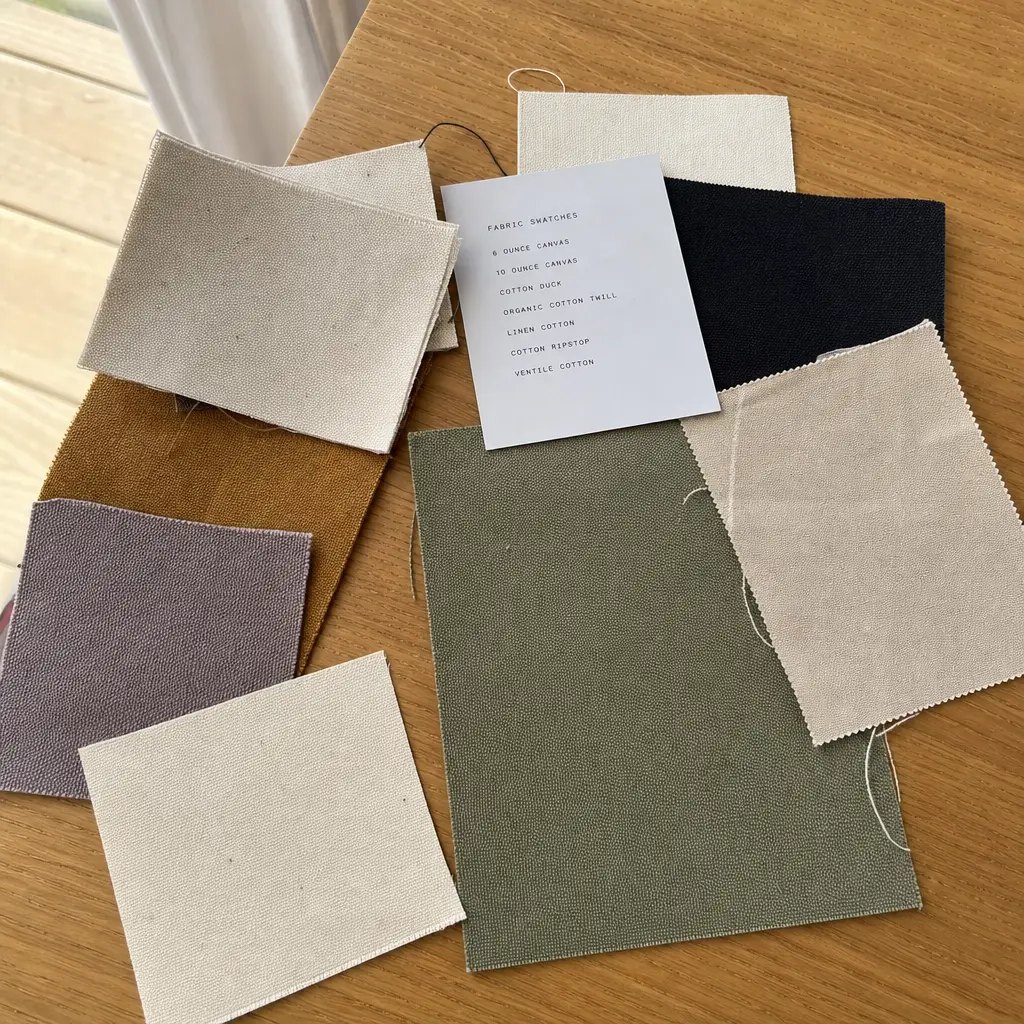
- Ask for a fabric swatch set before committing to a weight; feel the hand and drape.
- Request the GSM test report from the factory to verify weight consistency across rolls.
- Specify pre-shrunk fabric to prevent size variations and lining puckering after washing.
Strap and Closure Choices That Impact MOQ and Usability
The strap is the most stressed part of a messenger bag. For coffee roasters, a 1.5-inch wide cotton webbing strap with a metal buckle is the standard. It distributes weight well and looks rugged enough to match an industrial coffee aesthetic. Avoid 1-inch straps—they dig into the shoulder when carrying heavy items and break faster at the attachment point. Plastic buckles are cheaper but crack in cold weather, which is a problem if your customers commute by bike or walk in winter climates.
Closure type also significantly affects MOQ. A magnetic snap alone is the simplest and lowest MOQ, but it doesn't secure loose items if the bag tips over. A zipper top adds $0.30-$0.60 per bag and increases MOQ by 100-200 pieces because the factory must order zipper chain and sliders in bulk from their hardware supplier. A combination—snap plus zipper—is best for coffee bags that might tip over in a car or on a bike. Plan for at least 500 pieces per closure variant to avoid setup fees.
When selecting hardware, pay attention to the metal finish. Antique brass or matte black hardware complements the natural khaki of canvas well, but cheap plating can rust or chip. Ask the factory about the plating thickness and whether the hardware passes a salt spray test. Also, ensure the D-rings used to attach the strap are welded shut, not butted, to prevent the strap from detaching under heavy load.
- Cotton webbing strap: 1.5" wide, adjustable, with metal buckle and welded D-ring attachment.
- Zipper top: use #5 nylon coil zipper for smooth operation; avoid metal zippers that corrode.
- Magnetic snap: 15 lb pull strength minimum; test with bag fully loaded.
- Combination closure: snap keeps flap closed, zipper secures contents; adds $0.50-$0.80 per bag.
- Hardware finish: specify antique brass or matte black; verify plating thickness to prevent rust.
Print Method Selection: Screen Print, Woven Label, or Embroidery
Your logo on a canvas messenger bag is a walking billboard for your coffee brand. The print method affects both cost and MOQ. Screen printing with water-based ink is the most common for orders of 300-500 pieces. It gives a soft hand, doesn't crack easily, and costs $0.20-$0.50 per color per bag. For a 1-2 color logo, this is the most cost-effective option. Water-based ink also soaks into the canvas fibers, making it feel like part of the fabric rather than a plastic layer on top.
Woven labels are a premium alternative. They are sewn onto the bag and last the life of the product without fading or peeling. The MOQ for a custom woven label is typically 500-1,000 pieces per design, and the tooling cost is $50-$100. Once the labels are woven, they can be used across multiple bag styles, making them a smart investment for brands planning a merchandise line. Embroidery is the most expensive—$1.50-$3.00 per bag—and has a higher MOQ because the factory needs to digitize the logo and set up the machine.
For small test orders under 200 pieces, heat transfer is an option, but it peels after repeated washing and looks cheap. It is not recommended for retail merchandise. When deciding on print placement, consider the flap of the messenger bag. It provides a large, flat surface for branding, but remember that the flap folds over the body of the bag. Avoid placing critical design elements near the fold line where they might be obscured.
- Screen print: best for 1-2 color logos on flat surfaces; MOQ 300 pcs per color/design.
- Woven label: premium look; MOQ 500 pcs per design; add $0.30-$0.60 per bag.
- Embroidery: high durability; MOQ 200 pcs per design; cost $1.50-$3.00 per bag.
- Heat transfer: low MOQ (100 pcs); but peels after 10-15 washes; not recommended for retail.
- Placement: center logo on the front flap; avoid the fold line to ensure visibility.
Sample Approval Process: What to Check Before Bulk Production
A proto sample is your first chance to see if the bag meets your expectations. Always request a sample with your chosen fabric, closure, strap, and print method. The factory should provide a sample within 7-10 business days. Do not skip this step to save time. A rushed sample—3 to 4 days—often has incorrect stitching, poor color matching, or hardware that doesn't align, giving you a false impression of the factory's true quality.
When you receive the sample, test it with actual weight. Fill it with 5-10 lb of coffee bags and carry it for 10 minutes. Check the strap stitching, bottom seam, and closure under load. Measure the dimensions against your spec sheet. If the sample is off by more than 0.5 inch in any direction, request a revised sample before approving. Pay special attention to the gusset width; a narrow gusset makes the bag look flat and limits its capacity, while a wide gusset makes it bulky.
Once approved, keep a sealed reference sample for the factory to match during production. This sample serves as the contractual standard for quality. If the bulk production bags differ from the sealed sample, you have grounds to request a remake or discount. Also, photograph the sample from all angles and document any specific details—stitch density, label placement—in a spec sheet to accompany the sample.
- Request a proto sample with your exact fabric, closure, strap, and print method.
- Test the bag with weight equivalent to your intended use (e.g., 5 lb coffee bags).
- Check all dimensions: length, width, gusset, strap length, pocket sizes.
- Verify print color and placement against your artwork; use a Pantone reference.
- Keep a signed and dated reference sample for bulk production comparison.
- Document all specs in a tech pack to accompany the sealed sample.
Packing and Labeling: Retail-Ready vs. Bulk Distribution
How you pack your canvas messenger bags affects freight cost, warehousing, and retail presentation. For direct-to-cafe distribution, bulk packing—50 bags per carton without individual polybags—is cheapest. But if you sell through retail stores or online, individual polybags protect the bag from dust and moisture during transit and storage. Add $0.10-$0.20 per bag for polybagging. Biodegradable or compostable polybags are also available for eco-conscious brands, though they cost 30-50% more.
Carton size matters for freight. A standard export carton for 50 messenger bags measures about 24x18x12 inches and weighs 25-35 lb depending on fabric weight. Confirm the carton dimensions and weight with the factory to calculate shipping cost per unit. Also decide on labeling: do you need a hang tag with care instructions, a barcode sticker, or a branded dust bag? Each adds cost and may increase MOQ. For retail readiness, a hang tag with a string loop is essential, as it allows the bag to be displayed on hooks.
Don't forget interior labeling. A care label sewn into the interior seam should include fabric content, country of origin, and washing instructions—for example, "Cold wash, line dry." Missing or incorrect care labels can lead to customer complaints and returns if the bag shrinks or colors bleed after washing. Ensure the factory uses a label material that doesn't scratch the skin, as rough labels can irritate the neck when the bag is carried on the shoulder.
- Individual polybag: protects bag; adds $0.10-$0.20 per bag; recommended for retail.
- Bulk pack: 50 bags per carton without polybags; lower cost but risk of dust or moisture.
- Carton labeling: include SKU, quantity, and barcode if shipping to a warehouse or retailer.
- Hang tags: $0.05-$0.15 each; include care instructions and brand story.
- Dust bag: premium option; adds $0.50-$1.00 per bag; MOQ 500+ pieces.
- Care label: include fabric content, origin, and wash instructions to prevent returns.
Lead Time Planning: From Sample Approval to Shipment
Bulk production for canvas messenger bags typically takes 30-45 days after sample approval. This includes fabric cutting, sewing, printing, assembly, and final inspection. If you need the bags for a specific event or holiday season, add 2 weeks for potential delays. Common delays include fabric shortage, print color matching, and hardware backorders. For example, custom metal buckles can take 2-3 weeks to produce if the factory doesn't have them in stock.
To reduce lead time risk, order fabric and hardware early. Some factories allow you to pre-order materials while the sample is being finalized. This can cut 1-2 weeks from the total lead time. Also, request a production schedule with milestones: cutting start, sewing start, print date, and inspection date. This gives you visibility and allows you to intervene if a milestone is missed. A factory that refuses to provide a production schedule may be hiding capacity issues.
Plan around Chinese New Year—late January to mid-February—and other major holidays, as factories shut down for 2-3 weeks. Orders placed in December often don't ship until March. If you must have bags delivered during this period, place your order by November and confirm the factory's holiday shutdown dates in writing. Air freight is an option for urgent orders, but it costs 3-5x sea freight and is only viable for high-margin products or small quantities.
- Standard lead time: 30-45 days after sample approval for 500-2,000 pieces.
- Pre-order materials: ask if you can order fabric and hardware while sample is in progress.
- Request a production schedule with milestones to track progress.
- Add 2 weeks buffer for holiday seasons or peak production months (Aug-Oct).
- Air freight option: 7-10 days but costs 3-5x sea freight; only for urgent orders.
- Plan around Chinese New Year; place orders by November to avoid March delays.
Cost Breakdown: What Drives the Per-Unit Price
The per-unit price of a canvas messenger bag depends on fabric weight, print method, hardware, and order quantity. A typical 12 oz canvas bag with screen print, magnetic snap, and cotton webbing strap might cost $4.50-$6.50 FOB for 500 pieces. Upgrading to 14 oz canvas adds $0.50-$1.00. Adding a zipper adds $0.30-$0.60. Embroidery adds $1.50-$3.00. These are FOB—Free on Board—prices, meaning they include the bag and delivery to the port of origin, but not international freight or import duties.
The biggest cost driver is quantity. Moving from 500 to 1,000 pieces typically reduces per-unit cost by 15-25% because setup costs—pattern making, screen printing, hardware ordering—are spread over more units. Moving from 1,000 to 2,000 pieces reduces cost by another 5-10%. Beyond 2,000, the savings diminish because material cost becomes the dominant factor. When calculating your total landed cost, don't forget to add freight—10-20% of FOB price—import duties, which vary by country, and domestic shipping to your warehouse.
Labor is another significant component. Messenger bags require more sewing time than tote bags due to the complexity of the flap, strap attachment, and interior pockets. Factories with skilled labor—for instance, in Vietnam or India—may charge more per unit but offer better quality and fewer defects, reducing your long-term cost of returns and replacements. Don't choose a factory solely on price; consider their experience and quality control processes.
- Fabric: 12 oz canvas ~$2.00-$3.00 per bag; 14 oz canvas ~$2.50-$3.50 per bag.
- Print: screen print $0.20-$0.50 per color; woven label $0.30-$0.60; embroidery $1.50-$3.00.
- Hardware: magnetic snap $0.10-$0.20; zipper $0.30-$0.60; metal buckle $0.15-$0.30.
- Labor: sewing and assembly $1.50-$2.50 per bag depending on complexity.
- Quantity discount: 500 pcs ~$5.50/unit; 1,000 pcs ~$4.50/unit; 2,000 pcs ~$4.00/unit.
- Total landed cost: add freight (10-20%), duties, and domestic shipping to FOB price.
Common Mistakes Coffee Roasters Make When Ordering Messenger Bags
The most common mistake is ordering a bag that is too small. Coffee roasters often underestimate the size needed to hold a 12 oz bag of coffee, a notebook, and a phone. A messenger bag should be at least 14x10x4 inches to be useful. A bag that is 12x8x3 inches looks good in a photo but is too small for daily use, leading to returns or low sell-through. Always check the interior dimensions, not just the exterior, as thick canvas and padding can eat into usable space.
Another mistake is ignoring the strap attachment. Many bags use a single stitch to attach the strap to the bag. This fails under weight, especially when the bag is loaded with coffee. Always specify bar-tack stitching—3 rows of dense zigzag—at all stress points. Also, avoid bags with a single interior pocket. Coffee roasters need at least two pockets: one for a phone and one for a pen or small notebook. These details cost little but add significant value.
Finally, don't overlook the lining. An unlined canvas bag looks cheap and allows seams to fray, shortening the bag's lifespan. A cotton or polyester lining adds $0.50-$1.00 per bag but gives the bag a premium feel and protects the contents from loose threads. If you use a polyester lining, ensure it is bonded to the canvas to prevent sagging. A hanging lining looks sloppy and makes it difficult to slide items in and out of the bag.
- Size: minimum 14x10x4 inches to hold coffee bags and daily essentials.
- Strap attachment: require bar-tack stitching at all stress points.
- Interior pockets: at least two slip pockets; one padded sleeve for tablet if applicable.
- Bottom reinforcement: double-layer bottom or extra stitching to prevent sagging.
- Care label: include washing instructions (cold water, line dry) to prevent shrinkage.
- Lining: use cotton or bonded polyester lining to prevent fraying and sagging.
How to Compare Factory Quotes for Canvas Messenger Bags
When you receive quotes from multiple factories, don't compare only the per-unit price. Look at the MOQ per SKU, sample fee, lead time, and packing terms. A factory with a lower per-unit price but a higher MOQ may force you to order more than you need, tying up cash flow. A factory with a longer lead time may miss your launch date. Create a comparison table with these factors before deciding. Also, check if the quote includes interior lining, pockets, and hardware, as some factories quote a low base price and add fees for these components later.
Also check the factory's experience with messenger bags. Ask for photos of similar bags they have produced. Look for clean stitching, consistent print alignment, and proper hardware attachment. A factory that mainly produces tote bags may not have the skills to make a messenger bag with a zipper and padded sleeve. Request a proto sample from your top two factories and compare them side by side. The sample quality is a strong indicator of bulk production quality.
Communication is key. A factory that responds slowly to emails or avoids answering specific questions about materials or QC is likely to cause problems during production. Choose a factory with a dedicated sales representative who understands your requirements and can provide clear, detailed answers. A good factory will proactively offer suggestions to improve your design or reduce costs, demonstrating their expertise and commitment to a long-term partnership.
- Compare per-unit price at your target quantity, not at the factory's minimum.
- Check MOQ per SKU: some factories require 500 pcs per color/print combination.
- Sample fee: $50-$150 is typical; some factories waive it for bulk orders.
- Lead time: 30-45 days is standard; shorter lead times may indicate rushed quality.
- Packing: confirm if individual polybags and carton labeling are included in the price.
- Factory experience: ask for photos of messenger bags, not just tote bags or pouches.
- Communication: choose a factory with responsive, knowledgeable sales staff.
Specification comparison for buyers
| Spec decision | Recommended option | When it fits | Buyer risk to check |
|---|---|---|---|
| Fabric weight (GSM) | 12 oz (400 GSM) or 14 oz (470 GSM) | Daily carry of 5-10 lb coffee bags or merchandise | Too light (8 oz) sags under weight; too heavy (18 oz) adds freight cost |
| Strap type | Adjustable cotton webbing, 1.5" wide with metal buckle | Roasters selling to cyclists or commuters | Thin webbing (1") digs into shoulder; plastic buckles break in cold weather |
| Closure | Magnetic snap + zipper top | Bags that hold loose coffee bags or small accessories | Velcro wears out; only snap risks spill if bag tips |
| Interior pocket | Padded laptop sleeve + 2 slip pockets | Roasters who include a tablet or order pad | No padding risks damage; too many pockets increase MOQ |
| Print method | Screen print (water-based ink) or woven label | Orders under 500 pcs with simple 1-2 color logo | Heat transfer peels after wash; embroidery adds $1.50-$3.00 per bag |
| MOQ per SKU | 300-500 pcs per color/print | First test order for a new coffee brand | Under 300 pcs often incurs setup fees or higher per-unit cost |
| Sample lead time | 7-10 business days for proto sample | Before committing to bulk production | Rushed samples (3 days) skip color matching or stitch tension checks |
| Bulk lead time | 30-45 days after sample approval | Standard production window for 500-2000 pcs | Under 25 days risks skipped inspection or fabric substitution |
| Packing | Individual polybag + 50 pcs per export carton | Retail-ready or direct-to-cafe distribution | Bulk packing without polybags causes dust or moisture damage |
Buyer checklist before sampling
- Confirm fabric GSM with a swatch in hand; don't rely on spec sheets alone.
- Request a proto sample with your chosen closure, strap, and pocket configuration.
- Test the bag with actual weight (e.g., 5 lb of coffee) to check strap stitching and bottom seam.
- Ask for a print strike-off or woven label sample before approving bulk production.
- Verify carton dimensions and weight to estimate freight cost per unit.
- Get a written MOQ breakdown per SKU, including color and print variations.
- Confirm lead time in calendar days, not business days, to avoid warehouse delays.
- Request photos or video of the first 50 pieces before full production runs.
- Check that interior seams are bound or French-seamed to prevent fraying.
- Ask about overrun tolerance (usually +/-5%) and how it's billed.
Factory quote questions to send
- What is your MOQ per SKU for a canvas messenger bag with a zipper top and adjustable strap?
- How does the per-unit price change if I order 500 vs 1000 vs 2000 pieces?
- What is the cost difference between screen print, woven label, and embroidery for a 2-color logo?
- Can you provide a proto sample within 10 business days, and what is the sample fee?
- What is the lead time for bulk production after sample approval, and what could delay it?
- Do you offer AQL 2.5 inspection before shipment, and what is the standard defect threshold?
- What packing options do you offer: individual polybag, bulk pack, or retail-ready with hang tags?
- What is the cost and lead time for adding a padded laptop sleeve or interior zip pocket?
- Can you provide a fabric swatch set for the 12 oz and 14 oz canvas options?
- What is your policy on overruns or underruns, and how are they invoiced?
Quality-control points to confirm
- Fabric weight tolerance: +/-5% of specified GSM; heavier is acceptable, lighter is not.
- Strap stitching: minimum 3 rows of bar-tack at stress points (attachment to bag, buckle loops).
- Zipper operation: smooth open/close with no snagging on lining; pull tab securely attached.
- Print adhesion: rub test with dry cloth for 10 seconds; no ink transfer or fading.
- Seam strength: bottom seam must hold 15 lb static weight for 1 minute without tearing.
- Color consistency: Delta E ≤ 2.0 between sample and production run under D65 light.
- Pocket stitching: double-stitched at corners; no loose threads or skipped stitches.
- Hardware finish: no sharp edges, rust spots, or plating defects on buckles or snaps.
- Packing condition: cartons must be dry, sealed with tape, and labeled with SKU and quantity.
- Sample approval: signed off by buyer before bulk production; keep a sealed reference sample.