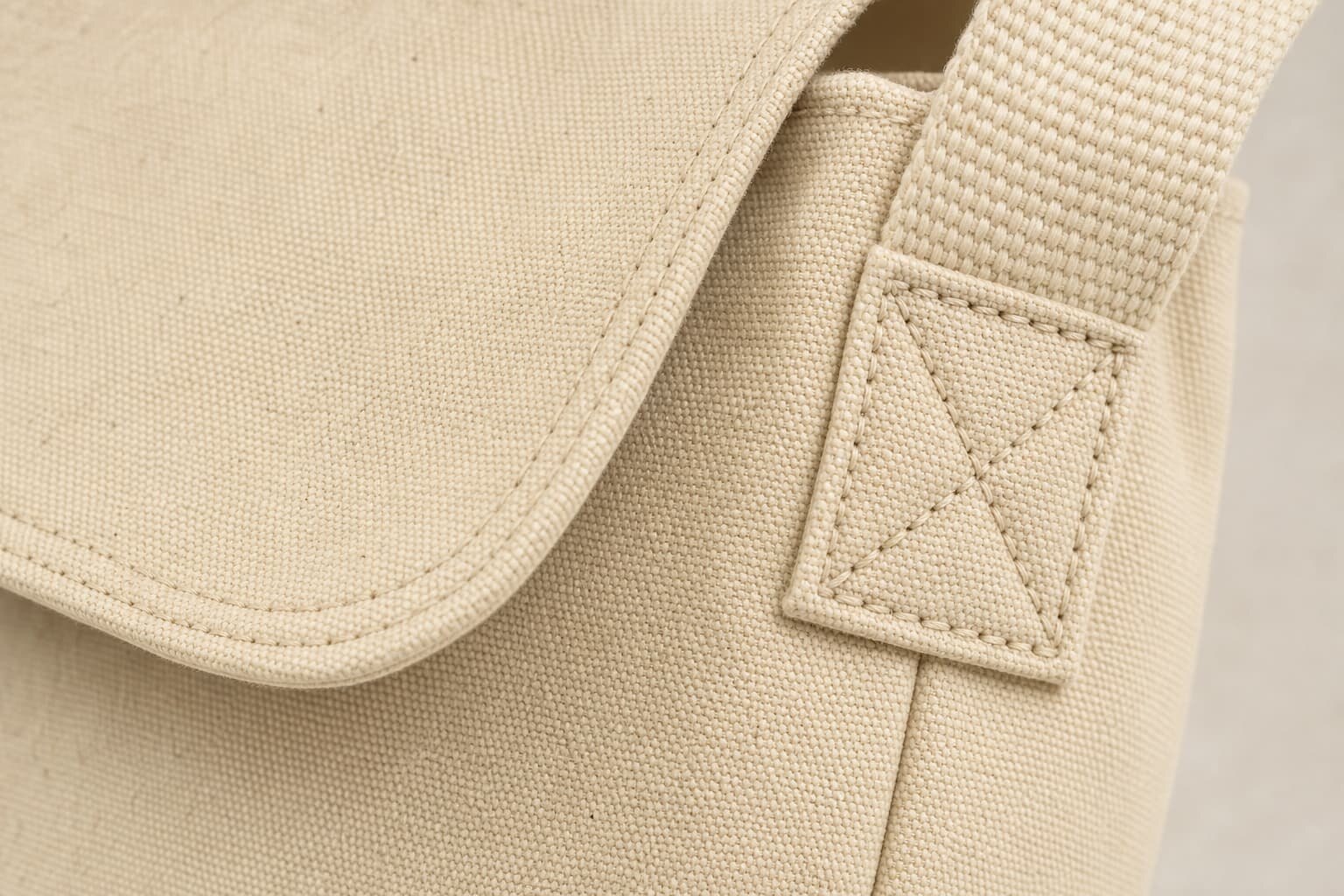
Why material compliance is harder on messenger bags
A canvas messenger bag is not just one fabric panel with a logo. It normally combines heavy canvas, lining, webbing, zipper tape, thread, metal hardware, magnetic snaps, reinforcement patches, labels, coatings, print ink, and retail packaging. Each component can create a compliance question. If the RFQ only says "12 oz canvas messenger bag with logo," suppliers may quote different material packages while all appearing similar in the first photo.
The buying problem is simple: procurement needs comparable quotes that can pass the buyer's market requirements without delaying production. The safest approach is to build compliance into the product specification before sampling. This reduces the chance of approving a good-looking sample that later fails restricted substance checks, labeling review, or retailer intake inspection.
- Treat canvas, lining, webbing, trims, print, labels, and packing as separate compliance inputs.
- Ask for finished material details, not only supplier catalog descriptions.
- Avoid approving substitute sample materials if compliance approval depends on bulk components.
- Document the sales market because EU, UK, US, and other markets may require different evidence.
Start with the correct canvas specification
Canvas weight is one of the first cost drivers, but it is also a compliance and performance variable. Messenger bags often use 10 oz, 12 oz, 14 oz, or 16 oz canvas. In GSM terms, buyers commonly see a range from roughly 340 GSM to 540 GSM depending on yarn, weave, finishing, and moisture content. A 12 oz canvas from one mill may not feel identical to another supplier's 12 oz canvas, especially after dyeing, enzyme washing, water-repellent finishing, or lamination.
For RFQ control, specify whether the weight is greige fabric weight or finished fabric weight. Finished weight is more useful for inspection because it reflects what the customer receives. If the bag must carry a laptop or heavy documents, do not choose fabric only by lowest GSM. A slightly heavier canvas with proper seam reinforcement may reduce returns, while an over-heavy fabric may increase freight cost, needle breakage, and bulky packing.
- Light promotional messenger bag: often 8 oz to 10 oz canvas, but confirm if shape collapse is acceptable.
- Everyday retail messenger bag: often 12 oz to 14 oz canvas with reinforced stress points.
- Premium structured messenger bag: often 14 oz to 16 oz canvas, sometimes with lining or interlining.
- Quote requirement: ask for fabric composition, weave, finished GSM or oz, color process, shrinkage, and tolerance.
Map compliance by component, not by bag description
A frequent sourcing mistake is asking, "Is the bag compliant?" That question is too broad. A supplier may have a test report for natural cotton fabric, but your ordered bag may use dyed black canvas, polyester lining, PU zipper pullers, nickel-plated metal sliders, PVC patches, and plastisol ink. The test report may not cover the actual risk materials in your order.
A better method is a component map. List every visible and hidden material and mark whether it needs a declaration, test report, or buyer approval. This is especially important for retail chains and brand owners that maintain restricted substance lists. If the supplier cannot define the material package at quote stage, the quote is not ready for serious comparison.
- Main body: cotton canvas, recycled blend canvas, washed canvas, coated canvas, or dyed canvas.
- Inside: polyester lining, cotton lining, internal binding tape, foam padding, or interlining.
- Carry system: cotton webbing, polyester webbing, metal D-rings, plastic adjusters, reinforcement patches.
- Closure: zipper, magnetic snap, buckle, hook-and-loop tape, rivets, or press buttons.
- Branding: screen print ink, heat transfer film, embroidery thread, woven label, leather-look patch, or rubber badge.
- Packing: polybag, paper wrap, sticker, carton ink, desiccant, and retail hangtag.
Choose print and branding methods with compliance in mind
Logo method affects both appearance and compliance workload. Screen printing is practical for solid-color logos on canvas and can be cost-efficient at larger quantities. Heat transfer can handle gradients and fine artwork, but the film and adhesive layer should be checked for restricted substances and heat resistance. Embroidery gives a durable retail feel, but it adds thread, backing, needle holes, and possible puckering on lighter canvas. Woven labels and patches look controlled, but they introduce separate supplier inputs.
Do not approve artwork only from a digital proof. For canvas messenger bags, the surface texture, fabric color, and curing process can change logo sharpness. A print strike-off on the actual canvas is more useful than a paper color proof. For dark canvas, ask whether a white underbase is needed. For coated canvas, confirm ink compatibility because poor adhesion may not show until abrasion or packing pressure.
- Screen print: ask for ink type, curing temperature, colorfastness, and rub resistance.
- Heat transfer: ask for film composition, adhesive safety, wash or abrasion performance, and edge lifting risk.
- Embroidery: check thread colorfastness, backing material, stitch density, and fabric distortion.
- Woven label: confirm fiber composition, label dye compliance, needle placement, and whether the label is sewn before or after washing.
- Patch branding: avoid vague terms such as leather patch unless the material and compliance scope are confirmed.
Understand MOQ logic before comparing quotes
MOQ for canvas messenger bags is rarely based only on sewing capacity. It usually comes from fabric dyeing minimums, canvas mill lot size, custom webbing dyeing, lining availability, hardware plating, logo setup, woven label minimums, and packaging printing. Two suppliers may quote different MOQs because one uses stock natural canvas and stock black webbing, while another books custom-dyed fabric and matching trims.
Procurement teams should separate product MOQ from component MOQ. This helps when negotiating a first order. For example, a supplier may accept a smaller bag quantity if the buyer uses stock fabric and standard hardware, but custom Pantone canvas may require a larger fabric order. If the order has multiple colors, confirm whether MOQ applies per color, per style, or per total order.
- Low MOQ route: stock natural or black canvas, standard webbing, standard metal finish, one-color screen print.
- Medium MOQ route: custom fabric color, custom lining, branded woven label, standard hardware.
- Higher MOQ route: organic or recycled claims, custom dyed webbing, custom metal finish, printed retail carton.
- Quote comparison rule: ask suppliers to show which MOQ is driven by fabric, trims, logo, or packing.
Set sample checks before approving bulk materials
A messenger bag sample should answer more than appearance questions. It should show whether the chosen material package can be sewn cleanly, packed without deep creases, and handled without color transfer. Request a pre-production sample made with bulk-intended fabric, webbing, lining, hardware, thread, label, and print method. If substitutions are unavoidable during early development, mark the sample as appearance reference only and do not use it for final compliance approval.
After receiving the sample, check the bag like an inspector, not only like a merchandiser. Fill it with a realistic load, adjust the strap several times, open and close all hardware, rub dark areas with a white cloth, and inspect the inside seam finishing. If the bag has a flap, make sure the flap covers the opening evenly after the bag is filled, not only when empty on a table.
- Measure body width, height, gusset, flap drop, strap length, pocket depth, and handle drop if included.
- Check shade under daylight and store lighting because canvas dye can shift visually.
- Inspect stitch density, skipped stitches, broken thread, seam allowance, and reinforcement bartacks.
- Test print by light scratching, tape pull, folding, and rubbing against canvas texture.
- Pack the sample for 24 hours to check print blocking, creasing, odor, and shape recovery.
Build realistic lead time into the compliance plan
Lead time becomes unreliable when compliance steps are treated as paperwork after production. For a custom canvas messenger bag, the sequence may include fabric sourcing, lab dip, dyeing, print strike-off, trim approval, sample sewing, buyer review, material testing, bulk booking, cutting, sewing, final inspection, and packing. If a retailer requires test reports before shipment, testing should be planned before bulk goods are completed.
Buyers should ask suppliers to show the timeline by milestone, not only give one total production lead time. A supplier may say production takes 30 to 45 days, but that may exclude lab dip approval, sample revision, third-party testing, carton label approval, or holiday closures. When the order has custom-dyed canvas, custom hardware, or recycled content documentation, add buffer for document review and rejected lab dips.
- Lab dip and material approval: confirm number of rounds included and approval deadline.
- Print strike-off: approve logo size, color, hand feel, and placement before bulk printing.
- Pre-production sample: require bulk-intended materials where possible.
- Testing: define who books, who pays, what standard applies, and when samples are pulled.
- Final inspection: schedule after packing but before final balance payment or shipment release.
Packing and storage can create compliance failures
Canvas bags can fail commercially even when the material itself is acceptable. Moisture, poor curing, heavy compression, and wrong packing can cause mildew, odor, print transfer, rust marks, and permanent creasing. Messenger bags are especially sensitive because the flap and strap can press against printed panels during long sea freight. Light natural canvas also shows dirt and carton dust easily.
Packing should be specified in the RFQ, not left to the factory's default. Decide whether each bag needs a polybag, paper sleeve, tissue, strap tie, silica gel, hangtag, barcode label, or retail carton. If your market restricts certain plastic packaging or requires suffocation warnings, include that requirement early. For ecommerce distribution, also ask whether the packed bag can pass normal carton handling without deformation.
- Use dry cartons and avoid packing bags before print ink is fully cured.
- Place straps so metal adjusters do not dent or stain the front flap.
- Separate dark and light colors if there is any risk of dye migration.
- Use agreed carton dimensions to control compression and freight calculations.
- Confirm carton marks, barcode position, country of origin, and retail labels before mass packing.
Quote data procurement should require
A useful quote for a canvas messenger bag should let your team compare material risk, not only unit price. Ask for a structured quote sheet that states the body fabric, lining, webbing, hardware, print method, label, packing, MOQ, sample cost policy, lead time, and testing responsibility. If a supplier leaves these blank, the low price may depend on assumptions that are not suitable for your market.
The most important quote detail is whether the supplier is quoting your specified bag or a simplified version. Small changes can move cost and compliance: 12 oz instead of 14 oz canvas, polyester instead of cotton webbing, unlined instead of lined construction, standard zinc alloy hardware instead of nickel-free hardware, or heat transfer instead of screen print. Make the supplier state deviations in writing.
- Fabric: composition, finished GSM or oz, color, finish, shrinkage, and tolerance.
- Construction: dimensions, gusset, flap style, pocket layout, lining, seam finishing, and reinforcement.
- Trims: strap width, webbing composition, hardware material, plating, zipper type, and label type.
- Branding: artwork size, color count, print method, logo position, setup charge, and strike-off timing.
- Compliance: target market, available reports, missing reports, testing cost, and component coverage.
- Logistics: carton quantity, carton size, gross weight, net weight, packing method, and estimated CBM.
Common mistakes that delay approval
Most delays come from unclear assumptions rather than difficult manufacturing. A buyer approves a sample with stock fabric, then asks for custom color after the bulk fabric is booked. A supplier quotes standard hardware, then the retailer requests nickel-free confirmation. A logo is approved on screen, then the actual print looks weak on textured canvas. These problems are avoidable when material compliance and sample approval are connected.
Another common issue is claiming sustainability without documentation. If the product page says organic cotton, recycled cotton, recycled polyester lining, or eco-friendly ink, procurement must confirm the claim can be supported. Unsupported claims can create retailer rejection, customs questions, or marketing risk. Keep claims specific and evidence-based.
- Do not rely on old test reports unless they cover the same material, color, finish, and component type.
- Do not approve a logo proof without checking print on the actual canvas surface.
- Do not mix custom color approval and bulk production booking without signed lab dip approval.
- Do not assume metal hardware is acceptable without nickel, lead, cadmium, and corrosion review where relevant.
- Do not let factories choose packing after production if the bag has light canvas or front-panel printing.
Specification comparison for buyers
| Spec decision | Recommended option | When it fits | Buyer risk to check |
|---|---|---|---|
| Main canvas weight | 12 oz to 16 oz cotton canvas, roughly 400-540 GSM depending on finish | Retail messenger bags needing structure, durability, and a premium hand feel | Confirm whether the supplier quotes greige, dyed, or finished GSM; coating and washing can change weight and shrinkage |
| Lining material | 210D or 300D polyester, or unlined with bound seams for a natural look | Lined bags fit tech, work, and school use; unlined bags fit eco and promotional ranges | Check colorfastness, odor, REACH restricted substances, and whether lining reduces recyclability claims |
| Print method | Screen print for solid logos, heat transfer for detailed color, embroidery or woven patch for premium branding | Choose based on logo detail, order quantity, and required wash or rub resistance | Ask for ink compliance documents and print adhesion test results before approving bulk |
| Hardware | Nickel-free metal slider, D-rings, magnetic snap, or plastic hardware if metal testing is sensitive | Metal gives a stronger retail look; plastic reduces weight and some metal compliance risk | Request heavy metal test scope, nickel release requirement, and pull strength for strap connection points |
| Shoulder strap | 38 mm to 50 mm cotton or polyester webbing with reinforced box stitching | Wider straps suit laptop and commuter styles; narrower straps suit light promotional bags | Check strap length tolerance, color migration, edge fraying, and stitch density at load-bearing seams |
| Closure system | Flap with magnetic snap, buckle, hook-and-loop, or zipper under flap | Magnetic and buckle closures suit retail; hook-and-loop suits budget or school use | Confirm child safety, sharp edges, noise expectation, and corrosion resistance after humidity exposure |
| Packaging | Individual recyclable polybag or paper sleeve plus export carton with moisture control | Needed when bags have light color canvas, printed panels, or retail-ready presentation | Check suffocation warning, polybag thickness rules, carton drop strength, and mildew prevention for sea freight |
Buyer checklist before sampling
- Define the market of sale first: EU, UK, US, Canada, Australia, Japan, or mixed markets may need different restricted substance and labeling controls.
- State the exact canvas type: cotton, recycled cotton blend, organic cotton, cotton-poly blend, dyed canvas, washed canvas, coated canvas, or natural unbleached canvas.
- Specify finished fabric weight in oz or GSM, not only the fabric name, and ask whether the quoted weight is before or after dyeing, washing, coating, or lamination.
- Confirm the restricted substance scope for fabric, lining, thread, webbing, zipper tape, print ink, coating, metal hardware, adhesive, and packaging.
- Ask the factory to identify all components that directly touch the user: shoulder strap, handle, flap edge, metal slider, zipper pull, label, and printed surface.
- Require print method, ink type, curing process, and print position in the quotation so the compliance risk is not hidden inside a vague logo charge.
- Request a pre-production sample made with bulk fabric, bulk trims, bulk print process, and intended packing method before authorizing cutting.
- Set measurable sample acceptance points: dimensions, GSM, shade, odor, rub resistance, seam strength, strap pull, print adhesion, hardware function, and carton packing.
- Check care label, fiber content label, origin marking, brand label, barcode label, warning label, and retail packaging text before bulk packing starts.
- Keep one signed approval sample at the supplier and one with your QC team so inspection is based on the same physical standard.
Factory quote questions to send
- What is the finished GSM or oz weight of the canvas after dyeing, washing, coating, or finishing, and what tolerance do you apply?
- Is the canvas 100% cotton, recycled cotton blend, organic cotton, cotton-poly blend, or another composition, and can this be supported by documents if claimed on the product?
- Which compliance standards can your material package support for our target market, and which components are included in the test report scope?
- Are print inks, heat transfer films, adhesives, coatings, zipper tapes, webbing, labels, and metal trims covered by restricted substance declarations or test reports?
- What MOQ applies separately to fabric dyeing, custom webbing color, custom lining, hardware color, logo printing, woven labels, and retail packaging?
- Will the sample use bulk fabric and bulk trims, or substitute available stock materials for appearance confirmation only?
- What are the normal lead times for lab dip, strike-off print, pre-production sample, material booking, cutting, sewing, inspection, and packing?
- What information do you need from us to quote accurately: artwork format, Pantone color, bag dimensions, fabric GSM, lining, pocket layout, hardware, packing, and compliance market?
- How do you prevent mildew, shade variation, metal corrosion, and print blocking during sea shipment?
- Can you provide component-level material breakdown, carton specification, gross weight, net weight, carton dimensions, and HS code suggestion for import planning?
Quality-control points to confirm
- Measure finished bag dimensions against approved tolerance after the sample has rested flat, especially flap width, body height, gusset depth, and strap length.
- Check fabric GSM from the actual production lot, not only the lab swatch, and record whether it matches the approved pre-production sample.
- Run dry and wet rub checks on dyed canvas, dark webbing, printed logos, lining, and any contrast binding that may stain clothing.
- Inspect print adhesion with tape pull and light abrasion checks before bulk packing, especially on coated or washed canvas.
- Apply pull testing to shoulder strap attachments, D-rings, buckles, handles, and magnetic snap positions because these are common failure points in messenger bags.
- Check zipper movement, slider function, snap alignment, buckle adjustment, and loose metal burrs on every inspection sample set.
- Smell random packed bags after 24 hours in polybags to detect solvent odor, mildew, or insufficiently cured print ink.
- Open export cartons to verify bag orientation, anti-crease packing, desiccant placement where agreed, barcode accuracy, carton marks, and mixed-color separation.