Start With the Carry Job, Not the Fabric Name
A canvas messenger bag material comparison is useful only when the buyer defines what the bag must carry and how it will be sold. A 10 oz canvas event bag, a 14 oz retail shoulder bag, and an 18 oz waxed canvas work bag can all be called canvas messenger bags, but they do not cost, sew, print, pack, or age the same way. If the RFQ only says canvas messenger bag with logo, suppliers will quote their easiest default material, not necessarily the best material for your channel.
Procurement teams should write the use case into the RFQ before asking for price. The factory needs to know whether the bag carries a laptop, documents, samples, school books, tools, or light daily items. This affects fabric weight, strap width, reinforcement, lining, closure choice, and carton packing. It also prevents a common mistake: comparing a low-cost promotional quote against a heavier retail construction and assuming the supplier margin is the difference.
- For event giveaways, 10 oz to 12 oz canvas may be acceptable if the bag has a simple flap and light strap load.
- For retail or brand merchandise, 12 oz to 16 oz canvas usually gives better structure and perceived value.
- For laptop or work bags, material choice must be reviewed together with padding, lining, strap anchors, and hardware.
- For outdoor or heritage styling, washed canvas or waxed canvas can work, but color variation and care labels need attention.
Canvas Weight: Oz and GSM Must Be Verified
Canvas bag factories and fabric mills often discuss cotton canvas by ounce weight, while many importers compare material by GSM. Both are useful, but they are not always applied consistently. As a practical guide, 10 oz canvas is often around 340 GSM, 12 oz around 400 GSM, 14 oz around 470 GSM, 16 oz around 540 GSM, and 18 oz around 610 GSM. These are approximate because weave density, yarn count, finishing, dyeing, washing, and coating can shift the final handfeel and measured weight.
The most important buying question is whether the quoted fabric weight is the greige fabric weight or finished fabric weight. Greige fabric is the unfinished fabric before dyeing or washing. Finished fabric is what the factory actually cuts and sews. A washed 16 oz canvas can feel softer and slightly less structured than an unwashed 16 oz canvas. A coated canvas can feel heavier and stiffer than the same base fabric. If two suppliers quote 16 oz but one means greige and one means finished, their unit prices and final bags may not be comparable.
- Ask for both oz and GSM in the quote sheet, not one or the other.
- Request a small fabric swatch with the quoted GSM written on the back or attached by sticker.
- For repeat orders, keep an approved cutting from the first shipment and compare it with new production fabric.
- If the bag will be garment washed, approve the fabric handfeel after washing, not before washing.
Natural, Dyed, Washed, and Waxed Canvas
Natural cotton canvas is usually the easiest material for stable costing and simple printing. It has a raw cotton tone, works well with one-color screen printing, and avoids the MOQ and shade risk of custom dyeing. It is a strong choice for promotional, eco-positioned, or minimalist retail bags. The limitation is that natural canvas can show cotton seed specks, yarn slubs, and shade differences between fabric batches. These are normal for the material, but the buyer should decide whether they are acceptable before bulk production.
Dyed canvas, washed canvas, and waxed canvas create a more finished product but add control points. Piece-dyed canvas can require higher fabric MOQ and lab dip approval. Garment washed canvas gives a soft handfeel and vintage look, but it can shrink, twist, fade, and make logo placement less exact. Waxed canvas improves water resistance and rugged appearance, but it can crease, mark, and change shade with handling. These effects may be desirable for a lifestyle bag and unacceptable for a strict corporate uniform program.
- Use natural canvas when price, print clarity, and shorter material lead time are priorities.
- Use dyed canvas when brand color is important and the order quantity can support fabric MOQ.
- Use washed canvas when a softer, casual retail look is required and shade variation is accepted.
- Use waxed canvas when rugged texture is part of the product value, not when a clean flat logo is the main feature.
Lining, Interlining, and Internal Structure
The outside canvas gets most of the attention, but the lining and internal reinforcement often decide whether a messenger bag feels professional. A simple unlined canvas bag can be cost-effective and honest, especially when seams are cleanly bound. However, buyers should not expect an unlined bag to feel like a laptop carrier. If the bag has internal pockets, zipper compartments, pen slots, or a padded sleeve, lining material and seam construction must be specified clearly.
Common lining choices include 210D polyester, 300D polyester, cotton sheeting, or recycled polyester if available from the supplier's material base. For a laptop sleeve, the buyer may need foam padding, nonwoven reinforcement, or PE board in selected panels. These materials add cost and sewing time, but they also reduce complaints about sagging pockets and weak bag shape. When comparing quotes, check whether the supplier included lining only in the main compartment or also inside the flap, front pocket, zipper pocket, and side gussets.
- Unlined with bound seams is suitable for simple canvas utility styles and lower packing weight.
- 210D polyester lining is a practical standard for many mid-range messenger bags.
- Cotton lining matches a natural story but can shrink and stain more easily than polyester.
- Laptop sleeves need padding and reinforcement, not only a fabric divider.
Straps, Hardware, and Load-Bearing Points
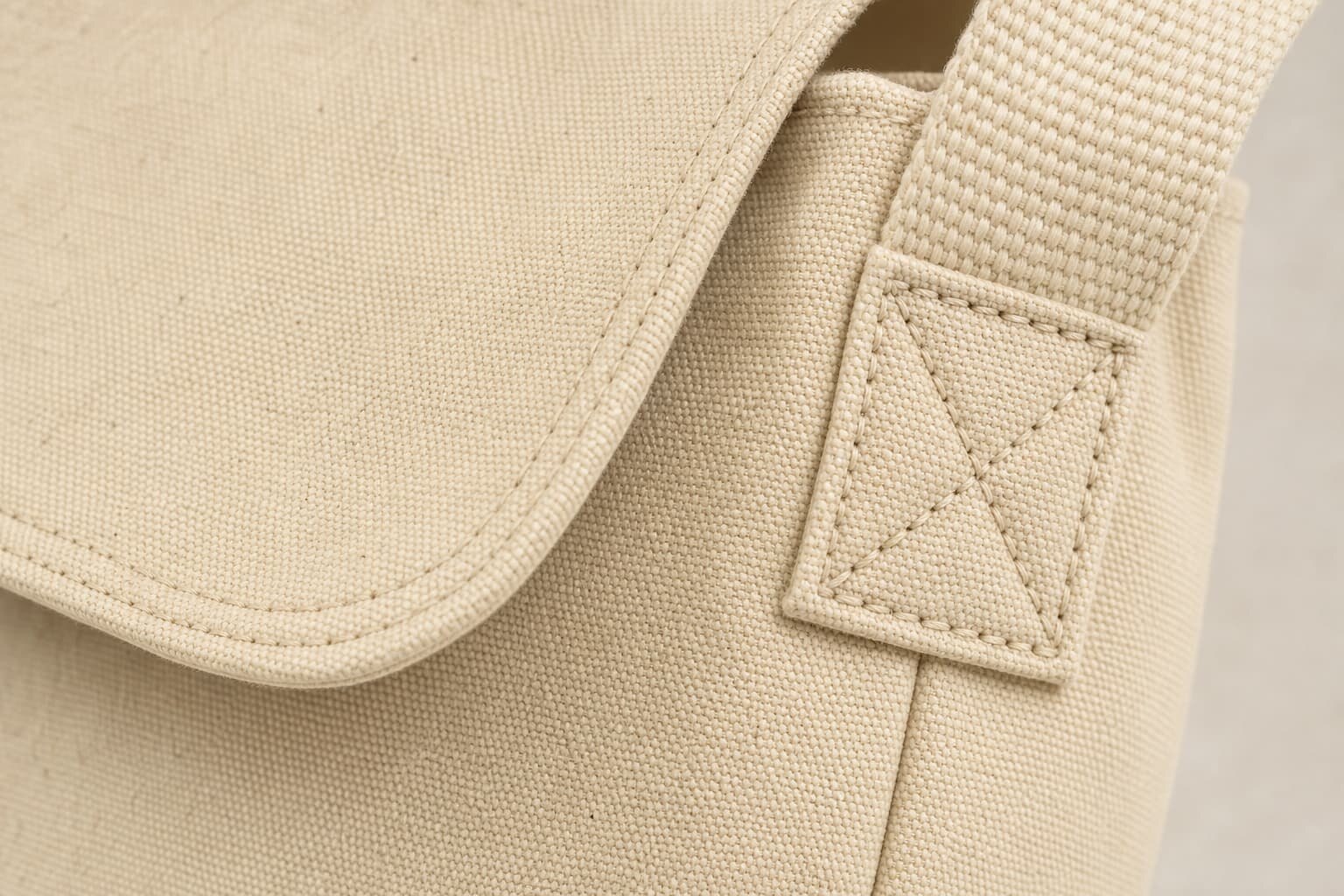
Material comparison should include the strap system because the main canvas body is not the only load-bearing part. A messenger bag usually carries weight through the shoulder strap, side D-rings, strap tabs, flap closure, and stitch reinforcement. If the body uses 16 oz canvas but the strap anchor is a small single-layer fabric tab, the bag may still fail under use. This is why a buyer should specify strap width, webbing material, adjuster type, and reinforcement method in the same RFQ as fabric weight.
Cotton webbing gives a natural look and matches canvas well, but it can stretch, fade, and absorb moisture. Polyester webbing is more stable in color and strength, but the texture may look less natural. Metal hardware improves perceived value, yet cheap metal plating can rust or rub off. Plastic buckles reduce weight and cost but can feel less premium. For factory comparison, request hardware material and finish, not just buckle included.
- For light promotional bags, 32 mm to 38 mm webbing can be acceptable if the bag is small.
- For retail messenger bags, 38 mm to 50 mm adjustable straps usually feel more balanced.
- For laptop bags, use reinforced side tabs, bar tacks, and load testing on strap anchors.
- Ask whether metal parts are iron, zinc alloy, brass, or stainless steel where corrosion risk matters.
Branding Method by Canvas Surface
The best logo method depends on fabric surface, color, order quantity, and brand positioning. Flat natural canvas is usually friendly for screen printing. It can hold solid one-color or two-color marks well if the weave is not too loose. Dyed dark canvas may need underbase printing for good opacity, which adds screen setup and print cost. Washed or waxed canvas can be more difficult because the surface is uneven, softer, or oily, so logo approval should be based on the final material, not a clean white fabric proof.
Woven labels and sewn patches are often safer for repeat retail programs because they avoid some print shade variation and can be stocked for reorders. Embroidery gives texture but can pucker lighter canvas and becomes expensive for large filled logos. Heat transfer can reproduce detailed artwork but may not match the natural feel of canvas and can fail on some coated surfaces. For a professional quote, provide logo artwork, size, placement, color count, and expected durability instead of asking for logo printing in general.
- Screen print works best for clean shapes, moderate detail, and flat canvas surfaces.
- Embroidery suits small logos, monograms, or premium detail, but test puckering.
- Woven labels work well for brand consistency across multiple bag styles.
- Leather, PU, or cotton patches can elevate the look but need stitch tolerance and edge testing.
MOQ Logic: Fabric, Color, Hardware, and Labels
Canvas messenger bag MOQ is not only a factory sewing MOQ. It is built from the smallest economic quantities of fabric, dyeing, washing, hardware, printing, labels, and packing materials. A supplier may accept a small sewing order if the buyer uses stock natural canvas and standard hardware. The same supplier may require a much higher MOQ for custom dyed canvas, custom metal logo buckles, special webbing color, or private-label woven labels.
When buyers compare quotes, they should separate standard material MOQ from custom component MOQ. For example, using stock 12 oz natural canvas with a one-color screen print may support a lower trial order. Using a custom Pantone dyed 16 oz canvas, matched cotton webbing, antique brass hardware, printed lining, custom zipper pullers, and retail hangtags will push the MOQ up because the supplier must book or produce each component. This is not only a price issue; leftover custom materials create reorder and liability questions.
- Lower MOQ is easier with stock natural canvas, stock black or natural webbing, standard zipper, and screen print.
- Higher MOQ is common with custom dyed canvas, washed finish, wax coating, printed lining, or custom hardware.
- Private woven labels may have their own MOQ even if the bag order is smaller.
- Ask the factory to show which components control MOQ so you can simplify the design if needed.
Sample Approval: What to Check Before Bulk Cutting
A good canvas messenger bag sample approval is more than checking whether the logo looks nice. The buyer should review the sample as a construction and material benchmark. Measure the body width, height, gusset, flap length, strap length range, pocket depth, zipper opening, and carton folding shape. Weigh the finished sample and compare it with the expected material spec. If the sample uses substitute fabric or substitute hardware, mark it clearly and do not approve it as the production standard.
For branded orders, the best practice is to approve a material swatch or lab dip first, then a counter sample, then a pre-production sample with final materials. If timing is tight, buyers sometimes combine steps, but the risk must be understood. Approving artwork on one fabric and production on another fabric can create print color, position, and curing issues. Approving construction before the final wash can create size complaints after bulk washing. The sample process should answer production questions, not just create a sales photo.
- Check GSM and handfeel against the RFQ, not only against the supplier's sample note.
- Load the bag with realistic weight and inspect strap anchor stress and flap alignment.
- Open pockets with one hand to see whether the layout works in normal use.
- Rub the logo area after curing or drying to identify weak ink adhesion before shipment.
Packing, Carton Weight, and Moisture Control
Canvas is a bulky material, and messenger bags have straps, flaps, buckles, and sometimes padding. Packing method affects carton size, shipping cost, product shape, and defect rate. Folding the bag tightly can save volume but may create hard creases across the flap or printed logo. Shipping flat can protect the appearance but increases carton volume. For retail bags, buyers should decide whether the bag must arrive shelf-ready or whether warehouse repacking is acceptable.
Moisture control is also important for cotton canvas. Natural fiber can absorb humidity during storage and ocean shipment. If bags are packed too soon after washing, printing, or steaming, mildew risk increases. Ask the factory how they dry washed goods, how long goods rest before packing, whether desiccants are used, and what carton liner is planned. For distributors and retail buyers, carton marks, barcode labels, inner packing, and mixed-SKU rules should be agreed before production because changing packing at the end often delays shipment.
- Set a carton gross weight limit so warehouse teams can handle the goods safely.
- Confirm whether each bag is in a polybag, paper sleeve, dust bag, or bulk packed.
- Protect metal buckles from marking the canvas or printed flap during transit.
- Use desiccants or moisture-control packing when shipping cotton canvas in humid seasons or long sea transit.
Quote Data That Makes Supplier Comparison Fair
The fastest way to get unusable quotes is to send a product photo and ask for best price. The supplier must guess fabric weight, lining, hardware quality, pocket structure, printing, packing, and inspection standard. Low quotes often leave out details that will be added later. Serious buyers should request a structured quote with material line items, production assumptions, sample timing, bulk lead time, packing data, and validity period.
A fair comparison should identify what is included in the unit price and what is excluded. Print setup, label development, mold charge, sample freight, testing, inspection, and export documents may be treated differently by different suppliers. Also ask for estimated carton dimensions and gross weight because a heavier canvas option can change landed cost even if the unit price looks reasonable. The best canvas messenger bag material choice is the one that meets product requirements at the right total landed cost, not simply the lowest FOB number.
- Ask for main fabric, lining, webbing, hardware, logo method, packing, and carton data in the same quote.
- Request separate pricing for 10 oz, 12 oz, 14 oz, and 16 oz canvas if the design is still open.
- Ask the supplier to state which materials are stock and which must be custom ordered.
- Compare sample lead time, bulk lead time, and material booking risk together with unit price.
Specification comparison for buyers
| Spec decision | Recommended option | When it fits | Buyer risk to check |
|---|---|---|---|
| Main body fabric | 12 oz to 16 oz cotton canvas, roughly 400-540 GSM depending on weave | Most retail, promotional, school, and light work messenger bags where structure and printability both matter | Confirm actual GSM after dyeing or washing, not only greige fabric weight |
| Premium rugged body fabric | 18 oz canvas, waxed canvas, or heavy washed canvas | Higher perceived value, outdoor styling, boutique retail, or long-use corporate gifting | Higher fabric cost, heavier carton weight, longer sewing time, and possible shade variation |
| Budget body fabric | 10 oz canvas or cotton-poly canvas | Large promotional orders where cost and shipping weight are more important than structure | Bag may collapse, strap seams may pucker, and dark prints can show lower coverage on loose weave |
| Lining | 210D polyester, 300D polyester, or unlined bound seams | Use lining for laptop sleeves, zipper pockets, and cleaner retail finish; use unlined for simple eco canvas styles | Check color transfer, lining tearing at pocket corners, and seam allowance visibility |
| Strap | 38 mm to 50 mm cotton webbing or polyester webbing with adjustable slider | Cotton webbing for natural look; polyester webbing for stronger colorfastness and lower stretch | Test strap load, slider slippage, and whether webbing color matches the canvas dye lot |
| Closure hardware | Magnetic snaps, metal buckles, plastic side release buckles, or hook-and-loop | Magnetic snaps for retail simplicity, buckles for heritage styling, plastic for school or event bags | Metal finish consistency, magnet pull strength, rust resistance, and noise during handling |
| Branding method | Screen print for simple logos, woven label for repeat retail programs, embroidery for premium texture | Choose based on logo detail, order quantity, color count, fabric surface, and target retail price | Print cracking on washed canvas, embroidery puckering on light fabric, label placement tolerance |
| Packing | Individual polybag or paper belly band, then export carton with moisture control | Polybag for clean warehouse handling; belly band for plastic-reduction programs if buyer accepts handling marks | Carton compression, mildew risk, barcode placement, and final folded bag shape |
Buyer checklist before sampling
- Define the bag use case first: laptop carry, school, retail fashion, event giveaway, or outdoor-style accessory.
- Request fabric weight in oz and GSM, plus whether the quoted weight is before or after dyeing, washing, or coating.
- Confirm fabric composition, weave type, shrinkage range, colorfastness expectation, and whether fabric is stock dyed or custom dyed.
- Specify bag dimensions, gusset depth, flap length, strap width, pocket layout, lining requirement, and closure type in the RFQ.
- Match branding method to fabric surface: screen print for flat natural canvas, woven label for washed canvas, emboss patch or embroidery for premium programs.
- Ask for a material cutting or lab dip before full sample if color, coating, or wash effect is important.
- Check sample weight, stitch density, strap reinforcement, pocket access, flap coverage, and whether the bag stands or collapses as expected.
- State packing method, carton weight limit, barcode position, hangtag requirement, desiccant use, and carton drop-test expectation.
- Separate tooling, print setup, sample fee, mold fee, label fee, and freight from the unit price so supplier quotes can be compared fairly.
- Approve a sealed pre-production sample with final fabric, final hardware, final print, final lining, and final packing before bulk cutting.
Factory quote questions to send
- What is the exact main fabric composition, oz weight, GSM, weave, and finished width used for costing this messenger bag?
- Is the quoted fabric weight before dyeing, after dyeing, after washing, or after wax coating?
- Is the color from stock fabric, custom piece dyeing, garment washing, or pigment dyeing, and what MOQ applies to each option?
- What lining material, pocket fabric, interlining, binding tape, and reinforcement patches are included in the unit price?
- Which print method is included, how many logo colors are costed, and what is the maximum printable area on the flap or body?
- Are metal buckles, magnetic snaps, zipper sliders, D-rings, strap adjusters, and rivets quoted in iron, zinc alloy, brass, or plastic?
- What is the sample lead time for a material sample, counter sample, print proof, and pre-production sample?
- What is the bulk lead time after sample approval and deposit, and what materials must be booked before approval?
- How many pieces per carton, what is the estimated carton size and gross weight, and will bags be folded or shipped flat?
- What inspection standard do you recommend for stitching, color shade, logo position, strap strength, and packing defects?
Quality-control points to confirm
- Measure fabric GSM from production fabric, not only from the approved sample swatch.
- Compare bulk fabric shade against approved lab dip or sealed sample under consistent light.
- Check body size tolerance after sewing, washing, and pressing because canvas can shrink or distort.
- Pull test strap anchors, D-rings, magnetic snaps, and buckle attachment points before final packing.
- Inspect print position, ink coverage, curing, rubbing resistance, and cracking on folded flap areas.
- Check stitch density, skipped stitches, broken thread, seam allowance, reinforcement bar tacks, and edge binding.
- Open and close all zippers, snaps, buckles, and hook-and-loop parts on inspected pieces.
- Confirm lining is not twisted, pocket corners are reinforced, and laptop sleeve padding is even if included.
- Review packing cleanliness, moisture control, barcode accuracy, carton marks, and carton compression resistance.
- Keep a signed pre-production sample and compare it with inline and final inspection pieces.