Define the Logo Job Before the Bag Style
For wellness studios, the logo placement decision usually comes before the final canvas messenger bag specification. A yoga studio, pilates chain, spa group, therapy clinic, or wellness retailer may use the same bag in several ways: welcome kit, workshop merchandise, retail product, teacher uniform accessory, or corporate gift. The correct logo position depends on how the bag is viewed, handled, packed, and photographed.
A procurement team should not send only a logo file and say “print on front.” That instruction leaves the supplier to choose the size, position, and method, and it creates inconsistent quotations. One factory may quote a small one-color screen print on the lower flap. Another may quote a large front print after sewing, with higher rejection risk. The RFQ should define the brand exposure target, bag structure, and acceptance tolerance together.
- For retail display, prioritize centered front flap branding because it is visible when the bag hangs.
- For premium studio merchandise, use a smaller lower-corner print or woven side label to avoid a promotional look.
- For staff or practitioner bags, keep the logo away from the strap path and high-abrasion zones.
- For event giveaways, choose a print area that can be produced quickly with low setup complexity.
Choose a Safe Placement Zone
The front flap is the most common logo zone on canvas messenger bags, but it is also the area most affected by construction. Snaps, Velcro, buckle straps, zipper welt seams, inner pocket stitching, and flap edge binding can all reduce the usable print area. If the factory prints after sewing, the raised seams can prevent even screen pressure. If the factory prints before sewing, cutting and sewing tolerance can shift the final logo position.
A practical rule is to keep the printed logo at least 20 mm away from stitched edges, flap folds, snaps, and hardware reinforcement. For a standard adult messenger bag around 350-400 mm wide, a front logo width of 90-140 mm is usually readable without making the bag look like a billboard. Very wide artwork may look good on a flat proof but become visually unstable once the flap curves over the contents.
- Centered flap print: good visibility, stronger retail shelf impact, higher need for accurate centering.
- Lower corner print: more discreet, easier to keep clear of snaps, but less visible in stacked packing.
- Side seam label: premium and repeatable, but requires label MOQ and sewing control.
- Back panel print: useful for staff bags, but less visible in retail display and more exposed to rubbing.
Match Fabric Weight to Print Clarity
Canvas weight affects both bag durability and logo appearance. For canvas messenger bags used by wellness studios, 10 oz canvas, roughly 300-340 GSM, can work for lightweight events or low-cost programs, but it wrinkles more easily and may not support a structured flap. A 12 oz canvas, roughly 380-410 GSM, is a common balanced option for branded merchandise because it holds shape better and gives the print surface more stability. Heavier 14-16 oz canvas can feel premium, but it increases cost, sewing effort, carton weight, and sometimes ink absorption.
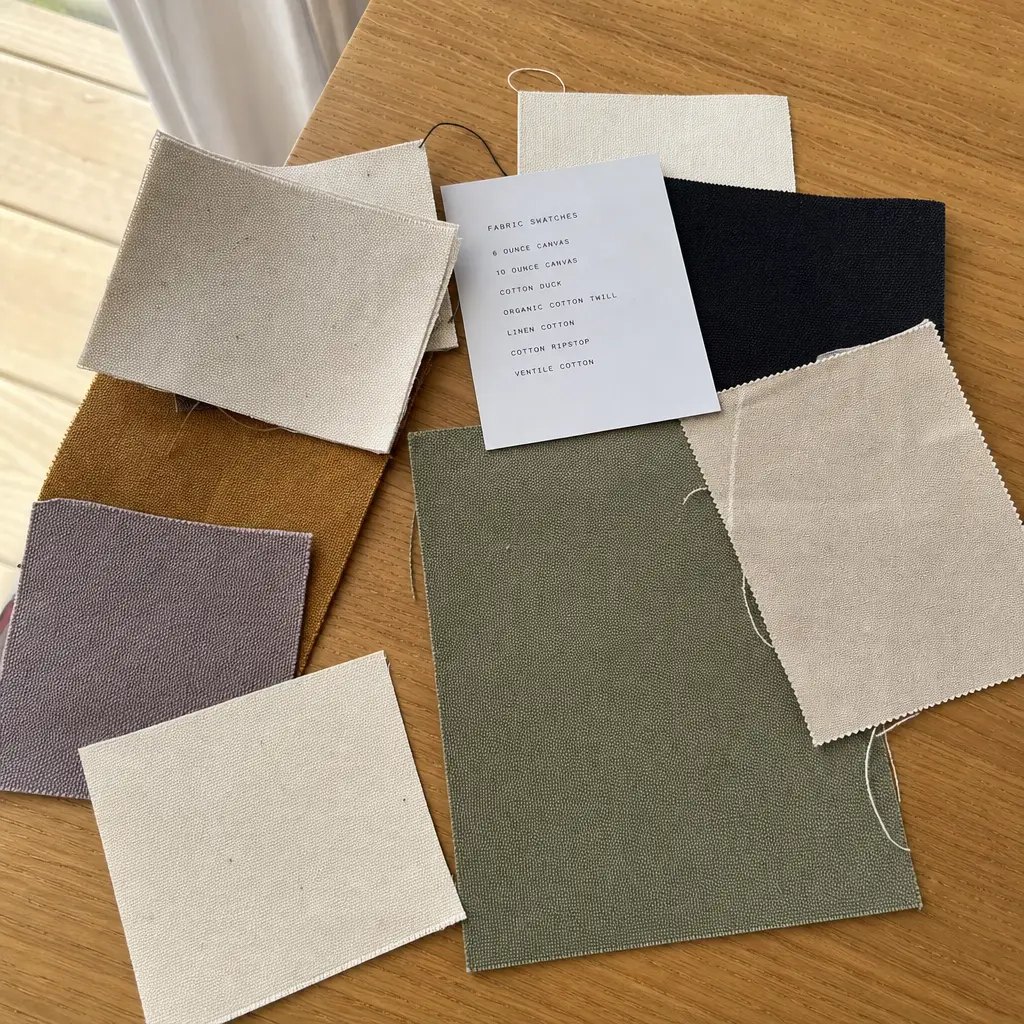
The weave is as important as the headline GSM. A rough, slubby natural canvas can fit an eco wellness brand, but it breaks fine logo lines and small typography. A smoother plain weave gives sharper print edges. If the logo includes thin leaves, mandala lines, small studio taglines, or light serif type, request a fabric swatch and print strike-off before approving the bulk order.
- 10 oz canvas: lower cost, lighter freight, acceptable for simple bold logos and short campaigns.
- 12 oz canvas: better flap stability, good print balance, suitable for most wellness studio retail programs.
- 14 oz canvas: more premium hand-feel, stronger structure, higher unit cost and longer sewing time.
- Washed canvas: softer feel, but post-wash shrinkage and uneven surface can shift logo appearance.
Select the Print Method by Artwork Risk
Screen printing is usually the safest choice for one to three solid colors on cotton canvas messenger bags. It gives a clean, durable finish, predictable setup cost, and reasonable output speed. For wellness studio logos in sage green, charcoal, navy, terracotta, cream, or black, screen print handles most marks well if the line thickness is suitable and the ink is fully cured.
Heat transfer can reproduce gradients, watercolor marks, or multi-color illustrations, but it changes the hand-feel and may not age as naturally on canvas. Embroidery can look premium on small marks, yet it may pucker a flap unless the canvas is heavy and the backing is controlled. Woven labels are a good alternative when the buyer wants brand consistency across many bag styles, but label production adds its own lead time and MOQ.
- Use screen print for solid logos, clear text, and repeat orders where cost control matters.
- Use embroidery only for compact marks, not wide thin-line artwork across a flexible flap.
- Use woven labels when the logo should feel sewn-in rather than printed as promotion.
- Use heat transfer only when artwork detail justifies the higher surface and aging risk.
Understand MOQ and Cost Drivers
MOQ is not only about sewing the bag. A canvas messenger bag order may have separate minimums for fabric dyeing, canvas purchase, printing setup, woven labels, metal hardware finish, zipper color, and packing materials. If the wellness studio wants a custom canvas color plus a custom woven label and two print positions, the real MOQ may be driven by fabric or label suppliers rather than the bag sewing line.
For quote comparison, separate the base bag cost from decoration and packing. A supplier quoting a low unit price may exclude print setup, sample remake, label mold, export carton marking, or inner packing. Another supplier may include these in the unit cost. Without a cost breakdown, importers and distributors cannot compare quotations fairly or explain margin changes to retail buyers.
- Base bag cost: fabric GSM, bag size, lining, pockets, flap structure, strap, and hardware.
- Decoration cost: screen setup per color, print position count, label cost, embroidery stitch count, or transfer film.
- Sampling cost: artwork adjustment, strike-off, courier, remake fee, and sample lead time.
- Packing cost: individual bag, hangtag, barcode label, carton quality, desiccant, and pallet requirement.
Build the RFQ Around Measurements
A useful RFQ for logo placement should include a flat technical drawing or marked photo with dimensions in millimeters. The logo should be located from fixed references, such as the top flap edge, side seam, flap center line, or bottom edge. Avoid defining position by visual terms such as “slightly lower” or “small on the side,” because each merchandiser and printer will interpret those words differently.
The RFQ should also state whether the bag is intended to carry wellness items such as towels, books, water bottles, yoga straps, retail products, or practitioner documents. This affects the flap curve, pocket layout, and stress points. A logo placed perfectly on an empty flat bag can look too high once the bag is filled. If the bag will be photographed with contents, test the logo on a loaded sample.
- Bag size: width, height, bottom gusset, flap height, and strap length range.
- Logo size: final width and height, with clear space around the artwork.
- Placement reference: distance from flap top edge and side edges to logo center or baseline.
- Tolerance: acceptable movement, usually plus or minus 5 mm for many canvas bag programs.
Approve Samples in the Correct Order
Sampling should not jump directly from artwork file to bulk production. A good sequence is fabric swatch, print strike-off, prototype sample, then pre-production sample. The strike-off shows how the ink sits on the chosen canvas. The prototype confirms bag construction and approximate logo position. The pre-production sample should use bulk fabric, bulk hardware, bulk thread, bulk label, and the actual approved print method.
For wellness studio branding, small color differences are noticeable because many brands use muted natural palettes. Ink printed on natural canvas will not look the same as the Pantone chip on coated paper. The buyer should approve the actual printed sample under neutral light and keep a signed reference sample for final inspection. If the order is distributed across several studio locations, duplicate approved samples may be needed for the buyer, factory, and third-party inspector.
- Fabric swatch approval confirms GSM, weave, color, shrinkage feel, and surface smoothness.
- Print strike-off approval confirms ink color, edge sharpness, coverage, curing, and hand-feel.
- Prototype approval confirms size, pocket layout, flap shape, strap comfort, and hardware placement.
- Pre-production sample approval locks bulk construction, logo placement, packing, and carton method.
Set QC Thresholds Before Production
Logo placement problems are easier to prevent than repair. Once a screen print is cured or a woven label is sewn into a seam, rework is slow and often visible. The purchase order should define measurable inspection points: logo center position, skew, color, print adhesion, label alignment, stitching quality, and carton packing condition. These points should be written into the approved sample comments, not left as a general “quality as sample” statement.
For bulk inspection, pull samples from different cartons and production times. First pieces may be accurate because the line is being watched, while later pieces can drift if the screen, jig, or sewing guide moves. On canvas messenger bags, flap stitching and snap attachment can also pull fabric slightly, so inspection should include both flat measurements and visual review with the flap closed.
- Measure logo placement from the same reference points used in the approved sample.
- Reject obvious skew, double print, ink bleeding, missing strokes, or label twisting.
- Test print adhesion with a rub or tape check suitable for the ink system.
- Open and close the flap to confirm the logo does not fold across a stress line.
Plan Packing Around the Printed Flap
Packing is part of logo protection. A canvas messenger bag may pass sewing and printing inspection but arrive with transfer marks, deep flap creases, or abrasion on the logo if packed too tightly. Natural canvas also absorbs moisture, so long ocean shipments need sensible carton strength, dry storage, and protection from direct ink-to-ink contact.
Flat packing usually works well for messenger bags if the strap is folded neatly and hardware is isolated from the printed panel. If the bag has metal buckles, the factory should prevent buckle pressure from marking the logo area. Retail buyers may need individual bags, hangtags, barcode labels, or shelf-ready carton markings, while distributors may prefer efficient master cartons with lower packing cost.
- Use tissue, paper band, or individual bagging when printed flaps touch each other.
- Avoid over-compressing cartons because canvas creases can become permanent in humid transit.
- Separate metal hardware from the printed face with folding instructions or protective paper.
- Record carton dimensions, gross weight, and packing count before calculating freight.
Control Lead Time and Schedule Risk
Logo placement adds schedule risk because artwork approval, strike-off review, and sample remake can delay material booking. A realistic timeline separates artwork preparation, sample making, buyer approval, fabric purchase, printing, sewing, inspection, packing, and export handling. If the buyer needs bags for a retreat launch, studio opening, or seasonal retail window, the approval calendar is as important as the production calendar.
The most common delay is not sewing capacity; it is unclear artwork or late approval of the placement sample. Another frequent issue is a custom label or dyed canvas that has a longer lead time than the bag itself. To reduce risk, freeze the bag body and logo position before adding optional features such as custom lining, extra pockets, or special hardware finishes.
- Allow time for artwork cleanup if the logo file is PNG or low-resolution PDF instead of vector.
- Approve ink strike-off before the full sample when color is brand-critical.
- Book fabric only after size, GSM, and color are fixed to avoid waste and cost disputes.
- Keep one backup placement option if hardware or pocket construction reduces the print zone.
Specification comparison for buyers
| Spec decision | Recommended option | When it fits | Buyer risk to check |
|---|---|---|---|
| Front flap logo position | Centered print, 35-45 mm below top edge, sized 90-140 mm wide | Best for retail visibility, studio membership gifts, and merch walls where the bag hangs face-out | Logo may distort if flap has a curved edge, magnetic snap, or heavy seam allowance under the print zone |
| Lower corner logo position | Small logo at lower right or lower left, 45-70 mm wide | Fits premium wellness brands that want subtle placement and lower visual weight | Too small a print can fill in on 12 oz canvas if line thickness is below 0.35 mm |
| Side label branding | Woven or cotton label sewn into side seam, 25-35 mm exposed width | Good for minimalist studios, resale channels, or programs needing repeat production consistency | Label MOQ and color matching may differ from bag MOQ; confirm label lead time before bulk cutting |
| Print method on canvas | Screen print for solid 1-3 color logos; heat transfer only for complex gradients | Screen print gives stronger cost control and better hand-feel on cotton canvas messenger bags | Heat transfer can crack on folded flap areas if the coating is too thick or cured incorrectly |
| Fabric weight for logo clarity | 12 oz canvas, about 380-410 GSM, with smooth weave and pre-shrunk finish if possible | Balanced choice for wellness studio merchandise, event gifts, and distributor programs | Low GSM canvas can wrinkle around the printed panel and high-slub fabric can break thin logo strokes |
| Pocket and seam layout | Keep logo clear of flap seams, darts, snaps, pocket edges, and buckle stress points by at least 20 mm | Useful when the bag includes inner pockets, pen slots, or a structured flap | Supplier quote may ignore artwork collision unless the RFQ includes a marked placement drawing |
| Colorway and ink contrast | Natural canvas with dark green, charcoal, navy, or terracotta ink | Matches many wellness studio palettes while keeping registration simple and economical | Very pale inks on natural cotton may look weak after curing and carton abrasion |
| Packing style | Individual recycled polybag or paper band, then flat packed 50-80 pcs per export carton | Protects printed flaps for retail and keeps warehouse receiving tidy | Over-tight carton compression can transfer ink or crease the logo panel before the buyer sees it |
Buyer checklist before sampling
- Send logo artwork as vector AI, EPS, or PDF with Pantone references and minimum line thickness noted.
- Mark the exact logo center point on a flat bag drawing, not only on a lifestyle reference image.
- Specify fabric weight in oz and GSM, including acceptable tolerance, weave preference, and color name.
- Define logo size in millimeters, print method, ink color, and placement tolerance before sampling.
- Confirm whether the front flap has snaps, zippers, pockets, or buckles that reduce the safe print area.
- Require a physical pre-production sample using bulk fabric, bulk ink, and actual label or trim quality.
- Measure sample logo position from fixed seams and edges, then record the approved measurements in the PO.
- Inspect bulk production for print adhesion, color consistency, skew, stitching near logo zones, and carton pressure marks.
- Approve packing method with one packed carton photo and one drop-tested or compression-checked sample carton if retail presentation matters.
- Collect quote data by fabric GSM, bag dimensions, print setup, label cost, carton size, gross weight, MOQ, sample fee, and lead time.
Factory quote questions to send
- What is the actual canvas weight in oz and GSM, and what tolerance do you apply during bulk purchase?
- Is the bag panel printed before sewing or after sewing, and how does that affect logo placement tolerance?
- What is the maximum printable area on the flap after allowing for seams, snaps, zippers, and buckle positions?
- Which print method do you recommend for this artwork on 12 oz canvas, and what is the setup charge per color?
- Can you match the ink to Pantone on natural cotton canvas, and will you provide a cured strike-off before the full sample?
- What is the MOQ for the bag, the printed logo, and any woven side label if they are produced by different workshops?
- Will the pre-production sample use bulk fabric and trim, or only available stock fabric for shape approval?
- What logo placement tolerance can your sewing and printing team hold in bulk, stated in millimeters?
- How many pieces per carton, what carton dimensions, and what gross weight should we use for freight estimation?
- What are the current sample, material booking, production, inspection, and export packing lead times?
Quality-control points to confirm
- Logo position tolerance within plus or minus 5 mm from the approved center point on the flap or side label location.
- Print skew not more than 3 mm across the logo width for centered front flap branding.
- No ink cracking, peeling, pinholes, excessive fibrillation, or visible under-cure after a standard tape pull or rub check.
- No print overlap with snap reinforcement, flap stitching, pocket edge, buckle strap, or fold line unless approved.
- Canvas GSM within agreed tolerance, normally plus or minus 5 percent unless a tighter specification is written.
- Color shade checked under neutral light against approved strike-off, allowing for natural cotton base variation.
- Stitching around branded panels straight, secure, and free from puckering that changes logo shape.
- Woven side labels aligned, fully caught in seam, and not twisted, frayed, or hidden by seam allowance.
- Packing prevents face-to-face ink contact, deep flap creases, moisture exposure, and carton crushing.
- Final inspection includes measurement of logo placement across multiple cartons, not only top-layer pieces.