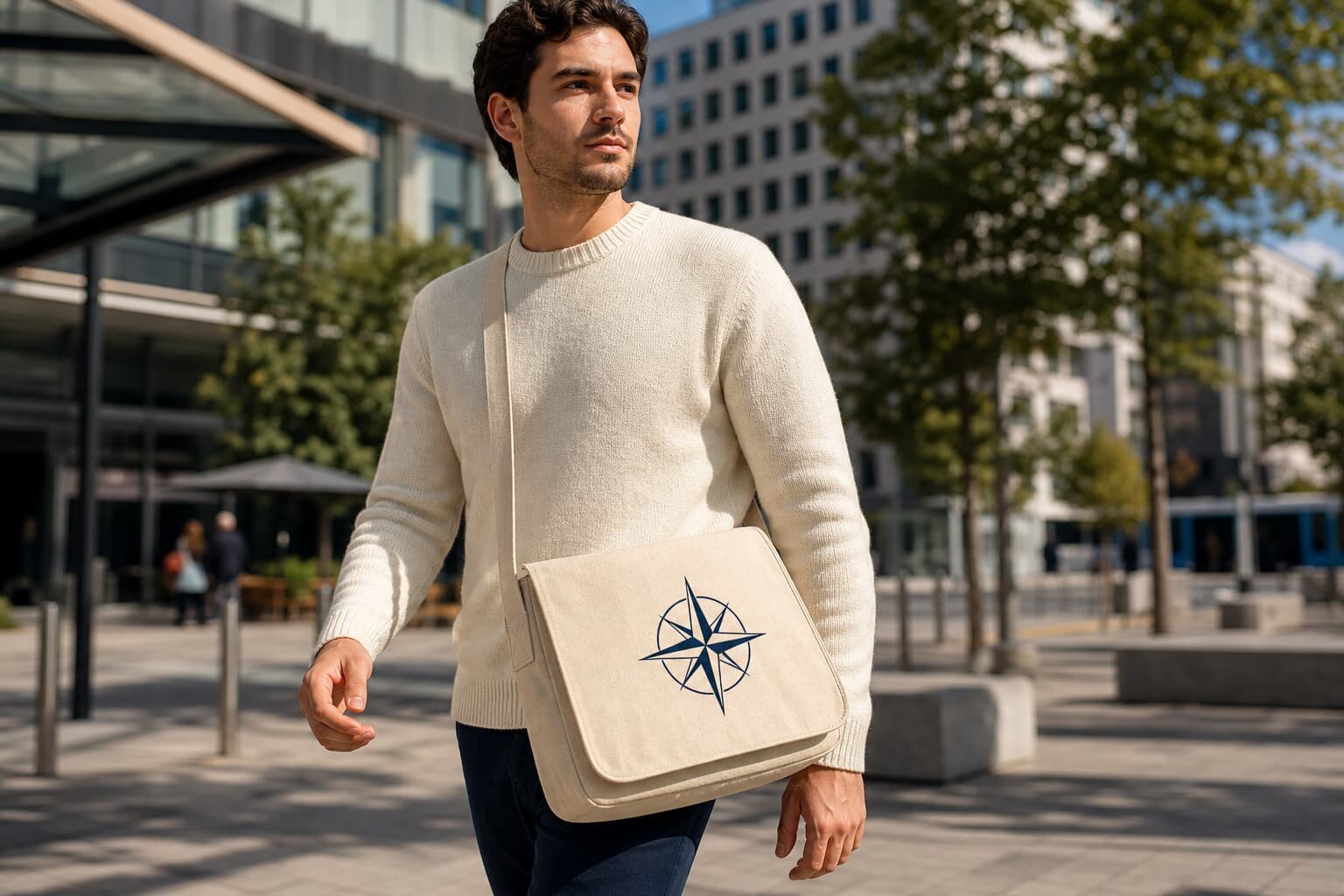
Why Fabric Weight Is a Buying Decision, Not Just a Material Detail
For a canvas messenger bag, fabric weight affects more than thickness. It changes the bag structure, print appearance, sewing difficulty, unit cost, carton volume, and even how the buyer compares supplier quotes. A 12 oz canvas messenger bag and a 16 oz canvas messenger bag may look similar in a small catalog image, but they are different products once loaded, folded, printed, and packed.
The common procurement mistake is asking factories for a quote based only on size and logo. Suppliers then choose their own canvas weight to match a target price. One quote may use 10 oz canvas, another 14 oz, and another may use heavy canvas only on the flap but lighter fabric on the gusset. The lowest quote can look attractive until the sample feels weak or the bag collapses after loading.
- Use fabric weight to control the product level: promotional, retail, work bag, or premium fashion.
- Compare quotes only when the outer fabric, lining, reinforcement, and hardware are clearly stated.
- Ask for finished bag weight because it often reveals whether the construction matches the stated specification.
- Treat fabric weight as part of the RFQ, not a detail to solve after price negotiation.
Understand Oz, GSM, and What the Factory Is Actually Quoting
Canvas is often described by ounces, such as 10 oz, 12 oz, 14 oz, or 16 oz. Buyers also see GSM, which means grams per square meter. The two values are related, but in real sourcing they are not always used consistently. One mill may state the greige fabric weight before dyeing, while another supplier may state finished fabric weight after dyeing, washing, or coating.
For RFQs, ask for both oz and GSM, and ask when the measurement applies. Natural unbleached canvas, dyed canvas, enzyme-washed canvas, and waxed canvas can feel and weigh different even if the base fabric is similar. A factory sales engineer should be able to tell you whether the weight is mill specification, tested incoming material, or an estimated conversion.
- 10 oz canvas is commonly used for lighter promotional or casual bags.
- 12 oz canvas is a practical middle option for many branded messenger bags.
- 14 oz canvas gives better structure and retail handfeel without becoming too difficult to sew.
- 16 oz canvas and above can support a premium look but need stronger sewing control and higher freight planning.
- GSM should be written in the quote to avoid confusion between local ounce standards and supplier shorthand.
Match Fabric Weight to the Bag's Real Use
The correct fabric weight starts with the loading purpose. A bag for brochures and light merchandise does not need the same canvas as a laptop-style messenger bag. If the buyer does not define expected use, the supplier may choose the cheapest canvas that can pass a basic visual sample review.
Procurement teams should write the use case in the RFQ. For example: daily commuter bag for notebooks and tablet, not laptop; retail messenger bag for fashion accessory use; or event merchandise bag for documents only. This helps the factory recommend fabric, lining, strap width, reinforcement, and stitching density as one construction package.
- Documents only: consider 10 oz to 12 oz canvas, simple lining optional, lower packing volume.
- Daily casual carry: consider 12 oz to 14 oz canvas with reinforced strap points and stable flap shape.
- Tablet or small laptop use: consider 14 oz to 16 oz canvas plus padding or interlining, not fabric weight alone.
- Premium fashion look: consider heavier canvas, washed finish, waxed finish, leather patch, or metal hardware, but confirm MOQ.
- Distributor catalog item: choose a repeatable fabric weight that will be available for reorders, not a one-time stock fabric.
How Fabric Weight Changes Cost, MOQ, and Lead Time
Heavier canvas usually costs more, but the unit price difference is not only the fabric price. Heavy fabric increases cutting effort, needle wear, sewing time at folded seams, carton gross weight, and sometimes rejection risk. It can also reduce the number of pieces per carton, which increases CBM and freight cost per bag.
MOQ depends on whether the factory can buy stock canvas or must arrange mill production. Natural canvas and common black or navy canvas may be easier to source at lower MOQ. Custom dyed colors, washed canvas, waxed canvas, unusual weights, or organic cotton claims may require higher fabric MOQ and longer lead time. A serious quote should separate bag MOQ from fabric MOQ where relevant.
- Stock natural canvas can support faster sampling and smaller trial orders.
- Custom dyed canvas may require lab dip approval, bulk dyeing, and additional shade control.
- Washed canvas adds processing time and may change size tolerance and handfeel.
- Waxed or coated canvas needs print compatibility testing and careful packing to avoid marks.
- Heavier fabric may require a longer sample cycle if the first construction does not sew cleanly at thick joints.
Choose the Right Canvas Weight for Printing and Branding
Many canvas messenger bag orders are driven by logo visibility. Fabric weight and weave directly affect the print result. A rough heavy canvas can look premium, but it may not hold fine print detail as well as a tighter medium-weight canvas. If the artwork has small text, thin lines, or multiple colors, the buyer should not approve the fabric only by touch.
Screen printing works well on many cotton canvas bags when the surface is reasonably flat and tight. Heat transfer can give sharper graphics but needs testing for adhesion, handfeel, and heat marks. Embroidery gives a durable branded result but can pucker lighter canvas or become too stiff on small flaps. Woven labels, leather patches, and rubber patches are useful when the canvas surface is too textured for clean direct printing.
- For large one-color logos, 12 oz to 14 oz canvas is often a reliable print base.
- For fine artwork, request a printed swatch on the actual bulk fabric before full sample approval.
- For heavy slub canvas, use bold artwork, patches, labels, or embroidery instead of tiny printed text.
- For washed canvas, test print after washing or confirm whether printing happens before or after the wash process.
- For waxed canvas, avoid assuming standard screen print adhesion without a rub and scratch test.
Do Not Ignore Lining, Interlining, and Reinforcement
A heavier outer canvas does not automatically make a good messenger bag. The bag may still fail if the strap anchor, bottom gusset, zipper opening, or flap corners are weak. Conversely, a 12 oz canvas bag with proper lining, webbing reinforcement, and clean stitching can perform better than a 16 oz bag with poor construction.
When comparing supplier quotes, ask where the main canvas is used. Some suppliers quote a heavy-looking flap but reduce the fabric weight on the back panel or gusset. Others may use the stated canvas for all visible panels but use thin lining and no reinforcement inside stress points. This is why the RFQ should define construction details, not only material name.
- Specify whether the main canvas applies to front, back, flap, side gusset, bottom, and pocket panels.
- Ask whether strap anchors include internal reinforcement fabric or bar-tack stitching.
- Confirm lining material, lining weight, pocket fabric, and whether the lining is loose or bound into seams.
- For laptop-style bags, request padding thickness and placement instead of relying on heavy canvas.
- Check folded seam bulk on heavy canvas because too many layers can cause broken needles and uneven stitching.
Sample Approval: What to Check Before Bulk Material Purchase
A messenger bag sample made from available fabric is useful for shape review, but it is not enough for production approval if the bulk order will use a different fabric weight, color, wash, or coating. Buyers should separate fit sample, material sample, print proof, and pre-production sample in their timeline.
For the pre-production sample, check the same details that will affect the final shipment: actual fabric weight, finished bag weight, dimensions after sewing, logo placement, pocket function, hardware finish, strap length, carton folding method, and barcode or hangtag placement if needed. If the sample feels slightly too soft, solve it before bulk fabric cutting, not after sewing starts.
- Keep one approved fabric swatch and one approved finished sample sealed for production comparison.
- Weigh the finished sample and record it in the approval comments.
- Measure flap width, body height, gusset depth, strap length, pocket opening, and print position.
- Load test the sample with the intended weight for at least basic handling checks.
- Photograph stress points and construction details so the factory understands what must not change.
Packing and Freight Effects of Canvas Weight
Fabric weight affects packing in two ways: the bag is heavier and it may occupy more carton space. Heavy canvas messenger bags do not always fold flat without creating hard creases or distorted flaps. If the product is for retail shelves, over-compression can damage the appearance before the goods reach the store.
Before awarding an order, ask each factory for packing quantity, carton size, gross weight, and estimated CBM. This prevents a common quote comparison error: one supplier appears cheaper because they quote only unit price, while another includes a more realistic carton plan. For importers, carton gross weight can also affect warehouse handling, courier limits, and pallet planning.
- Request carton quantity per fabric option, such as 25 pieces per carton for heavier bags or 50 pieces for lighter bags.
- Ask whether bags are folded, flat packed, individually polybagged, or packed with paper insert.
- For waxed or dark canvas, check whether tissue paper is needed to reduce marking.
- Confirm carton board strength if gross weight is high.
- Include shipping marks, barcode labels, suffocation warning, and retail packaging requirements in the quote.
Quote Data Buyers Should Require for Fair Comparison
A useful factory quote for canvas messenger bags should read like a production plan, not only a price line. If the quote says only cotton canvas messenger bag, logo print, export carton, it is not enough for procurement comparison. Buyers need the data that explains why one quote is lower or higher.
Ask suppliers to quote two or three controlled fabric options if you are not sure which weight to use. For example, request 12 oz natural canvas, 14 oz dyed canvas, and 16 oz washed canvas using the same bag size and artwork. This allows your team to compare product level, sample quality, freight effect, and lead time before committing.
- Material: composition, canvas oz, GSM, color, finish, and lining details.
- Construction: bag size, gusset, pocket layout, zipper type, webbing width, hardware material, and reinforcement.
- Branding: print method, print size, print position, number of colors, label or patch details.
- Commercial terms: MOQ, sample cost, bulk lead time, packing method, carton data, quote validity, and payment terms.
- Quality terms: tolerance for fabric weight, size, color shade, print position, and inspection standard.
Common Specification Mistakes That Cause Production Problems
The most expensive mistakes usually happen before production starts. A buyer approves a nice sample but does not confirm that the sample fabric is the same as bulk fabric. Another buyer asks for a premium heavy canvas but keeps the same print artwork with tiny text. A third buyer compares a 12 oz quote with a 16 oz quote and pushes the heavier supplier to match the lower price without changing the specification.
Clear specifications reduce back-and-forth and protect both sides. Factories can recommend practical fabric weights, but they need to know your target product level, retail price position, artwork, packing requirement, and shipping method. The better your RFQ, the fewer surprises you will have during sample approval, pre-shipment inspection, and repeat orders.
- Do not use only the word heavy duty without defining oz, GSM, and construction.
- Do not approve print artwork before confirming the final fabric surface.
- Do not assume all panels use the same fabric weight unless the quote states it.
- Do not compare FOB unit prices without carton CBM and gross weight.
- Do not place a repeat order without checking whether the same fabric lot, dye method, and finish are still available.
Specification comparison for buyers
| Spec decision | Recommended option | When it fits | Buyer risk to check |
|---|---|---|---|
| Light promotional messenger | 10 oz to 12 oz cotton canvas, usually 270-340 GSM | Event giveaways, bookstore bags, light daily carry, low freight sensitivity | May look soft after loading; confirm flap shape, handle pull strength, and whether lining is needed |
| Retail casual messenger | 12 oz to 14 oz canvas, about 340-475 GSM depending on weave | Lifestyle retail, campus use, brand merchandise with better handfeel | Color shade and shrinkage can vary by dye lot; approve lab dip and pre-production sample |
| Structured work bag | 14 oz to 16 oz canvas with lining or interlining | Laptop-style messenger, distributor catalog products, higher perceived value | Higher sewing difficulty at folded seams; check needle marks, seam allowance, and carton weight |
| Heavy heritage canvas bag | 16 oz to 18 oz canvas, sometimes waxed or washed | Premium fashion, outdoor look, durable branded goods | MOQ rises for dyeing or finishing; print may crack or lose sharpness on rough fabric |
| Print-first order | 12 oz to 14 oz tightly woven canvas, flat panel printing before assembly | Large logo, multi-color screen print, heat transfer, detailed graphics | Heavy slub canvas reduces print clarity; request printed fabric swatch before bulk cutting |
| Cost-controlled private label | One body fabric weight with lighter lining and standard webbing | Repeat programs where stable cost and lead time matter more than maximum thickness | Do not compare only by oz; ask for GSM, yarn count or sample cutting weight, and finished bag weight |
Buyer checklist before sampling
- Define the load use first: documents only, daily carry, laptop, retail fashion, or promotional giveaway.
- Specify canvas weight in oz and GSM, not only one unit, because mills and suppliers may convert differently.
- Ask whether the weight is greige, dyed, washed, coated, or finished fabric weight.
- Confirm whether the quoted weight applies to the outer body, flap, gusset, strap reinforcement, lining, or all canvas parts.
- Request a fabric swatch plus one finished sample, because the same GSM can feel different after washing, dyeing, backing, or coating.
- Check the print method against the fabric surface: screen print, heat transfer, embroidery, woven label, leather patch, or emboss patch.
- Ask for finished bag weight, carton quantity, carton size, and gross weight before comparing freight.
- Confirm seam construction at stress points: flap corners, strap anchors, zipper ends, bottom gusset, and handle attachment.
- Approve color lab dip and print proof before bulk cutting, especially for dyed cotton canvas or washed canvas.
- Write acceptance criteria for fabric weight tolerance, size tolerance, print position tolerance, and packing method in the PO.
Factory quote questions to send
- What is the actual GSM and oz of the proposed outer canvas, and is the value measured before or after dyeing, washing, coating, or finishing?
- Can you quote two fabric options side by side, for example 12 oz and 14 oz, with finished bag weight, carton quantity, and estimated CBM?
- Which bag parts use the main canvas weight, and which parts use lighter fabric, lining, interlining, webbing, PU, or reinforcement tape?
- What is your MOQ for this canvas weight in natural color, dyed color, washed finish, or custom color?
- Is the fabric stock canvas, made-to-order canvas, or mill-dyed fabric, and how does that affect lead time?
- Which print methods are suitable for this fabric surface, and do you recommend printing before cutting or after bag assembly?
- Can you provide a fabric swatch, printed swatch, and full pre-production sample before bulk material purchase?
- What fabric weight tolerance do you control during production, and how will it be checked during incoming material inspection?
- How many pieces per export carton for each fabric option, and what are the carton dimensions and gross weight?
- What data will appear on the formal quote: fabric weight, GSM, material composition, bag size, hardware, print size, packing, sample cost, tooling cost, lead time, and quote validity?
Quality-control points to confirm
- Measure fabric weight from approved bulk fabric using a GSM cutter or agreed lab method, not only by handfeel.
- Compare bulk fabric shade against the approved lab dip or pre-production sample under consistent light.
- Check fabric defects before cutting, including slubs, oil marks, weaving bars, heavy creases, and uneven coating.
- Verify finished bag weight against the approved sample to catch fabric substitution or missing reinforcement.
- Inspect seam strength at strap anchors, flap corners, gusset corners, zipper ends, and handle bases.
- Check print adhesion, color, registration, cracking, and placement on the actual production fabric.
- Confirm bag dimensions after sewing and pressing, because heavier canvas can reduce finished tolerance at folds.
- Review packing for deformation: heavy canvas bags should not be over-compressed if the flap must stay flat.
- Check carton gross weight and carton strength to avoid courier or retail warehouse rejection.
- Keep a sealed production sample and material swatch for repeat order comparison.