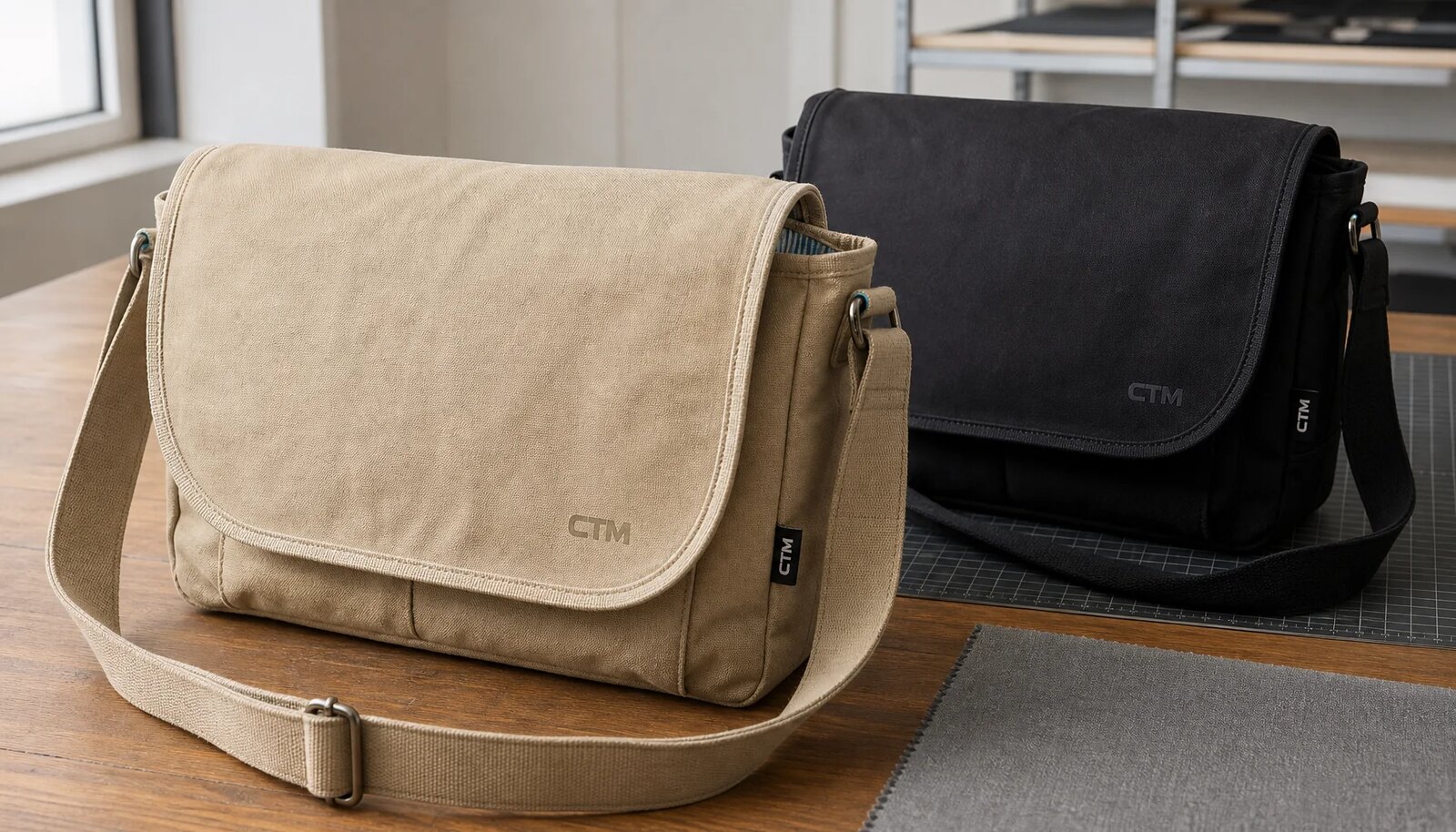
Start with the load, not the lowest FOB
Fabric weight should be one of the first decisions in a canvas messenger bag RFQ because it affects structure, print behavior, sewing difficulty, carton quantity, and landed cost. Two suppliers can both quote a “canvas messenger bag” while one uses soft 10oz fabric and the other prices a firmer 14oz retail body. The FOB difference may look attractive until the buyer compares handfeel, flap stability, strap reinforcement, and freight impact.
Messenger bags carry load differently from totes. Weight transfers through the side strap anchors, the flap is opened repeatedly, and the gusset is under pressure when the bag holds books, apparel packs, catalogs, a tablet, or sample kits. Heavier canvas helps structure, but it does not replace reinforcement. A procurement-ready specification should connect the fabric weight to the expected use case and contents.
For eco apparel brands, the best choice is rarely “the heaviest canvas possible.” The right fabric weight should support the product story, feel credible at retail, photograph well, and still ship efficiently. A 12oz or 14oz bag with well-designed reinforcement can often be more commercially balanced than a 16oz bag that increases seam bulk and freight cost.
- Use 10oz to 11oz for light promotional or casual carry programs.
- Use 12oz to 14oz as the practical baseline for most retail messenger bags.
- Use 16oz when the design needs a premium structured or heritage utility feel.
- Confirm expected contents before choosing fabric, strap width, closure, and reinforcement.
- Compare carton quantity and gross weight before treating heavier fabric as an automatic upgrade.
Convert oz to GSM, then ask what the number actually means
Canvas is often sold in ounces per square yard, while technical files and mill data may use GSM. The standard conversion is 1 oz/yd² ≈ 33.9 GSM. By that reference, 10oz is about 339 GSM, 12oz is about 407 GSM, 14oz is about 475 GSM, and 16oz is about 542 GSM. These numbers are useful for quote comparison, but they are not enough for bulk control.
The commercial oz label may not match the finished fabric weight exactly. Dyeing, washing, softening, coating, printing, sanforizing, and calendaring can change measurable weight, shrinkage, surface feel, and panel behavior. If one supplier quotes greige fabric weight and another quotes finished fabric weight, the comparison is not equal.
Ask each supplier for the actual finished GSM range of the canvas used for bulk production and the allowed tolerance. For many commercial bag orders, target GSM plus/minus 5% is a practical starting point unless the mill can support tighter lot control. If your brand has strict durability, sustainability, or retail handfeel requirements, the tolerance should be written into the RFQ before sampling.
- 10oz canvas is roughly 339 GSM by standard conversion.
- 12oz canvas is roughly 407 GSM by standard conversion.
- 14oz canvas is roughly 475 GSM by standard conversion.
- 16oz canvas is roughly 542 GSM by standard conversion.
- Ask whether the stated weight is greige, dyed, finished, washed, coated, or printed.
- Reject vague labels such as heavy canvas, premium canvas, or eco canvas unless measurable specs are supplied.
Choosing 10oz, 12oz, 14oz, or 16oz canvas
A 10oz to 11oz canvas can work when the order is price-sensitive, low-load, and casual. It folds easily, keeps the carry weight lower, and may improve carton efficiency. The trade-off is a softer silhouette. Large flaps may collapse, large prints may ripple, and the finished bag can feel closer to promotional merchandise than a retail accessory if the construction is too simple.
For most apparel brand messenger programs, 12oz to 14oz is the safer shortlist. This range usually gives the flap enough body, provides a better branding surface, and remains manageable for sewing and packing. It can be used unlined with bound seams for a natural look or lined for a cleaner interior and added organization.
A 16oz canvas creates a stronger, more structured impression, but it raises practical questions. Heavy fabric stacks at flap corners, gusset seams, pocket openings, and strap anchors. If the factory’s machines and operators are not comfortable with that bulk, defects can include skipped stitches, distorted corners, uneven topstitching, and stiff handling. A 14oz body with targeted reinforcement is often a better balanced procurement choice.
- Choose lighter canvas only when the intended load is light and clearly communicated.
- Choose 12oz to 14oz for everyday retail bags, campus merchandise, and employee programs.
- Choose 16oz for premium structure, not as a substitute for strap and seam engineering.
- Review actual sample handfeel after dyeing or washing because finishing can change the perceived weight.
- Check the effect of fabric weight on carton pack count, gross weight, and freight quote.
Construction details that matter as much as fabric weight
Durability comes from the whole construction system: fabric, seam allowance, thread, stitch density, reinforcement patches, webbing, hardware, lining, and load path. The highest-stress points are predictable: shoulder strap anchors, top opening, side gussets, bottom corners, flap base, closure area, zipper ends, and pocket openings. These points should be defined in the tech pack instead of left to the sample room.
Strap geometry is especially important. Messenger bags hang from the side, so anchor placement affects balance and comfort. A 38mm strap works for many everyday 12oz bags. For heavier 14oz to 16oz styles, 50mm webbing can distribute weight better. Cotton webbing gives a natural handfeel, while recycled polyester webbing may offer more color consistency and abrasion resistance depending on the supplier’s material.
Interior finishing also changes the buyer’s cost comparison. Unlined canvas can fit an eco product story, but raw seams should not be assumed acceptable for retail. Bound internal seams, often 20mm to 25mm when specified, help control fraying and improve appearance. Lining supports pockets and laptop sleeves but adds cost, labor, and another QC layer.
- Specify strap width, webbing material, adjuster type, anchor angle, and stitch method.
- Require reinforcement patches behind strap anchors, especially when lining hides the load point.
- Use bartacks or box-x stitching where strap anchors carry weight.
- Specify bound seams for unlined interiors when raw fraying is not acceptable.
- Check bulk at gusset intersections, flap corners, folded edges, and pocket openings during sample review.
Logo method and placement on canvas
A canvas messenger bag is often a walking brand surface, so artwork must be planned with the construction. Fabric weight affects how flat the panel stays, but placement is just as important. Artwork should avoid flap fold lines, snap positions, buckle contact points, raised seams, gusset edges, and high-abrasion zones. A logo that looks centered on a flat panel can skew once the bag is filled and the flap curves.
Screen print is usually practical for simple one- to three-color graphics on flat canvas panels. Request an actual-size strike-off on the final canvas, not a small logo test on substitute fabric. Check opacity, edge sharpness, ink handfeel, curing, and whether the print stiffens the flap. Placement should be measured from finished seams, not raw panel edges.
Embroidery, woven labels, patches, and heat transfers can all work, but each has a risk. Dense embroidery may pucker lighter or loosely woven canvas unless backing and stitch density are controlled. Woven labels and patches are useful for subtle premium branding and reduce risk on textured or washed canvas. Heat transfers can reproduce fine detail, but they should not cross fold lines or pressure points.
- Set logo placement tolerance, often plus/minus 5mm where accurate positioning matters.
- Approve strike-offs on the final bulk fabric weight and color direction.
- For embroidery, confirm backing, stitch density, trimming, thread color, and pucker tolerance.
- For heat transfer, check flex, rub, adhesion, and placement away from folds.
- For large screen prints, evaluate flap stiffness and print transfer risk in packing.
MOQ, color planning, and eco material claims
Fabric weight affects MOQ because mills and factories do not stock every weight in every color. Natural canvas may be easier to source at lower quantities than custom-dyed olive, navy, black, rust, or seasonal colors. A supplier may offer a low MOQ for 12oz natural canvas but require higher fabric booking for 14oz custom-dyed canvas or certified organic cotton.
For small eco apparel assortments, control complexity by using one base canvas weight, one strap width, one hardware finish, and one lining or binding construction across several colors or artwork versions. This keeps quote comparison clean and avoids inconsistent handfeel between SKUs. Vary the print, woven label, patch, or hangtag rather than changing too many structural components.
Sustainability claims require documentation. If the product will be described as organic cotton, recycled cotton, recycled polyester webbing, GOTS-certified, GRS-certified, OEKO-TEX tested, FSC paper packed, or plastic-free, ask what evidence is available for the exact bulk lot and supply chain. Generic wording like eco canvas is a greenwashing risk if the material claim cannot be supported.
- Ask MOQ by total order, SKU, fabric color, artwork, label, packing, and certification requirement.
- Confirm whether certified material requires higher MOQ, longer lead time, or separate documentation fees.
- Use precise claims: organic cotton, recycled cotton, recycled polyester webbing, or FSC paper packaging.
- Request transaction certificates or supplier declarations only where they genuinely apply to the order.
- Avoid marketing broad “sustainable bag” claims without material-specific documentation.
Sample approval should prove the final specification
A sample should be reviewed as a working product, not only as a photo. Load it with realistic contents, wear it over the shoulder, adjust the strap, open and close the flap, and inspect it again. This often reveals twisting strap anchors, weak snap alignment, curling flap corners, strained gussets, stiff print areas, or hardware pressure marks.
Measure the sample against the tech pack. Canvas weight, washing, lining, binding, interlining, and seam take-up can all affect finished dimensions. The factory may cut correctly and still miss width, height, or gusset depth because heavy fabric consumes more seam allowance or washed fabric shrinks. Record measurements instead of approving with a vague “looks good.”
The pre-production sample should use the actual fabric weight, color direction, final webbing, hardware finish, lining or binding, branding method, and reinforcement. Substitute-material samples are useful for early shape review, but they should not authorize bulk cutting. Keep the approved sample sealed or clearly documented for inspection reference.
- Measure body width, height, gusset, flap length, flap overlap, pocket size, laptop sleeve size, and strap drop range.
- Set dimension-specific tolerances, such as plus/minus 10mm for many soft bag dimensions where appropriate.
- Check logo placement from finished seams and fold lines.
- Photograph inside binding, lining, reinforcement patches, anchors, hardware, and bottom corners.
- Load the sample with intended contents and check balance, closure, and strap comfort.
- Record approved deviations before bulk production begins.
Lead time risks tied to fabric, trims, and approvals
Messenger bag lead time is more than sewing time. Fabric booking, dyeing, washing, lab dips, strike-offs, trim sourcing, sample revisions, in-line corrections, inspection, and packing all affect the schedule. Natural stock canvas is usually simpler than custom-dyed, washed, coated, heavy specialty, or certified material. Custom webbing colors, branded zipper pulls, logo hardware, and non-standard plating can also extend approvals.
A practical calendar separates milestones instead of relying on a broad “30 days after approval” promise. Ask for dates for lab dip, fabric booking, bulk fabric arrival, artwork strike-off, pre-production sample, cutting, sewing line start, final inspection, packing, and ex-factory release. This makes the critical path visible.
Repeat orders need records. Custom-dyed canvas can vary between lots, and washed finishes may show even more variation. Keep approved lab dips, shade bands, fabric spec sheets, GSM records, strike-offs, and the sealed sample. This helps the supplier reproduce the product and gives QC a standard for future runs.
- Ask whether fabric and trims are stock or made to order.
- Confirm whether trims can be sourced while fabric approval is pending.
- Build time for lab dips, strike-offs, sample revisions, and certified-material documentation.
- For repeat orders, ask how long the mill and factory keep fabric and shade records.
- Do not approve production until artwork, fabric, reinforcement, and packing assumptions are aligned.
Normalize quotes before choosing a supplier
The lowest FOB is meaningful only when the specification is equivalent. Price gaps often come from quiet differences: lighter canvas, smaller dimensions, no lining, raw seams, narrower webbing, plastic hardware, fewer bartacks, smaller print area, lower carton strength, or no inspection allowance. Put every quote into the same comparison grid before selecting a supplier.
Start with visible specifications: finished size, body fabric GSM, color, lining or binding, closure, strap, pockets, logo method, labels, and packing. Then compare hidden construction: reinforcement patches, stitch type, seam allowance, thread, binding width, hardware quality, and anchor method. Finally compare commercial terms: MOQ by color, sample charge, setup charge, carton quantity, gross weight, payment terms, inspection process, and lead time.
Landed cost belongs in the same conversation as fabric weight. A 16oz bag may justify a higher retail price, but it may also reduce pieces per carton and increase freight. A 12oz or 14oz bag with targeted reinforcement may deliver a better balance of handfeel, durability, and shipping efficiency. The goal is not the cheapest bag or the heaviest bag; it is the most defensible specification for the sales channel.
- Normalize quotes by finished dimensions, GSM, lining, print area, strap width, hardware, reinforcement, and packing.
- Ask suppliers to list included and excluded components.
- Separate one-time screen, mold, digitizing, label, and sample charges from repeat unit price.
- Compare carton count, carton dimensions, and estimated gross weight.
- Flag any quote missing fabric weight, strap spec, interior finish, or reinforcement details.
Bulk QC and shipment release criteria
Bulk QC should be based on measurable standards. For many bag orders, buyers use ANSI/ASQ Z1.4 or ISO 2859-1 sampling with agreed AQL levels, such as Critical 0, Major 2.5, and Minor 4.0, unless the brand has its own standard. Define defect severity before production is complete. Wrong fabric weight, missing anchor reinforcement, broken hardware, incorrect branding, and open seams at load points should be treated as serious defects.
Inspection should include fabric, cutting, sewing, branding, hardware, function, measurements, packing, and carton marks. Inspectors should not only lay the bag flat. They should close the flap, align snaps or buckles, adjust the strap, open and close zippers, pull-check anchor points, and review a loaded bag. For printed canvas, check adhesion, dry rub, wet rub where relevant, scratch resistance, curing, and placement against the approved strike-off.
Packing can damage otherwise acceptable goods. Open sealed cartons, not just display samples. Check for creased flaps, distorted straps, print transfer, hardware pressure marks, wrong carton count, weak cartons, and incorrect labels. Shipment release should require passed inspection, defect counts within AQL, correct packing, matching carton marks, and complete required material or sustainability documents.
- Use Critical, Major, and Minor defect definitions tied to the tech pack.
- Check fabric GSM, shade, surface defects, and panel matching before and after sewing.
- Pull-check strap anchors and inspect bartacks, box-x stitching, reinforcement patches, skipped stitches, and broken threads.
- Test snaps, buckles, sliders, zippers, rivets, and adjusters for function and alignment.
- Verify measurement tolerances for body, gusset, flap, pocket, laptop sleeve, and strap drop.
- Release shipment only after inspection pass, correct packing, accurate carton data, and required documents are complete.
Specification comparison for buyers
| Spec decision | Recommended option | When it fits | Buyer risk to check |
|---|---|---|---|
| Budget body fabric | 10oz to 11oz canvas, roughly 339 to 373 GSM by standard oz/yd² conversion | Event merchandise, low-load lifestyle bags, soft casual silhouettes, and price-sensitive programs where the bag is not expected to carry laptops or heavy books | Lower fabric cost and lighter cartons may help landed cost, but the body can sag, large flap prints may ripple, and strap anchors need reinforcement to avoid a giveaway feel |
| Most balanced retail fabric | 12oz to 14oz canvas, roughly 407 to 475 GSM before supplier-specific finishing adjustments | Eco apparel brand accessories, bookstore and campus programs, employee merchandise, daily light commuter use, and mid-range retail bags | Do not compare quotes labeled only as 12oz or 14oz. Ask for actual finished GSM range, weighing stage, shrinkage, colorfastness, and tolerance, commonly plus/minus 5% unless tighter control is agreed |
| Premium structured fabric | 16oz canvas, about 542 GSM by standard conversion, often paired with bottom reinforcement, flap interlining, or 50mm webbing | Heritage utility styling, heavier expected contents, premium retail positioning, and bags that need stronger shelf structure | Higher material weight can reduce pieces per carton, raise gross weight, increase freight exposure, and create sewing bulk at gussets, corners, flap folds, and strap anchors |
| Interior finish | Unlined canvas with 20mm to 25mm bound seams, or lined construction using cotton, 210D/300D polyester, or recycled-content lining where specified | Unlined fits simple natural-material stories; lined fits laptop sleeves, zipper pockets, and cleaner retail interiors | Low quotes may hide raw seams, narrow binding, weak pocket openings, or substituted lining. Confirm binding width, seam allowance, lining material, and inside photos |
| Load expectation | Light use: small notebooks and apparel packs; medium use: tablet, catalogs, books; heavier use: laptop sleeve plus daily commuter contents | Helps match fabric weight, strap width, closure, reinforcement, and carton planning to real use instead of aesthetic preference only | A bag designed for a 1 to 2 kg casual load should not be marketed as laptop-ready unless construction, strap anchors, and pocket support are upgraded |
| Shoulder strap and webbing | 38mm to 50mm adjustable webbing; cotton for natural handfeel or recycled polyester for color consistency and abrasion resistance | 38mm suits many 12oz everyday bags; 50mm is better for heavier 14oz to 16oz commuter styles | Confirm webbing width, material, thickness or weight, shrinkage, slider material, hardware finish, and anchor reinforcement. A 25mm strap is usually too narrow for a loaded messenger bag |
| Reinforcement | Hidden or visible reinforcement patches behind strap anchors, bartacks or box-x stitching, reinforced pocket openings, flap base, top opening, and bottom corners | Essential because messenger bags transfer load through side anchors and are repeatedly opened by the flap | Heavier canvas without reinforcement is not a durability solution. Confirm patch size, stitch type, stitch density, and whether reinforcement is visible or hidden under lining |
| Logo method | Screen print for simple graphics; woven label, patch, or embroidery for premium branding; heat transfer only when detail requires it and placement avoids folds | Screen print works well on flat canvas panels; labels and patches reduce risk on textured, washed, or high-fold areas | Large ink areas can stiffen the flap. Heat transfers can crack or lift over fold lines. Embroidery can pucker lighter canvas without correct backing |
| MOQ strategy | Use one base fabric weight, one strap width, one hardware finish, and one lining or binding construction across 2 to 4 colorways | Good for eco apparel brands testing a small messenger assortment while keeping quotes comparable | Ask MOQ by fabric weight, fabric color, artwork, label, certification, and packing. A 500-piece total MOQ may still require 300 pieces per fabric color or a higher custom-dye minimum |
Buyer checklist before sampling
- Define the intended use: promotional giveaway, retail accessory, campus/bookstore bag, laptop-friendly employee bag, workwear-inspired product, or sample-carrying sales bag.
- State the body fabric in both oz and GSM. Use 1 oz/yd² ≈ 33.9 GSM as a reference, then ask for the supplier’s actual finished GSM range.
- Clarify the weighing stage: greige, dyed, finished, washed, coated, or printed canvas. Do not approve a quote based on the commercial oz label alone.
- Set a GSM tolerance in the RFQ, for example target GSM plus/minus 5% unless the mill confirms tighter lot control.
- Include finished dimensions: width, height, gusset, flap length, flap overlap, pocket dimensions, laptop sleeve size if any, strap length, and adjustable strap drop range.
- Specify construction: single-layer canvas, unlined with bound seams, lined, interlined flap, reinforced bottom, or localized reinforcement only.
- Confirm strap width, webbing material, slider or buckle material, hardware finish, anchor placement, reinforcement patch size, and stitch method.
- Place artwork away from flap fold lines, magnetic snap positions, raised seams, gusset edges, bottom corners, and high-abrasion zones.
- List branding by component: screen print, embroidery, woven label, patch, hangtag, inner label, care label, barcode label, or side tab.
- Ask for MOQ by total order, SKU, fabric color, artwork, label type, certified material, and packing method.
Factory quote questions to send
- What is the exact canvas construction quoted, including weave type, commercial oz label, actual GSM range, and GSM tolerance?
- Is the quoted weight measured on greige, dyed, finished, washed, coated, or printed canvas, and can you provide a lot-specific fabric specification sheet?
- Is the fabric stock, made-to-order, custom dyed, washed, organic cotton, recycled-content, or standard conventional cotton?
- If organic, recycled, or low-impact claims are requested, which documents are available for the actual bulk material and chain of custody?
- What is the MOQ by fabric weight, fabric color, body colorway, artwork, label, certification requirement, and packing method? Please separate total MOQ from per-SKU MOQ.
- Does the FOB price include lining, inside binding, zipper pockets, slip pockets, laptop sleeve, magnetic snaps, buckles, reinforcement patches, hangtags, main labels, care labels, and barcode labels?
- What binding width, seam type, seam allowance, stitch count, and thread specification are included for main seams and internal seams?
- What reinforcement is added behind shoulder strap anchors, what is the patch material and size, and how many bartacks or box-x stitches are used per side?
- What strap width, webbing material, webbing thickness or weight, slider material, buckle material, hardware finish, and hardware testing method are included?
- Which logo method is included, what print or embroidery area is covered, how many colors are included, and what triggers screen, setup, digitizing, or mold charges?
Quality-control points to confirm
- Use an agreed inspection plan, commonly ANSI/ASQ Z1.4 or ISO 2859-1 single normal sampling, with AQL levels agreed before production, such as Critical 0, Major 2.5, and Minor 4.0 unless the buyer standard differs.
- Fabric weight checked against approved GSM tolerance using mill data, internal weighing records, or third-party test results tied to the bulk fabric lot where required.
- Fabric shade consistency checked across body panels, gussets, flap, pockets, straps, binding, and lining under the agreed light source and approved shade band.
- Canvas surface free from unacceptable slubs, stains, oil marks, holes, broken yarns, dye streaks, heavy crease lines, and visible contamination on front panels and flap.
- Finished measurements checked against the tech pack: body width, height, gusset, flap length, flap overlap, pocket dimensions, laptop sleeve dimensions, and strap drop range.
- Panel alignment checked so the flap closes squarely, side gussets are balanced, bottom corners match, and the front logo does not skew when the bag is loaded.
- Seam quality checked for correct seam allowance, even stitch density, no skipped stitches, no broken threads, no open seams, no severe puckering, and secure backtacks.
- Strap anchors checked for reinforcement patch presence, bartack or box-x execution, skipped stitches, loose threads, and pull resistance appropriate to the intended load.
- Hardware checked for function and alignment: magnetic snaps, buckles, sliders, zippers, rivets, adjusters, pullers, and plating consistency.
- Interior finish checked for correct lining material, binding width, no raw fraying seams where binding was specified, clean pocket openings, and no loose thread nests.