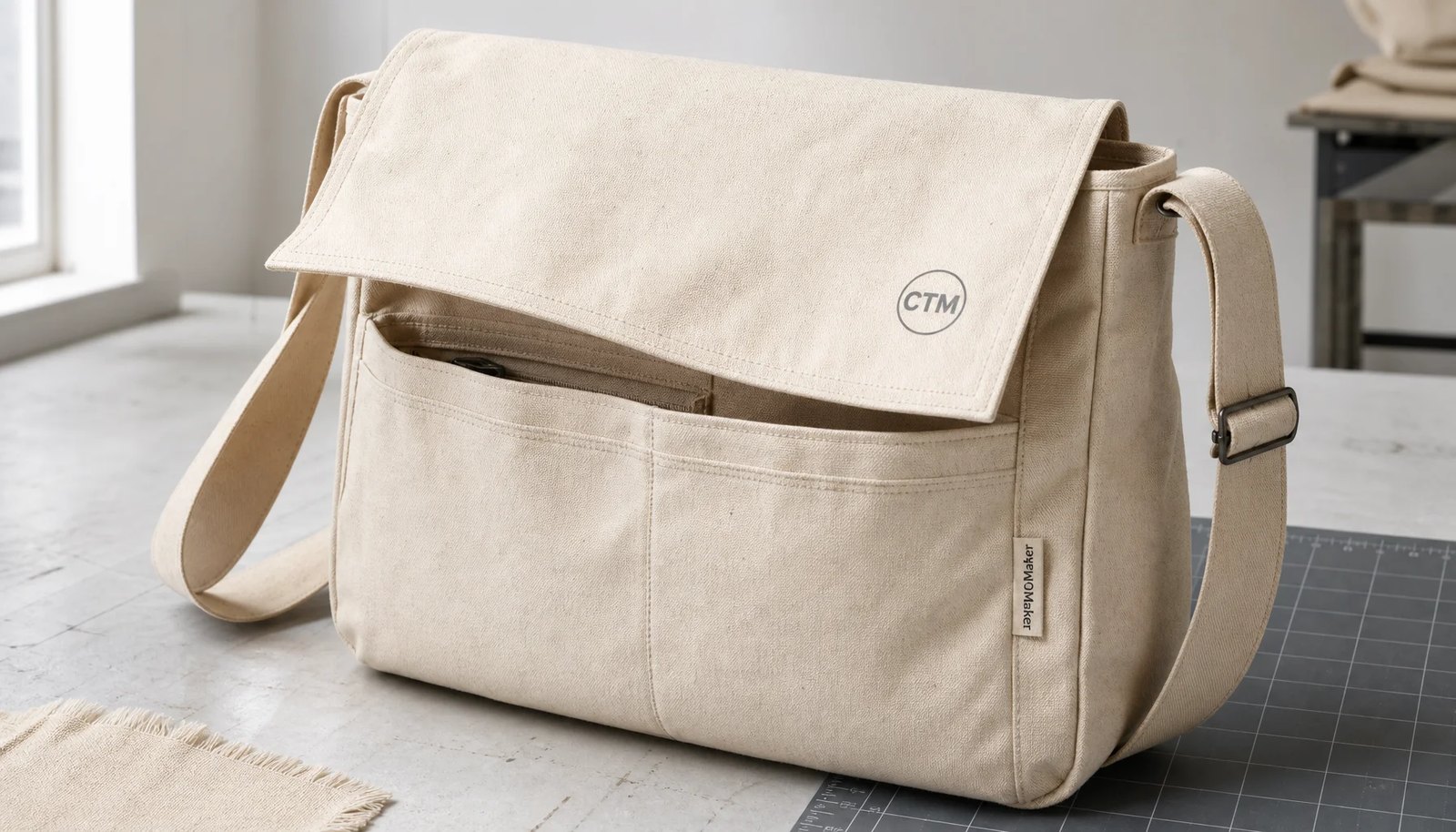
Start With the Failure Point, Not the Logo
For trade show exhibitors, a canvas messenger bag is not a decorative giveaway. It is a working carrier for catalogs, product cards, notebooks, chargers, badge holders, tablets, and sample packs. The fastest way to create a weak order is to start with logo size and target price, then treat construction as a factory detail. That usually produces a bag that looks fine in renderings but fails where procurement buyers actually measure value: on the show floor, during setup, in transit, and after repeated daily use.
A useful canvas messenger bag durability testing checklist for trade show exhibitors begins with use-case definition. Who carries the bag, what goes inside, how far it travels, and whether it is distributed empty or pre-packed all change the spec. A 2 kg brochure bag can survive with lighter construction. A 6 kg exhibitor kit needs stronger fabric, better strap reinforcement, a more stable bottom, and packing that does not crush the flap or print surface.
Procurement should force the supplier to confirm the intended use in writing. Ask whether the bag is for one event, a multi-show campaign, staff use, distributor resale, or retail resale. Those use cases create different durability expectations, different packing needs, and different acceptable defect rates. If the bag is meant to be reused across multiple shows, the buyer should ask for stronger reinforcement and a tighter inspection standard than a one-day giveaway bag would require.
- Set a target load in kilograms, not a vague phrase such as heavy duty.
- Define whether the bag is distributed empty or pre-packed before shipment.
- List the largest item that must fit, such as A4 catalogs, a tablet, or a sample folder.
- State the service life: one event, a multi-show campaign, staff use, or resale.
- Separate visual requirements from strength requirements so suppliers cannot trade one off silently.
Turn the Buyer Brief Into Measurable Specifications
Procurement teams often lose control of messenger bag quality because the brief is written in marketing language instead of production language. Phrases like premium, durable, roomy, and eco-friendly do not tell the factory how to cut, sew, reinforce, or pack the bag. A supplier can interpret those words in several ways, and the final order may still match the vague brief even if it misses the business need. The fix is to convert the brief into measurable items before requesting a quote.
A useful spec sheet for canvas messenger bags should define finished size, internal usable size, canvas weight in both oz and GSM, weave type, finish, strap width, closure type, pocket count, logo method, and packing style. It should also identify what is critical and what is flexible. For example, a buyer may allow minor variation in flap depth but not in internal width because the bag must fit a specific folder or tablet. That distinction saves time during sampling and prevents disputes later.
The buyer should also decide whether the order is optimized for unit cost, long service life, brand visibility, or logistics simplicity. Those goals do not always align. A bag with more structure, better reinforcement, and better packing may cost more, but it can reduce failure rates and event-day replacements. A procurement team that names the tradeoff can make a rational decision instead of negotiating blindly against the lowest quote.
- Write the spec as production instructions, not brand adjectives.
- Mark critical dimensions separately from acceptable cosmetic variation.
- State whether the order prioritizes cost, durability, appearance, or logistics.
- Include the largest intended insert, folder, or device in the brief.
- Ask the supplier to confirm every measurable item before sampling begins.
Choose Canvas Weight by Load, Shape, and Finish
Canvas messenger bag durability starts with the fabric, but fabric weight alone does not guarantee strength. A 12 oz tight weave canvas can outperform a heavier loose weave that distorts at seams and stretches at the strap anchor. For trade show use, buyers usually see 10 oz, 12 oz, 14 oz, and 16 oz cotton canvas, with GSM values that vary by yarn, weave density, washing, and finishing. That is why the quote should name both oz and GSM, plus an allowed tolerance.
If the bag must hold catalogs, chargers, and a tablet, 12 oz to 16 oz is usually the practical range. Lighter 8 oz to 10 oz canvas can work for low-cost promotional messenger bags, but it should be treated as a light-load item with more wrinkling and less seam-holding power. Heavier canvas improves perceived value and resistance to bag collapse, yet it also increases material cost, sewing difficulty, needle marks, freight weight, and the chance that a supplier will raise MOQ for dyed colors or special finishing.
Procurement should also ask how the fabric is finished. Washed canvas changes hand feel and size stability. Dyed canvas introduces shade control and colorfastness risk. Coated canvas can improve stain resistance, but it may affect print adhesion and the way the flap folds. The right specification is not just a fabric type; it is a set of measurable properties that should be referenced in the PP sample and final inspection.
- 8 oz to 10 oz canvas: suitable for light giveaways, low carry load, and short campaign use.
- 12 oz canvas: balanced option for many exhibitor bags with moderate contents and screen print logos.
- 14 oz to 16 oz canvas: better for premium event kits, resale, heavier catalogs, and longer service life.
- Washed canvas: softer hand feel but more size variation and more shade movement.
- Dyed canvas: useful for brand colors, but MOQ and colorfastness testing become more important.
Reinforce the Load Path: Straps, Seams, and Base
The strap area is where many messenger bags fail first. Buyers often focus on the front flap and logo while the actual failure starts on the back panel, side seam, or gusset where the shoulder strap is attached. For trade show bags, specify strap width, material, hardware, and reinforcement as one load system, not as separate cosmetic items. A 38 mm to 50 mm strap distributes weight better than a narrow promotional strap and is more comfortable when the bag carries a tablet or thick stack of literature.
Cotton webbing matches a natural canvas look, but heavy polyester webbing may offer better strength and less stretch. Metal adjusters can feel more premium, but they add weight and can scratch the bag during packing if the design is tight. Plastic adjusters reduce cost and weight, but only if the grade is suitable for the target load. The RFQ should state whether the supplier may substitute webbing material or hardware finish. If substitutions are allowed, the buyer should require written approval before mass production.
At the anchor point, a simple straight stitch is not enough. Box stitching, cross stitching, bar tacks, or a reinforced internal patch should be visible in the sample and documented in the production spec. Ask the factory to explain whether the strap is sewn through one layer, two layers, or a hidden reinforcement patch. That detail determines whether the bag survives a full exhibition cycle or starts to tear at the first heavy load.
- Use box stitch plus cross reinforcement where the strap joins the bag body.
- Add an internal patch if the strap is sewn into a single fabric panel.
- Avoid placing strap stress directly on a lightweight side seam without reinforcement.
- Test the loaded bag by hanging it for several hours and checking stitch movement.
- Reject samples where the strap twists easily or the adjuster slips under load.
Specify Closures, Pockets, and Bottom Structure
Messenger bag shape affects durability as much as fabric weight. A flat envelope-style bag is simple and economical, but it strains quickly when buyers load thick catalogs, samples, or a power bank. A boxed bottom or gusset distributes load better and helps the bag stand with contents inside, which matters at a busy booth. For exhibitor kits, this extra structure is often worth the cost because it reduces seam tension and improves day-to-day usability.
Closures deserve the same practical review. Magnetic snaps are clean and quick, but the backing area must be reinforced so the canvas does not tear after repeated opening. Metal snaps are secure and simple, but poor placement can leave pressure marks if the bag is packed tightly. Hook-and-loop tape is economical and strong, yet it can collect lint, make noise in meetings, and abrade printed surfaces if it sits in the wrong place. If the bag will be used in a premium client-facing setting, the buyer should ask how the closure affects both function and perceived value.
Internal pockets are useful, but too many compartments increase labor, inspection risk, and bulk lead time without adding real value to the user. A single slip pocket plus one zipper pocket is often enough for trade show use. If the buyer wants more organization, define pocket openings, pocket depth, and whether the pocket mouth must fit a passport, phone, notebook, or folded flyer. The pocket spec should be testable, not descriptive.
- Use a boxed bottom when the bag will carry thick catalogs or sample sets.
- Reinforce magnetic snap positions with an inside patch or extra layer.
- Keep inner pockets large enough for real items, not decorative shallow pockets.
- Use zipper pockets only when security justifies the extra sewing and inspection cost.
- Confirm flap coverage so contents stay protected even when the bag is full.
Match Branding Method to Canvas Texture and Wear
Logo durability is part of bag durability because buyers judge failure by appearance as much as by function. Canvas has texture, absorbency, and surface irregularity, so artwork that looks clean on paper can fill in, crack, or fade on fabric. For solid logos and event marks, screen printing is usually the most stable and economical method at quantity. It works best for simple color blocks, clear line weights, and controlled curing. If the supplier cannot explain the ink system and curing control, the print is not ready for bulk production.
Heat transfer can handle gradients and detailed artwork, but the edge feel and long-term adhesion should be tested on the actual canvas, not only on smooth fabric. Embroidery gives a premium look for small logos, yet it can pucker lightweight canvas and may not suit large filled areas. Woven labels or side labels are useful when the buyer wants subtle branding with lower abrasion risk. For dark canvas, underbase coverage, ink opacity, and color bleed need to be discussed before the quote is accepted, not after the sample arrives.
If the bag will be handled by warehouse teams, trade show staff, or retail buyers who stack items tightly, print abrasion matters as much as color match. Ask the factory to show the print after curing and after a dry rub check on the same fabric color. For frequent reuse, buyers should also ask whether the print can tolerate folding along the flap line without visible cracking. That is a practical durability concern, not a cosmetic one.
- Screen print: best for one to three solid colors and repeatable event branding.
- Heat transfer: useful for full-color logos, but test edge lift and cracking.
- Embroidery: premium for small marks, but control puckering and thread density.
- Woven label: durable brand detail with lower risk on rough canvas.
- Discharge or pigment effects: require fabric and color testing before bulk approval.
Use Samples to Prove Construction, Not Just Appearance
A messenger bag sample can mislead buyers if it is treated as a photo approval item. A look sample may use available fabric, substitute hardware, temporary thread, or a similar strap. That can help early design review, but it is not enough for production approval. A pre-production sample should use the final canvas weight, final color, final closure, final strap, final print size, final label, and final packing method. If any of those elements change later, the sample no longer represents the order.
During sample review, measure the bag as a user would use it. Check the internal size after sewing, not only the flat panel measurement. Put the intended contents inside and close the flap. Wear the bag with the expected load and see whether the strap cuts into the shoulder, the flap lifts, or the bottom sags. Then inspect the back side of the stitching, not only the front view. Many weak samples look neat from the outside but show short seam allowance, loose tension, or poor reinforcement inside the bag.
The best sample review process is simple and documented. Mark the approved sample with date, fabric spec, print reference, and key measurements. Keep one sealed buyer-side reference and one sealed factory-side reference. If the supplier later proposes a substitution, the team can compare against a real approved standard instead of relying on memory or photographs.
- Approve a look sample for shape only, then require a pre-production sample before cutting bulk fabric.
- Mark critical measurements with tolerance, such as width, height, gusset, strap length, and pocket opening.
- Photograph the approved reinforcement stitches and use them as the production reference.
- Test print rubbing after the ink is fully cured, not immediately after sample printing.
- Keep one sealed approved sample for factory reference and one buyer-side reference.
Set Practical Durability Tests Before Bulk Production
Not every trade show bag needs laboratory-grade testing, but every commercial order should have practical acceptance criteria. The supplier needs to know what will be rejected before the order reaches final inspection. For canvas messenger bags, the key checks are fabric weight verification, seam strength, strap load, closure cycling, print rub, zipper function if used, and carton handling. These can be scaled to the order value and the risk profile of the event schedule. A low-cost campaign bag may need only basic checks, while a high-visibility exhibitor program should include documented test results and photo records.
A simple factory-side load test can prevent many problems. Fill the bag to the target weight, hang it from the shoulder strap, and inspect strap anchors and seam movement after a defined period. For higher-value programs, buyers may require pull testing with a defined force, but even a well-documented static load check is better than no standard at all. Print rub testing should use the actual canvas color and print method, because natural canvas, black canvas, and washed dyed canvas behave differently. The same applies to closure hardware: magnets, snaps, and zippers should be cycled before the factory books shipment.
Procurement should define the pass-fail standard in advance. If the buyer does not specify the number of cycles, the target load, or the acceptable visual change, the factory will apply its own internal threshold. That may be adequate for a giveaway, but it is not enough for a trade show program that must arrive on time and survive repeated handling.
- Fabric check: weigh cut fabric or confirmed swatches against the agreed GSM tolerance.
- Load check: hang the finished sample at target load plus a safety margin and inspect stitch movement.
- Closure check: cycle snaps, magnets, or zippers repeatedly before approving hardware.
- Print rub check: use dry and light damp rubbing on the final print surface.
- Carton check: confirm bags are not crushed, stained, or abraded after compression and handling.
Understand MOQ and Cost Drivers Before You Price the PO
Canvas messenger bag pricing is driven by more than fabric weight. The biggest cost drivers are canvas consumption, dyeing or color minimums, strap and hardware grade, number of sewing operations, pocket complexity, print colors, packing style, and inspection requirements. A small change such as adding an inner zipper pocket or switching from natural canvas to a custom dyed brand color can move the quote more than the buyer expects. This is why the RFQ should isolate each variable instead of asking for a single all-in number without construction detail.
MOQ logic should be discussed by component. Natural canvas often has a lower MOQ because the material is commonly available. Custom dyed canvas usually has a higher MOQ because dye vat requirements and shade control create production minimums. Screen printing MOQ may be affected by artwork setup and ink color changes. Hardware MOQ can apply if the buyer wants a specific metal finish, branded puller, or nonstandard adjuster. Procurement should ask the factory to state which parts are stocked, which are custom, and which trigger a higher minimum.
The quote should also separate one-time setup from recurring unit cost. Screen plates, embroidery digitizing, woven label setup, and carton artwork are not the same as unit sewing cost. If those items are hidden in the unit price, it becomes hard to compare bids across factories. A clear quote makes later reorders easier because the buyer can see what is truly amortized and what must be repeated on the next PO.
- Fabric cost rises with GSM, dyeing, washing, coating, and panel waste.
- Sewing cost rises with gussets, lining, zipper pockets, piping, binding, and reinforcement patches.
- Print cost rises with number of colors, print area, underbase, special ink, and artwork setup.
- Packing cost rises with individual bags, hang tags, barcode labels, inserts, and carton sorting.
- MOQ rises when fabric color, hardware finish, strap color, or print setup cannot be shared.
Compare Supplier Quotes on the Same Basis
Many canvas messenger bag quotes look cheaper because they exclude details rather than because the supplier is more efficient. One quote may include 14 oz canvas, reinforced strap anchors, individual polybags, and final inspection. Another may assume 10 oz fabric, basic straight stitching, bulk packing, and no carton marking. Procurement teams should not compare those numbers as equivalent. The RFQ has to force each supplier to price the same construction, the same packing, and the same shipment handover point.
A useful quote should show dimensions, fabric specification, print method, packing method, MOQ, sample cost, sample lead time, bulk lead time, payment terms, carton details, and shipment handover point. If the supplier cannot provide estimated carton size and gross weight, landed-cost planning becomes weak. For distributors and retail buyers, carton dimensions affect warehouse storage, event advance receiving, rework time, and last-mile handling. Ask for line-item clarity so you can identify whether the supplier is actually competitive or merely incomplete.
The best procurement habit is to compare at the same volume tiers and with the same assumptions. Ask for pricing at 500, 1,000, 3,000, and 5,000 pieces if that matches your likely run sizes. Then compare the total landed cost with samples, freight, packaging, and inspection included. A low unit price can disappear once the buyer adds missing setup fees, packing upgrades, or correction costs caused by vague specs.
- Request fabric weight in oz and GSM, not only the phrase cotton canvas.
- Require a construction drawing or marked sample photos for strap and pocket details.
- Ask for carton quantity, carton dimensions, and estimated gross weight before order confirmation.
- Separate unit price from sample fee, setup charge, packing upgrade, and inland freight.
- Compare price changes at realistic tiers such as 500, 1,000, 3,000, and 5,000 pieces.
Specification comparison for buyers
| Spec decision | Recommended option | When it fits | Buyer risk to check |
|---|---|---|---|
| Main fabric weight | 12 oz to 16 oz cotton canvas, with both oz and GSM stated and an agreed tolerance on the approved swatch | Trade show exhibitor bags carrying catalogs, notebooks, tablets, chargers, and sample packs | A loose weave can feel weaker than a heavier tight weave; request actual GSM, weave density, shrinkage allowance, and the approved sample weight |
| Finished size control | Critical dimensions held to about +/- 1 cm, with usable internal size called out separately | Orders where the bag must fit A4 materials, a 13 inch tablet, or a specific insert tray | Flat cut size is not the same as usable size; ask for post-sewing dimensions, gusset depth, and flap overlap |
| Shoulder strap construction | 38 mm to 50 mm webbing with box stitch plus cross reinforcement or bar tacks at all load points | Bags expected to carry 4 to 7 kg during show days, setup days, and airport transfers | Narrow straps twist, stretch, or cut into the shoulder; confirm webbing thickness, adjuster grade, and anchor stitch pattern |
| Flap and closure | Full flap with magnetic snap, metal snap, or hook-and-loop only when noise and lint are acceptable | Exhibitor kits that need fast access while keeping contents covered | Weak snap backing or poorly placed magnets can tear canvas or distort the flap after repeated use |
| Bottom structure | Boxed bottom or double-layer base with optional insert board | Heavier literature packs, sample swatches, and small electronic accessories | Flat envelope bottoms overload seams and reduce usable volume; confirm board fit and moisture-safe packing |
| Print method | Screen print for solid logos, heat transfer for gradients, embroidery or woven label for premium smaller branding | Corporate event giveaways, sponsor kits, and retail-ready promotional merchandise | Print cracking on coarse canvas, dye migration on dark fabric, and embroidery puckering on light panels |
| Internal organization | One inner slip pocket plus optional zipper pocket; avoid overly complex compartment layouts | Buyers who need practical utility without pushing sewing cost too high | Extra pockets add labor, inspection points, and MOQ pressure; confirm pocket width, depth, and seam allowance |
| Packing method | Individual polybag or paper belly band, silica gel for humid routes, export carton sized below practical lifting weight | International shipments to trade show warehouses, distributors, or retail DCs | Overpacked cartons crush shape and print; underpacked cartons cause abrasion, dirt pickup, and corner damage |
Buyer checklist before sampling
- Define the real carrying load in kilograms, not a vague phrase like heavy duty.
- State whether the bag is handed out empty or pre-packed with inserts, catalogs, or samples.
- List the largest item that must fit, such as A4 folders, a 13 inch tablet, or a sample binder.
- Specify fabric in both oz and GSM, plus tolerance, weave type, finish, and whether the canvas is pre-shrunk or washed.
- Set the strap width, webbing material, adjuster type, anchor reinforcement, and minimum finished-bag load test target.
- Confirm finished dimensions as usable internal size, not only flat cutting size.
- Approve artwork on the final canvas color and texture before bulk printing or embroidery sampling.
- Require a pre-production sample using final fabric, thread, hardware, closure, strap, label, and packing method.
- Ask for a full quote breakdown: fabric, sewing, print, labels, packing, setup, sample, and inland freight to forwarder.
- Lock the timeline with sample approval date, material booking date, production window, inspection date, and cargo handover date.
Factory quote questions to send
- What is the proposed canvas weight in oz and GSM, and what tolerance will be used for incoming fabric inspection?
- Is the canvas greige, dyed, washed, enzyme washed, or coated, and how will shrinkage and shade variation be controlled?
- What is the finished bag size and internal usable size, and what tolerance do you hold after sewing and pressing?
- What is the maximum recommended carrying load for this construction, and what static load or pull test can the factory perform before shipment?
- Which stitch type, stitches per inch, seam allowance, thread size, and reinforcement method will be used at strap anchors, flap corners, and gussets?
- Which print method is quoted, what is the maximum print area, and how will rub resistance or wash resistance be checked on the final canvas?
- What is the MOQ by fabric color, logo color, hardware color, and packing style, and what changes trigger a higher MOQ?
- Will the pre-production sample use final bulk materials, and how many days are needed after artwork and deposit approval?
- How many pieces fit per export carton, what is the estimated carton size and gross weight, and can the carton pass a 1 m drop test when filled to normal pack density?
- Which quote items are excluded: artwork setup, sample courier, carton marking, barcode label, inner packing, document fee, or inland delivery to the forwarder?
Quality-control points to confirm
- Fabric GSM, weave density, and hand feel match the approved sample within the agreed tolerance before cutting starts.
- Canvas is inspected for slubs, dirty marks, oil stains, broken yarns, shade panels, and wash variation beyond the approved standard.
- Finished dimensions are measured after sewing and pressing, with special attention to flap alignment, gusset depth, and usable pocket size.
- Strap anchors pass static load testing without skipped stitches, seam cracking, stitch tunneling, or visible fabric tearing.
- Zippers, snaps, magnets, buckles, and adjusters operate smoothly and are positioned consistently across the lot.
- Print edges are sharp enough for the artwork style and pass dry rub testing on the same canvas texture and color.
- Thread color, stitch density, seam allowance, and bar tack position match the approved pre-production sample.
- Natural canvas and light colors are checked for oil marks, corner dirt, loose fibers, and lint contamination before packing.
- Carton compression does not deform the flap, crush hardware, or scuff print surfaces during handling and stacking.
- Carton markings, item labels, and any distributor or event warehouse requirements match the shipping instruction exactly.