Start with the studio use case
Canvas messenger bags for wellness studios can serve several jobs in one buying program: yoga teacher training, retreat welcome kits, spa staff carry, member gifts, retail merchandise, or distributor replenishment. Those uses may share the same outside shape, but they do not create the same stress. A light retail bag holding a towel and brochure does not need the same reinforcement as a teacher training bag carrying manuals, a bottle, apparel, and a tablet-style device every week.
Before requesting price, define the use profile in practical terms: expected contents, working load in kilograms, sales channel, storage conditions, presentation requirement, and reorder expectation. This prevents suppliers from quoting the same photo with different canvas weights, webbing grades, stitch density, seam allowances, reinforcement patches, and hardware quality. The goal is not to over-engineer every bag; it is to match construction to the buyer’s real risk.
- Light retail profile: 2 kg to 3 kg load, clean logo finish, smooth flap alignment, and strong shelf presentation.
- Retreat welcome profile: 3 kg load, efficient packing, reliable closure, low defect rate, and clear SKU separation.
- Daily studio profile: 4 kg to 5 kg load, reinforced anchors, stronger bottom seams, and durable closure attachment.
- Teacher training profile: manuals, bottle, notebook, pens, apparel, and tablet-style contents with reduced seam distortion.
- Distributor profile: repeatable materials, stable shade, carton mark accuracy, barcode control, and replenishment consistency.
Specify canvas by finished performance
Canvas weight is useful only when the measurement point is clear. For messenger bags, a durable commercial range is often 12 oz to 16 oz cotton canvas, roughly 380 to 540 GSM depending on weave and finishing. A 10 oz fabric may suit a short-term giveaway but can collapse on a retail fixture. An 18 oz fabric can feel substantial but may increase needle marks, sewing difficulty, carton weight, and freight cost.
Ask for finished fabric weight, not only greige weight. Greige canvas is measured before dyeing, washing, coating, printing, or pressing. Finished canvas is the material that is cut and sewn. Dyeing, pigment finishing, enzyme washing, coating, and curing can change GSM, shrinkage, stiffness, shade, and hand feel. If one quote uses 14 oz greige canvas and another uses 14 oz finished canvas, the offers are not equivalent.
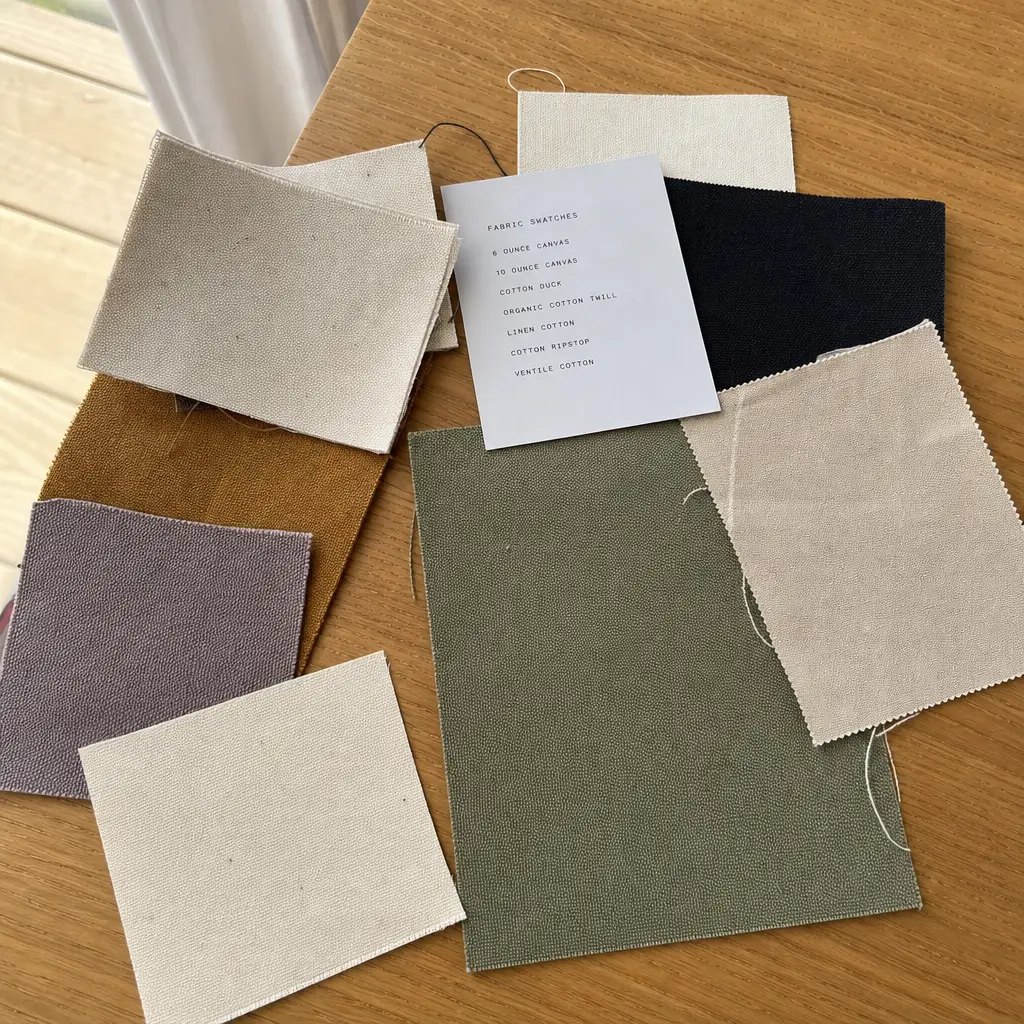
Weave stability matters as much as weight. A tight 12 oz duck canvas may resist seam slippage better than a loose 14 oz plain canvas. Washed canvas can match a relaxed wellness aesthetic, but it may wrinkle more and vary by lot. Natural unbleached canvas can include seed flecks and shade variation. Dyed sage, clay, charcoal, or navy canvas needs stronger crocking checks, especially if it will touch light linings, tissue paper, labels, or apparel.
- State finished GSM or oz after dyeing, washing, coating, printing, curing, pressing, and conditioning.
- Agree fabric weight tolerance, commonly expressed as a percentage such as ±5% when the supplier can control it.
- Request shrinkage data when bags may be steamed, spot cleaned, washed, humid-stored, or shipped by ocean.
- Use 12 oz to 14 oz canvas for balanced cost, lighter freight, moderate load, and flexible hand feel.
- Use 15 oz to 16 oz canvas for stronger body, improved shape, heavier load, and premium retail presence.
Lock dimensions and tolerances
Messenger bag dimensions deserve the same discipline as apparel measurements. Finished size affects capacity, flap coverage, strap comfort, carton quantity, and perceived value. A 10 mm change in gusset can decide whether a bottle, manual, or boxed kit fits. A flap that is too short may expose contents. A flap that is too long may buckle, hide the logo, or crease during packing.
A practical tolerance plan separates critical, visible, and flexible areas. Body width and height can often be controlled at ±5 mm. Gusset depth may need tighter control, such as ±3 mm, if the bag must hold boxed kits or printed manuals. Strap length range can allow ±10 mm, but the shortest and longest usable settings still need to be checked. Logo placement usually needs ±3 mm to ±5 mm depending on artwork size, panel shape, and canvas texture.
Write the measurement method into the tech pack. State whether the bag is measured flat with no tension, lightly smoothed, filled, after pressing, or after packing recovery. Canvas can shift with pressure and humidity. If the inspector measures differently from the sample room, a preventable argument can become a shipment delay.
- Measure body width, body height, gusset, flap length, flap width, strap range, pocket depth, and logo position.
- Use diagrams for pocket placement, closure position, strap anchor angle, label position, and hardware distance from edges.
- Define whether measurements are taken flat with no tension, lightly smoothed, filled, or after packing recovery.
- Set separate tolerances for critical fit areas, visible logo areas, and less critical internal details.
- Record approved sample measurements on the purchase order or inspection checklist, not only in email photos.
Engineer the stress points
Most messenger bag failures start where the customer does not look first: strap anchors, flap closures, side seam corners, zipper ends, pocket bottoms, and reinforcement patches. A low quote can preserve the same silhouette while reducing seam allowance, stitch density, reinforcement size, thread quality, webbing thickness, or hardware grade. Those differences usually appear only when the bag is loaded, worn crossbody, dropped into a locker, or opened repeatedly.
Straps need special attention because the load is often angled rather than vertical. A common shoulder strap width is 38 mm to 50 mm. Cotton webbing gives a natural feel. Polyester improves abrasion resistance and colorfastness. Cotton-rich webbing can be a practical middle ground. The anchor should use box-X stitching, bartacks, or an equivalent reinforcement plan, not one straight stitch line.
Closure choice should match the channel. Magnetic snaps look clean and retail-friendly, but they need reinforcement washers or patches behind the flap. Buckles feel more rugged and retreat-ready, yet they add labor and can dent fabric in cartons. Hook-and-loop is economical but collects lint. Zippers improve content security, but they need cycling tests, end reinforcement, and smooth puller operation.
- State strap width, webbing thickness, finished adjustable length, slider type, and whether the strap is fixed or detachable.
- Require reinforcement behind snaps, buckles, rivets, D-rings, zipper ends, strap loops, and pocket corners.
- Specify seam allowance, stitch density, thread type, and seam type for side, gusset, bottom, and flap seams.
- Use binding tape, overlock plus topstitch, or enclosed seams where raw edges would fray under repeated use.
- Define bottom construction as single layer, double layer, lined, padded, stiffened, or reinforced only at stress points.
Choose branding after testing
Wellness branding often favors muted color, small logos, natural texture, and calm retail presentation. The production method still needs technical control. Screen printing is usually efficient for one to three solid colors. Water-based ink can give a softer hand on natural canvas. Plastisol or rubber ink may improve opacity on dark fabric, but it can feel heavier. Textured canvas changes how inks sit on the surface, so the strike-off should use the production fabric and color.
Heat transfer can reproduce gradients and small typography, but canvas texture can reduce adhesion. Transfers may lift at the edges, crack when folded, or leave a visible film outline on large artwork. Embroidery can look premium, especially on flap logos or side panels, but it may create puckering, backing show-through, needle marks, or stiffness. Woven labels are often reliable for replenishment because the label can be controlled separately and stitched consistently.
Placement is part of durability. A logo crossing a fold line is more likely to crack. A print too close to a buckle, slider, or D-ring may abrade during packing or use. The artwork approval should include size, placement tolerance, color reference, orientation, acceptable texture show-through, and whether small flecks or weave gaps are acceptable.
- Use screen print for solid logos, cost control, and repeatable production on natural or dyed canvas.
- Use woven labels for subtle premium branding, lower abrasion risk, and multi-season replenishment.
- Use embroidery only after checking puckering, backing, needle marks, thread shade, and flap flexibility.
- Use heat transfer only after adhesion, edge lift, fold, and rub checks on textured canvas.
- Set logo placement tolerance, commonly ±3 mm to ±5 mm depending on artwork size and panel shape.
Make durability tests measurable
Durability language must be testable. Words such as strong, premium, heavy duty, and good stitching do not control production. The supplier needs a load weight, duration, pull direction, number of cycles, inspection points, and pass/fail condition. These factory checks do not replace certified lab testing when a retailer or regulation requires it, but they catch many avoidable defects before shipment.
Core checks include static load, strap pull, seam slippage review, closure cycling, zipper cycling, pocket loading, dry and wet print rub, color crocking, and packing recovery. The test level should match the use case. A welcome kit may be tested at 3 kg. A daily-use or teacher training bag may need 5 kg with rectangular contents that imitate manuals and devices, not just loose weights that settle softly in the bottom.
Use clear pass/fail examples. A static load sample may need to hold 5 kg for 24 hours with no strap detachment, no seam opening over 2 mm, no hardware tearing, and no major flap distortion versus the approved sample. A closure test may require 200 open-close cycles with no loose snap, bent prong, broken puller, or alignment failure. A print rub check should define unacceptable cracking, staining, color transfer, or visible ink loss.
- Static load: hang at 3 kg or 5 kg for the agreed duration and inspect anchors, seams, bottom, and flap shape.
- Strap pull: pull each anchor in use direction and reject thread break, webbing slippage, fabric tearing, or open seams over the agreed limit.
- Closure cycling: open and close snaps, buckles, hook-and-loop, or zippers repeatedly and inspect alignment and reinforcement.
- Pocket loading: fill pockets with realistic contents and check zipper ends, pocket bottoms, lining attachment, and sleeve sag.
- Print rub: test dry and wet rubbing on the logo and dyed areas, then check transfer, abrasion, cracking, and staining.
- Packing recovery: compress packed samples, then check creases, hardware dents, logo transfer, corner crushing, and shape return.
Control samples with approval gates
A photo sample is not enough for canvas messenger bags because the main risks are material, construction, and packing related. The pre-production sample should use the same canvas, dye color, webbing, hardware, closure, thread, print or label, lining if any, and packing method expected in bulk. Any component change after approval can change the durability result.
A cleaner development path uses gates. Start with a construction sample for size, capacity, flap shape, strap comfort, pocket layout, and balance. Substitute fabric may be acceptable at this stage if everyone understands that durability is not approved. Next review fabric lab dips or swatches, then the print strike-off, embroidery sample, transfer sample, or woven label. Only the complete pre-production sample should release bulk cutting.
The approved sample sheet should become part of the purchase order. Include measurements, tolerances, bill of materials, branding method, packaging, test requirements, defect classification, approval date, and any allowed deviations. That turns the sample from a design reference into a production control document.
- Approve construction first, then fabric color, then branding, then the complete pre-production sample.
- Measure body, gusset, flap, strap range, pocket dimensions, closure location, and logo placement on every sample round.
- Load the sample with realistic studio contents and wear it crossbody to check balance and anchor distortion.
- Open and close all hardware before approving appearance, because function defects can hide in attractive samples.
- Keep one sealed approved sample at the factory and one with the buyer or inspection agent.
Separate MOQ and cost drivers
MOQ for canvas messenger bags is rarely one simple number. A factory may support a lower quantity when the buyer uses stock natural canvas, stock webbing, standard hardware, one-color screen print, and simple packing. The same factory may require a higher MOQ for custom dyed canvas, special webbing, antique brass hardware, woven labels, embroidery, multiple colorways, or retail packaging. Ask which component creates the minimum.
Cost drivers should be separated so quotes can be compared fairly. Fabric weight affects material cost, cutting yield, sewing speed, and freight. Lining, padding, zipper pockets, binding, reinforcement patches, and metal hardware add labor. Large prints, embroidery, hangtags, barcode labels, and retail cartons add setup and inspection points. A 16 oz lined bag with a padded sleeve and embroidery should not be compared with a 12 oz unlined bag with one-color print.
Request quantity tiers such as 300, 500, 1,000, and 3,000 pieces when relevant. Ask for sample charges, screen charges, label minimums, hardware surcharge, carton cost, barcode cost, inspection cost, excess fabric policy, and courier charges. A quote that hides these items may look cheaper until development begins.
- Lower MOQ route: stock canvas, stock webbing, standard hardware, one-color print, simple interior, and bulk packing.
- Mid-range route: dyed canvas, woven label, reinforced anchors, slip pocket, upgraded closure, and controlled packing.
- Premium route: heavier canvas, lining, padded sleeve, zipper pocket, metal hardware, embroidery, and retail-ready packing.
- Hidden costs: sample revisions, screens, labels, hangtags, barcode stickers, special cartons, inspection, courier, and overage fabric.
- Compare quotes by finished GSM, construction, trims, logo method, packing, CBM, Incoterms, payment terms, and lead time.
Approve packing before shipment
Messenger bags are more shape-sensitive than flat totes. Flaps, straps, gussets, buckles, snaps, padding, and pockets all affect packing. Flat packing protects the front panel and logo but increases carton footprint. Folding reduces volume but may crease the flap, logo, or bottom panel. For wellness retail channels, shape recovery is part of the product experience.
The packing specification should include units per carton, carton dimensions, gross weight, inner packing, strap placement, tissue placement, hardware protection, silica gel use when needed, SKU separation, barcode position, and carton marks. If the bag is printed, the logo should not rub against hardware, dark dyed fabric, or another printed surface. Metal sliders and buckles should not sit directly on the visible flap face under compression.
Packing recovery should be tested from a real packed sample. Keep a carton under stacked weight or compression for the agreed period, then inspect flap creases, hardware dents, odor, tissue staining, dye transfer, and barcode readability. For long ocean freight or humid seasons, add checks for mildew risk, metal marks, and moisture control.
- Use tissue or protective sheets between printed panels when ink transfer, dye crocking, or hardware rubbing is possible.
- Place buckles, sliders, snaps, and D-rings away from logos and high-visibility flap surfaces during packing.
- Set carton dimensions, units per carton, gross weight, net weight, CBM, and carton strength before final price approval.
- Separate colorways, labels, sizes, and SKUs with clear inner marks, carton marks, barcode checks, and packing lists.
- Confirm whether cartons need drop, compression, or stack checks for distributor warehouses or long-distance freight.
Inspect with clear defect classes
Final inspection works best when defect classifications are agreed before production. Critical defects involve safety, compliance, or unsellable risk: sharp hardware, mold, broken needle contamination, severe odor, missing required warnings, or wrong product. Major defects affect function or retail acceptability: weak strap, open seam, loose snap, broken zipper, severe shade mismatch, wrong measurement beyond tolerance, poor print, or incorrect SKU. Minor defects are small appearance issues within agreed limits.
Inspection should not wait until every carton is packed. In-line checks at cutting, printing, strap attachment, hardware setting, pocket sewing, trimming, and pressing catch problems earlier. If strap anchors are sewn with the wrong SPI, finding the issue after packing can require opening every carton. If printing is misaligned, panels should be rejected before sewing.
AQL inspection may be used for shipment release, but the checklist should still be product-specific. The inspector should measure samples, compare shade and logo to the approved reference, load test selected bags, cycle closures, rub printed areas, inspect inside seams, verify barcodes, and compare packing against the approved carton setup. Multi-color orders should be checked by colorway, not only by overall shipment quantity.
- Critical defects: sharp edges, mold, broken needle risk, unsafe hardware, severe odor, missing legal marking, or wrong product.
- Major defects: weak strap, open seam, broken zipper, loose snap, wrong size, severe shade mismatch, poor print, or wrong SKU.
- Minor defects: small loose thread, slight wrinkle, tiny fabric fleck, light removable mark, or appearance issue within tolerance.
- In-line QC: fabric shade, panel cutting, print placement, strap stitching, hardware setting, pocket sewing, trimming, and pressing.
- Final QC: measurement, load check, closure cycling, rub check, packing recovery, barcode accuracy, carton marks, and sample comparison.
Specification comparison for buyers
| Spec decision | Recommended option | When it fits | Buyer risk to check |
|---|---|---|---|
| Finished canvas weight | 12 oz to 16 oz cotton canvas, roughly 380 to 540 GSM after dyeing, washing, coating, printing, curing, pressing, and conditioning; agree tolerance such as ±5% before cutting | Yoga studios, retreat kits, teacher training folders, spa staff bags, apparel add-ons, and retail merchandise carrying books, bottles, towels, and small devices | Some quotes use greige weight before finishing; require finished bulk fabric weight from roll inspection, not only supplier catalog weight |
| Canvas construction | Tight plain weave or duck canvas with controlled shrinkage, stable bias stretch, and clear face/back direction; natural, dyed, washed, or light coated according to sales channel | Natural canvas for calm wellness branding, dyed canvas for retail color stories, washed canvas for softer lifestyle appearance | Loose weave can slip at seams even when GSM looks high; washed and pigment-dyed canvas may show higher shade variation, shrinkage, and crocking |
| Dimensional tolerances | Finished bag body ±5 mm, gusset ±3 mm, flap length ±5 mm, strap length range ±10 mm, logo placement ±3 mm to ±5 mm depending on artwork size | Multi-location studios, retail programs, distributor SKUs, and replenishment orders where repeatability matters | Vague size approvals create disputes; confirm whether measurements are taken flat, filled, after pressing, or after packing recovery |
| Strap and anchors | 38 mm to 50 mm webbing, appropriate thickness for fiber type, box-X plus bartack or equivalent reinforcement, with anchor patch behind stress points | Daily studio use, teacher training manuals, retreat kits, staff bags, and merchandise expected to carry 3 kg to 5 kg | Single-row stitching, narrow webbing, missing reinforcement, weak sliders, and low stitch density can fail before the canvas body wears out |
| Closure system | Magnetic snap with reinforcement washer/patch, metal buckle with reinforced flap end, side-release buckle, zipper under flap, or heavy hook-and-loop selected by price point and use | Magnetic snaps for clean retail look; buckles for retreat/outdoor feel; hook-and-loop for budget programs; zipper plus flap for contents security | Magnets can pull through weak flaps, buckles can dent cartons, hook-and-loop collects lint, and zipper openings need cycling tests before approval |
| Branding method | Screen print for solid logos, woven label for repeatable premium branding, embroidery only after puckering review, heat transfer only after adhesion and fold testing | Wellness studios needing muted colors, subtle branding, consistent replenishment, or retail-ready presentation | Ink cracking, dye migration, poor curing, logo abrasion, wet crocking, label skew, and embroidery puckering must be checked on final canvas color |
| Interior build | Simple open body for low MOQ; one slip pocket for manuals; padded sleeve for tablet-style contents; zipper pocket for staff or retail bags; bound seams for cleaner interior | Teacher training, reception staff, retail merchandising, retreat welcome kits, loyalty gifts, and spa staff carry | Extra compartments increase labor, defect opportunities, inspection time, and cost; unpadded sleeves should not be described as device protection |
| Bottom reinforcement | Double-layer canvas bottom, bound internal seam, boxed corners, or hidden reinforcement panel for bags over 35 cm wide or intended for 4 kg to 5 kg load | Heavier contents such as manuals, bottles, apparel bundles, skincare kits, and small devices | If reinforcement material shrinks or flexes differently, the bottom can twist, pucker, or telegraph through the outer canvas |
| Packing method | Flat pack or shallow fold with tissue between printed panels, hardware isolated from flap face, carton gross weight limit, silica gel when needed, and approved carton compression setup | Ocean freight, distributor storage, wellness retail launches, multi-location receiving, and retail-ready cartons | Over-tight cartons crease flaps, deform snaps, rub dark canvas onto natural panels, dent hardware into fabric, and increase repacking cost |
Buyer checklist before sampling
- Define the finished bag size and measurement method: body width/height ±5 mm, gusset ±3 mm, flap length ±5 mm, strap range ±10 mm, pocket location ±5 mm, and logo placement ±3 mm to ±5 mm where practical.
- State canvas weight as finished GSM or oz after all dyeing, washing, coating, printing, curing, pressing, and conditioning; confirm the tolerance before bulk cutting.
- Confirm fiber composition, weave type, face direction, shrinkage range, colorfastness target, crocking requirement, and whether the canvas is natural, bleached, reactive dyed, pigment dyed, enzyme washed, or coated.
- Define the working load: 2 kg for light retail, 3 kg for retreat welcome kits, 4 kg for mixed daily use, or 5 kg for teacher training manuals, bottle, apparel, and tablet-style contents.
- Specify strap width, finished adjustable length range, webbing material, slider material, D-ring or buckle material, stitch density, bartack location, box-X dimensions, and reinforcement patch size.
- Require reinforcement behind magnetic snaps, buckles, rivets, D-rings, zipper ends, pocket corners, and strap anchors; the technical sheet should show material, size, placement, and stitch route.
- Choose branding only after reviewing logo size, canvas color, ink system, curing method, label type, embroidery backing, abrasion risk, wash expectation, and replenishment consistency.
- Approve a pre-production sample made with production fabric, color, webbing, thread, hardware, closure, logo method, lining if any, and packing method.
- Set measurable tests for static load, strap pull, seam slippage, closure cycling, zipper cycling, print rub, crocking, pocket loading, seam appearance, and carton recovery.
- Confirm interior requirements precisely: padded sleeve, slip pocket, zipper pocket, key loop, bottle pocket, pen slot, lining, bound seams, raw-edge finish, care label, and whether device protection is claimed.
Factory quote questions to send
- What is the finished GSM or oz of the canvas after all finishing steps, and what bulk tolerance do you apply by roll?
- Can you provide fabric composition, weave type, shrinkage result, dry/wet crocking result, and colorfastness method for the selected canvas color?
- Are you quoting stock natural canvas, stock dyed canvas, custom dyed canvas, pigment-washed canvas, or coated canvas, and which option controls MOQ, lead time, and shade tolerance?
- What maximum recommended carry load applies to this exact bag size, strap width, seam construction, anchor patch, and hardware setup, and what test method supports that recommendation?
- Which stitch type, SPI range, bartack position, box-X dimensions, seam allowance, thread type, and reinforcement patch size will be used at strap anchors, side seams, flap seams, and bottom corners?
- What closure do you recommend for our sales channel, and can you perform a pull test or repeated open-close cycling test on that closure?
- What logo process do you recommend for our artwork and canvas color, and can you run dry rub, wet rub, fold, adhesion, and visual shade checks before approval?
- What MOQ applies separately to fabric color, webbing color, hardware finish, woven label, embroidery, screen print color, carton label, hangtag, polybag, and finished bag style?
- How many calendar days are needed for artwork review, lab dip, fabric booking, print strike-off, construction sample, pre-production sample, bulk cutting, sewing, final inspection, and packing?
- What are the proposed carton dimensions, units per carton, gross weight, net weight, CBM, packing orientation, inner packing, loading estimate, and carton strength for sea or air shipment?
Quality-control points to confirm
- Finished canvas weight should be measured from bulk rolls after all finishing and should match the approved specification within the agreed tolerance before cutting starts.
- Fabric shade should be checked by lot, roll, colorway, panel direction, and component so flap, gusset, body, strap, pocket, and binding do not show unacceptable mismatch under standard lighting.
- Finished bag measurements should be checked flat after pressing and after packing recovery, including body width, height, gusset depth, flap length, strap range, pocket depth, and logo position.
- Strap anchors should pass the agreed load or pull check without skipped stitches, broken thread, seam opening, webbing slippage, hardware deformation, or visible fabric tearing.
- Main seams should show consistent SPI, secure backstitching, correct seam allowance, clean corner turns, no unapproved raw fraying, and no broken thread at stress points.
- Reinforcement patches behind snaps, buckles, rivets, D-rings, zipper ends, and strap anchors should be centered, fully caught in stitching, and made from approved material and thickness.
- Hardware should open and close smoothly without sharp edges, rust marks, plating scratches, weak spring tension, loose prongs, uneven pressure, or staining on nearby canvas.
- Printed logos should pass visual shade review plus dry rub, wet rub, fold, adhesion, and curing checks before packing, especially on dark dyed, pigment-washed, or textured canvas.
- Dyed canvas should be checked for crocking against light fabric, natural lining, white tissue, labels, and adjacent panels during stacked, folded, or compressed packing.
- Internal pockets should be checked for zipper smoothness, slider stop security, pocket depth, bottom seam strength, lining attachment, padding placement, and loose thread removal.