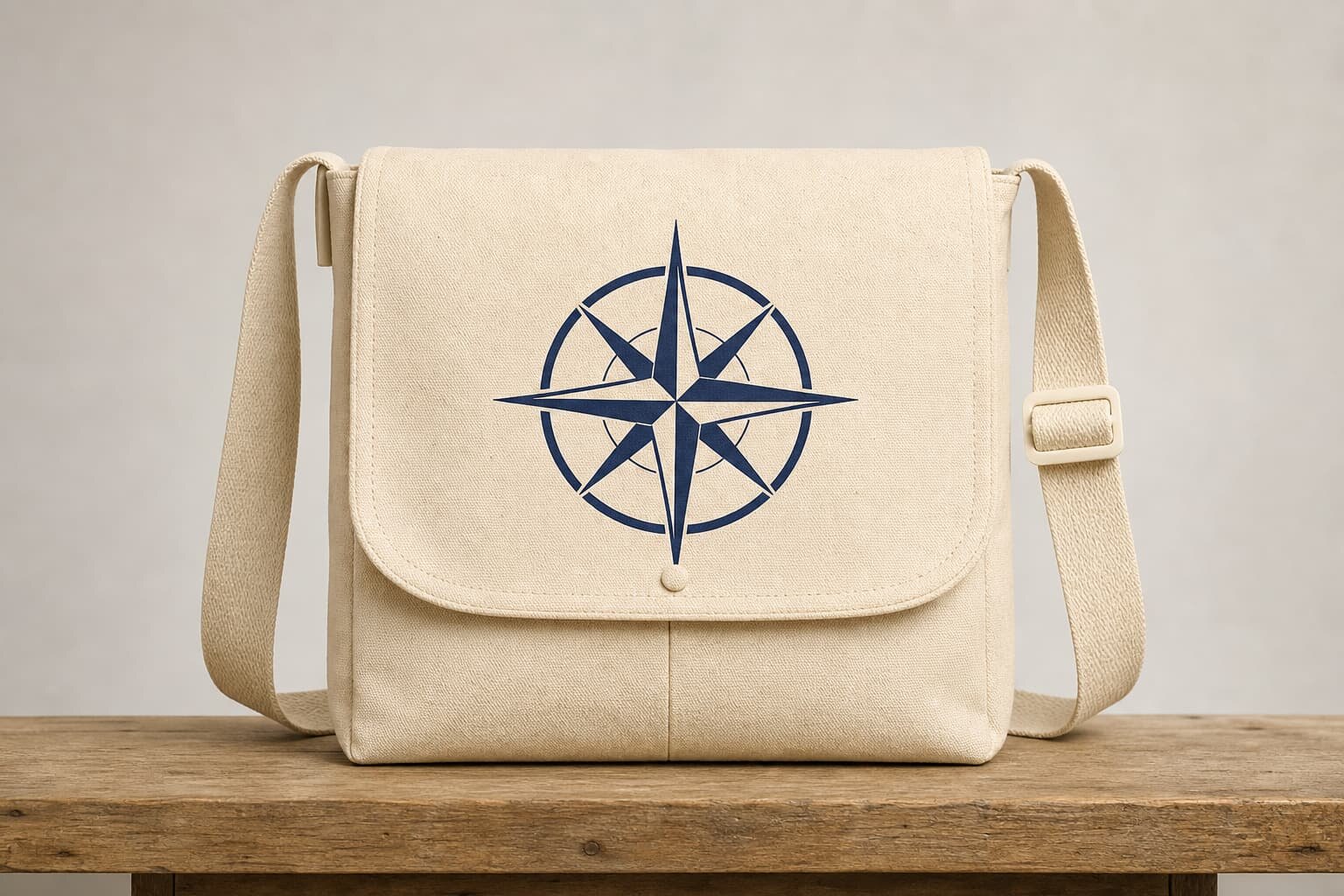
Why the Logo Proof Controls the Whole Order
For a custom canvas messenger bag, the logo proof is not a small artwork approval step. It is the document that connects the buyer's brand standard, the factory's print process, the sewing pattern, and the final inspection criteria. If the proof only shows a flat digital mockup, the production team may still be guessing about ink absorption, safe print area, flap curve, hardware position, and how the bag will be folded in cartons.
Procurement teams often compare quotes by unit price first, but many disputes start from an unclear proof. A supplier can quote the same bag size and the same logo size while using different canvas weight, different print method, different curing process, or different packing pressure. The buyer then receives a bag that is technically close to the artwork but commercially wrong for retail, corporate gifting, or distributor resale.
- Use the proof to lock logo size, color, method, position, fabric base, and tolerance.
- Do not treat a computer rendering as final approval for bulk production.
- Ask the supplier to sign the same proof file that your QC team will use for inspection.
- Keep one approved physical sample at the factory and one with the buyer or inspection company.
Start With the Real Print Surface, Not the Logo File
A messenger bag has more print restrictions than a flat tote bag. The front flap may have a curved bottom edge, a hidden pocket, snap buttons, magnetic closures, binding tape, or a fold line where the fabric bends every time the bag opens. A logo that looks clean in a rectangular artwork area may sit too close to a seam or be distorted after the flap is sewn and turned.
Before approving logo size, ask the factory to mark the print area on the actual pattern or on a finished blank sample. The useful print area is smaller than the flap size. The factory should reserve margin from stitching, edge binding, closure hardware, and any thick seam allowances. For most medium canvas messenger bags, a centered front-flap logo is safer than a logo placed low near the flap edge, but the final decision depends on the bag construction.
- Request a photo of the blank bag with ruler marks showing maximum print width and height.
- Confirm whether printing happens before sewing or after sewing; this changes placement accuracy.
- Avoid placing small text over flap curves, snap pressure points, or heavy seam areas.
- Record placement as measurements, such as 80 mm below top seam and centered between side seams.
Choose Canvas Weight Before Choosing Print Method
Canvas weight affects both the bag performance and the logo result. A lightweight canvas may be easier to fold and cheaper to ship, but it can wrinkle around a large print and feel weak for a messenger bag carrying documents, laptops, catalogs, or daily items. A heavier canvas gives the bag more structure, but rough texture and thick yarns may reduce fine print sharpness. For many custom messenger bags, 12oz to 16oz canvas, roughly 340 to 540 GSM depending on fabric construction and finish, is a practical range.
Natural canvas, dyed canvas, washed canvas, and waxed-style finishes behave differently. Natural cotton may contain specks and shade variation, which can look acceptable for an eco or casual style but less precise for a clean corporate logo. Dark dyed canvas may need an underbase for light color printing. Washed canvas can have an uneven surface, and the buyer should accept that the logo may look more vintage than sharply commercial.
- For sharp screen printing, ask for a smooth, tight canvas rather than a loose rustic weave.
- For premium retail feel, consider heavier canvas but review freight impact and crease risk.
- For natural canvas, approve the logo on actual fabric shade because cotton color affects ink appearance.
- For dark canvas, confirm whether the quote includes white underbase or extra print passes.
Match the Print Method to the Artwork and Use Case
Screen printing is usually the most practical option for solid-color logos on canvas messenger bags. It works well for one to three colors, bold text, and simple brand marks. The cost structure includes screen setup, ink, labor, and curing time, so it becomes more efficient when the same logo is repeated across a meaningful quantity. Buyers should confirm whether the quoted price includes all logo colors, underbase, and screen charges.
Heat transfer can handle gradients, photographic detail, or very fine artwork, but buyers should check hand feel, edge outline, and durability on fabric that bends. Embroidery gives a durable raised effect but may not suit very small lettering on heavy canvas. A woven patch or sewn label can be better when the buyer wants a premium detail, wants to avoid ink color issues, or plans to use the same branding across several bag styles.
- Use screen print for simple solid logos and clean cost control.
- Use transfer print when artwork has gradients, shadows, or many colors.
- Use embroidery for small premium marks, not for tiny legal text or large stiff panels.
- Use woven patch or side label when brand consistency across different fabrics is more important than direct printing.
What a Proper Logo Proof Should Include
A useful proof is a controlled production reference, not a pretty image. It should show the final artwork version, print method, Pantone or color reference, logo dimensions, placement measurements, fabric color, fabric weight, bag style, sample date, and approval status. If the bag has multiple branding points, such as flap logo plus inner woven label plus hangtag, each should be shown clearly and approved separately.
The proof should also state tolerances. Canvas bags are sewn goods, not molded plastic products. A small placement tolerance is normal because fabric stretches, sewing allowance varies, and the flap may shift slightly during production. The buyer should define a commercially acceptable tolerance before bulk production, for example plus or minus a few millimeters for logo placement and a reasonable color tolerance against the approved physical sample.
- Include artwork file name and revision number so old logos cannot be used by mistake.
- Show logo width and height in millimeters, not only percentage scale.
- Mark the distance from top seam, flap edge, side seam, or hardware centerline.
- Define whether the approved color is based on Pantone, physical strike-off, or buyer-provided sample.
- Add approval signature or written approval date before the factory starts bulk printing.
Sample Approval: Strike-Off, Proto Sample, and Pre-Production Sample
There are several sample stages, and buyers should not confuse them. A print strike-off only proves the logo effect on fabric. A proto sample checks the bag construction, size, pocket layout, strap, and trims. A pre-production sample should combine the final bag construction with the final logo process and final packing direction. For low-risk repeat orders, a buyer may approve fewer stages, but for a new messenger bag program the pre-production sample is the most useful control point.
When reviewing the sample, do not only look at the logo from the front. Open the flap, bend it naturally, check whether the print cracks or lifts, inspect the back side for ink penetration, and compare the print position to closure hardware. If the logo is on a flap that folds over a thick gusset, the logo may look slightly different when the bag is filled. For retail buyers, it can be useful to put paper or a sample insert inside the bag and view the packed shape.
- Keep the approved sample unwashed, unaltered, and clearly labeled as the inspection reference.
- Photograph the proof with a ruler in frame to reduce later arguments about placement.
- Check logo readability from normal viewing distance, not only close-up.
- Reject samples that use substitute fabric unless they are clearly marked as construction-only samples.
MOQ and Cost Logic Behind Custom Logo Proofing
MOQ is not only about sewing quantity. A factory may be willing to sew a small batch of messenger bags, but custom logo printing still has setup time, screen making, color mixing, curing setup, and production line cleaning. If the buyer also requests custom dyed canvas, special hardware color, custom woven labels, or retail carton labels, each component can create its own MOQ. This is why two suppliers can give different MOQ numbers for the same-looking product.
To compare quotes fairly, ask the supplier to separate bag cost, logo setup, logo running cost, sample charge, packing cost, and any component MOQ. A low unit price may exclude screen charge, pre-production sample, export carton upgrade, or branded inner label. For distributors collecting orders from several end customers, it may be cheaper to standardize the bag body and change only the logo, instead of changing fabric color and trims for every small batch.
- Ask whether screen charges are one-time, per color, per size, or per reorder.
- Confirm if MOQ changes when the logo moves from flap to strap or side label.
- Check whether custom canvas dyeing has a higher MOQ than stock canvas colors.
- Separate sample lead time from bulk lead time when building the purchasing schedule.
- Request a reorder price rule if the same logo will be repeated later.
Lead Time Planning From Artwork to Packed Cartons
A realistic timeline starts before sewing. The factory needs time to review artwork, confirm print feasibility, make the proof or sample, wait for buyer approval, purchase or prepare fabric and trims, cut panels, print or embroider, cure or finish the logo, sew the bag, inspect, and pack. If the buyer delays approval of a small logo correction, the production slot may move, especially during peak seasons or before holidays.
The printing sequence matters. Some factories print panels before sewing for better flatness and cleaner registration. Others print finished bags for smaller runs or when the logo position depends on final sewn shape. Printing before sewing may create a better result but requires careful cutting and sewing control. Printing after sewing may reduce pattern mismatch but can be harder near seams and hardware.
- Ask for a dated schedule showing artwork confirmation, sample dispatch, approval deadline, bulk start, inspection date, and shipment readiness.
- Confirm whether logo proof approval is required before fabric cutting or only before printing.
- Build buffer time for sample shipping, buyer comments, and corrected proof if brand color is strict.
- Do not approve bulk production based on a phone photo if color, scale, or placement is critical.
Packing Decisions That Protect the Printed Logo
Many logo defects are not printing defects; they are packing defects. A canvas messenger bag with a front flap logo can be damaged if the bag is folded sharply through the print area, compressed too tightly, or packed with hardware rubbing against the logo. Pigment prints and transfers are especially vulnerable before they have fully settled and cooled. Even a durable print can arrive with crease marks if the carton is overloaded.
For retail or distributor programs, the packing method should be approved together with the pre-production sample. Flat packing usually protects the logo better but increases carton volume. Light folding can reduce freight cost but must avoid hard folds across the logo. Tissue paper, simple paper interleaving, or careful strap positioning can prevent metal buckles and adjusters from marking the printed flap.
- Confirm units per carton, carton size, gross weight, and whether bags are flat packed or folded.
- Ask the factory to show one packed carton photo before mass packing starts.
- Keep buckles, snaps, and strap adjusters away from direct contact with printed logos.
- Use carton drop or handling checks when the order will travel through multiple warehouses.
- If retail presentation matters, specify whether each bag needs a polybag, hangtag, barcode label, or tissue insert.
How Buyers Should Compare Supplier Quotes
When comparing custom canvas messenger bag quotes, do not compare only the headline FOB unit price. One supplier may quote 14oz canvas with one-color screen print and simple export packing. Another may quote 16oz canvas, reinforced strap anchors, woven label, two-color logo with underbase, individual polybag, and stronger carton. These are not the same product even if the photo looks similar.
A clean quote comparison should include bag dimensions, canvas GSM or oz, lining if any, hardware, strap specification, print method, print colors, logo size, sample cost, setup cost, MOQ, lead time, carton packing data, and inspection standard. If a supplier cannot provide this information before sampling, the buyer should expect more changes after the first sample, which can waste time and weaken negotiation power.
- Put every supplier into the same spec sheet before comparing price.
- Ask for fabric weight in both oz and GSM where possible to avoid misunderstanding.
- Separate optional upgrades, such as lining, zipper pocket, reinforced base, or metal buckle.
- Require carton data because messenger bags can have higher freight volume than flat totes.
- Use the approved proof as a quote attachment, not as an informal email image.
Specification comparison for buyers
| Spec decision | Recommended option | When it fits | Buyer risk to check |
|---|---|---|---|
| Fabric weight for printed flap | 12oz to 16oz cotton canvas, usually 340-540 GSM depending on finish | Best balance for retail messenger bags that need body, print clarity, and acceptable freight weight | Very loose weave or heavy slub texture can break fine logo lines and make small text unreadable |
| Logo print method | Screen print for solid 1-3 color logos; heat transfer for gradients; embroidery or woven patch for premium texture | Choose by artwork complexity, brand positioning, and expected wash or abrasion exposure | Do not approve only a digital mockup; request a physical strike-off on the actual canvas color |
| Logo placement | Centered on front flap with measured distance from flap edge and stitching line | Most common for corporate, retail, school, and event messenger bags | Pocket seams, snap buttons, flap curve, and fold line may reduce the safe print area |
| Proof approval sample | Pre-production sample with final fabric, final logo method, final trim, and final packing reference | Needed before production when logo color, size, or placement affects brand compliance | A sample made on substitute fabric may approve the wrong ink absorption, hand feel, and color result |
| Packing method | Flat packed or lightly folded with tissue paper in each bag; carton sized to avoid hard creases across logo | Useful for printed flap bags going to retail, distributor stock, or kitting centers | Tight compression can leave crease marks through the print area, especially on pigment or transfer prints |
| MOQ logic | MOQ depends on fabric dyeing, print setup, hardware sourcing, and sample approval route | Lower MOQ is easier with stock canvas colors and simple one-color logo | Custom dyed fabric, special hardware, or multi-position printing can raise the practical MOQ even if bag sewing MOQ looks low |
Buyer checklist before sampling
- Confirm the final bag size, flap size, gusset, strap width, pocket layout, closure type, and whether the logo sits on flap, body, strap, patch, or side label.
- Provide vector artwork in AI, EPS, or editable PDF format, plus Pantone references and a note on whether exact color matching or close commercial matching is acceptable.
- Ask the factory to mark the maximum safe print area on the actual messenger bag pattern, not only on a flat rectangle drawing.
- Approve a physical logo proof on the confirmed canvas weight and color before bulk printing, especially for dark canvas, natural cotton, or textured canvas.
- Check whether the print method suits the artwork: screen print for solid marks, transfer for fine gradients, embroidery or patch for a higher perceived value.
- Measure logo width, height, distance from flap edge, and distance from side seams on the sample; record these dimensions in the approved proof file.
- Review print hand feel, opacity, edge sharpness, color shade, and whether the logo cracks when the flap is bent naturally.
- Confirm inner label, hangtag, barcode, carton mark, polybag warning text, and retail packing requirements before the pre-production sample is sealed.
- Request carton dimensions, gross weight, units per carton, packing direction, and whether logo panels are protected from rubbing during transit.
- Lock the approved proof with date, version number, buyer signature, and factory signature so production, QC, and shipping teams inspect against the same reference.
Factory quote questions to send
- What canvas weight and construction are you quoting: oz, GSM, yarn count if available, and whether the fabric is greige, dyed, washed, or finished?
- Is the quoted logo method screen print, heat transfer, embroidery, woven patch, leather patch, or side label, and how many colors or stitches are included?
- What is the maximum safe print area on the front flap after allowing for seams, snaps, flap curve, and production tolerance?
- Will the proof be made on the same fabric color, same fabric weight, same ink, same mesh, and same curing process as bulk production?
- What color tolerance do you use for print approval, and can you match Pantone on natural canvas or only provide a close production match?
- How many days are needed for artwork review, strike-off, pre-production sample, buyer approval, material preparation, bulk sewing, printing, inspection, and packing?
- What MOQ applies to the bag body, custom fabric color, logo setup, hardware color, woven labels, and retail packing components separately?
- What tests can be done before shipment: logo rub test, tape test, flap bend check, seam strength, strap pull, carton drop, and barcode scan?
- How are printed flaps protected inside cartons, and will bags be flat packed or folded through the logo area?
- What quote details are excluded, such as sample fee, logo screen charge, mold charge for hardware, inner label, export carton, palletization, or local port charges?
Quality-control points to confirm
- Compare bulk print position against the signed proof using measured distance from flap edge, side seam, and closure hardware, not by eye only.
- Check logo color under consistent light and against the approved physical sample because natural canvas shade can change perceived ink color.
- Perform dry rub and light wet rub checks on printed areas to detect weak curing, poor ink adhesion, or transfer surface problems.
- Bend the front flap in the normal opening direction and inspect for cracking, lifting, whitening, or ink build-up on the fold area.
- Inspect fabric defects around the logo zone, including oil marks, weaving slubs, needle holes, loose threads, and uneven washing marks.
- Measure bag body size, flap depth, strap length, strap width, gusset, and pocket opening against the approved specification sheet.
- Check stitching density, back-tacking, strap anchor reinforcement, and closure alignment because logo approval does not replace bag construction inspection.
- Scan any barcode or retail label after final packing to confirm that packing changes did not hide, wrinkle, or misplace required labels.
- Open cartons from top, middle, and bottom during inspection to confirm that printed panels are not rubbed, creased, or contaminated during packing.