Start carton planning before the RFQ is sent
For wholesale canvas messenger bags for nonprofit campaigns, shipping carton planning belongs at the RFQ stage. Waiting until the bags are sewn is risky because a messenger bag is not a flat tote. The flap, gusset, shoulder strap, closure, pockets, hardware, and logo position all affect folded thickness. They also decide where pressure builds inside the carton. A packing method that is convenient for the sewing floor may be inconvenient for warehouse receiving, chapter distribution, school delivery, parcel re-shipping, or volunteer handling.
Carton planning has a direct effect on landed cost and campaign readiness. Oversized cartons increase CBM and freight cost. Heavy cartons slow unloading and may be difficult for volunteers, school staff, or small partner offices to move safely. Over-compressed cartons can crease flaps, distort corners, mark natural canvas, or push hardware into printed areas. The bag may pass a basic product inspection and still arrive in a condition that creates problems at launch.
Nonprofit campaigns often run on fixed dates: public events, donor deadlines, grant periods, conference schedules, back-to-school drives, or sponsor activations. A carton error can disrupt those dates as much as a sewing defect. Treat the export carton as part of the product, not as an afterthought. Ask for pieces per carton, carton length, width, height, gross weight, net weight, wall construction, carton marks, and CBM per 1,000 pieces before approving the pre-production sample.
- Set a gross-weight target, often below 15-18 kg when cartons will be handled manually by volunteers, schools, or event staff.
- Request carton dimensions in centimeters and calculate CBM per 1,000 pieces so suppliers can be compared on landed cost, not only FOB price.
- Approve the folding method with photos showing flap direction, strap position, closure position, number of stacks, and whether printed panels touch hardware.
- Confirm the distribution route before quoting: one warehouse, multiple chapters, parcel hubs, event venues, schools, partner offices, or mixed destinations.
- Avoid quotes that say packing to be confirmed later when freight budget, launch timing, and receiving labor depend on carton data.
Write a specification that factories can price consistently
A useful B2B specification removes guesswork. Instead of asking for a standard canvas messenger bag, define finished outside size, usable internal size, gusset depth, flap coverage, strap width, strap length, closure type, pocket layout, stitching method, canvas weight, decoration method, and packing. If the bag must carry A4 documents, US letter folders, brochures, a tablet sleeve, T-shirts, volunteer forms, or sponsor inserts, list those contents and the estimated load. That detail helps the supplier quote the right structure instead of the cheapest-looking version.
Finished size and usable capacity are not the same. A 36 cm wide bag may lose real space to seam allowance, gusset shape, flap overlap, or pocket construction. A flap that covers an empty sample may lift when the bag is loaded. A front pocket shown in a photo may be too shallow for the actual campaign insert. Ask the supplier to confirm internal fit and usable opening, not only external width and height.
Tolerances should be practical and written. For sewn canvas goods, +/-1 cm on main body width or height is a common commercial starting point when agreed, while print placement, pocket position, closure alignment, and strap anchor placement may need separate limits. Cotton canvas moves during cutting, sewing, pressing, and packing. Unrealistic tolerances cause disputes; vague tolerances leave too much room for interpretation.
- Define outside size and usable internal size separately, especially for A4, letter-size, tablet, or folder capacity.
- Specify gusset depth only when needed; every extra centimeter adds material, folded thickness, and carton volume.
- List strap width, strap length range, fixed or adjustable design, and whether hardware is allowed to contact printed panels.
- State closure type and placement, because Velcro, snaps, buttons, buckles, and no-closure designs require different inspection checks.
- Include agreed dimensional tolerances in the purchase order and sealed sample record, not only in email conversation.
Choose canvas weight by load, feel, and freight volume
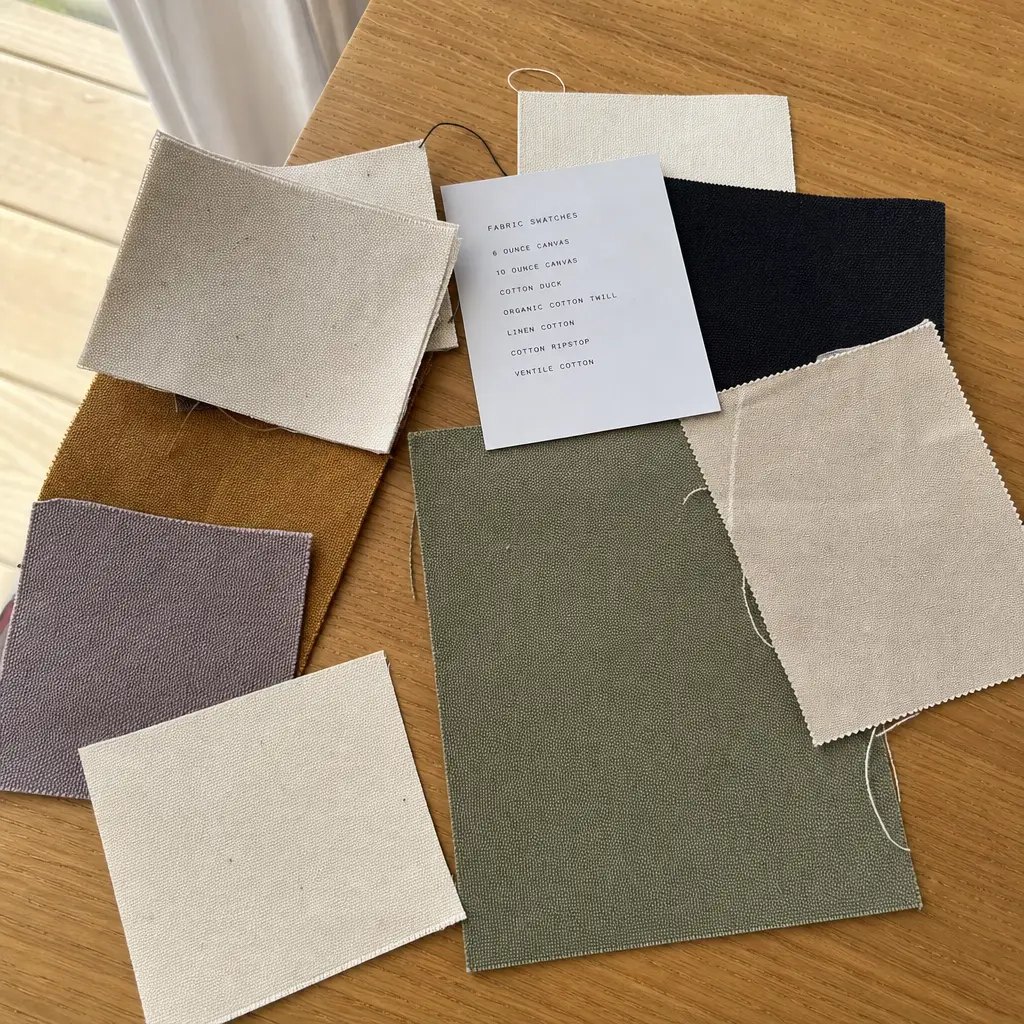
Canvas weight drives cost, hand feel, strength, print result, folded height, and carton CBM. For many nonprofit campaign messenger bags, 12 oz cotton canvas, often around 380-420 GSM depending on mill and finishing, is the balanced option. It gives enough structure for documents, brochures, volunteer instructions, light tablets, and sponsor materials without becoming difficult to fold or expensive to ship.
A 10 oz canvas, commonly around 300-340 GSM, can work for awareness events, school drives, short-duration handouts, and campaigns with tight unit-cost targets. The risk is performance under load. A wide messenger shape can sag or wrinkle, and strap joints may carry more stress than expected once the bag contains brochures, notebooks, and a water bottle. If the buyer chooses lighter canvas, reinforced strap anchors and a loaded sample test should be non-negotiable.
Heavier 14 oz canvas, often around 450-500 GSM, can make the product feel more durable and retail-ready. It also changes the production and packing equation. Needles work harder, seams become bulkier, flaps can feel stiff, and cartons may become taller or heavier. Compare finished unit weight and CBM per 1,000 pieces, not only fabric GSM. Also ask whether the quoted weight is greige, dyed, washed, coated, or final finished fabric; suppliers do not always report weight at the same stage.
- Use 10 oz canvas for light handouts and strict budgets, but require strap reinforcement and load testing.
- Use 12 oz canvas as the main planning option for donor gifts, volunteer kits, chapter programs, and campaign document bags.
- Use 14 oz canvas for premium reuse or merchandise only after checking flap behavior, stitch quality, carton height, and gross weight.
- For recycled cotton blends, confirm tensile strength, lint level, color consistency, and whether the claim is supported by documentation.
- Require the supplier to state both oz and GSM and identify the measurement stage: greige, dyed, washed, coated, or finished.
Design construction around repeatable packing
Many carton failures begin as design decisions. A deep gusset, long loose strap, metal slider, bulky buckle, padded panel, or oversized flap may look attractive in a sample photo. In a carton, those same features can create uneven stacks, pressure marks, and bulging sides. If operators fold each unit differently, carton condition will vary across the order. For campaign goods, repeatable folding is often more valuable than decorative complexity.
A flat or light-gusset messenger bag with a cotton webbing strap is usually predictable for nonprofit programs. It can carry documents, forms, light apparel, and inserts while staying manageable in export cartons. If the campaign needs extra room for field supplies or retail merchandise, a deeper gusset may be justified, but it should be tested in a packed carton before bulk approval.
Strap construction needs more attention than many RFQs give it. A 3-4 cm cotton webbing strap is common because it balances comfort, cost, and sewing stability. Fixed straps usually pack flatter and have fewer failure points. Adjustable straps improve fit, but sliders and buckles can press into canvas or printed panels. If adjustable hardware is required, the packing instruction should show exactly where the hardware sits after folding.
- Ask the factory to fold at least three sample bags using the proposed export method and measure the stacked height before approving carton count.
- Use fixed straps for simpler packing and adjustable straps only when user-fit value justifies the hardware and added inspection points.
- Specify reinforcement at strap joints, such as box stitch, cross stitch, bartack, or a buyer-approved equivalent.
- Avoid placing large prints where buckles, sliders, snaps, or strap folds will press during carton compression.
- Confirm that flap length still covers the opening after the bag is filled with the intended campaign contents.
Control decoration before bulk printing starts
Screen printing is usually the practical decoration method for nonprofit canvas messenger bags with one to three solid colors. It suits campaign logos, sponsor marks, school names, slogans, event dates, and chapter branding. Still, canvas is not paper. Natural cotton has texture, flecks, weave variation, and different absorbency from lot to lot. A digital proof can approve layout, but it cannot prove ink behavior on the actual fabric.
Artwork should be checked for production risk. Fine sponsor text may fill in on rough canvas. Large solid ink areas may show weave texture, feel stiff, or crack when folded. Tight multi-color registration can shift if the fabric moves during printing. Gradients and photographic artwork are often poor fits for basic screen printing on canvas. If brand color matters, provide Pantone references, but evaluate the printed strike-off visually on the same canvas planned for bulk production.
Print placement must be measurable. For a flap logo, define the distance from the top flap edge and both side edges. For a front-panel print, measure from sewn-bag reference points, not only from a flat cut panel. A placement tolerance of +/-0.5 cm to +/-1 cm may be workable depending on artwork size and bag construction, but the agreed number should be written into the specification. Then test the packed condition: fold the printed sample, compress it, and check for rub, transfer, cracking, and impressions from closures or hardware.
- Provide vector artwork, Pantone references, print size, print position, and version names for every chapter, sponsor, language, or event date.
- Approve a strike-off on actual canvas for ink coverage, edge sharpness, opacity, color, hand feel, rub resistance, and fold behavior.
- Avoid fine text, large heavy ink blocks, gradients, print across seams, and artwork positioned directly under hardware pressure points.
- Define print placement tolerance from sewn-bag reference points, not only from flat artwork files.
- Keep one approved printed reference sample with the factory and one with the buyer or inspection team.
Separate MOQ, versions, and destination sorting
MOQ is rarely one number. A factory may accept 500 sewn bags, while the fabric supplier has a dye-lot minimum, the printer charges setup by artwork, and the label maker has a separate woven-label MOQ. Nonprofit campaigns often add regional chapters, sponsor groups, school names, bilingual artwork, or event-specific dates. If the RFQ says assorted logos without detail, the supplier may miss setup, sorting, and labeling work.
A cleaner structure is to separate the base bag from decoration and packing. For example, a buyer may order one natural canvas body with four printed versions, each sorted by chapter and labeled by destination. The factory can cut and sew the base bag efficiently, while printing, counting, carton marking, and destination allocation become controlled steps. If versions also use different strap colors, labels, closures, or hardware, treat them as separate SKU requirements.
Overrun and underrun rules matter. A small overrun may be acceptable for a general giveaway, but a shortage in one chapter’s cartons can create a launch problem. If exact quantities by destination are required, the supplier should quote the extra control needed for counting, final sorting, carton labeling, and inspection. Exact version splits are operational work, not a small note to handle after packing.
- State total order quantity, quantity by artwork version, quantity by destination, and quantity by language or sponsor group.
- Separate MOQ for base bag, dyed fabric, screen setup, woven label, patch, closure, hardware, and custom carton labels.
- Ask whether overrun or underrun tolerance applies to the total order or to each version and destination split.
- Provide carton marks and destination labels at RFQ stage if goods must be sorted by chapter, event site, school, or partner office.
- Request a price matrix for 500, 1,000, 2,500, and 5,000 pieces if sponsor funding or campaign scope may change.
Approve samples for function, branding, and packing
A messenger bag sample needs three approvals: product function, printed appearance, and packed condition. A bag can look good on a table and still pull at the strap seam when loaded. A flap may sit flat when empty but curl after compression. A logo can look sharp before packing and then rub against a buckle, snap, or strap in transit. Do not approve a sample unless it represents the final fabric, strap, closure, print method, artwork size, folding method, and inner packing.
Sample stages should be used for their proper purpose. A development sample checks size, construction, and general appearance. It may use substitute fabric or temporary hardware. A printed strike-off checks decoration on actual canvas. A pre-production sample should reflect final approved construction and artwork. The sealed sample becomes the reference for bulk production and inspection. If the buyer accepts a deviation, write it into the approval record so inspectors are not forced to guess later.
The sample test should use the real campaign load. Put in the documents, brochures, tablet sleeve, T-shirt, welcome-kit items, or forms the bag is expected to carry. Check strap comfort, strap length, anchor stress, flap coverage, closure alignment, pocket access, and how the bag looks when carried. Then fold it exactly as proposed for export packing, compress it for a reasonable period, and inspect the print, flap corners, strap folds, and hardware contact points.
- Request final-material samples before bulk approval; showroom samples are useful only for early reference.
- Load the sample with real campaign contents and inspect strap anchors, side seams, flap coverage, pocket usability, and closure function.
- Fold the sample in the approved packing method and inspect after compression for print rub, flap creasing, strap marks, and hardware impressions.
- Seal one approved sample for the factory and keep one buyer sample for incoming QC or third-party inspection.
- Require written sample comments that list approved deviations and any changes that require a revised sample.
Set carton counts by weight, volume, and route
For canvas messenger bags, 20-40 pieces per export carton is a useful planning range, not a fixed rule. The right count depends on finished bag size, canvas weight, gusset depth, strap hardware, closure type, inner packing, and whether the bags are stacked flat or alternated. More pieces per carton may reduce carton count, but it can also increase gross weight, compression, bulging, and print damage. Fewer pieces may protect the goods and simplify handling, but carton count and freight volume can rise.
Compare suppliers using the same carton assumptions. A quote based on 40 pieces per carton may look efficient until the buyer checks gross weight, carton deformation, or compression marks. Another supplier using 25 pieces per carton may be more realistic for volunteer handling or parcel re-shipping. Landed-cost comparison should include FOB price, carton count, CBM per 1,000 pieces, expected local handling, and any repacking needed after import.
The route after import matters. A central warehouse with pallets and forklifts can manage larger cartons better than a volunteer team unloading into a school gym. If cartons will be broken down and shipped to local chapters, carton dimensions and gross weight should fit the practical limits of the carrier and receiving team. If goods will be stored before launch, cartons should stack without crushing the lower layers.
- Approve carton count together with carton L x W x H, gross weight, net weight, carton board specification, and packed-carton condition.
- Use CBM per 1,000 pieces to compare fabric weights, gusset depths, and suppliers on a landed-cost basis.
- Keep cartons liftable for volunteer, school, and event-site handling; do not optimize only for container loading.
- Request pallet pattern, cartons per layer, layers per pallet, pallet height, pallet gross weight, and overhang status when palletizing.
- Ask for packed-carton photos before mass packing and random packed-carton photos during final inspection.
Specify inner packing and strap control
Inner packing should match how the campaign will handle the bags. Individual polybags keep canvas cleaner, support barcode labeling, and make repeated handling easier. They also add material, labor, plastic, and thickness. Paper bands reduce plastic and can keep units organized, but they offer less protection from dust and moisture. Bulk packing can work for direct warehouse delivery, but it becomes riskier when cartons are opened repeatedly at event sites or split into smaller shipments.
For messenger bags, strap control is often the detail that decides whether cartons arrive neatly. A loose cotton webbing strap can create lumps between units, press into printed panels, or distort the flap. Sliders, D-rings, snaps, and buckles can leave impressions on canvas under compression. The packing instruction should show whether the strap is tucked inside, folded under the flap, banded, tied with cotton tape, wrapped in tissue, or positioned away from the print.
Sustainability goals should be specific rather than broad. If the nonprofit wants reduced plastic, ask for recyclable polybags, paper bands, paper wrap, or bulk packing options and compare cost, cleanliness, and damage risk. If the bags will be sold as supporter merchandise, stored for months, barcode-labeled, or parcel-shipped, some unit-level protection may still be justified. The best option is the least packaging that still delivers clean, countable, undamaged bags to the final distribution point.
- Use individual recyclable polybags when units need barcodes, retail cleanliness, parcel re-shipping, or frequent chapter handling.
- Use paper bands when reducing plastic is important and cartons will remain in clean, controlled storage.
- Use bulk packing only when cartons ship to a clean warehouse and will not be repeatedly opened before distribution.
- Add tissue or protective paper when print coverage is heavy or hardware could mark the flap under compression.
- Write strap-control instructions into the purchase order and verify them during final inspection, not after cartons arrive.
Define QC standards before production begins
Quality control for canvas messenger bags should be more detailed than general workmanship. The checklist should cover dimensions, fabric, stitching, reinforcement, decoration, closures, odor, stains, inner packing, carton labels, and packed-carton condition. If a third-party inspection will be used, agree on the sampling standard and AQL levels before production starts. Many buyers use ANSI/ASQ Z1.4 or an equivalent sampling plan, but AQL levels and defect classifications must be agreed by buyer and supplier.
Classify defects by real campaign risk. Sharp hardware, mold, wrong logo, wrong destination label, missing strap, or unsafe construction may be critical or major because they affect safety, brand reputation, or distribution. A loose thread may be minor if it can be trimmed without affecting seam strength. A print that is 2 cm off-center may be major for a sponsor-facing campaign even if the bag still carries documents. Clear defect definitions prevent arguments at final inspection.
Packed-carton QC deserves its own line in the inspection plan. Verify quantity per carton, artwork version count, carton marks, destination labels, barcode labels if used, gross weight, carton condition, strap-control method, and print protection. Inspectors should open random cartons, not only the top cartons in the stack. If goods are palletized, check pallet pattern, label visibility, stretch wrap, and whether cartons overhang.
- Set critical, major, and minor defect definitions for safety, logo accuracy, stitching strength, stains, odor, function, packing, and labeling.
- Measure main dimensions, strap length, pocket position, closure alignment, and print placement against agreed tolerances.
- Inspect fabric for weight, color, weave, hand feel, stains, oil marks, mildew, dust, needle damage, and color transfer.
- Check stitching for stitch density, skipped stitches, broken thread, loose bartacks, open seams, puckering, and reinforcement accuracy.
- Open random packed cartons to verify piece count, version split, carton marks, strap control, print protection, and carton deformation.
Specification comparison for buyers
| Sourcing decision | Practical B2B specification | Best use case | Quote or QC risk to control |
|---|---|---|---|
| Canvas body weight | 10 oz cotton canvas, commonly around 300-340 GSM depending on mill and finishing | Budget awareness events, light document handouts, school drives, short-duration volunteer kits | Confirm whether weight is greige, dyed, washed, or finished; require strap reinforcement because wide messenger bodies can sag under brochures or tablets |
| Balanced fabric option | 12 oz cotton canvas, commonly around 380-420 GSM before or after finishing depending on supplier reporting | Most nonprofit campaign messenger bags, donor gifts, chapter kits, conference satchels, document packs | Approve hand feel and folded thickness on a production-quality sample; compare CBM per 1,000 pieces against 10 oz and 14 oz options |
| Premium fabric option | 14 oz cotton canvas or reinforced cotton blend, often around 450-500 GSM | Supporter merchandise, staff field bags, reusable chapter bags, longer-life campaign products | Higher GSM increases needle stress, carton height, gross weight, flap stiffness, and freight volume; run a carton-fit test before bulk approval |
| Finished size | Common planning size: 34-38 cm wide x 26-30 cm high, with 4-8 cm gusset if needed | A4 or letter documents, brochures, event forms, small tablets, T-shirts, sponsor inserts | Specify usable internal size separately from outside size; seam allowance, flap overlap, and gusset shape reduce real capacity |
| Strap construction | 3-4 cm cotton webbing strap, fixed or adjustable, with box stitch, cross stitch, or bartack reinforcement | Volunteer handling, walking events, field outreach, campus programs | Ask for stitch pattern photos and a loaded hang test using the intended load; metal sliders must be positioned so they do not mark the print |
| Closure choice | No closure, Velcro, magnetic snap, button, or buckle selected by campaign use | No closure for low-cost handouts; Velcro or snap for document security; buckle for retail-style merchandise | Closures change sewing time, thickness, carton pressure points, and inspection criteria; define alignment and holding strength |
| Logo method | Screen print, usually 1-3 solid colors, on flap or front panel | Campaign logos, sponsor marks, slogans, event names, chapter branding | Approve a printed strike-off on actual canvas; define print size, Pantone target, placement tolerance, rub resistance, and acceptable weave show-through |
| Alternative branding | Woven side label, cotton patch, printed patch, or sewn logo label | Subtle branding, reusable donor gifts, merchandise where a large campaign logo is not desired | Labels and patches have separate MOQs, color approvals, sewing tolerances, edge-fray checks, and possible lead-time impact |
| Inner packing | Strap tucked inside or controlled under flap; optional recyclable polybag, paper band, tissue, or bulk pack | Warehouse receiving, chapter distribution, parcel re-shipping, event staging | Loose straps and hardware cause uneven cartons and print impressions; require packing photos and inspect packed-carton compression |
Buyer checklist before sampling
- Define finished outside dimensions, usable inside dimensions, gusset depth, flap overlap, pocket layout, strap width, strap length range, closure type, and the actual contents the bag must carry.
- State canvas weight in oz and GSM, and require the supplier to identify whether the weight is measured on greige fabric, dyed fabric, washed fabric, coated fabric, or final finished fabric.
- Confirm material composition, such as 100% cotton, recycled cotton blend, cotton-poly blend, or organic cotton if required, and request supporting documentation only for claims that must appear in marketing.
- Provide vector artwork, Pantone or brand color references, maximum print size, print location, sponsor-logo hierarchy, and approval rules for each chapter, language, or event version.
- Ask the quote to separate base bag cost, fabric surcharge, dyeing, print setup, per-color print charge, label or patch cost, hardware, closure, inner packing, export carton, sample fee, inspection support, and estimated CBM.
- Set carton planning targets before sampling: pieces per carton, maximum gross weight, carton dimensions, carton board grade if known, carton marks, barcode labels, pallet height, and destination sorting requirements.
- Require a pre-production sample using final canvas, strap, closure, print method, artwork size, folding method, and inner packing; a showroom sample should not be treated as production approval.
- Test the approved sample with realistic load, then inspect strap anchors, flap shape, closure alignment, seam stress, pocket access, print rub, and folded condition after compression.
- Define QC tolerances for main dimensions, print placement, color variance, stitch density, loose threads, stains, odor, needle holes, metal marks, carton deformation, and carton label accuracy.
- Confirm whether production lead time starts after deposit, artwork approval, fabric approval, print strike-off approval, sealed sample approval, or receipt of labels and hardware.
Factory quote questions to send
- What is the quoted canvas weight in oz and GSM, and is the figure based on greige fabric, dyed fabric, washed fabric, coated fabric, or finished fabric?
- What is the material composition, yarn style if known, fabric finish, shrinkage expectation, and colorfastness level for natural, dyed, or recycled canvas options?
- What are the finished bag dimensions, usable internal dimensions, gusset depth, flap length, strap width, strap length, pocket dimensions, and recommended carrying load?
- Which MOQ applies separately to the base bag, fabric color, print version, print color count, woven label, cotton patch, closure, zipper, buckle, magnetic snap, and any custom hardware?
- What print method is quoted, what is the maximum print area, what ink type is used, and is one printed strike-off on actual canvas included before bulk production?
- What print placement tolerance, color tolerance, registration tolerance, and rub-resistance check can be written into the production specification?
- What reinforcement is used at strap joints, flap corners, pocket openings, side seams, top opening seams, and closure attachment points?
- Can you perform a simple loaded hang test or pull check on strap anchors, and what load, duration, and pass/fail condition will be used?
- How will the strap be folded, tucked, tied, banded, or otherwise controlled so it does not press against the printed flap or create carton bulging?
- What are the proposed export carton dimensions, pieces per carton, gross weight, net weight, carton wall construction, carton board strength if available, and CBM per 1,000 pieces?
Quality-control points to confirm
- Finished main body dimensions should follow the approved spec, commonly within +/-1 cm for width and height when agreed; pocket, flap, and strap positions often require tighter or separate tolerances.
- Print placement should be measured from consistent reference points, with many buyers using +/-0.5 cm to +/-1 cm depending on artwork size, fabric movement, and print location.
- Canvas weight, color, weave, hand feel, shrinkage behavior, and surface cleanliness should match the sealed sample; bulk goods should not shift to lighter fabric after price approval.
- Screen print should be checked for Pantone closeness, edge clarity, pinholes, ink cracking, excessive bleed into the weave, registration error, opacity, hand feel, and sponsor-logo distortion.
- A dry rub check should be performed on printed areas when agreed, especially for dark inks on natural canvas or prints that may contact straps, hardware, or other bags in the carton.
- Strap joints should match approved reinforcement, such as bartack, box stitch, or cross stitch, with no skipped stitches, broken thread, loose bartacks, tearing, or uneven anchor placement.
- Seams should be inspected for stitch density, seam allowance, loose threads, open seams, needle damage, puckering, pocket strength, flap symmetry, and consistent corner finishing.
- Closures and hardware should be checked for placement, rust, sharp edges, magnetic alignment, Velcro grip, button security, buckle function, and marks that could transfer onto canvas during packing.
- Odor, stains, oil marks, mildew, color transfer, dust, fiber contamination, and moisture exposure should be checked before packing because campaign goods may be stored before public distribution.
- Cartons should match approved piece count, dimensions, gross weight, carton marks, destination labels, barcode labels if used, inner packing method, and strap-control method.