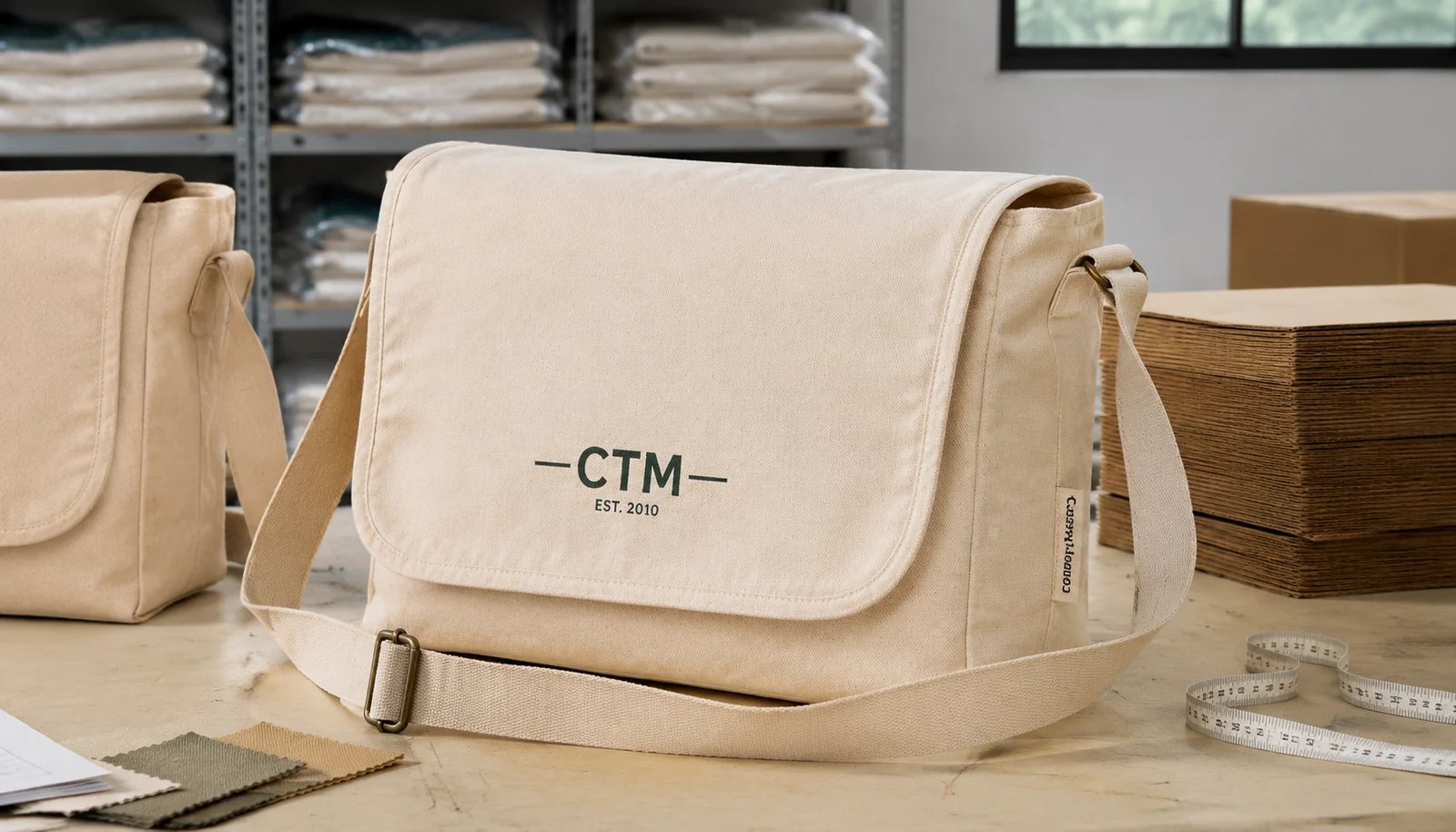
Why carton planning belongs in the bag specification, not after production
Canvas messenger bags for natural grocers are not the same shipping problem as flat grocery totes. The flap, strap, gusset, pocket layers, and heavier canvas all create bulk. If carton planning starts only after bulk sewing, the factory may force the goods into oversized export cartons or reduce carton pack quantity without updating the buyer's freight estimate. That affects landed cost, warehouse handling, store allocation, and sometimes retailer receiving compliance.
A good RFQ for a messenger bag should connect the product spec to the shipping carton from the beginning. Fabric weight, bag width, strap hardware, print curing, and individual packing all change how tightly the product can be stacked. For a natural grocer program, this matters because buyers often want a durable, low-plastic, brand-right bag while logistics teams want predictable cube, clean cartons, and clear SKU labels.
- Do not accept carton estimates based only on a drawing; require a sample packing test before final PO confirmation.
- Treat carton pack quantity as a controlled spec, not a casual factory decision.
- Include carton cube and gross weight in quote comparisons, because a low unit price can be cancelled out by poor packing density.
- Keep retail receiving rules visible to the product team before artwork, labels, and carton marks are approved.
Start with the messenger bag structure that your carton can actually carry
The most carton-efficient canvas messenger bag is a soft, flat body with a front flap, a webbing shoulder strap, and limited internal construction. A bag around 35-40 cm wide, 28-32 cm high, with a modest 8-10 cm gusset can usually stack well if the strap is tucked consistently. Once you add padding, metal buckles, thick bound seams, a rigid bottom board, or multiple internal dividers, the bag behaves more like luggage and carton volume rises fast.
For natural grocer buyers, the usual tradeoff is between premium feel and distribution efficiency. A staff messenger bag can justify a heavier construction. A loyalty gift or seasonal retail item usually needs a cleaner structure with fewer hard components. Decide this before comparing suppliers, because a quote for a simple soft messenger bag and a quote for a reinforced hardware-heavy bag are not comparable.
- Flat soft-body messenger: best carton density and lowest handling risk.
- Moderate gusset messenger: useful when the bag must hold catalogues, tablets, or small groceries, but requires packing discipline.
- Padded messenger: more protective and premium, but freight cube and carton count increase.
- Metal hardware version: stronger perceived value, but can mark canvas, damage print, or create pressure points during compression.
Fabric GSM choices and their effect on pack count
Canvas weight is one of the biggest cost and carton drivers. A 10 oz canvas, roughly 300-340 GSM depending on weave, packs flatter and costs less, but may feel light for a messenger bag. A 12 oz canvas, about 380-400 GSM, is often a practical middle point for branded natural grocer programs. A 14 oz or 16 oz canvas adds stiffness and perceived durability, but the folded flap and seam intersections become bulky, reducing the number of units per carton.
Buyers should quote by GSM and ounce together, then approve a physical swatch. The ounce label alone can be misleading because suppliers may refer to yarn count, finished weight, or market naming conventions. Natural canvas with cottonseed flecks may look right for organic retail branding, but shade variation and specks need to be accepted or limited in the QC standard. Dyed canvas adds lab dip approval and shade control risk, especially if multiple production lots are used.
- 10 oz canvas: good for price-sensitive promotions, less structure, better carton density.
- 12 oz canvas: balanced option for retail merchandise and staff programs.
- 14 oz canvas: stronger handfeel, higher material cost, lower carton pack quantity.
- 16 oz canvas: premium but heavy; verify warehouse carton weight limits before approving.
- Washed canvas: softer and attractive, but may shrink, twist, and require larger dimensional tolerances.
Print method decisions that affect folding, stacking, and carton cleanliness
The flap is usually the best print location on a canvas messenger bag because it is visible when worn and easier to print before assembly. For natural grocers, water-based screen print is often the safest commercial choice for simple logos, earthy graphics, and one to three colors. It keeps the handfeel soft and reduces the risk of thick ink cracking when the flap is folded in the carton. Heat transfer can work for detailed designs, but it needs testing on textured canvas and can change the sustainability perception of the product.
Print planning must include curing and packing rules. If printed flaps are stacked before the ink is fully cured, ink transfer can appear as ghost marks on the next bag. If a large print area crosses a fold line, compression in the carton may cause visible crease marks. The sample approval should include a print strike-off on actual canvas, then a folded packed sample after at least normal curing time.
- Screen print: economical for bulk orders, good on flat flap panels, requires color and registration control.
- Water-based ink: softer finish, better for natural branding, needs proper curing before packing.
- Heat transfer: useful for gradients or fine detail, but test adhesion on coarse canvas.
- Embroidery: premium but adds thread density and backing; not ideal for very large flap graphics.
- Woven label: good secondary branding on side seam or strap, minimal carton impact.
MOQ logic: carton multiples, fabric lots, and store allocations
MOQ should not be discussed only as the minimum number of bags. For canvas messenger bags, the workable MOQ is affected by fabric availability, dyeing minimums, print setup, cutting efficiency, sewing line setup, trim sourcing, and carton packing multiples. A factory may accept a smaller order if natural stock canvas and simple one-color print are used. Custom dyed canvas, custom woven straps, multiple print versions, or individual barcode packing will push the practical MOQ higher.
Carton multiples are often ignored in early negotiations. If the approved pack is 30 pieces per carton and the buyer orders 1,000 pieces, the last carton is partial unless the order is adjusted to 990 or 1,020 pieces. That sounds minor, but partial cartons create receiving confusion, repacking labor, and possible shortage claims. For programs shipping to many stores, carton pack count should align with store allocation units whenever possible.
- Define MOQ separately for bag style, fabric color, print artwork, strap color, and packing version.
- Use carton multiples to refine final PO quantity after the packed sample test.
- If stores receive 6 or 12 units, consider inner bundles or carton quantities that divide cleanly.
- Avoid too many artwork versions unless each version has enough quantity to justify print setup and carton labeling.
- For small launches, use stock natural canvas and standard webbing to keep MOQ realistic.
How to estimate carton size before the packed carton test
Early carton planning is still useful before samples are finished, but it should be treated as an estimate. Start with the folded bag footprint, not the open bag size. The strap should be placed inside the body or under the flap in the same way for every unit. Then estimate stack height by fabric thickness, seam bulk, and whether the gusset collapses flat. The first estimate should include a safety margin because canvas does not compress evenly like paper.
For many soft canvas messenger bags, a master carton in the range of 50 x 40 x 35 cm to 60 x 45 x 40 cm may be considered, but the correct size depends on bag dimensions and pack quantity. Buyers should set a maximum acceptable gross weight as well as a maximum carton cube. A carton that is dense but 22 kg may be unacceptable for retail warehouse handling. A carton that is light but oversized may increase dimensional weight for air or courier shipments.
- Measure folded bag length, width, and average thickness after the strap is tucked.
- Test at least two packing directions before locking carton dimensions.
- Keep gross weight within your DC handling rule, often below 15-18 kg for manual handling.
- Use five-ply export cartons for heavier canvas bags or long-distance sea shipments.
- Avoid cartons that bulge after taping; bulging changes pallet stability and dimensional weight.
Packing options for natural grocer programs with less plastic waste
Many natural grocer buyers prefer to reduce plastic packaging, but unbagged canvas requires cleaner carton control. A simple option is to use a kraft paper liner inside the master carton and pack bags in neat stacks without unit polybags. This reduces plastic and improves the brand story, but it offers less protection from carton dust, moisture, and abrasion. It works best when the bags are not individually scanned at store level.
If the distribution center requires unit barcodes, individual recycled polybags or paper bands may be needed. Paper bands look better from a sustainability angle but can tear during handling and may not protect against dust. Recycled LDPE or OPP bags provide barcode placement and product protection, but they add cost, labor, and plastic reporting obligations. The RFQ should state the packing method clearly so supplier quotes include the same labor and material assumptions.
- Unbagged with carton liner: lowest plastic use, needs clean factory handling and dry cartons.
- Paper band with barcode: good retail presentation, moderate protection, possible tearing risk.
- Recycled polybag with warning text: better for DC scanning and dust control, higher packaging cost.
- Inner bundle of 5 or 10 pcs: useful for store allocation and counting, but adds labor.
- Silica gel: only when justified by route and humidity risk; do not use as a substitute for dry storage.
Sample approval should include a packed carton, not only a finished bag
A finished bag sample shows construction, print, and dimensions. It does not prove that the goods can be packed safely and economically. Before bulk production is released, buyers should require a pre-production sample made with actual fabric, actual print, actual strap, actual label, and actual folding method. Then the factory should prepare a packed carton test using the proposed unit count and carton material. Even if the carton contains fewer samples and fillers for simulation, the factory should document the packing logic.
The packed carton approval is where many hidden issues appear. Printed flaps may rub against each other. Straps may tangle and make repacking slow. Carton sides may bulge. The top layer may receive compression marks. Carton labels may be placed on the wrong side for the retailer's receiving process. Taking photos and recording weights before bulk production gives the buyer a reference for final inspection.
- Approve folded unit photo, open carton photo, full carton photo, sealed carton photo, and carton mark photo.
- Record master carton length, width, height, net weight, gross weight, and pack count.
- Confirm whether straps are tucked inside, folded under flap, or secured by paper band.
- Check that print surfaces do not contact rough hardware or zipper pulls.
- Use the approved carton test as the standard for final random inspection.
Lead time risks that change carton planning and shipping cost
Messenger bag lead time is not only sewing time. The schedule usually includes fabric booking, dyeing or fabric preparation, lab dip if dyed, print strike-off, sample sewing, buyer approval, bulk cutting, printing, curing, sewing, trimming, QC, packing, inspection, and export booking. Carton planning touches several of these steps. If the carton size is changed late, carton printing and procurement may delay packing. If the print takes longer to cure than expected, packing may be held back or quality may suffer.
Buyers should separate production lead time from shipping lead time and include approval deadlines in the PO. A factory may quote 30-45 days after sample approval for a standard canvas messenger bag, but that depends on order quantity, material availability, and season. For holiday or seasonal natural grocer programs, late sample approvals often force expensive air freight or split shipments. A carton-efficient design decided early is one way to protect the shipping plan.
- Stock natural canvas can shorten material lead time compared with custom dyed canvas.
- Large screen prints need curing space and cannot always be packed immediately after printing.
- Retail barcode labels and carton marks should be approved before mass packing starts.
- Final inspection should happen after goods are fully packed, not while cartons are still being assembled.
- Shipping bookings need accurate carton count, cube, and gross weight; estimates should be replaced after packing starts.
Quote data that lets procurement compare suppliers fairly
A unit price alone is not enough for canvas messenger bags. Procurement needs enough data to compare landed cost and operational risk. Two suppliers may both quote the same bag size and fabric, but one packs 40 pieces per carton and the other packs 25 because of folding method, carton size, or construction differences. The second supplier may appear cheaper per bag but create more cartons, more pallet positions, more warehouse touches, and higher freight cost.
Require each supplier to quote a complete technical and packing profile. The quote should identify fabric GSM, print method, trim details, packaging materials, MOQ, sample charges if any, production lead time, carton dimensions, pack count, net weight, gross weight, and whether the carton data is estimated or verified by sample packing. Mark unverified carton data as provisional in your comparison sheet.
- Compare unit price together with carton cube per 1,000 bags.
- Calculate gross weight per 1,000 bags for freight and warehouse handling review.
- Separate product cost from unit packing, carton, labeling, and inspection costs.
- Request Incoterm clearly, such as EXW, FOB port, or DDP only if the supplier is qualified to quote it.
- Do not mix estimated carton data from one supplier with tested carton data from another without noting the difference.
Specification comparison for buyers
| Spec decision | Recommended option | When it fits | Buyer risk to check |
|---|---|---|---|
| Fabric weight for retail messenger bag | 12 oz cotton canvas, about 380-400 GSM, with pre-shrink control if washing is required | Good balance for natural grocer loyalty gifts, staff bags, and premium merchandise without making cartons too heavy | If upgraded to 14-16 oz, carton gross weight rises quickly and flap corners may become bulky after folding |
| Bag structure before packing | Flat body with front flap, simple inner slip pocket, webbing strap packed inside the bag body | Keeps each unit relatively flat and reduces carton cube for ocean or domestic pallet shipping | Heavy hardware, padded panels, or rigid bottoms can double carton volume and change the freight class |
| Print method on canvas flap | Water-based screen print or discharge-style effect for simple one to three color natural grocer graphics | Best for earthy branding, readable logos, and lower unit cost at bulk quantities | Thick plastisol or large ink blocks may crack on fold lines if bags are compressed too tightly in cartons |
| Individual packing | No polybag for basic retail programs, or recycled LDPE/OPP bag only when distribution requires barcode control | Reduces plastic use and carton waste for sustainability-focused grocers | Unbagged canvas can pick up carton dust, so inner carton liner and clean folding rules become more important |
| Carton packing direction | Flat stack with flaps aligned, straps tucked, 25-50 pcs per master carton depending on bag size and fabric weight | Works for standard messenger bags around 35-40 cm wide and keeps carton shape stable | Random strap placement creates carton bulging, unstable pallets, and higher dimensional weight |
| Master carton size | Keep within common export handling ranges, often near 50 x 40 x 40 cm or adjusted after actual sample packing test | Useful for mixed SKU consolidation and easier warehouse handling | Choosing carton size from a spreadsheet before packing a real sample can understate cube by 10-20 percent |
| MOQ planning logic | Set MOQ by fabric dye lot, print setup, and carton packing multiple rather than only by total bag quantity | Prevents leftover printed pieces and mismatched carton counts across store allocations | A PO quantity that is not divisible by carton pack can create partial cartons, extra labels, and receiving exceptions |
| Sample approval before production | Approve one pre-production sample plus one packed carton test with gross weight, net weight, and carton photos | Gives procurement, logistics, and retail operations the same physical reference before bulk cutting | Approving only the bag appearance can miss compression marks, print transfer, strap tangling, and carton failure |
Buyer checklist before sampling
- Define the actual use: retail merchandise, staff issue, loyalty program, event giveaway, or grocery delivery support.
- Lock bag dimensions including body width, height, gusset depth, flap length, strap length range, and pocket size before requesting carton estimates.
- Choose fabric by GSM and feel, not only by ounce label, because mills may convert ounce and GSM differently.
- State whether the canvas must be natural, dyed, washed, enzyme-washed, or undyed with visible cottonseed flecks.
- Mark all print locations with maximum printable area, number of colors, PMS references, and whether print can cross a fold line.
- Decide if each bag is unbagged, paper-banded, packed in recycled polybag, or packed with barcode sticker on the unit.
- Specify carton pack quantity as a target and require the factory to verify it by actual sample packing.
- Set acceptable carton gross weight for warehouse handling, commonly below 15-18 kg unless your DC allows heavier cartons.
- Require carton marks, SKU labels, purchase order number, country of origin, and any retailer routing label rules before carton artwork is printed.
- Approve a packed carton photo set showing open carton, folded unit, pack count, carton dimensions, gross weight, and pallet suggestion.
Factory quote questions to send
- What exact fabric weight in GSM and ounce will be used, and is it stock fabric or custom woven/dyed fabric?
- What shrinkage tolerance applies to the canvas before and after sewing, and will fabric be pre-shrunk or sanforized?
- What bag dimensions and tolerances are included in the quote, including flap, gusset, strap width, and strap length?
- Which print method is quoted, how many colors are included, and what is the maximum safe print area on the flap or body?
- What is the MOQ by bag style, fabric color, print design, and carton packing version?
- How many units fit in one master carton after actual sample packing, and what are the estimated carton dimensions, net weight, and gross weight?
- Are unit polybags, barcode stickers, hangtags, carton liners, silica gel, and export carton labels included or quoted separately?
- What sample steps are included: lab dip, fabric swatch, print strike-off, blank sample, pre-production sample, and packed carton test?
- What production lead time starts after which approval point, and how many days are needed for inspection and booking after goods are packed?
- What inspection standard will the factory accept, and what repair or replacement process applies if carton packing or print quality fails inspection?
Quality-control points to confirm
- Fabric weight should match approved swatch within practical tolerance, commonly plus or minus 5 percent unless a stricter tolerance is contracted.
- Canvas surface should be free from major slubs, oil marks, weaving holes, mildew odor, and unacceptable shade variation between panels.
- Finished measurements should follow approved tolerance, for example plus or minus 1 cm for main body dimensions and plus or minus 2 cm for long straps.
- Print position should remain centered within agreed tolerance, typically within 3-5 mm for front flap logos on flat canvas panels.
- Ink adhesion should pass reasonable rub testing after full curing, especially if bags are packed face to face in compressed cartons.
- Stress points at strap joints, flap corners, and pocket openings should have reinforcement stitches or bartacks as approved.
- Needle size and thread tension should avoid puckering, skipped stitches, loose thread nests, or seam waviness on heavy canvas.
- Each carton should match approved pack count, carton dimensions, carton marks, inner liner requirement, and gross weight tolerance.
- Packed cartons should resist normal compression without bulging sides, crushed corners, broken tape, or exposed products.
- Final inspection should include carton drop or handling review when goods will move through retail DCs with multiple touch points.