Start with the studio’s real use, not a generic bag price
A canvas messenger bag bulk quote guide for yoga studios should start with the way the bag will be used. A studio is rarely buying a random giveaway. The same messenger bag might be sold at the front desk, included in a new-member welcome kit, issued to teachers, bundled with a retreat package, or distributed across several locations. Each use changes the specification. A resale item needs clean folding, consistent logo placement, barcode readiness, and a finish that feels intentional. A welcome gift may prioritize durability, simple branding, and reliable delivery. A multi-location program needs carton allocation and SKU control just as much as it needs a good-looking sample.
Messenger bags sit in a useful middle ground between totes and backpacks. They offer more closure and organization than a basic tote while still fitting a wellness, studio, and lifestyle environment. For most yoga studio programs, the bag should carry daily items: a notebook, small towel, phone, wallet, keys, light apparel, small retail purchases, and possibly a compact water bottle. It is not usually the best body shape for carrying a full-size rolled yoga mat inside the main compartment. If mat carry is part of the concept, specify an external strap, side sling, or separate mat carrier instead of making the messenger body oversized and awkward.
The first procurement control point is language. If the RFQ says only natural canvas messenger bag with logo, suppliers will fill in the blanks themselves. One may quote 10 oz canvas and hook-and-loop closure; another may quote 14 oz canvas, lining, magnetic snaps, and individual packing. Both may look similar in a thumbnail image. They will not cost the same or perform the same. A stronger RFQ states the sales channel, target load, finished measurements, canvas standard, logo method, packing needs, inspection expectations, and timeline in one place.
- State whether the bag is for retail resale, gifting, teacher kits, retreats, workshops, or multi-location distribution.
- Define the target carrying load before finalizing size, strap width, and reinforcement.
- Do not design around full yoga mat carry unless the RFQ includes an external mat strap, sling, or separate mat-carrier solution.
- Treat barcode labels, carton marks, and destination allocation as product requirements, not warehouse afterthoughts.
Build the finished specification before requesting prices
Most quote confusion begins when buyers send a reference photo and a logo but no finished specification. A photo can show the general look, but it cannot define fabric weight, lining, flap length, pocket depth, closure reinforcement, strap construction, logo placement tolerance, or packing format. Those details drive cost. More importantly, they drive whether the bag will feel acceptable when a member picks it up in the studio.
A practical starting point for many yoga studio retail or membership programs is a medium messenger bag around 34-38 cm wide, 26-30 cm high, and 8-10 cm deep. Pair that with 12 oz or 14 oz canvas, a front flap, an adjustable shoulder strap, one internal slip pocket, and a logo on the flap or front panel. This is not a universal formula. It is a baseline that helps suppliers quote the same product. From there, the buyer can create controlled options: lighter canvas for an event budget, heavier canvas for premium retail, a lining for a cleaner interior, or a simpler closure to reduce labor.
Use finished measurements, not pattern measurements. Finished size should be measured after sewing, pressing, washing if applicable, and final packing preparation. For many canvas messenger bags, a practical tolerance is around plus or minus 1 cm on major dimensions unless the design needs tighter control. Smaller details, especially logo placement, often need tighter tolerances such as plus or minus 5 mm to 10 mm depending on panel size and branding method. If a supplier cannot state what tolerance they can hold, the quote is not yet ready for production.
- Specify width, height, gusset depth, flap length, pocket dimensions, strap width, strap drop, and adjustable strap range.
- Clarify whether dimensions are measured flat, lightly filled, or standing, and whether measurement happens before or after pressing.
- Keep construction options separate when comparing quotes; do not let fabric weight, lining, closure, pocket count, and logo method all change at once.
- Ask the supplier to return a spec sheet with the quote, then attach the final spec sheet to the purchase order.
Canvas weight, GSM, shrinkage, and fabric language buyers should control
Canvas is often quoted in ounces, GSM, or both. In bag sourcing, ounce weight usually refers to fabric weight per square yard, while GSM means grams per square meter. Suppliers do not always present the conversion consistently, so ask for the stated range and verify it against the approved swatch. As a practical buying reference, 8-10 oz canvas is usually in the lighter promotional range, 12 oz is a common retail starting point, and 14 oz gives a firmer hand feel. Heavier canvas can improve structure, but it also increases sewing difficulty, carton weight, and freight cost.
Fabric weight is only one part of quality. Fiber content, yarn size, weave density, finishing, washing, and shrinkage control all affect the finished bag. Natural cotton canvas may show small slubs and seed flecks. That can be acceptable, even desirable, if it matches the studio’s brand. Oil marks, holes, broken yarns, major streaks, and obvious shade variation should not be accepted as natural character. Dyed canvas adds another layer of risk because bulk shade can vary by dye lot. Custom color fabric usually requires lab dips, bulk-lot approval, and higher minimums than stock natural or stock black canvas.
Shrinkage deserves a direct question before artwork is approved. Printing, pressing, washing, or garment-style finishing can change final dimensions and shift logo placement. Ask whether the canvas is pre-shrunk, washed, sanforized, or otherwise stabilized. Also ask how the factory builds shrinkage allowance into cutting. If the bag is made from washed canvas, the pre-production sample should reflect the same wash process planned for bulk. If the supplier quotes untreated fabric while the buyer assumes pre-shrunk canvas, measurement disputes are likely later.
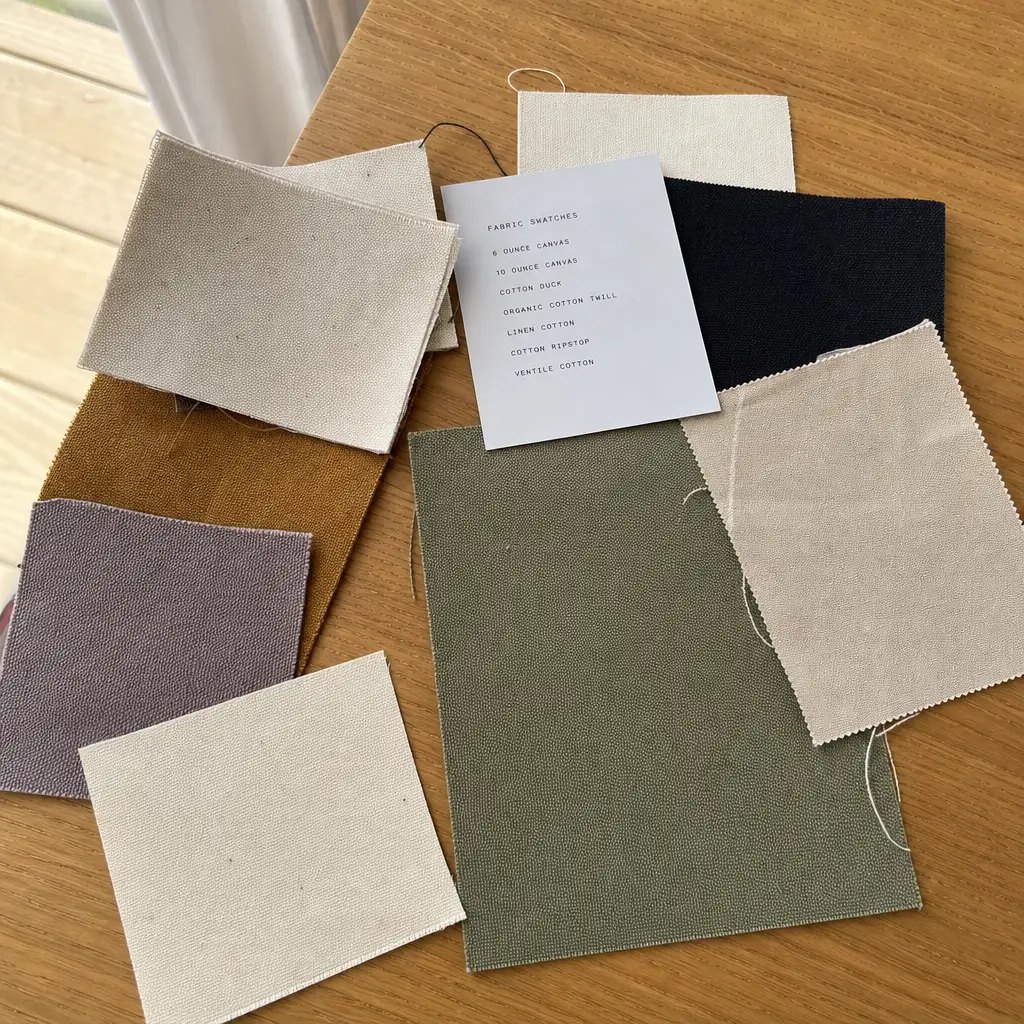
- Request swatches for the proposed canvas, webbing, lining, thread, and logo base before approving the final pre-production sample.
- State fabric weight as both oz and GSM range when available, and ask the supplier to confirm the testing method or mill specification.
- Use plus or minus 5% as a common fabric-weight tolerance unless a different tolerance is agreed in the contract.
- For custom color, request lab dip approval and define acceptable shade variation against the approved standard.
- If sustainability claims matter, request documentation for organic, recycled, or certified materials rather than accepting broad marketing wording.
Construction choices that change both durability and cost
Messenger bag pricing is shaped by construction details as much as by fabric. Lining, seam binding, internal pockets, padded panels, closure reinforcement, flap shape, strap adjusters, and bartacks all add labor. The goal is not to load the bag with every possible feature. The goal is to choose the features that improve member use, retail presentation, and repeat-order consistency. A clean unlined bag with neatly bound seams may be better than a low-quality lined bag. One well-sized internal slip pocket may be more useful than several small pockets that slow production and complicate inspection.
Strap construction needs special attention because a messenger bag concentrates load at the anchor points. A member may carry a bottle, notebook, small towel, wallet, and retail purchase without thinking about weight. A strap width of about 3.2-3.8 cm is common for everyday comfort. Cotton webbing has a natural look but can stretch or soil more easily. Polyester webbing can be stronger and more color-stable, though it may look more technical. Ask for webbing material, width, color, hardware type, and reinforcement stitch. At the anchor points, the approved sample should show a box stitch, X-box stitch, bartack, or multiple stitch rows.
Closures affect price, appearance, and inspection. Magnetic snaps feel clean and retail-friendly, but they need backing reinforcement so they do not tear through the canvas. Hook-and-loop is inexpensive and quick to use, but it can collect lint and make a louder opening sound. Buckles and side-release closures add visual detail and perceived structure, but they also add labor and may not be necessary for a studio retail bag. Whatever you choose, test the flap when the bag is lightly loaded. It should close smoothly, sit straight, and align with the receiving hardware.
- Specify seam finish: raw, overlocked, bound, French seam, lined, or partially lined.
- Define strap reinforcement at both anchors and require close-up photos during sample approval.
- Confirm hardware material, finish, plating color, corrosion resistance, and nickel-free requirement if relevant to your market.
- Check that the bag closes correctly when loaded with realistic contents, not only when it is empty.
- Avoid adding pockets, buckles, lining, and padding unless each feature has a clear commercial purpose.
Logo method, artwork setup, and brand presentation
The logo method should fit the artwork, the studio’s brand position, and the order quantity. Screen printing is often the best value for simple one- or two-color yoga studio logos on canvas. It works well for larger flap or front-panel artwork, but the buyer still needs to define print size, placement, ink color, setup charges, and approval procedure. Screen printing across seams, heavy folds, or highly textured areas can reduce consistency, so place the logo on a stable flat panel whenever possible.
Embroidery can create a premium look for small marks, monograms, or icons. It is usually less suitable for large filled artwork because dense stitching can pucker the flap or make the panel stiff. Woven labels are useful for subtle boutique branding, location labels, and repeat programs where a small side label or flap label feels more refined than a large print. Heat transfers can handle gradients or complex artwork, but buyers should review edge adhesion, hand feel, and expected abrasion performance on canvas before approving bulk production.
Artwork should be production-ready at the RFQ stage. Send vector artwork where possible. Specify logo size in centimeters or inches, identify Pantone or other color references if used, and provide a placement map measured from fixed edges. If each studio location needs a different city name, secondary mark, or teacher-program logo, quote each artwork version separately. One setup charge rarely covers multiple screens, embroidery tapes, woven-label designs, or transfer prints unless the supplier confirms it in writing.
- Request a logo strike-off, embroidery sew-out, woven label proof, or transfer sample before bulk production.
- Specify logo-position tolerance, commonly plus or minus 5 mm to 10 mm depending on method and panel size.
- Separate artwork setup, screen charge, embroidery digitizing, label mold, application cost, and repeat-order charge in the quote.
- Keep logos away from flap folds, strap anchors, pocket edges, and heavy seams unless the sample proves the placement works.
- For natural canvas, approve print opacity on the actual fabric, not only on a digital proof.
MOQ, price breaks, and quote structure
MOQ is a production constraint, not only a sales rule. It can come from fabric purchasing, dye lots, cutting efficiency, sewing-line setup, logo setup, hardware procurement, label ordering, or packing labor. A factory may accept a lower quantity for stock natural canvas with one screen-printed logo, then require a higher quantity for custom dyed canvas, special webbing, lining, custom hardware, or multiple artwork versions. That is why the RFQ should ask for MOQ by color, logo, lining, and packing style rather than one total number.
For many custom canvas messenger bag programs, buyers evaluate quantities in the several-hundred to several-thousand-piece range. A useful RFQ asks for controlled price breaks at 500, 1,000, 2,000, and 3,000 pieces using the exact same specification. The supplier should not switch from 14 oz to 12 oz canvas, remove lining, or change from individual packing to bulk packing at a higher price break unless that change is clearly shown as a separate option. Otherwise, the buyer is not seeing scale savings; they are comparing different bags.
Small bulk orders can still make sense for a yoga studio testing a new retail product. The tradeoffs just need to be visible: higher unit cost, sample charges that carry more weight per unit, less flexibility on custom materials, and sometimes fewer packing options. If the studio expects reorders, ask for first-order and reorder pricing. Some setup charges may not repeat, but fabric shade, webbing shade, and material availability can change if the reorder happens months later.
- Ask for MOQ by canvas color, webbing color, lining color, logo version, and packing version.
- Request price breaks using the identical specification so savings are visible and credible.
- Ask which costs are one-time charges and which repeat on every order.
- Do not split colors too aggressively if each color creates a separate fabric, dye, or webbing minimum.
- For consolidated multi-location orders, compare lower unit cost against the labor needed for allocation and carton labeling.
Sample approval is the last safe checkpoint before bulk cutting
Sample approval is the buyer’s strongest leverage before fabric is cut and sewing capacity is booked. A production-ready sample process should confirm material, dimensions, construction, logo, hardware, strap comfort, closure function, and packing. A rough mockup made from substitute fabric can be useful for early shape review, but it should not become the production standard. For first orders, the full pre-production sample should use final fabric, final logo method, final hardware, final seam finish, final strap, and proposed packing.
Several sample stages may be useful. A fabric swatch confirms hand feel and color. A lab dip confirms custom dye direction. A logo strike-off confirms print color, opacity, and placement method. A construction sample confirms bag shape and sewing. The pre-production sample brings the approved elements together and becomes the inspection reference. To reduce risk, keep one approved sample internally and ask the factory to keep a duplicate reference sample on the production floor.
Approval should be written, measured, and easy to audit later. Record the sample version, date, supplier, fabric weight, finished dimensions, logo placement, strap measurements, closure notes, pocket details, carton or polybag plan, and any accepted deviations. Photograph the front, back, side, interior, strap anchors, logo close-up, closure, and packed form. If corrections are required, state whether the factory must make a revised sample or may correct directly in bulk. Short emails such as looks good except the strap are not precise enough for a purchase order.
- Measure the sample against the spec sheet before approving it, including finished size, flap length, pocket size, strap drop, and logo placement.
- Test with realistic contents: notebook, towel, phone, wallet, keys, light apparel, and retail inserts.
- Check whether the strap is comfortable and whether the flap closes cleanly when the bag is lightly loaded.
- Do not approve bulk cutting until the supplier confirms all corrections in writing.
- Use the approved pre-production sample as the inspection standard for fabric, sewing, logo, hardware, and packing.
Quality-control standards and practical tolerances
Quality control for canvas messenger bags should focus on defects that affect appearance, function, safety, and receiving accuracy. Important checkpoints include fabric consistency, finished dimensions, logo accuracy, stitching, strap reinforcement, closure alignment, hardware condition, cleanliness, trimming, folding, and packing. A bag can look fine in a photo while still having weak strap anchors, off-center printing, mixed carton quantities, or incorrect labels that create operational problems after delivery.
Define tolerances before the purchase order. For many standard canvas bag programs, fabric weight plus or minus 5%, major finished dimensions plus or minus 1 cm, and logo placement plus or minus 5 mm to 10 mm are practical starting points. Final tolerances should reflect design complexity and supplier capability. Stitch density can also be specified, such as stitches per inch or stitches per centimeter, when the buyer needs tighter control. Stress points should match the approved reinforcement exactly, not a visually similar substitute.
If using AQL inspection, define critical, major, and minor defects. Critical defects may include sharp hardware, unsafe broken metal, mold, or contamination. Major defects may include open seams, missing closure, wrong logo, severe stain, strap anchor failure, incorrect SKU label, or large measurement deviation. Minor defects may include small thread ends, slight washable marks, or small slubs within the approved canvas character. Whether inspection is performed by the factory, buyer, or a third party, the defect list should be attached to the order.
- Require inline photos or checks for first orders: fabric cutting, logo application, sewing, reinforcement, and packing.
- Use random carton selection during final inspection rather than inspecting only factory-selected samples.
- Pull-check strap anchors manually against the approved construction and reject loose bartacks or open seams.
- Measure logo placement from fixed seams or edges instead of judging by eye.
- Verify carton count, SKU labels, barcode readability, and destination allocation before shipment release.
Packing, cartons, freight assumptions, and landed cost
Packing affects unit cost, freight cost, receiving labor, and customer presentation. Bulk packing can work for internal giveaway programs, but retail or multi-location programs usually need individual polybags, SKU labels, barcode stickers, hangtags, insert cards, or clean folding instructions. If the bag is folded too tightly, canvas and printed areas can develop hard creases. If it is packed too loosely, carton volume and dimensional freight cost increase. The packing method should be sampled or photographed before shipment.
Ask for carton data before confirming the purchase order: pieces per carton, carton dimensions, gross weight, net weight, and CBM. This information lets procurement compare landed cost instead of only FOB or ex-factory unit price. A heavier 14 oz lined bag may look like a small unit-cost increase but can raise freight cost through higher weight and larger cartons. Too much compression can damage presentation. The best carton plan balances product condition with shipping efficiency.
For multi-location yoga studio groups, carton marks are operational controls. Each carton should show purchase order, SKU, color, logo version, quantity, destination, and carton sequence such as carton 1 of 12. Avoid mixed cartons unless the receiving team explicitly approves them. If mixed cartons are required, ask for an internal packing list and internal separation by SKU. The factory’s convenience should not create hours of sorting work at the buyer’s warehouse or studio locations.
- Specify individual polybag, recycled polybag if required, hangtag, insert card, barcode, SKU sticker, and folding direction.
- Request packed-carton photos for first orders or new packing formats.
- Require carton marks with PO number, SKU, color, logo version, quantity, destination, and carton sequence.
- Compare landed cost including unit price, setup, sample, packing, inspection, freight, duty, and receiving labor.
- Confirm Incoterms, shipment method, quote currency, payment terms, and quote validity before award.
Lead time, reorders, and purchase-order discipline
Lead time should be broken into stages, not quoted as one vague number. A realistic schedule includes artwork proofing, sample production, sample courier, sample review, material booking, cutting, logo application, sewing, trimming, packing, inspection, and shipment release. If the buyer approves the sample late or changes artwork after screens are made, the timeline moves. If the order uses custom dyed fabric or custom labels, material lead time may control the schedule.
A common procurement mistake is placing the PO with only a headline description. The purchase order should attach the final quote, specification sheet, artwork placement sheet, approved sample record, packing instructions, QC tolerance list, and shipping instructions. If the supplier’s proforma invoice or quote contains assumptions that differ from the buyer’s RFQ, resolve them before deposit or production release. Small wording differences can become large disputes once goods are finished.
Reorders need their own controls. Ask whether the supplier can use the same fabric source, webbing, thread, lining, hardware, and logo setup. Even when the same supplier makes the reorder, shade variation can occur because natural canvas lots, dye lots, and ink batches change. For important retail programs, request a reorder swatch or production confirmation photo before bulk production. Keep the previous approved sample, but understand that exact shade matching across different fabric lots may require a new approval standard.
- Request a stage-by-stage lead time from artwork approval to shipment release.
- Build sample review and correction time into the launch calendar.
- Attach all approved documents to the PO so the supplier is not working from scattered emails.
- For reorders, confirm material availability, shade standard, setup charges, and whether a new sample or swatch is required.
- Do not release production based only on price if dimensions, logo placement, packing, and QC tolerances remain open.
Specification comparison for buyers
| Quote variable | Practical recommendation for yoga studios | What to specify in the RFQ | Procurement risk to control |
|---|---|---|---|
| Finished bag size | A medium messenger profile is often the safest starting point: about 34-38 cm wide, 26-30 cm high, and 8-10 cm gusset for a notebook, small towel, wallet, phone, keys, light apparel, and studio retail items. | Finished width, height, gusset depth, flap length, pocket dimensions, strap width, strap drop, adjustable strap range, and measurement tolerance after sewing and pressing. | Suppliers may quote pattern dimensions, flat measurements, or pre-wash measurements instead of finished size, causing fit, display, and packing problems. |
| Main fabric | Use 12 oz canvas for many standard retail or membership programs; choose 14 oz for a firmer premium feel; reserve 8-10 oz for budget, event, or short-term promotional use. | Ounce weight and GSM range, fiber content, weave, color, pre-shrink or washed status, dye method, stock versus custom fabric, and fabric-weight tolerance. | Unspecified canvas can lead to a thin hand feel, unexpected shrinkage, shade movement, poor print opacity, or higher freight cost than expected. |
| Lining and seam finish | Unlined with clean overlocked or bound seams can work well for cost control; cotton lining or partial lining improves the boutique feel and hides internal construction. | Lining material and GSM, seam finish type, inside binding width, pocket count, reinforcement panels, trimming standard, and whether loose yarns are acceptable. | A lined bag costs more but looks more finished; an unlined bag without clean seam finishing can fray or feel unfinished at retail. |
| Logo method | Screen print suits simple one- or two-color logos; embroidery works for small premium marks; woven labels suit subtle repeat branding; heat transfer should be used when artwork complexity requires it. | Artwork file type, logo size, Pantone or ink references, placement from fixed edges, number of colors, setup charges, and logo-position tolerance. | Setup fees, strike-offs, repeat screens, embroidery digitizing, woven-label molds, and artwork-version charges may be missing from the first quote. |
| Strap and stress points | A 3.2-3.8 cm cotton or polyester webbing strap is common for daily use. Use reinforced anchors and an adjustable strap if the bag will be used by different members or teachers. | Strap material, width, thickness or GSM if available, adjustable range, hardware type, stitch pattern, bartack count, and anchor reinforcement. | Thin webbing, weak anchors, or missing bartacks can fail before the canvas body wears out. |
| Closure system | Magnetic snaps give a clean retail finish; hook-and-loop is lower cost and fast to use; buckles or side-release buckles are best only when they support the design and budget. | Closure type, size, color, placement, backing reinforcement, corrosion resistance, nickel-free requirement if needed, and alignment tolerance. | Hardware can pull out, dent fabric, scratch adjacent bags, rust, or make the flap sit unevenly. |
| MOQ and color splits | Keep one base specification and limit the first run to one or two colors if price control matters. Stock canvas usually supports lower MOQ than custom dyed fabric. | MOQ by fabric color, lining color, webbing color, logo version, packing version, and reorder quantity; price breaks at 500, 1,000, 2,000, and 3,000 pieces. | A low total MOQ can hide separate minimums for fabric, dyeing, printing, hardware, labels, or packing. |
| Sample approval | For first orders, approve material swatches, a logo strike-off or sew-out, and a full pre-production sample before bulk cutting begins. | Sample type, sample cost, sample lead time, courier cost, required corrections, approval standard, and whether bulk starts only after written approval. | Photo-only approval leaves fabric hand feel, true dimensions, strap comfort, closure alignment, and print feel unresolved. |
| QC tolerance plan | Use measurable tolerances: fabric weight commonly plus or minus 5%, finished size plus or minus 1 cm, and logo placement plus or minus 5 mm where practical. | Inspection level, AQL if used, measurement method, defect definitions, carton sampling, required production photos, and third-party inspection requirements. | Vague wording such as good quality gives inspectors little authority to reject off-spec goods. |
Buyer checklist before sampling
- Define the commercial use first: front-desk retail resale, new-member gift, teacher welcome kit, retreat merchandise, workshop bundle, or multi-location merchandise program.
- Confirm finished dimensions after sewing and pressing, including width, height, gusset, flap length, pocket size, strap width, strap drop, and adjustable strap range.
- Lock the canvas specification by ounce weight and GSM range, fiber content, weave, color, pre-shrink or washed status, and fabric-weight tolerance before requesting final price.
- State the target carrying load, such as notebook, small towel, wallet, phone, keys, compact water bottle, retail insert, or light apparel, and test the sample against that load.
- Choose the interior standard: unlined with overlocked seams, unlined with bound seams, lined body, lined flap only, or reinforced base panel.
- Send vector artwork with final logo dimensions, placement from fixed edges, color references, number of artwork versions, and acceptable placement tolerance.
- Ask suppliers to separate unit bag cost, logo setup, logo application, sample cost, hangtag or barcode cost, packing cost, carton cost, inspection cost, and freight assumptions.
- Request MOQ and price breaks by fabric color, webbing color, logo version, lining option, packing style, and reorder quantity, not only by total pieces.
- Require a physical pre-production sample for first orders and document approval with measurements, photos, version number, and any accepted deviations.
- Specify QC criteria before the purchase order: fabric weight tolerance, size tolerance, logo placement tolerance, stitch quality, stain rejection, hardware performance, carton count, and label accuracy.
Factory quote questions to send
- What exact canvas weight, GSM range, fiber content, weave type, and pre-shrink or washing treatment are you quoting, and is the fabric stock or custom produced?
- Can you confirm finished bag dimensions after sewing and pressing: width, height, gusset depth, flap length, internal pocket size, strap width, strap drop, and adjustable strap range?
- What measurement tolerance can you hold for finished size, flap position, pocket size, strap length, and logo placement?
- Does the unit price include lining, bound interior seams, pocket construction, closure hardware, strap reinforcement, final trimming, individual packing, and export cartons?
- What logo method are you quoting, how many colors are included, what is the maximum print or embroidery area, and what setup, screen, tape, mold, or repeat charges apply?
- Can you quote screen print, embroidery, woven label, and heat transfer options separately while keeping the bag construction unchanged?
- What is the MOQ by canvas color, webbing color, lining color, logo version, and packing style, and what price breaks apply at 500, 1,000, 2,000, and 3,000 pieces?
- What sample stages do you recommend: material swatch, print strike-off, construction sample, or full pre-production sample with final materials and packing?
- How many calendar days are required for artwork proof, sample making, sample courier, material booking, cutting, printing, sewing, trimming, packing, final inspection, and shipment release?
- What stitch reinforcement will be used at strap anchors, flap corners, pocket openings, closure points, and other stress areas?
Quality-control points to confirm
- Fabric weight should match the approved sample and RFQ within the agreed tolerance, commonly plus or minus 5% unless a tighter range is contracted.
- Finished bag dimensions should be measured after sewing and pressing, including width, height, gusset depth, flap length, pocket size, strap width, strap drop, and adjustable strap range.
- Logo placement should be measured from fixed edges such as flap edge, side seam, pocket seam, center line, or bottom edge, with a defined tolerance such as plus or minus 5 mm for many standard placements.
- Print quality should be checked for opacity, cracking, pinholes, ink bleeding, off-registration, smudges, excessive hand feel, and shade mismatch against the approved strike-off.
- Embroidery, woven labels, and heat transfers should be checked for alignment, thread trimming, puckering, edge lifting, bubbling, adhesive marks, and uncomfortable backing inside the bag.
- Strap anchors should have the approved reinforcement, such as bartack, box stitch, X-box stitch, or multiple stitch rows, with no loose threads, skipped stitches, or open seams.
- Flap, pocket, and closure alignment should allow the bag to open and close smoothly without twisting, pulling, flap skew, or obvious asymmetry.
- Hardware should be free from sharp edges, rust, weak plating, dents, burrs, and poor attachment; magnetic snaps should include backing reinforcement where needed.
- Canvas panels should be free from oil marks, stains, holes, broken yarns, major slubs outside the accepted fabric character, and obvious shade variation within the same carton.
- Interior seams should be clean, secure, and trimmed; unlined bags should not have excessive fraying or loose yarns that affect appearance or function.