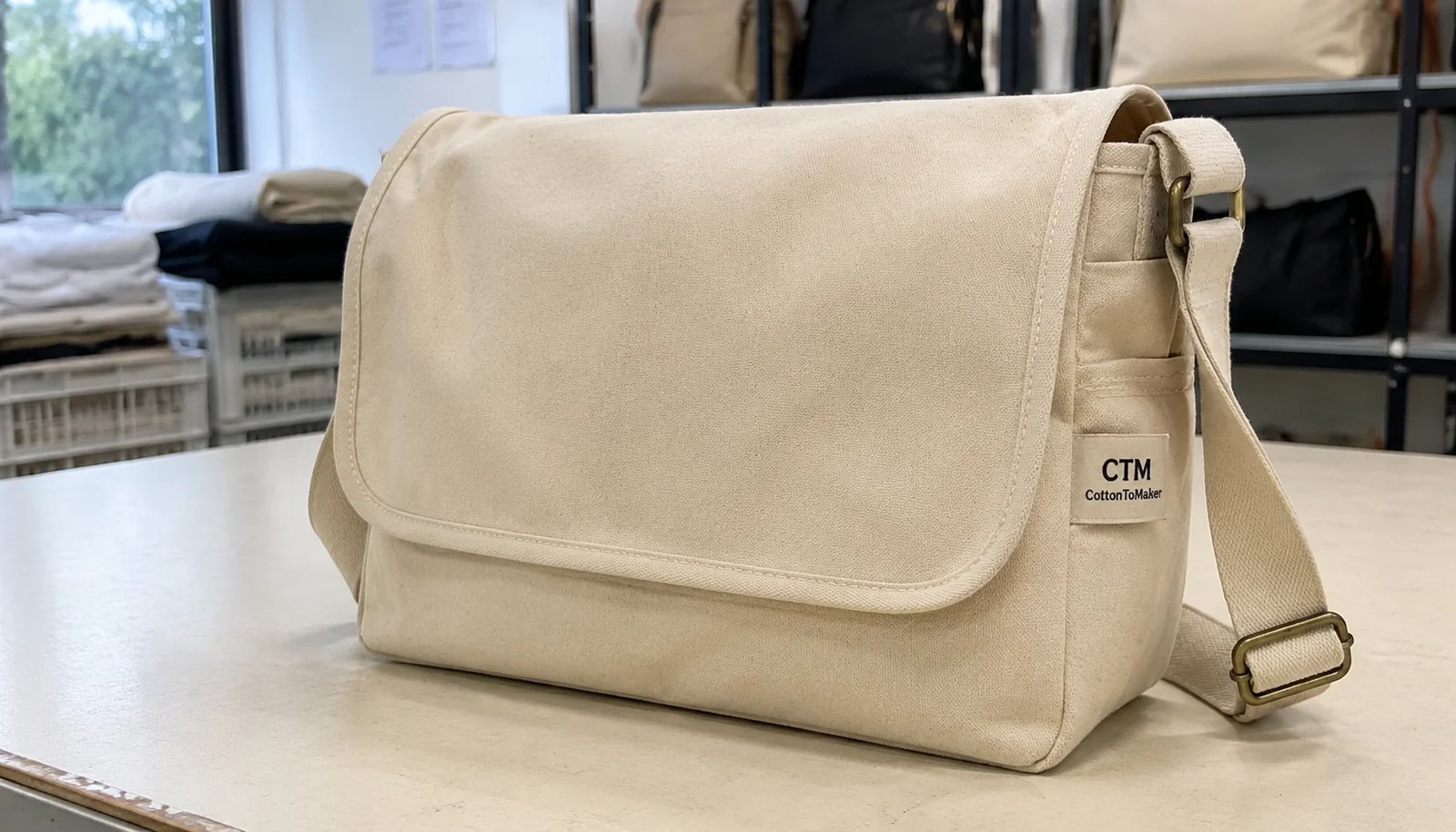
Start with the museum shop selling context, not just the bag spec
A museum shop does not buy canvas messenger bags the way a promotional-products buyer does. The bag has to fit an assortment strategy, a visual standard, and a retail margin target. That changes what a useful quote looks like. If the RFQ says only "canvas messenger bag with logo," suppliers will fill in missing details with the lowest-risk assumptions for themselves: lighter canvas, simpler construction, basic print, and minimal packing. The quote may arrive quickly, but it will not be decision-ready.
The stronger approach is to define the bag's role in the store before asking for pricing. Is it a permanent branded item that should sit near books and design goods? Is it tied to a temporary exhibition and expected to sell through a fixed launch window? Is it a member-store exclusive, a school-program resale item, or a mid-price souvenir? These are different commercial use cases, and they can justify different material and construction choices even when the product category is the same.
Museum retail also has internal approval layers that many generic sourcing guides ignore. Visual identity teams may need to approve logo presentation. Curatorial or exhibition teams may care about title treatment on limited-run merchandise. Retail operations may need barcodes, carton sorting, and receiving logic that keeps launch prep manageable. Procurement should capture those needs in the RFQ so suppliers quote the real job rather than a simplified version of it.
This is why a good canvas messenger bag bulk quote guide for museum shops is less about getting the fastest price and more about getting comparable prices on the right build. When the quote includes retail intent, construction detail, operational requirements, and acceptance rules, the buying team can compare suppliers on substance instead of sales language.
- Name the selling role: permanent line, exhibition-program SKU, premium giftable item, or value souvenir.
- State the intended retail price band early so suppliers understand whether the bag is cost-led or finish-led.
- Note display method if relevant: folded shelf stack, wall fixture, tabletop display, or ecommerce backstock.
- Tell suppliers whether store operations require barcode labels, hangtags, or color-sorted cartons.
Set the product specification before you invite pricing
The quote becomes useful only when the product specification is stable enough that suppliers are pricing the same item. For museum shops, the core spec should start with finished dimensions, target capacity, and the typical contents the bag must carry. A bag meant for exhibition catalogues and A4 notebooks needs a different proportion and reinforcement logic than one meant for lighter souvenirs or brochures.
Canvas weight is usually the first material choice buyers focus on, and for good reason. In this category, heavier canvas generally gives a better retail handfeel, stronger shelf presence, and more confidence for carrying books. But weight alone is not enough. Buyers should ask for fabric composition, weave basis, color basis, and tolerance. A supplier quoting "16 oz canvas" without tolerance or composition detail may still be pricing a different material from another supplier using the same shorthand.
Construction choices affect both cost and perceived value. Lining improves interior finish and can make the bag feel more giftable, but it adds labor and bulk. A gusset adds usable capacity but changes cutting consumption and carton fill. Inside pockets, pen slots, key loops, or zipped compartments may sound minor, yet each one adds sewing steps and inspection points. If these details are undecided, price comparisons will be noisy and misleading.
For museum buyers, specification discipline also prevents a common problem: approving a sample that looks visually acceptable but does not fit store economics. A softer, thinner bag may photograph well yet feel too promotional in hand. A premium build may look excellent but push the retail price beyond what visitors will pay. Setting the product brief before the RFQ helps suppliers quote toward the right balance.
- Write finished width, height, and gusset depth in measurable terms, not size words like small or medium.
- Identify what the bag must carry: catalogues, notebooks, boxed gifts, or mixed daily-use items.
- Specify whether the bag should hold shape on display or can have a softer drape.
- List required internals clearly: no pocket, one slip pocket, zip pocket, or multi-function interior.
Choose materials and branding that fit museum retail
Museum shops often need products that feel considered rather than overtly promotional. Material and branding choices drive that perception. Natural cotton canvas can support a heritage, institutional, or design-led look, but buyers should discuss visual variation up front. Small flecks, slubs, and slight tone differences may be acceptable as part of the material character, or they may conflict with a stricter brand expectation. The RFQ should make the standard explicit.
Dyed canvas can deliver cleaner color impact when the museum wants a deep navy, black, or custom exhibition palette. The tradeoff is that shade consistency and dye control become more important. If exact color continuity across batches matters, suppliers should explain whether they use stock fabric, custom dyeing, or mill color approval. This is especially relevant when a museum shop wants a bag to match packaging, signage, or an existing branded merchandise line.
Branding method should match both the artwork and the retail position. Screen print is often the most efficient option for front-panel graphics or exhibition marks, especially when the artwork is flat and limited in color count. Woven labels can look more permanent and refined, particularly for collection branding. Embroidery can work for small marks, but it should be tested carefully because it may distort lighter panels or look too bulky on a cleaner graphic concept.
Buyers should also think about how branding interacts with merchandising. A large front print may sell well for exhibition tie-ins but can also date the SKU faster. A discreet woven side label may fit a permanent assortment better. The right decision depends on whether the bag is expected to sell for one season, one show, or as a long-running institution-branded item.
- Natural canvas suits heritage and institutional aesthetics but needs an agreed visual-variation standard.
- Dyed canvas supports stronger branding but requires clearer shade-control discussion.
- Screen print is efficient for flat artwork; woven labels often suit longer-running branded assortments.
- Ask whether artwork placement will remain visible when the bag is folded for display.
Write the RFQ so every supplier prices the same job
The most commercially useful RFQs translate design intent into factory language without becoming overcomplicated. The goal is simple: every supplier should quote the same build, the same packaging expectation, and the same commercial terms. That is what makes line-by-line comparison possible.
A strong RFQ for a canvas messenger bag should include a product sheet and a commercial sheet. The product sheet covers dimensions, materials, construction, artwork, labels, hardware, and tolerances. The commercial sheet covers MOQ, sample cost, lead time, incoterm, payment terms, setup charges, carton data, and compliance documents available. When those two pieces travel together, fewer assumptions fall through the gap.
Museum buyers should be especially careful with artwork instructions. Suppliers need vector files, Pantone references where relevant, print size, placement diagrams, and notes on whether printing near seams or flap edges is acceptable. A print that looks centered on a flat layout can shift visually once the flap closes or the bag is filled. Placement language should therefore reference actual panel landmarks rather than generic wording.
The RFQ should also state what is not allowed. If fabric substitution, hardware substitution, or label relocation requires written approval, say so. If mixed cartons are unacceptable because the museum warehouse receives by style and color, put that in the request. Good RFQs reduce clarification cycles and make later claims easier to defend because expectations were documented at the start.
- Send one master spec sheet to all quoting suppliers.
- Separate product specifications from commercial quote fields so omissions are easier to spot.
- Include artwork placement drawings with dimensions, not just mockup images.
- State approval rules for substitutions, packing changes, and carton assortments.
Compare suppliers beyond unit price
Procurement decisions go wrong when buyers compare only the headline unit cost. In this category, many of the meaningful differences sit behind the first number: fabric basis, whether the quote includes packing, whether the lead time begins after deposit or after approved sample, and whether the company quoting the order actually controls production. Museum shops should normalize these variables before discussing who is cheapest.
Supplier route matters. A direct factory can offer better visibility into technical details, but communication may be less polished. A trading company may provide cleaner English documentation and easier coordination, but buyers need to know who the producing factory is and how substitutions are controlled. Neither model is inherently wrong; the risk is buying without understanding who is accountable if the bulk order drifts from the approved sample.
Country and vendor screening also deserve practical attention. Buyers do not need a political analysis, but they should ask straightforward questions: where is production, what is the export port, are key materials in stock domestically or externally sourced, and what documents can the vendor provide for institutional review? If the museum has internal supplier-approval steps, a quote from a vendor who cannot provide basic documentation may slow the project even if the price is attractive.
A disciplined quote comparison sheet should capture commercial and operational differences, not just product choices. MOQ split by color, sample lead time, packing configuration, carton weight, and claim policy all affect the real buying decision. The lowest quote can become the most expensive once receiving friction, rework, or delayed launch is considered.
- Normalize all quotes to the same incoterm before reviewing price gaps.
- Ask whether the quoting company owns production or places the order with another facility.
- Record MOQ by variant, not just total order quantity.
- Check claim policy and remake terms before confirming the supplier, not after a problem occurs.
Use practical factory and document checks before order confirmation
Generic advice to "vet the supplier" is not enough for museum procurement. Buyers need a short list of checks that improve confidence without creating unnecessary bureaucracy. The purpose is not to demand every certification imaginable. It is to confirm that the vendor can make the product as specified, document what they are selling, and respond clearly if an issue appears.
Start with basic identity and capability checks. Ask for the legal company name, manufacturing location, and whether the same facility handles sample development and bulk production. Request recent product photos of similar sewn canvas items, especially bags using comparable strap construction, flap assembly, and print methods. This does not prove performance, but it helps confirm the category fit between your order and the vendor's actual work.
Next, ask what documents are available rather than assuming. Depending on the museum's internal requirements, useful documents may include a fabric composition statement, declarations on azo-restricted dyes, substance declarations for metal hardware, or available test reports for inks or trims. If the order will be sold in a market with specific consumer-product expectations, procurement and compliance reviewers should identify those needs before sample approval instead of adding them late.
Finally, use a light factory-audit lens even if you are not commissioning a full social or technical audit. Ask how incoming materials are checked, where approved samples are stored, who signs off print placement, and whether final inspection is done by in-house QC, third party, or both. Clear answers here are often more useful than broad marketing claims about quality.
- Confirm legal seller, manufacturing site, and whether production is in one facility or split.
- Ask for category-relevant sample photos, not only catalog images.
- Request the specific material and compliance documents your institution may need for review.
- Check how approved samples, incoming materials, and final inspections are controlled internally.
Treat the sample stage as a buying gate
Sample approval is where many museum-shop bag programs either become controlled or become vulnerable. The pre-production sample should confirm the actual build, not simply the visual concept. Buyers should resist approving a sample that uses substitute canvas, temporary hardware, or placeholder labels unless those exceptions are listed clearly and accepted as still open items.
The sample review should reflect real use. Load the bag with books, catalogues, or similarly weighted goods. Adjust the strap repeatedly, open and close the flap, and inspect how the front panel behaves when the bag is partly filled. Messenger bags often reveal their weak points only under realistic load: skewed flap alignment, uncomfortable strap width, webbing twist, or visible stress around attachment seams.
Museum retail teams should also review the sample as merchandise, not just as a sewn object. Does it hold enough shape to sit well on a shelf or fixture? Does the branding read correctly from normal customer viewing distance? Does the bag crease badly when folded, and if so, is that acceptable for the intended display method? These are store-level questions, but they affect whether the item can sell at the planned price.
Approval should end with a record, not just an email saying "looks good." Keep one approved sample, a signed dimension sheet, placement reference, and any notes on accepted visual variation. That set becomes the basis for bulk production, incoming checks, and any later claim.
- Approve the actual build specification, not just the visual appearance.
- Load-test the sample with realistic contents before sign-off.
- Review the sample for merchandising behavior as well as construction quality.
- Retain a documented approval pack with sample, dimensions, placement, and notes.
Use harder QC standards for bulk acceptance
Quality control on canvas messenger bags should be concrete enough that a factory, third-party inspector, and buyer would all reach similar pass/fail conclusions. Vague language such as "good quality" is not a usable control. Museum shops should define defect categories, inspection timing, and measurable tolerances in the purchase order or inspection brief.
A practical framework is to state the AQL basis to be used for final random inspection and then define the points that matter most for this product. Even when the buyer outsources inspection, the acceptance logic still needs to be theirs. Critical defects might include unsafe sharp hardware or grossly incorrect branding. Major defects might include broken stitching at strap joins, severe print misplacement, wrong dimensions beyond tolerance, or closure failure. Minor defects might include loose thread ends or slight cosmetic inconsistency within the approved visual range.
Construction checks should go beyond a general look-over. Strap attachments, gusset seams, flap corners, and any zipper ends should be inspected closely for reinforcement quality, skipped stitches, seam slippage, and thread tension problems. Print should be checked not only for color and placement but also for rub resistance after curing if screen printed. If the bag uses dark dyed canvas or hardware with plated finishes, buyers should pay extra attention to crocking risk, finish inconsistency, or marks transferred during packing.
Packaging also belongs inside QC. A bag that is correctly sewn but packed too tightly can reach the museum stockroom with deep fold memory, friction marks, or moisture-transfer risk. Final inspection should therefore include packed presentation, carton condition, assortment count, and carton marking accuracy, not only the bag itself.
- Define defect categories and AQL expectations before bulk production starts.
- Use written tolerances for dimensions and print placement.
- Inspect stress seams, hardware setting, and print-rub performance on sampled units.
- Include packing condition and carton verification in the final inspection scope.
Plan packing and cartons around real museum operations
Museum buyers often discover too late that packing decisions have operational consequences. The right packing method depends on how the goods move after import or local delivery. A central warehouse serving multiple shops may want style-sorted cartons and barcode-visible inner packing. A single-location museum shop with limited backroom space may prefer fewer handling steps and smaller cartons that staff can move safely.
Flat packing is usually the most freight-efficient baseline for canvas messenger bags, but it should not be treated as a default without review. Heavier canvas bags can take a set if compressed too hard, especially when flap folds and webbing hardware create pressure points. Buyers should ask how the bag will be folded, whether interleaving is used, and whether the carton fill density is likely to create difficult creasing that later requires steaming or hand preparation.
Carton data belongs in quote comparison because it affects freight, warehouse planning, and sometimes even health-and-safety handling. Units per carton, carton dimensions, net weight, and gross weight should be quoted before the order is placed. If the museum has stockroom constraints, stair access, or shared receiving docks, carton size may be as important as the bag price itself.
Labeling should be specified with the same discipline as the product. If the museum needs UPC, EAN, internal SKU labels, or bilingual hangtags, those should be in the RFQ. If cartons need PO number, style code, color, and sequence numbering for rapid receiving, state that early. These small operational details are often the difference between a clean launch and avoidable labor during opening week.
- Choose packing based on receiving and store workflow, not habit.
- Ask how the bag is folded and whether compression could damage presentation.
- Compare carton size and weight early if storage or handling space is limited.
- Specify unit labeling and carton marks before production, not at dispatch stage.
Build the schedule backward from the launch date
For exhibition-led retail, timing is a commercial requirement, not a nice-to-have. A bag arriving after opening week may still be technically acceptable, yet the missed launch period can reduce its value sharply. That is why museum buyers should build the timeline from the required in-warehouse date backward through every approval and logistics step.
The production lead time quoted by a supplier is only one segment. The real path includes RFQ clarification, sample development, revision if needed, internal brand approval, PO issuance, deposit, material readiness, bulk sewing, final inspection, freight booking, customs or local transit, and receiving. If the team treats only the factory production days as the schedule, it will underestimate risk.
Internal approval bottlenecks are common in museum environments. Exhibition titling may change. Brand teams may revise logo size or label language. Retail teams may add barcoding needs after initial review. These are normal institutional processes, but they should be mapped into the schedule honestly. A quote that looks slow may actually be the better option if the supplier can provide fast sample revisions and clear production milestones.
The practical rule is to separate fixed dates from controllable dates. The exhibition opening is fixed. The pace of artwork approval, sample sign-off, and freight booking is more controllable if the buying team identifies those decisions early. A little schedule discipline at RFQ stage usually costs far less than expediting finished stock later.
- Set the required in-warehouse date first, then work backward through approvals and logistics.
- Track sample timing separately from bulk production timing.
- Flag internal sign-off steps that could delay art, labels, or barcodes.
- Keep buffer for inspection booking, freight delays, and final-mile delivery.
Specification comparison for buyers
| Quote field | Supplier A | Supplier B | Supplier C | Why buyer should compare it |
|---|---|---|---|---|
| Factory type and production site | Direct factory; country and city stated | Trading company; factory not yet named | Direct factory with subcontract sewing line | Clarifies who controls sampling, production, and corrective action |
| Quoted MOQ | Total MOQ plus MOQ per colorway and artwork | Total MOQ only | MOQ split by color and closure option | Prevents hidden small-lot surcharges and unusable variant minimums |
| Canvas spec | Exact oz/GSM, composition, weave, color basis, tolerance | Weight stated but no tolerance | Weight and tolerance stated; color basis pending | Stops buyers from comparing different fabrics as if they were equal |
| Sample cost and lead time | Sample fee, refund policy, sample days | Fee only | Fee, courier terms, sample days | Shows development cost and how quickly approval can start |
| Unit price inclusion | States fabric, strap, hardware, label, print, polybag, carton | Unit price only | Partial inclusion list | Exposes missing cost items before PO stage |
| Lead time after approval | Production days from approved pre-production sample | Production days from deposit only | Production days with material readiness condition | Distinguishes a real schedule from a sales estimate |
| Incoterm | EXW or FOB port named | FOB without port | DDP or delivered warehouse quote | Makes freight comparison possible on the same basis |
| Carton pack data | Units per carton, carton size, NW, GW | Units per carton only | Full carton data with stacking note | Needed for freight budgeting, storage, and receiving |
| Tooling or setup charges | Print screen fee, label development, hardware mold if any | No setup detail | Setup detail listed separately | Avoids surprise charges after approval |
Buyer checklist before sampling
- Define the bag's retail role before asking for price: permanent collection item, exhibition-program SKU, member-store exclusive, school-group resale item, or institutional gift.
- State finished dimensions, target capacity, and intended contents, such as A4 catalogues, paperbacks, notebooks, or boxed souvenirs.
- Specify canvas basis in writing: cotton composition, target weight in oz or GSM, color basis, and acceptable weight tolerance.
- Lock core construction choices before RFQ: flap shape, closure type, lining or no lining, inside pocket count, strap width, and reinforcement points.
- Send artwork as vector files with Pantone references, print size, placement drawing, and notes on whether branding may cross seams or folds.
- Ask each supplier to quote the same commercial fields: MOQ by variant, sample cost, lead time, incoterm, carton data, setup charges, and payment terms.
- Request factory identity and production location, plus whether sampling and bulk production happen in the same facility.
- Ask for available compliance and material documents relevant to your institution's approval process, such as fabric composition statement, azo-restricted dye declaration, or hardware substance declaration.
- Require a pre-production sample made to the intended build, not a look-alike sample using substitute canvas or temporary hardware.
- Write acceptance rules into the PO: measurement tolerances, print placement tolerance, AQL level, carton marks, assortments, and claim procedure.
Factory quote questions to send
- Who will manufacture the order, in which country and city, and will sampling and bulk production be completed in the same facility?
- What exact canvas are you quoting: composition, weave, weight in oz or GSM, color basis, and allowed fabric weight tolerance in bulk?
- What finished dimensions and usable interior capacity is the quote based on, and what are your standard tolerances after sewing?
- What is included in the quoted unit price: shell fabric, webbing strap, lining, pockets, print, woven label, hardware, polybag, barcode sticker, hangtag, export carton, and carton marks?
- What is the MOQ by colorway, by artwork version, and by closure option, and what price changes apply if one variant drops below the quoted quantity?
- What sample fee, sample lead time, and revision process apply, and is the sample charge credited back after bulk order confirmation?
- What compliance or material documents can you provide for canvas, dyes, inks, and metal hardware if our museum requires vendor review?
- What QC method do you use for this product: AQL level, measurement checklist, stitch inspection points, print-rub check, and final carton verification?
- What carton pack count, carton dimensions, net weight, gross weight, and recommended stacking limits should we use for freight and stockroom planning?
- If bulk goods fail the written specification or approved sample, what is your policy for replacement, credit, rework, and response time after claim submission?
Quality-control points to confirm
- Use a written inspection plan with AQL levels agreed before production. For many retail soft-goods orders, buyers commonly specify a major/minor defect framework and define critical defects separately in the PO.
- Measure finished bags after sewing and pressing, not cut panels. Typical checkpoints include width, height, gusset depth, flap drop, pocket size, and strap length range; each point should have a written tolerance.
- Check stitch density on main seams and stress areas. A practical control point is to require consistent stitching with no skipped stitches, loose ends, seam grin, or weak back-tacking at strap joins, flap corners, and gusset seams.
- Inspect reinforcement at load points by light functional loading with books or equivalent weight. The goal is to confirm secure attachment, no immediate seam slippage, and no hardware distortion during normal handling.
- Verify print placement against the approved sample or placement drawing with a stated tolerance. Also inspect edge sharpness, color consistency, ink coverage, and dry-rub resistance after curing where screen print is used.
- Review fabric shade consistency panel to panel and lot to lot under standard lighting. Natural canvas should also be checked for whether visible flecking or slub variation stays within the approved visual standard.
- Check hardware finish, snap setting, zipper action if applicable, and slider movement on adjustable straps. Reject sharp edges, unstable plating appearance, or closure parts that scratch fabric or feel loose.
- Inspect inside finish carefully on unlined bags. Raw seams, overlock cleanliness, thread trimming, label orientation, and pocket attachment matter because museum customers often inspect the interior before purchase.
- Confirm packing protects the product from moisture transfer, abrasion, and excessive compression. Cartons should survive ordinary warehouse handling, and folded bags should recover without severe permanent creasing.
- Before shipment release, verify count accuracy, assortment accuracy, carton marks, barcodes or hangtags if required, and the match between inspection records and actual packed goods.