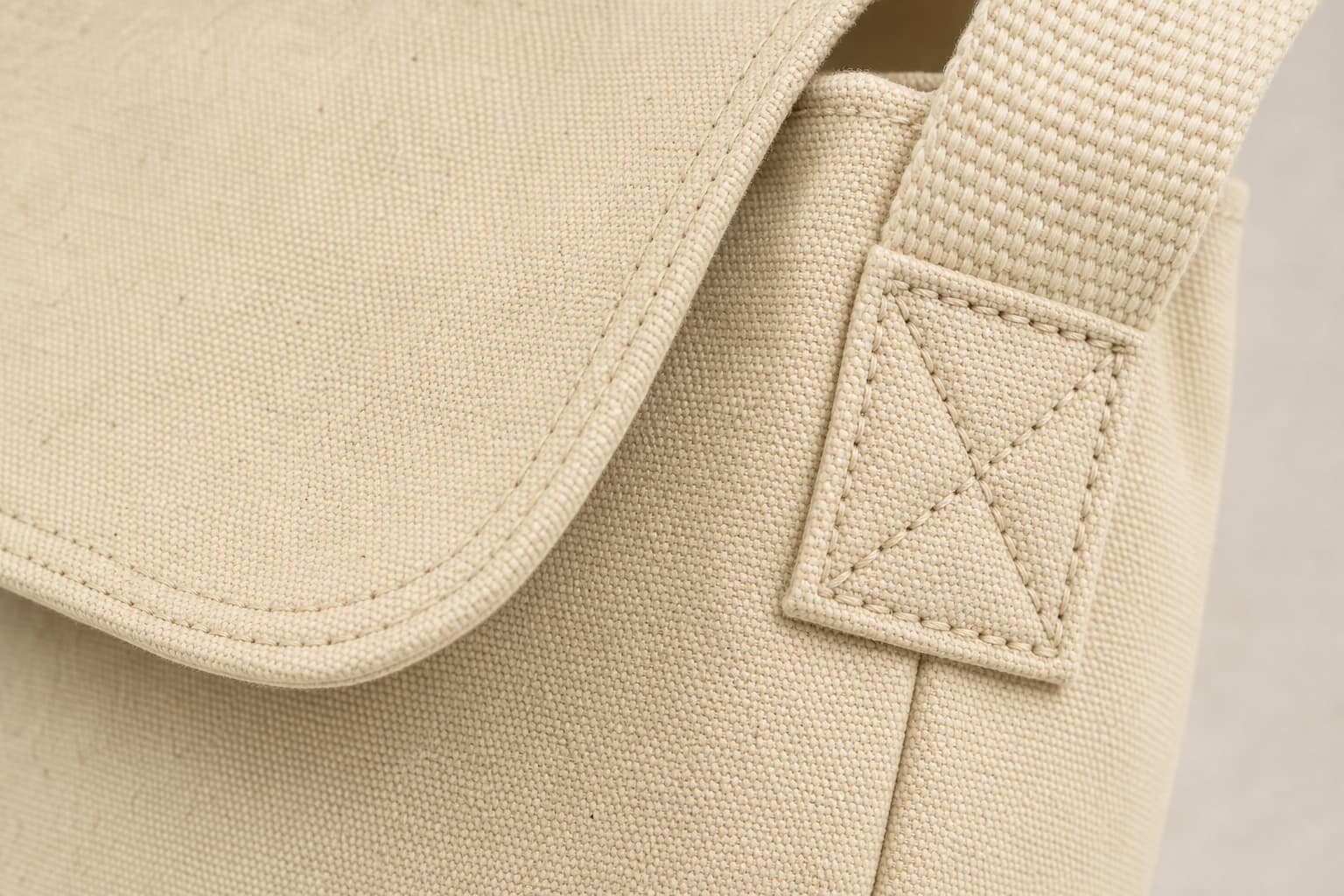
Why This RFQ Needs More Than Bag Size and Logo
A canvas messenger bag looks simple in a product photo, but a bulk order has many cost and quality variables hidden inside the construction. Two suppliers can quote the same size and logo but deliver very different bags because one includes lining, heavier canvas, metal hardware, reinforced strap stitching, and flat packing, while another quotes a thinner unlined version with basic plastic fittings. If your RFQ only says 'canvas messenger bag with logo,' the cheapest quote is often not the comparable quote.
For procurement teams and importers, the goal is not to make the longest RFQ. The goal is to remove guessing before sampling. A good RFQ tells the factory what the bag must do, what visual standard it must meet, how it will be packed, and how the quote should be broken down. This reduces repeated sampling, surprise charges, and disputes after inspection.
- Use the RFQ to define the product, not only to ask for a price.
- Ask factories to quote against the same fabric weight, hardware, logo method, and packing method.
- Separate must-have specifications from optional upgrades so you can compare cost impact.
- Do not approve bulk cutting until the pre-production sample matches the confirmed RFQ.
Start With Use Case Before Choosing Canvas Weight
Canvas weight is one of the first decisions that changes unit cost, carton weight, sewing difficulty, and perceived quality. For messenger bags, common cotton canvas options range from about 10 oz to 18 oz, roughly 340 GSM to 610 GSM depending on weaving and finishing. A lightweight promotional messenger bag may work at 10 oz or 12 oz, while a retail-style bag for daily use usually needs 14 oz to 16 oz canvas, especially when the bag has a flap, gusset, and adjustable shoulder strap.
Do not select fabric weight only by copying a competitor listing. Ask what the user will carry. A conference document bag does not need the same body strength as a canvas messenger bag used for books, tablets, and commuting. Heavier fabric gives better structure and durability, but it also increases material cost, shipping weight, needle wear, and sometimes minimum order quantity if the fabric must be dyed or washed.
- 10 oz to 12 oz canvas: suitable for light promotional bags, folders, brochures, or event giveaways.
- 12 oz to 14 oz canvas: balanced option for branded merchandise, school use, and general retail.
- 14 oz to 16 oz canvas: stronger handfeel for premium retail, corporate kits, and repeated daily carry.
- 18 oz canvas and above: useful for rugged styling but requires careful sewing, needle selection, and cost review.
- Natural canvas may have visible cotton seeds and slubs; dyed canvas needs shade control and colorfastness checks.
Define the Messenger Bag Construction in Plain Terms
A factory cannot quote accurately if the construction is described only as 'messenger style.' The RFQ should define the main compartment, flap depth, gusset, closure, strap, lining, pockets, and reinforcement. Even small details affect labor time. A zipper under the flap requires additional material, zipper tape, sewing steps, and inspection. A slip pocket is simpler than a zipper pocket. A buckle strap looks premium but is slower to sew than a magnetic snap.
For a buying team, the safest method is to describe the bag from outside to inside. Start with the outside dimensions, then the flap, then the strap, then the closure, then the interior. If you have a reference sample, send photos with marked dimensions, but still write the specification in text. Photos alone leave too much room for interpretation, especially for gusset depth, inner pocket size, and strap length.
- State finished size as W x H x D, for example 38 x 30 x 10 cm, and define acceptable tolerance.
- Confirm whether the flap covers half the bag height or reaches near the bottom edge.
- Specify strap width, total strap length, adjustable range, and whether the strap is cotton or PP webbing.
- Mention reinforcement: bartack at strap ends, double stitching on stress seams, or rivets if required.
- Define inside features: unlined, lined, open pocket, zipper pocket, laptop sleeve, pen slot, or key loop.
Choose Logo Application Based on Fabric and Position
Logo method should be selected after you know the canvas texture, print area, and brand standard. Screen printing is often the most practical choice for bulk canvas messenger bags because it works well on flat cotton panels and gives a clean result for one to four colors. However, heavy ink coverage on coarse canvas can crack or feel stiff if the ink system and curing are not suitable. Fine lines may also lose sharpness on open-weave or slub canvas.
Embroidery, woven labels, and patches are good alternatives when the artwork is small or the buyer wants a more durable retail detail. A woven side label can make the bag look finished without printing a large front logo. A leather or PU patch may fit a heritage style, but it adds cutting, embossing, and stitching steps. The RFQ should include artwork size, location, color reference, and whether the print is made before sewing or after sewing.
- Screen print: best for bold logos, larger print areas, and good unit cost at volume.
- Heat transfer: useful for detailed artwork but must be tested for adhesion on canvas texture.
- Embroidery: durable and premium, but can pucker lighter canvas and increases sewing time.
- Woven label: clean retail branding, especially on side seams, front flap edges, or inner pockets.
- Patch: suitable for premium positioning, but check edge finishing, stitching strength, and color consistency.
MOQ Logic: Why the Same Bag Has Different Minimums
MOQ is not only a factory sales policy. It is usually driven by fabric availability, dyeing, printing setup, hardware sourcing, and production line efficiency. If you choose natural stock canvas with a one-color screen print, the workable MOQ may be lower. If you need custom-dyed 16 oz canvas, matching cotton webbing, antique brass hardware, custom zipper pullers, and retail hangtags, the MOQ rises because each material supplier has its own minimum.
When comparing quotes, ask which part of the order is creating the MOQ. Sometimes the bag sewing MOQ is flexible, but fabric dyeing requires a larger batch. Sometimes a supplier can make 500 bags in stock natural canvas but needs 1,000 or 2,000 pieces for a custom Pantone fabric color. Understanding this lets buyers adjust the specification instead of rejecting a supplier too early.
- Lower MOQ is easier with stock natural canvas, standard black or natural webbing, and simple screen print.
- Custom fabric color may require higher MOQ because dyeing mills need minimum yardage.
- Custom metal hardware, zipper pullers, and embossed patches may carry separate tooling or minimums.
- Multi-color split orders can increase cost if each color needs separate fabric preparation and line changeover.
- Repeat orders become easier when approved materials are stocked or reordered with stable specifications.
Sample Approval Should Test Production Reality
A sample is useful only if it represents the bulk order. For canvas messenger bags, early samples are sometimes made with available fabric, substitute hardware, or hand-cut panels. That can be acceptable for checking shape, but it should not be treated as final approval. Before bulk production, request a pre-production sample using the confirmed canvas weight, lining, hardware, webbing, print method, and packing style.
Procurement teams should review the sample like an inspector, not only like a merchandiser. Load the bag with realistic contents, open and close the flap repeatedly, adjust the strap, check whether the print sits flat, and inspect whether the flap twists when the bag is filled. Messenger bags often fail at strap attachment, flap alignment, zipper smoothness, and uneven stitching around curved corners.
- Measure all dimensions and record tolerance before approving the sample.
- Check whether the bag stands, folds, or collapses in the way your sales channel expects.
- Confirm that the logo is centered when the bag is packed and when it is hanging on the shoulder.
- Inspect the inside seams, lining attachment, pocket opening, and zipper ends.
- Approve a physical sample or detailed sample report before bulk cutting, not only a digital photo.
Quote Data Buyers Should Request Line by Line
A useful quote should show what is included. If a supplier gives only one unit price, you cannot see whether the cost difference comes from fabric, lining, print, hardware, or packing. Ask for a structured quotation that includes product specification, unit price, sample fee if any, logo setup fee, MOQ, lead time, payment terms, packing data, and Incoterm. This is especially important when internal stakeholders are comparing two or three factories.
The quote should also state assumptions. For example, 'price based on 14 oz natural cotton canvas, unlined, one-color screen print, 1,000 pieces, flat packed one piece per polybag, FOB port.' If the factory changes canvas from 14 oz to 12 oz to hit a target price, that must be visible. Otherwise, your team may approve the cheaper quote without realizing the product has changed.
- Unit price with quantity breaks, such as 500, 1,000, 3,000, and 5,000 pieces if relevant.
- Canvas weight, color, lining, hardware material, strap material, and logo method included in the price.
- Separate charges for screen setup, embroidery digitizing, patch mold, label weaving, or sample courier.
- Estimated carton dimensions, gross weight, net weight, and units per carton.
- Lead time after sample approval and deposit, including any peak-season warning.
- Incoterm, loading port, payment terms, and quote validity date.
Packing Decisions Affect Shape, Freight, and Complaints
Packing is not a back-office detail for canvas messenger bags. A bag with a structured flap, metal buckles, or stiff canvas can arrive with deep creases if it is folded too tightly. On the other hand, flat packing increases carton volume and freight cost. Your RFQ should tell the supplier whether shape protection or freight saving is more important for the channel.
For retail buyers, individual polybags, barcode labels, hangtags, and clean carton segregation may be necessary. For corporate gifting or promotional distribution, bulk packing may be acceptable if the bags are protected from stains and moisture. If the bag is natural cotton canvas, consider the risk of dust, oil marks, and humidity during storage and shipping. Export cartons should be strong enough for stacking because canvas bags can be heavy in volume.
- Flat pack: better appearance, fewer flap creases, higher carton volume.
- Folded once: lower freight volume, but check crease position and print cracking risk.
- Individual polybag: cleaner handling and retail readiness, but adds material and packing labor.
- Bulk carton packing: lower cost, suitable for some promo orders, but higher stain and mix-up risk.
- Barcode labels and shipping marks should be confirmed before mass packing starts.
Lead Time Planning From Sample to Shipment Handover
Lead time for a canvas messenger bag bulk order depends on material readiness more than sewing alone. A simple order using stock natural canvas can move faster than a custom-dyed, lined, printed, multi-pocket messenger bag. Buyers should ask factories to break the schedule into sample making, sample approval, fabric preparation, printing or embroidery, cutting, sewing, finishing, inspection, packing, and shipment handover.
Avoid placing the full timeline risk on the final shipping date. Late artwork approval, slow sample comments, delayed label files, and changed packing instructions can all push production. If the bag is for a fixed event, retail launch, or seasonal program, share the required delivery window early and ask the factory which approval dates must be met. A realistic schedule is more useful than a short promise that cannot survive material delays.
- Sample lead time depends on whether correct fabric and hardware are available.
- Custom dyeing and custom webbing can add time before cutting starts.
- Printing is usually done before sewing when panels need a flat print area.
- Final inspection should be scheduled before the shipment handover date, not after goods are packed for pickup.
- Peak seasons and holidays can reduce sewing capacity and delay material suppliers.
Common RFQ Mistakes That Create Bad Comparisons
The most common mistake is asking several suppliers to quote without controlling the specification. One factory quotes 12 oz unlined canvas, another quotes 16 oz lined canvas, and a third quotes with different hardware. The price comparison then becomes misleading. Buyers may spend two weeks negotiating a lower price when the real issue is that the factories are not quoting the same product.
Another mistake is ignoring acceptance criteria until inspection. If print position, shade tolerance, stitching quality, and packing method are not agreed before production, the inspection becomes an argument. A good RFQ includes enough detail to prevent avoidable defects, but it also allows practical factory input. Experienced suppliers can suggest a better strap width, flap construction, or print position if the buyer shares the intended use and target market.
- Do not use only lifestyle photos as the product specification.
- Do not approve a sample if the fabric, hardware, or logo method is different from bulk production.
- Do not compare FOB and EXW quotes without adjusting logistics responsibility.
- Do not ignore carton data when the bag is heavy canvas or packed flat.
- Do not request a very low MOQ and custom-dyed material without expecting cost or timeline impact.
- Do not place barcode, hangtag, and retail label instructions after production has already finished.
Specification comparison for buyers
| Spec decision | Recommended option | When it fits | Buyer risk to check |
|---|---|---|---|
| Main body canvas | 12 oz to 16 oz cotton canvas, usually around 380-540 GSM | Retail, event merchandise, employee kits, book bags, light laptop carry | Quote must state finished GSM or ounce weight, not only 'heavy canvas' |
| Lining | Unlined for simple promo use; 210D/300D polyester or cotton lining for retail bags | Unlined lowers cost and lead time; lined bags look cleaner and protect inner seams | Lining changes sewing time, inside finishing, carton volume, and inspection points |
| Flap closure | Magnetic snap, zipper under flap, buckle strap, or Velcro depending on use | Magnetic snap for clean retail look; zipper for security; buckle for heritage style | Weak magnets, noisy Velcro, or slow buckle sewing can affect both user experience and cost |
| Shoulder strap | 38-50 mm cotton webbing or PP webbing with metal/plastic adjuster | Cotton webbing matches premium canvas; PP webbing controls cost and color consistency | Check strap length range, slider strength, bartack position, and colorfastness |
| Logo method | Screen print, heat transfer, embroidery, woven label, or leather/PU patch | Screen print for flat artwork and larger quantities; embroidery or label for premium branding | Artwork size, ink coverage, seam position, and flap curvature can cause print distortion |
| Internal pockets | One slip pocket or zipper pocket as standard upgrade | Useful for retail and corporate buyers who want higher perceived value | Pocket depth, zipper quality, and seam allowance must be confirmed before sampling |
| Packing | Flat packed per polybag, folded once, or carton bulk without individual bag | Flat packing protects shape; folded packing reduces carton size for budget shipments | Deep creases, crushed buckles, and uneven flap shape can trigger buyer complaints |
| Sample approval | Pre-production sample using confirmed fabric, hardware, print, and packing method | Necessary for custom size, lined bags, special hardware, or retail packaging | A lookalike sample made from substitute canvas does not prove bulk production readiness |
Buyer checklist before sampling
- Confirm bag size with width, height, gusset, flap depth, and whether measurements are taken empty or filled.
- Specify fabric in oz and GSM where possible, including whether canvas is natural, dyed, washed, or laminated.
- Define lining, internal pocket, zipper, snap, buckle, strap width, strap length range, and hardware color.
- Send vector logo files and mark print size, print location, ink color reference, and tolerance from seams or flap edge.
- State expected order quantity, color split, delivery country, preferred Incoterm, and whether you need export cartons or retail packaging.
- Ask the factory to separate unit cost, sample cost, mold or screen cost, packing cost, and estimated carton data.
- Require pre-production sample approval before bulk cutting, especially for new fabric weight, new hardware, or new print placement.
- Set inspection criteria for fabric defects, stitching, print registration, hardware function, strap pull strength, stains, and packing.
- Confirm carton size, gross weight, units per carton, inner polybag requirement, barcode label placement, and shipping marks.
- Ask for a realistic lead time broken into sample, material preparation, bulk sewing, packing, inspection, and shipment handover.
Factory quote questions to send
- What exact canvas weight are you quoting in oz and GSM, and is it greige, bleached, dyed, washed, or finished canvas?
- Is the quoted price based on stock fabric or custom-dyed fabric, and what MOQ applies for each color?
- What is included in the quoted bag construction: lining, zipper pocket, main zipper, flap closure, strap adjuster, and reinforced stitching?
- Which logo method is quoted, what is the maximum print area, and are screen setup charges or embroidery digitizing charges included?
- Can you provide sample photos of the proposed fabric, webbing, slider, snap, zipper, and lining before making the paid sample?
- What is the sample lead time and what materials may be substituted during sample making if bulk materials are not ready?
- How many units per export carton, what are the estimated carton dimensions, and will bags be flat packed or folded?
- What inspection standard do you recommend for this order, and which defects are considered critical, major, and minor?
- What production lead time applies after sample approval and deposit, and does it change during peak season?
- Can you quote the same specification at two fabric weights so we can compare cost, weight, and durability before final approval?
Quality-control points to confirm
- Measure finished bag size, gusset depth, flap length, strap width, and strap length adjustment range against the approved sample.
- Check canvas GSM, fabric handfeel, color shade, weaving defects, stains, oil marks, slubs, and shrinkage risk if washed finishing is used.
- Inspect seam allowance, stitch density, skipped stitches, loose threads, bartack placement, and reinforcement at strap attachment points.
- Test zipper, magnetic snap, buckle, slider, and Velcro function repeatedly on random samples from different cartons.
- Check logo print position, ink coverage, color consistency, curing, rub resistance, and whether print is distorted by seams or flap folding.
- Verify lining attachment, internal pocket depth, zipper pocket sewing, and no loose fabric caught in zipper teeth.
- Perform practical loading checks using a reasonable weight for the intended use, then inspect strap and side seam deformation.
- Review packing method, polybag size, desiccant use if required, carton strength, carton markings, barcode labels, and mixed color segregation.
- Compare bulk goods to the approved pre-production sample under consistent lighting, not only against digital photos.
- Record defect photos and carton numbers during inspection so rework can be targeted instead of delaying the full shipment.