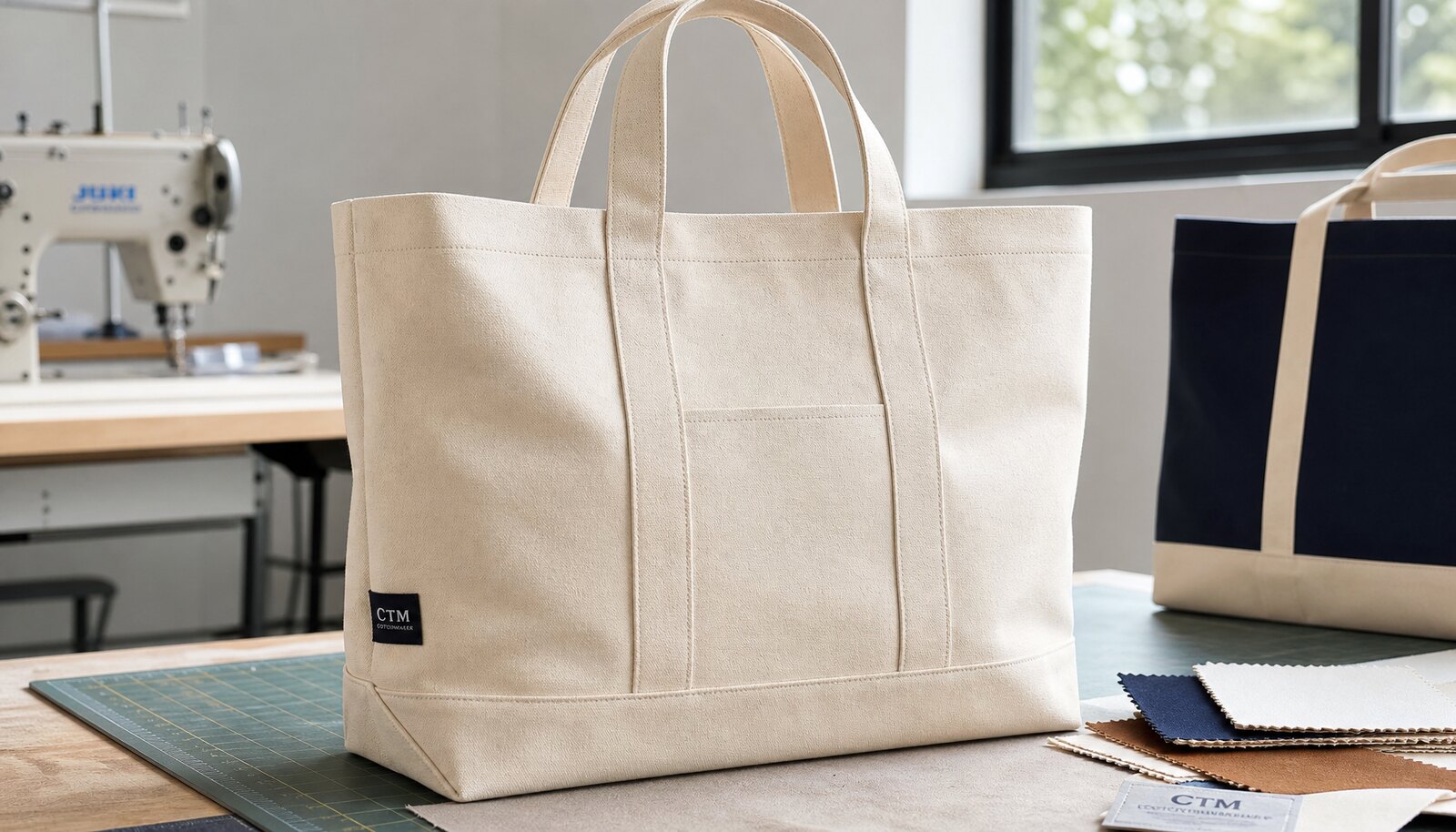
Why these totes need their own spec
A canvas library tote for trade shows is not the same product as a low-cost giveaway bag. It has to carry catalogs, notebooks, product sheets, or sample packs, often after the attendee has already filled it with other items. That means the tote is judged on function first: shape retention, handle comfort, seam strength, and whether it still looks presentable after repeated folding and handling. Buyers who start with decoration and leave the carry requirement vague usually end up with a bag that photographs well but fails on the event floor.
The practical sourcing mistake is to assume one tote size fits every program. A bag that works for handouts may be too small for a book launch, while a taller tote may look awkward if it is meant to sit in a retail rack. Before you ask for price, define the use case in plain terms: what goes inside, how much it weighs, how the tote is carried, and whether the bag must stand upright. That gives suppliers a target they can actually quote against and lets you compare offers on the same commercial basis.
- Define the real carry load before you discuss artwork or packing.
- Treat the tote as a functional product, not just a branded surface.
- If the bag must survive repeated event use, source it like a light-duty work bag, not a single-use promo item.
Lock size and carry behavior first
Finished dimensions drive every later decision. If the tote must hold A4 or letter-size materials flat, the width, height, and gusset should be frozen before the graphic layout is approved. Otherwise the logo can end up too close to the seam, too low on the panel, or distorted by a last-minute size change. In procurement terms, size is the first control point because it sets the print area, the carton cube, and the amount of fabric the factory needs to quote accurately.
Handle drop matters just as much. For shoulder carry, many buyers start around 10 to 12 inches of drop, while hand-carry programs are often shorter. The right number depends on how full the tote will be and who will use it. A short handle feels cramped once brochures are inside; an overly long handle makes the tote swing and look untidy. Set a tolerance as well, because a bag that measures correctly on paper but varies by more than a small amount in bulk will create a visible quality issue.
- Approve finished width, height, gusset depth, and handle drop before artwork finalization.
- Use a practical tolerance, such as plus or minus 1 cm or 0.5 in, and make the factory quote to that target.
- If the tote must stand upright, specify the bottom structure and do not rely on body fabric alone.
- Separate hand-carry and shoulder-carry programs into different specs if the content load is different.
Choose fabric and reinforcement around the load
Canvas weight is one of the biggest levers in both cost and performance. For most trade-show library tote programs, 10 to 12 oz canvas, roughly 340 to 407 GSM, is the most balanced starting point. It gives enough body for printing, feels credible in the hand, and usually keeps freight manageable. Heavier canvas can make sense for a premium retail tote or a bag that must be reused frequently, but the price and shipping weight rise quickly, so the business case needs to be clear.
Fabric weight alone does not guarantee durability. A tightly woven 10 oz canvas can outperform a looser 12 oz build if the yarn quality is better and the sewing is cleaner. Ask the supplier about weave density, shrinkage control, and whether the fabric is pre-washed, enzyme-washed, bleached, or dyed before cut-and-sew. If the tote includes a bottom gusset, a bottle pocket, or a reinforced base panel, make the buyer decision on the total construction, not on a single fabric number.
- Use 10 to 12 oz canvas as the default comparison point for trade-show programs.
- Ask for fabric lot identification and expected shrinkage if the tote must remain dimensionally stable.
- Require reinforcement at handle roots, bottom corners, and high-stress seam intersections.
- If the bag must keep a structured shape, specify a base insert or heavier bottom panel rather than assuming the body fabric will hold it.
Match decoration method to artwork and reuse
Screen print is still the safest choice for many private-label tote programs because it handles simple logos well and usually survives repeated handling. It is especially strong when the artwork uses one to three colors and needs to stay readable from several feet away. The buyer should still ask how fine text will behave against the canvas texture, because small type and thin lines can fill in once they hit the weave. For event bags, clarity matters more than decoration complexity.
Transfer and digital methods have a place when the artwork is more detailed, but they are not automatically better. A sample can look sharp while the bulk run shows cracking, transfer lift, or color shift after folding. For any tote that will be reused, ask the factory what happens after flexing, abrasion, and rub testing. Also set placement rules: a logo too close to a seam can warp, and a print that extends too near the top hem may get lost when the bag is folded for packing.
- Use screen print for simple logos, larger areas of color, and repeat orders.
- Use transfer or digital print only when the artwork complexity justifies the added risk and cost.
- Ask for a strike-off or print sample on the same canvas type, not just on a paper proof.
- Set a minimum edge clearance from seams and hems so the logo survives sewing variation.
Compare supplier routes with region context
The source route changes more than the price. A direct factory is usually easier to manage when the tote spec is stable, the buyer can approve samples carefully, and repeat orders matter. A trading company can be useful when the order is small, the buyer needs mixed services, or there are multiple SKUs to coordinate. A regional converter or decorator is often the better answer when speed, local receiving, or lower logistical friction matters more than the lowest unit price. That is why a supplier comparison should start with the commercial model, not just with the invoice total.
Region matters because fabric ecosystems, labor patterns, transit time, and documentation expectations are not identical. China often offers strong choice on canvas, stitching, and finishing at scale. India can be attractive for cotton-based programs and certain finishing needs. Vietnam and nearby Southeast Asia are often selected when buyers want tighter production discipline and are willing to pay a bit more for it. Turkey, Eastern Europe, and domestic finishing options can make sense when transit time, EU or regional receiving, or fast replenishment outweigh raw unit cost. The right decision is the one that fits your order profile, not the one that looks cheapest in isolation.
- Use a direct factory when the spec is stable and you expect reorders.
- Use a trading company only if it can name the factory and explain who owns QC decisions.
- Use a regional converter when transit time or local fulfillment matters more than the lowest price.
- If the quote is far below the cluster, assume something material is missing and ask what was excluded.
Build a quote package that can be compared
A quote is only useful when every supplier is quoting the same product. That means the RFQ, or quote package, needs more than a product name and a logo file. It should include finished dimensions, fabric weight, construction details, decoration method, reinforcement points, packing rules, carton requirements, and the delivery target. Without that structure, each supplier fills in the blanks differently and the buyer ends up comparing unrelated offers.
The strongest quote package also asks the factory to repeat the assumptions back in writing. That sounds basic, but it prevents the most common sourcing mistake: a supplier quietly simplifying the product to hit a target price. When you receive the quote, check whether the factory specified the same fabric, the same handle construction, the same print method, and the same carton count you asked for. If anything is missing, the number is not yet comparable.
- Use one finished size, one artwork version, and one packing standard across all quotes.
- Ask for setup charges and recurring unit cost as separate lines so reorder pricing is visible.
- Require carton dimensions and gross weight so freight and warehouse handling can be estimated.
- Ask the supplier to identify any assumption that would change the price later.
Treat sampling as a rehearsal, not a gallery shot
The sample stage should prove that the tote can be made consistently, not only that it looks good in a photo. A useful sample is measured, handled, loaded, and checked against the written spec. Verify the print position, handle drop, seam spacing, fabric shade, and the way the tote folds after use. If the bag will carry books or sample kits, place a realistic load inside and watch for distortion at the handle roots, side seams, and bottom corners. A pretty sample that cannot hold weight is not an approved sample.
Ask for a pre-production sample, not just a sales sample, and make sure it uses the same fabric and the same print process planned for bulk. If the factory revises the sample after the first approval round, document the change and circulate the new reference internally. A lot of avoidable production drift comes from teams approving one version verbally and buying another version on paper. For a trade-show program, that is enough to create complaints before the first event ship date.
- Approve against a written sheet with measurements and defect thresholds.
- Keep one sealed reference sample for final inspection and reorder comparison.
- If fabric, print, or trims change, restart the approval cycle.
- Consider a small pilot run before a large event order if the spec has multiple moving parts.
Set measurable QC limits before bulk starts
Quality control needs measurable rules, not general instructions to make the tote look nice. Define critical defects first. A wrong size beyond tolerance, a broken handle, missing stitches on a load-bearing seam, mold, odor, or the wrong artwork version should all be treated as critical and rejected. Major defects are different: print misalignment beyond your limit, seam skip, visible staining, shade mismatch, or handle asymmetry that makes the tote look off-brand. Minor defects can be cosmetic, but they still need a clear limit so the inspector is not guessing.
For the build itself, tie the inspection to numbers. Many buyers use 6 to 8 stitches per inch on load-bearing seams and more consistent topstitching on visible areas. Ask for reinforcement at the handle roots, and use a pull test against the expected use case, such as holding 2x to 3x the intended filled weight for 60 seconds with no seam opening or handle tear. For print, require no visible transfer after dry rub on the approved cloth, and if your program uses lab testing, map the acceptable result to the method your QA team already recognizes. AQL 2.5 major, 4.0 minor, and 0 critical is a reasonable starting point for many import programs, but retail-facing programs may need tighter limits.
- Set critical, major, and minor defect definitions before production starts.
- Use AQL 2.5 major, 4.0 minor, and 0 critical unless your buyer standard is stricter.
- Require a pull test that reflects actual use, not just a light hand tug.
- Reject loose threads longer than 5 mm, visible staining, broken reinforcement stitching, and any print transfer that would mark brochures or apparel.
Plan packing, logistics, and lead time around the channel
Packing affects cost, warehouse time, and first impression. Some programs need each tote individually packed for retail or e-commerce, while others work better in bulk cartons for event distribution. There is no universal answer. What matters is matching the pack style to the channel. If the tote will sit in a warehouse or travel long distances, carton count, fold consistency, and moisture protection deserve the same attention as the bag itself because they change freight cube and receiving labor.
Lead time should be broken into real steps: sample approval, material booking, production, inspection, and dispatch. That is more useful than a single delivery promise because it shows where the schedule can slip. The common bottlenecks are not always sewing capacity. More often they are delayed sample signoff, fabric not booked early enough, or a last-minute change in print method. Ask the supplier to give dates for each step and to explain what happens if the pre-production sample is not approved on the first pass.
- Specify fold method, carton count, and carton marks in the quote package.
- Confirm whether individual polybags are required or prohibited by the channel.
- Ask for carton dimensions and gross weight so warehouse receiving can be planned.
- Work backward from the event date and keep a buffer for sample or print revision.
Select the supplier with a scorecard, not a gut feel
A good supplier choice is a commercial decision, not a vibe check. Build a simple scorecard that weights spec compliance, QC evidence, communication speed, logistics fit, and commercial terms. For repeated event programs, the best supplier is usually the one that can reproduce the approved sample with the least drift, not the one that offers the lowest first quote. A small price gap is rarely worth taking if it adds uncertainty around fabric, print, or packing.
Use the scorecard to challenge outlier pricing. If one supplier is materially below the rest, ask what was removed, simplified, or assumed. If another quote is higher but includes better packing, clearer defect definitions, and a documented QC path, that may be the lower-risk choice once freight and rework are considered. For private-label tote programs, continuity matters. The best supplier is the one that can make the second order look like the first one without forcing your team to re-approve everything from scratch.
- Score the supplier on spec match, QC proof, lead time, logistics, and commercial clarity.
- Require one accountable contact who can answer questions on fabric, print, and packing.
- Prefer the supplier that can explain deviations before they happen, not after the shipment lands.
- For recurring trade-show orders, prioritize reorder stability over a small one-time savings.
Specification comparison for buyers
| Supplier option | What to verify | Commercial advantage | Buyer risk to control |
|---|---|---|---|
| Direct sewing factory | fabric swatch, approved sample, seam close-ups, logo test photos, packing pilot, and final inspection evidence | Better sample-to-bulk control and faster production feedback | May be weaker on export paperwork or branded packing unless checked early |
| Trading company | Factory name, production photos, trim-source proof, and who owns QC decisions | Can coordinate small mixed orders and extra services | Markup can hide real factory capability and slow defect decisions |
| Specialized bag workshop | bag size, gusset, handle drop, seam allowance, stitch density, reinforcement patch, and loading expectation | More practical for detailed construction, trims, and repeat programs | Capacity may be limited during peak seasons |
| Low-price general supplier | 8-12 oz cotton canvas, 120-220 gsm cotton, recycled cotton, or blended fabric selected by use case and target price | Useful for simple promotional runs with loose specs | Material downgrades, weak packing, and vague inspection scope can erase savings |
| Retail-ready supplier | fold method, inner bundle, carton count, carton mark, moisture protection, SKU separation, and warehouse receiving needs | Can handle labels, SKU separation, carton marks, and receiving rules | Higher unit cost must be compared against reduced warehouse work |
| Compliance-focused supplier | Fabric records, labeling review, test plan, and production traceability | Safer for retail programs and repeat brand orders | Documentation claims need evidence, not only sales language |
| Local sample room plus bulk factory | Signed sample, bulk factory handoff, first-piece photos, and deviation owner | Good for complex branding before large production | Sample room quality may not match bulk line unless handoff is controlled |
Buyer checklist before sampling
- Confirm whether the tote must hold A4 or letter-size brochures flat, and whether it also needs room for a sample folder or bottle.
- Lock finished width, height, gusset depth, and handle drop before artwork is approved.
- Specify fabric weight in GSM or oz, plus whether the canvas is natural, bleached, dyed, enzyme-washed, or recycled cotton.
- State the expected filled weight or contents so the supplier can size reinforcement around a real load.
- Define print area, number of colors, Pantone references, and the minimum edge clearance from seams and top hems.
- Ask for the exact sample reference, fabric lot, and production method that will be used for bulk.
- State packaging format, carton count, barcode needs, and whether individual polybags are required, optional, or prohibited.
- Request lead time split into sample, material booking, bulk production, inspection, and dispatch.
- Compare quotes on the same basis: fabric, construction, print, thread color, packing, carton size, and freight assumption.
- Require defect definitions in writing so the factory knows what counts as rejectable before production starts.
Factory quote questions to send
- What is the exact finished size, seam allowance, and tolerance you are quoting for this tote?
- What is the canvas weight, weave type, and expected shrinkage after washing or finishing?
- Is the fabric ring-spun cotton, open-end cotton, or a cotton blend, and which lot will bulk use?
- Which print method is included, how many colors are covered, and what setup charge applies?
- What handle construction will be used, and what load or pull target do you test it against?
- Are the sample, pre-production, and bulk pieces made from the same fabric and the same print process?
- What is the minimum order quantity by color and by artwork version, and can mixed sizes share one run?
- What packing is included, how many pieces per carton, and what carton dimensions and gross weight should I expect?
- What defect categories do you treat as rejectable, especially for print alignment, stains, seam skip, and handle attachment?
- What documents can you provide with the quote, such as spec sheet, carton plan, and inspection checklist?
Quality-control points to confirm
- Use a formal inspection plan, such as AQL 2.5 major, 4.0 minor, and 0 critical, unless your program requires tighter limits.
- Measure finished width, height, gusset, and handle drop on the approved sample and on random bulk cartons.
- Set a stitching target for load-bearing seams, such as 6 to 8 stitches per inch on main seams and consistent topstitch spacing with no skipped stitches longer than 25 mm.
- Require bar tacks or equivalent reinforcement at the handle roots and lower stress points, and reject any loose or broken reinforcement stitching.
- Define a pull test against expected use, such as holding 2x to 3x the intended filled weight for 60 seconds with no seam opening, handle tear, or visible distortion beyond your tolerance.
- Check print registration, edge sharpness, and coverage, and require no visible ink transfer after a dry rub test on the approved reference cloth.
- Verify wet rub or crock resistance if the bag may contact apparel, brochures, or books, and map the result to the lab method your buyer team uses.
- Inspect for stains, oil marks, needle damage, puckering, loose thread tails longer than 5 mm, odor, and shade mismatch between body, handle, and reinforcement panels.
- Match fold method, carton count, carton mark, and barcode placement to the approved packing spec, not to a verbal promise.
- Treat the golden sample as the controlling reference for bulk, and restart approval if fabric, print, or trim changes.