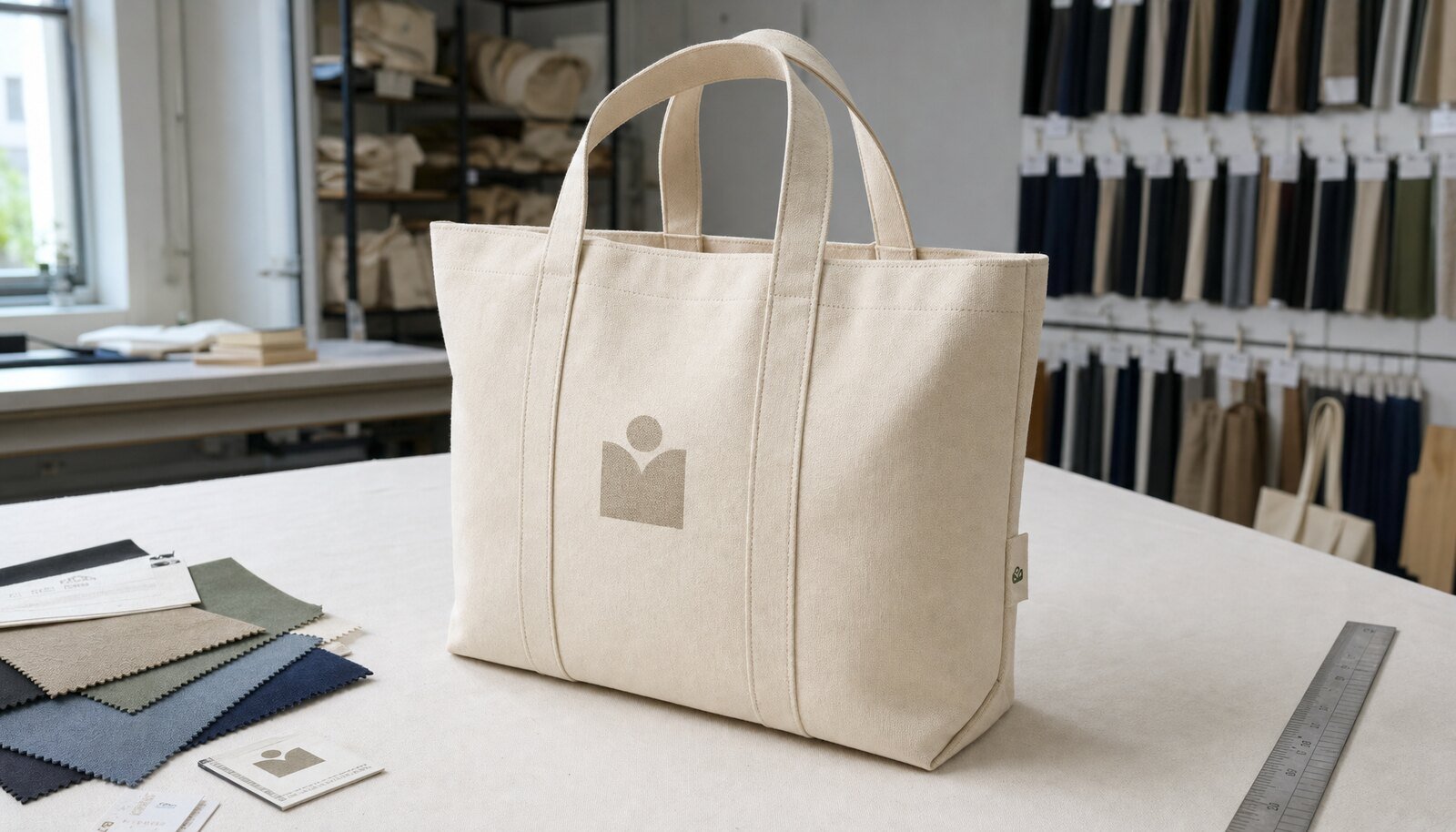
Why subscription box buyers need a different tote sourcing plan
A canvas library tote for a subscription box is not purchased like a generic promotional tote. It has to fit a fixed box size, look good when the customer opens the shipment, and survive both fulfillment handling and later reuse. That means the buying decision starts with the pack-out plan and landed cost, not with the headline bag price. If the tote folds too thick, it can force a larger mailer, reduce room for the paid contents, or raise the freight class of the outbound carton.
Procurement teams also need to treat the tote as part of the subscription experience, not as a separate accessory. If the bag arrives wrinkled, misprinted, or with loose threads, the customer sees that defect at the exact moment the brand is supposed to feel premium. The practical consequence is that the RFQ has to cover finished size, fold format, decoration, and carton count. A supplier quote that only covers fabric and print leaves too many unanswered cost questions.
The commercial planning question is simple: is this tote a recurring program item, a launch insert, or a one-time seasonal benefit? A recurring line deserves tighter spec control and better price break planning. A short pilot can justify faster sourcing and more flexible decoration. Once the use case is clear, the buyer can compare suppliers on the same basis instead of comparing one incomplete quote against another.
- Use pack-out fit as a core buying spec, not an afterthought.
- Separate launch pricing from repeat-order pricing.
- Write the tote’s role in the box before asking for quotes.
Fabric weight and hand feel: where the pricing gap starts
Fabric weight is usually the first major price divider in canvas tote sourcing. A 10 oz canvas, roughly 280–300 GSM, can work well for lighter subscription inserts and programs where cost control matters most. A 12 oz canvas, around 340 GSM, gives a firmer hand, more body, and a better retail feel when the tote is expected to be reused for books or everyday carry. In most factories, that jump in fabric weight also changes cutting resistance, needle load, scrap rate, and the time it takes operators to sew through the seams cleanly.
The important sourcing nuance is that suppliers do not always define canvas weight the same way. Some quote greige cloth, others quote finished cloth after processing, and some quote a fabric spec that sounds complete but is not tied to the actual bag body. Buyers should ask whether the GSM is measured before or after finishing, whether the canvas is preshrunk, and whether the bag body will shrink again after decoration or washing. If the bag is washed, dyed, or stone-finished, the final dimensions and seam behavior can shift enough to affect carton fit.
Natural canvas also deserves a separate conversation from bleached or dyed canvas. Natural goods often have normal shade variation, small flecks, and less color consistency from lot to lot. That is not automatically a defect, but the buyer should define what is acceptable. If the brand wants a cleaner visual presentation for a subscription unboxing, bleached or dyed canvas may be worth the extra cost even if the product itself is functionally similar.
- 10 oz / 280–300 GSM: cost-conscious, lighter hand, lower structure.
- 12 oz / 340 GSM: better body, more premium feel, usually safer for book-heavy use.
- Ask whether GSM refers to greige or finished fabric before comparing quotes.
Decoration method: how print choice changes repeat cost, durability, and schedule
For most subscription box tote programs, one-color screen print is the best balance of cost, speed, and repeatability. It works well when the artwork is stable, the logo is simple, and the buyer wants the lowest practical setup cost across repeat orders. The real technical issue is ink control. A print that looks strong in the sample can crack later if the ink deposit is too heavy or if the cure is incomplete. On textured canvas, weak registration and uneven pressure can also show up as fuzzy edges or uneven coverage.
Heat transfer and digital print have a place, but mainly when the project needs flexibility. They are useful for small launches, short seasonal runs, or artwork with more colors than a standard screen setup would handle efficiently. The tradeoff is not just per-unit decoration cost. It also affects setup, scrap rate, and how confidently the supplier can keep each bag consistent from batch to batch. If the subscription program will reorder the same art several times, a decoration process that is flexible but unstable may cost more than it first appears to save.
Buyers should also consider how the print interacts with folding. Large flood prints and full-front artwork may look strong in a flat sample but crease badly when the tote is folded into a subscription carton. That is why the pre-production sample should be reviewed in the same folded state the customer will receive. If the supplier cannot demonstrate rub resistance, fold tolerance, and cure consistency, the quote should not be treated as comparable to one from a factory with tighter print controls.
- Screen print: usually best for stable branding and lower repeat cost.
- Heat transfer or digital: better for short runs or changing artwork.
- Review the tote in its folded state, not only flat on the table.
Construction details buyers should price before they ask for a PO
The bag body is only part of the cost. Construction choices often explain why two seemingly similar tote quotes differ more than expected. Self-fabric handles are usually the most economical route, but the handle length, fold width, and reinforcement pattern still matter. If the tote is meant to carry books, a reinforced handle root and tighter stitch density are worth specifying because handle failure is one of the easiest ways to turn a low-cost tote into a customer service issue.
A gusseted body gives the tote better volume and a more upright shape, which can help when the bag is part of a curated subscription box and presentation matters. A structured bottom can also make the tote easier to load. Those improvements are real, but they add fabric consumption and sewing steps. Procurement teams should ask whether the extra structure is actually required for the box contents. If the bag only carries a soft insert, paying for a firm base may not be the best use of budget.
Labels also create meaningful price differences. A woven side label, printed neck label, sewn-in care label, or hangtag each adds labor and may require a different machine step. Some buyers want a simple brand tag for resale value; others only need a discreet mark for internal inventory. The better question for the supplier is not “Can you add a label?” but “What changes in labor, packing, and defect risk when you add this label?” That is where the price becomes more transparent.
- Handle reinforcement should be specified, not assumed.
- Structured bottoms and gussets improve shape but add cost.
- Label method affects labor and inspection complexity.
Supplier routes: factory-direct, trading, or stock, and why the route affects the plan
The sourcing route has a direct effect on both price transparency and quality control. Factory-direct buying usually gives the buyer the cleanest view into fabric source, cutting, sewing, printing, and packing. That matters for recurring subscription programs because the buyer can ask for the exact same spec again and again. A direct factory quote is also easier to benchmark because it is more likely to reflect actual production costs rather than layered markups.
Trading companies and stocked suppliers can still be useful, especially for launch tests or when the marketing team needs the tote before a fixed campaign date. A stocked route may shorten lead time and reduce the pain of a low initial order. But it also creates another layer between the buyer and the production site. If there is a defect issue, the buyer may need to resolve whether the root cause was the fabric source, the printing subcontractor, or the packing team. That can slow replacement decisions and make QC accountability harder to document.
For procurement, the route should match the maturity of the program. If the design is still being tested, speed may matter more than perfect pricing. If the tote is becoming a recurring subscription line item, the buyer should push toward a route that offers stable material control, repeatable packing, and clear responsibility for defects. The quote should be judged on the visibility it provides, not only the number printed at the bottom.
- Factory-direct usually offers better spec control and better repeat-order visibility.
- Stock or trading routes can help with speed, but may hide production detail.
- Choose the route based on program stage, not only on the first quote.
How to read a bulk pricing plan without getting misled by the headline unit cost
A serious bulk pricing plan should show how the price changes when the buyer changes the spec. If the supplier only gives one all-in number, there is not enough information to compare alternatives. The buyer should ask for a split that shows the bag body, decoration, label, packing, and any extra setup charges. Once those pieces are visible, it becomes easier to see whether a lower quote is genuinely cheaper or merely missing items that will be added later.
The most useful benchmark is tiered pricing. Ask for the unit price at the quantities you are likely to buy in the next cycle, not just the initial run. For a subscription box buyer, the relevant checkpoints are often the pilot order, first commercial order, and the expected reorder volume. If the supplier does not give meaningful savings at the next tier, the apparent bargain may not survive the second PO. Buyers should also ask whether the quote assumes full production in one color, one print location, and one packing method. Hidden complexity often appears only after the artwork or pack-out changes.
It helps to compare quotes by landed cost per usable tote rather than by ex-factory price. A slightly higher factory quote may still win if the supplier packs more efficiently, ships fewer damaged units, or reduces receiving labor. Likewise, a cheap tote that requires sorting, re-folding, or replacement after arrival can end up being the expensive option. The pricing plan should reflect the cost of a tote that is actually ready for the subscription box line.
- Ask for tiered pricing at realistic reorder volumes.
- Compare what is included: setup, label, fold, pack, carton, and print.
- Judge landed cost per usable tote, not only factory price.
More decision-rich comparison: which pricing route fits which subscription program
Different sourcing routes suit different commercial goals. Buyers often over-focus on the unit price and under-focus on the operational shape of the program. The table below is more useful when the goal is a bulk pricing plan, because it compares the commercial route, the likely fit, and the quality-control burden side by side. Use it as a buying guide before you ask suppliers to quote.
The decision is usually not between cheap and expensive. It is between low-friction and low-control, or between better repeat economics and faster launch timing. If the tote is part of a subscription line that will repeat every month or quarter, stability in fabric lot, print placement, and carton count matters more than shaving a few cents from the first order. If it is a one-time campaign insert, speed and artwork flexibility may deserve more weight. The right choice depends on how often the tote will be reordered and how much warehouse labor the pack-out can absorb.
Production planning: MOQ, lead time, and the schedule points that usually slip
MOQ is rarely just a supplier preference; it is tied to fabric booking, cutting efficiency, and decoration setup. On a simple canvas tote, a factory may accept a small initial order, but the quote often becomes less favorable because the fixed costs are spread over too few units. For a subscription box buyer, the better question is whether the MOQ lines up with the expected first reorder and the replenishment buffer. If the program is likely to continue, ordering just enough for launch can raise the total cost of ownership later.
Lead time should be mapped by production step instead of listed as a single number. A realistic schedule usually includes sample approval, fabric preparation, cutting, sewing, decoration, inspection, and packing. A standard tote made from ready cloth with a simple one-color print can often fit a 30–45 day production window after approval, but that range is only useful if the artwork is already locked. Custom dyeing, special labels, and tight pack-out requirements can extend the timeline quickly. The biggest hidden delay is often not sewing; it is waiting for approvals on the sample, proof, or carton layout.
One practical way to reduce schedule risk is to freeze the packing specification early. The bag itself may be simple, but if the buyer is still deciding whether it should be polybagged, folded to a target size, or packed with an insert card, the factory cannot plan the final carton configuration. That can lead to last-minute rework or a shipment that arrives technically correct but operationally awkward for the fulfillment team.
- MOQ should match the launch run plus a sensible replenishment buffer.
- Ask for lead time broken into sample, material, production, inspection, and packing.
- Freeze the pack-out format early to avoid warehouse surprises.
Sample approval: what to inspect before bulk production starts
A sample is only useful if it reflects the final production method. Buyers should ask for a pre-production sample made with the exact canvas weight, same decoration process, same label method, and same fold format that will be used in the order. A lookalike sample made from different fabric or a different print setup can create a false sense of security. In tote sourcing, that mistake often shows up later as size drift, poor fold behavior, or print quality that changes once the line is running in bulk.
The approval review should be practical and small enough to repeat. Check the finished size against the agreed spec, confirm the handle length in hand, and compare the print position to the approved artwork reference. Then fold the tote the way it will be packed for the subscription box and make sure the folded shape still closes cleanly inside the carton or insert tray. If the bag needs to be opened and refolded by fulfillment staff to fit, the packing instruction is not mature enough yet.
This is also the point to check the inside finish. Loose threads, uneven seam endings, and rough top edges are far more noticeable in a subscription unboxing than in a warehouse-only product. If the tote is intended to feel premium, ask the factory to show how they will trim thread ends, prevent seam puckering, and control the topstitch line around the opening. Those details are small, but they are exactly where an otherwise acceptable tote can fail the customer’s first impression.
- Approve a true pre-production sample, not a substitute sample.
- Check the tote folded inside the actual box or packing footprint.
- Inspect thread trim, seam finish, and print position as part of approval.
Packing and fulfillment fit: the hidden cost center in subscription tote programs
Packing decisions change both cost and warehouse behavior. If the tote arrives in an individual polybag, it is easier to keep clean and easier to count, but the material and labor costs rise. If it ships folded loose in cartons, the per-unit packing cost may be lower, but the warehouse team takes on more handling risk and the customer may receive more visible fold marks. There is no universal answer; the right format depends on the brand promise and the fulfillment flow.
Master carton planning matters more than many buyers expect. Overpacked cartons can crush the tote body and leave a permanent crease in the print area. Underfilled cartons waste space, raise freight cost, and sometimes create shifting that damages the corners of the bags. Buyers should ask for the carton count, carton dimensions, gross weight, and whether the cartons are suitable for palletization if pallets are being used. A good quote makes these details visible because packing efficiency is part of the total unit economics.
Warehouse receiving also benefits from disciplined labeling. SKU, color, size, quantity per carton, and carton sequence should be legible and consistent. If the tote is part of a multi-SKU subscription program, receiving errors can create production delays that have nothing to do with the tote itself. In other words, the packing spec is not just a logistics note; it is part of the risk control plan.
- Use polybags when cleanliness and presentation matter enough to justify the extra cost.
- Set carton counts to protect shape without over-compressing the bag.
- Label cartons clearly for SKU, size, quantity, and carton sequence.
Specification comparison for buyers
| Decision area | Option to consider | Best use case | Buyer tradeoff / QC risk |
|---|---|---|---|
| Fabric weight | 10 oz canvas / about 280–300 GSM | Value-focused insert bags, lighter subscription contents, or pilot programs where cost control matters more than structure | Can feel softer and cheaper if filled with books or dense items; ask for finished bag weight, shrinkage allowance, and seam test results |
| Fabric weight | 12 oz canvas / about 340 GSM | Recurring box programs, book-heavy assortments, and launches that need a more retail-grade hand feel | Higher material and sewing cost; confirm the tote still folds to the target carton size |
| Fabric finish | Natural/unbleached canvas | Programs that want a casual, bookstore-style look and lower dye complexity | Shade variation is normal in natural goods; define acceptable tone range and speck count if visual consistency matters |
| Fabric finish | Bleached or dyed canvas | Brand programs that need a cleaner white base or a specific color story | More process steps can add cost and lead time; request shrinkage and colorfastness details |
| Decoration | 1-color screen print | Stable artwork, recurring orders, and the lowest repeat setup cost | Fine detail, gradients, or oversized floods need stricter cure control to avoid cracking or rub-off |
| Decoration | Heat transfer / digital print | Short runs, seasonal designs, or artwork that changes often | Unit cost rises and durability can vary; require rub, fold, and adhesion checks |
| Construction | Self-fabric handles with reinforced stress points | Standard library tote function with books, catalogs, or mixed inserts | Handle length, seam density, and bartack placement need to be verified on the pre-production sample |
| Construction | Gusseted body with structured bottom | Totes that need better stand-up shape and easier packing presentation | More fabric and sewing steps usually increase cost; check whether the extra structure changes the carton count |
| Packing | Individual polybag plus master carton | Subscription fulfillment where cleanliness, count control, and presentation are important | Adds material and labor; too much compression can leave permanent folds and print marks |
Buyer checklist before sampling
- Define the tote’s job in the box: insert only, reusable utility item, or retail-quality add-on. That choice changes the acceptable GSM, handle strength, and decoration finish.
- Lock the finished dimensions, not only the flat pattern size. State the folded size if the tote must fit a specific mailer or subscription box insert tray.
- Specify fabric weight in oz and GSM, plus fabric state: natural, bleached, dyed, or washed. Ask the supplier to confirm whether the quoted spec is based on greige or finished cloth.
- Choose the decoration method early. Each additional print location, ink color, label type, or embroidery step adds cost and can change lead time.
- Ask for a true pre-production sample made with the exact fabric, decoration, label, and folding method that will be used in bulk.
- Confirm the pack-out method: individual polybag, folded loose in carton, carton liner, insert card, desiccant, or any special warehouse labeling.
- Request break pricing at the volumes you actually expect to buy, not only the launch quantity. If a reorder is likely, compare the economics at the next two tiers too.
- Set acceptance criteria for seam strength, print placement, shade consistency, and carton count before production starts.
- Align artwork lock with material booking so the supplier does not hold fabric while waiting for revised files.
- Ask how the factory handles defects: replacement allowance, rework decision point, and whether defects are counted at inspection or after shipment.
Factory quote questions to send
- What is the exact fabric specification, including GSM, weave count or yarn count if available, and whether the quote is for greige, bleached, dyed, or finished canvas?
- Can you break out the price at 1,000, 3,000, and 5,000 pieces, and explain what cost element drives the change between tiers?
- Does your unit price include screen setup, print screens, label application, folding, polybag, inner packing, and master cartons, or are any of those extra?
- What tolerance do you hold for finished size, handle length, print position, and seam alignment? Please state the tolerance in writing.
- Can you share photos or a video of the pre-production sample, in-line inspection, and final carton packing method before mass shipment?
- What is the production timeline by step: sample approval, fabric booking, cutting/sewing, printing, inspection, and carton close?
- If the artwork changes after approval, what happens to cost and schedule?
- What is your carton packing count, carton size, gross weight target, and palletization method if pallets are used?
- How do you handle shade variation in natural canvas and what visual standard do you use to judge acceptable variation?
- What is your defect policy for print misregistration, loose threads, crooked topstitching, and damaged cartons on arrival?
Quality-control points to confirm
- Finished dimensions should be checked against the approved spec, including width, height, and gusset depth if applicable. A practical tolerance is often about ±0.5 inch for smaller totes, but the buyer should set the tolerance based on box fit and warehouse handling needs.
- Review handle attachment carefully. The first failure point is often the handle root, not the middle of the strap. Ask for visible bartacks or reinforced stitch zones and compare the sample against the bulk line photo.
- Check seam consistency on side seams, bottom seams, and top edges. Loose thread ends, skipped stitches, or uneven stitch length often indicate poor line control even when the bag looks acceptable at first glance.
- Inspect print placement against a physical reference bag or marked template. Centering that looks acceptable on screen can drift in bulk, especially on thick canvas where the weave can distort ink edges.
- Test folding behavior. The tote should fold to the agreed dimension without fighting the carton closure or creating a hard wrinkle across the print area.
- Look at rub-off risk. A quick dry rub check on the printed area and a folded-contact check inside a packed carton can reveal weak cure or heavy ink transfer before shipping.
- Verify inside cleanliness. For subscription programs, stray threads, dust, or labeling adhesive can affect first impression immediately because the end user opens the bag at home.
- Check carton labels, SKU codes, color names, and counts against the PO. Receiving errors are common when multiple tote sizes or colors are packed on the same order.
- If the program includes natural canvas, define what level of shade variation is acceptable. Buyers should not assume every bag will match exactly; they should define the acceptable visual range in advance.
- If the bag is being inserted into a subscription box, sample the pack-out line. The bag may pass product QC but still fail box-fit QC if it is too bulky after folding or polybagging.