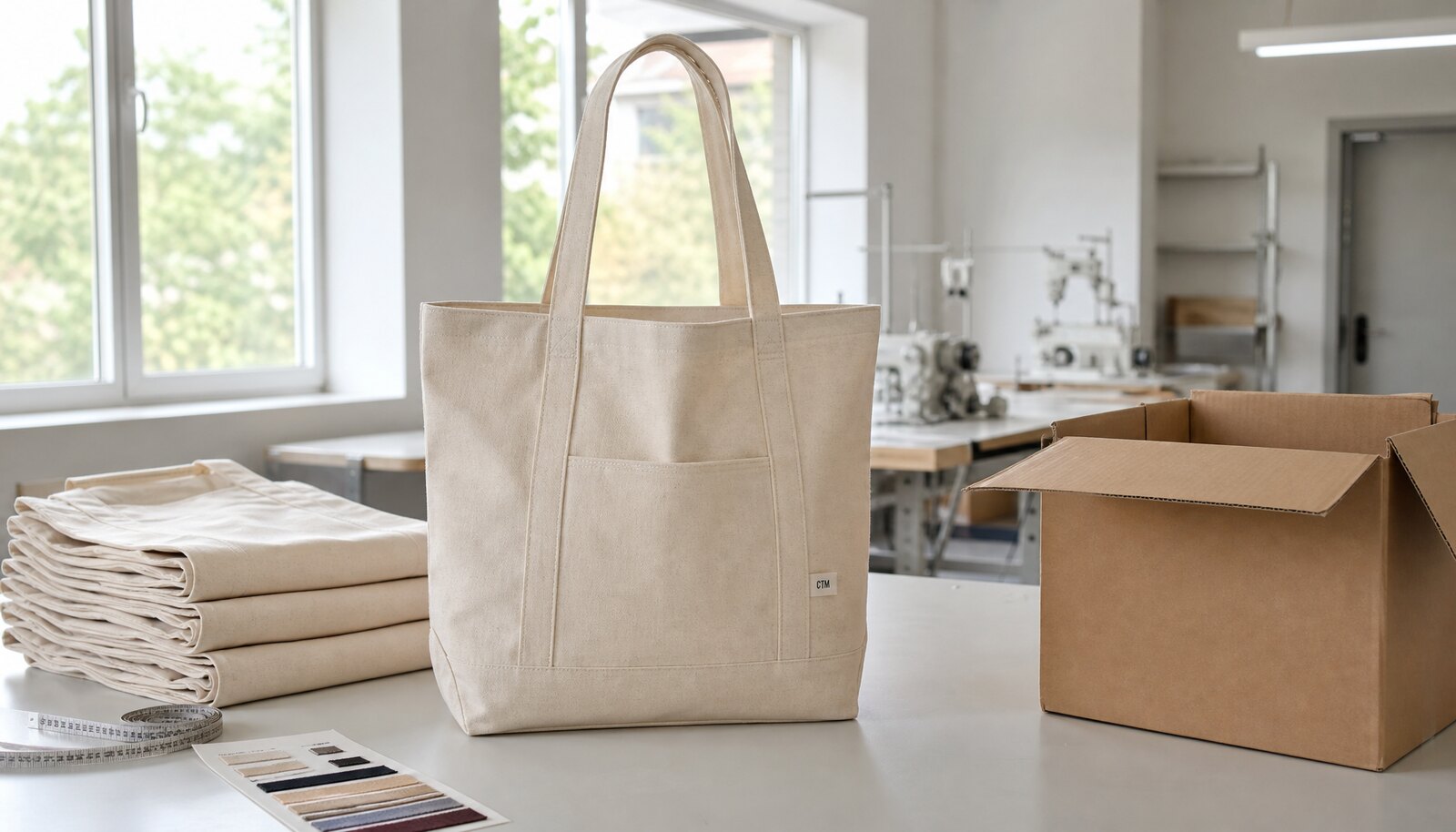
Start With the Carton, Not the Tote
For canvas library tote bags, the carton is not an afterthought. Ecommerce brands receive the bag as a packed unit, store it in a 3PL, and ship it again after pick and pack. If the tote is built well but the carton is oversized, weak, or hard to receive, the product still becomes expensive to move. The most common mistake is asking for a unit price before the supplier knows the fold method, inner count, or destination warehouse rules.
The right way to source this product is to treat the tote, the pack, and the carton as one system. Start with finished bag size, gusset depth, handle length, logo placement, and whether the bag must stay flat enough for shelf storage. Library-style totes often need more structure than a promotional shopper because they carry books, notebooks, and heavier retail items. That means the carton plan must respect the extra bulk created by a wider gusset, thicker canvas, and reinforced handles.
If the receiving warehouse has a carton dimension cap, pallet rule, or barcode orientation rule, lock that in before you approve the bag spec. A carton that is easy to sew around but hard to stack, scan, or store can erase margin. Buyers should ask factories to quote the same tote in at least two packing formats when they are still deciding between dust protection, cube efficiency, and retail presentation. That gives a real sourcing comparison instead of a guess.
In practice, carton planning starts with one question: what does the bag need to become once it leaves the sewing line? If the answer is "a clean, flat ecommerce unit," the fold and carton need to be tight and repeatable. If the answer is "a displayable premium tote," the carton may need more board strength and slightly looser interior packing. Either way, the carton spec is part of product design, not a warehouse afterthought.
- Fix finished dimensions before asking for freight quotes.
- Decide whether the bag ships flat, half-folded, or rolled.
- Tie carton size to warehouse receiving and label placement rules.
- Request a packed sample photo with measured thickness, not only an unfolded bag photo.
Choose Canvas Weight for Structure and Pack Density
Fabric weight drives almost every packing decision. A light 8 oz or roughly 280 to 320 gsm canvas can lower product cost and improve carton density, but it also produces a softer bag that may collapse in transit or look weak on arrival. For many ecommerce library tote programs, 10 oz to 12 oz canvas, roughly 340 to 400 gsm, is the practical middle ground because it gives enough body for books and keeps the tote reasonably flat when folded.
Heavier 14 oz to 16 oz canvas, roughly 450 to 500 gsm, makes a premium tote that feels durable, but the tradeoff is clear: fewer pieces per carton, more freight cube, and more handling weight in the warehouse. If the bag is natural cotton, ask the factory to confirm whether the fabric is pre-shrunk or whether you need a shrinkage allowance after heat pressing or finishing. A quote that says only "heavy canvas" is not enough for comparison.
The useful way to evaluate fabric is to ask how it changes the packed unit, not just the hand feel. Two suppliers may both say 12 oz, but one uses a denser weave, a stiffer finish, or a different cut orientation that changes fold thickness and carton fill. That is why a measured packed sample matters. A tote that feels slightly firmer in hand can translate into fewer pieces per carton, higher pallet height, or more damage from compressed handles if the fold plan is not adjusted.
For ecommerce brands, the best fabric is the one that survives both the product experience and the shipping chain. A tote that arrives with strong seams but a badly swollen carton creates labor issues at receiving. A tote that packs beautifully but looks flimsy on shelf can also miss the mark. Balance the retail perception with the carton math before you sign off on the GSM.
- 340 to 400 gsm usually gives the best balance of structure and pack density.
- 400 gsm and above helps when the tote must stand up in photography or retail display.
- Thicker canvas reduces pcs per carton and may raise cube even if the unit bag price is attractive.
- Ask for shrinkage tolerance, fabric width, and any weight variance before you compare suppliers.
Choose Decoration That Stays Flat in Transit
Print method is a packing issue, not just a branding choice. Screen print is still the most predictable option for one to three color logos because it keeps the ink layer thin and easy to stack. That matters when the tote is folded tightly in a polybag or packed in a dense master carton. Heat transfer and DTF can work well for short runs or complex art, but they usually add stiffness to the printed area and can create a noticeable ridge in the folded stack.
For a library tote sold through ecommerce, the artwork should stay clear of the main fold line, the bag mouth, and the handle root. If the logo is too close to a fold, the print may crack during packing or show pressure marks after transit. If the buyer wants a more refined presentation, a woven side label or a small sewn label often travels better than heavy embroidery. The cleanest quote is the one that names the print method, ink type, color count, and placement in millimeters or centimeters.
One practical rule: if the decoration changes the thickness of the folded unit, treat it as a packaging change, not just a design change. Buyers sometimes approve a mockup based on the flat bag, then discover the print adds enough surface stiffness to reduce carton count or make the top carton layer bow. Ask the supplier to show the decorated bag folded exactly as it will ship. Then check whether the print panel makes the stack uneven or marks the face of the next tote in the carton.
For repeat ecommerce orders, choose the decoration that gives the most predictable reorders. Screen print normally wins when the art is simple, because it is stable, thin, and easy to control across runs. Transfers and embroidery can still be right for a specific brand look, but they should be approved with a real packed sample and not only a decorated flat sample.
- Keep artwork away from fold lines and handle stress points.
- Require a rub test or cure check for any printed tote that will be handled repeatedly.
- Inspect the opposite panel for print ghosting after stacking.
- Use screen print for repeat orders unless the artwork genuinely needs a transfer process.
Map the Inner Pack Before You Design the Master Carton
The carton plan starts with the inner pack. One tote per polybag is common when the program needs dust control, clean receiving, or a retail-ready look, but the polybag itself must be sized correctly so it does not add extra cube or trap too much moisture. Then decide how many pieces go into the master carton. For many canvas tote programs, the practical range is 20 to 50 pcs per carton, but the right number depends on fabric weight, fold thickness, and handling limits.
Do not let the supplier optimize only for a low carton count. If the carton is too full, handles get crushed, seams distort, and the warehouse receives damaged product. If the carton is too loose, corrugated board and freight cube are wasted. Ask for the master carton dimensions, net and gross weight, carton closure method, and any moisture protection. A carton liner or desiccant may be worth the added cost if the route is humid or the transit time is long.
A better way to think about inner packing is to define a target packed thickness and then reverse-engineer the carton. That avoids the common mistake of picking a carton size first and forcing the bag into it. When buyers only ask for an approximate carton count, factories may fill the box differently from one line to the next. The result is inconsistent gross weights, partially compressed handles, and unit volumes that do not match the booking forecast.
For ecommerce and 3PL receiving, the carton should also be easy to identify. Put SKU, color, carton number, and carton count on the outside in a position the warehouse can scan without moving the box. If you use a multi-SKU order, make the carton marks obvious enough that a receiver can sort the shipment without opening every box. That small detail saves labor at destination and reduces mis-picks.
- Target a carton fill rate around 85 to 92 percent rather than a loose half-full box.
- Keep gross carton weight in a manual handling range your receiving team can lift safely.
- Use clear carton marks for SKU, color, size, and carton number.
- If the cartons will scan at a 3PL or fulfillment center, test the barcode on a real sample carton.
Use Real Carton Dimensions, Not Guesswork
Procurement teams often approve tote orders using vague carton notes like "standard export carton." That is not enough. You need actual carton dimensions, board grade, seal method, and a packed count. For canvas library tote bags, carton dimensions should be chosen around the folded unit rather than around the theoretical maximum number of bags. A useful carton is one that protects the bag while staying predictable for freight booking and warehouse receiving.
A carton example helps buyers think in concrete terms. A 10 oz to 12 oz canvas tote folded flat might fit comfortably into a master carton around 45 x 35 x 30 cm with 24 to 30 pcs, depending on handle length, gusset size, and whether each tote is polybagged. A heavier 14 oz canvas version may need a slightly larger carton or a lower piece count to avoid panel bowing and crushed handles. These are not universal dimensions, but they show why the answer changes with fabric and fold thickness.
When comparing carton options, ask the supplier to provide the dimensions in both centimeters and inches, plus the estimated gross weight. That makes it easier to compare freight quotes and warehouse requirements. The carton should also have enough board strength for the route. For routine ocean or truck shipping, a standard 5-ply carton may be enough. For heavier totes, longer routes, or stack-heavy pallets, a reinforced 7-ply spec can reduce corner crush and top-load damage.
There is a tradeoff between stronger board and freight cost. More board can protect the product, but it also adds weight and cost. The right answer depends on the route, not just the product. If the cartons are going straight to a high-turnover fulfillment center and will be broken down quickly, a lighter carton may be acceptable. If they will sit in a distribution center and be stacked, stronger board and better closure tape are worth the spend.
- Request carton dimensions in cm and inches for easier freight comparison.
- Confirm board grade, closure tape, and label placement before sample approval.
- Use lower carton counts if handle compression shows up in the packed sample.
- Ask for a packed carton photo with a ruler or tape measure in frame.
Compare Sourcing Routes Before You Compare Unit Price
A direct OEM factory is usually the best route when carton engineering matters, because the same plant can control cutting, sewing, folding, labeling, and master carton packing. A trading company can be useful when the program includes several components or when you want one contact to coordinate more than one factory, but the buyer still needs the same packing detail in writing. Stock tote suppliers are faster, yet they are least likely to optimize the carton around your warehouse rules.
The practical comparison is not just the bag price. You should compare the same finished dimensions, the same canvas weight, the same print method, and the same pack-out basis. One supplier may look cheaper until you add a bigger carton, a heavier polybag, or extra repacking labor at destination. If you are comparing direct factory versus local decorator versus stock importer, ask each one to quote the exact same fold pattern and carton count before you judge the price.
The cheapest quote can also hide process risk. A supplier that has no carton discipline may still be fine for a small campaign order, but on a reorder program the inconsistency shows up in receiving delays and carton rework. Procurement teams should look for the lowest landed cost on the same basis, not the lowest bag price. When the carton spec is unclear, ask the supplier to show a sample of the actual packed box, not only the tote itself.
For a B2B buyer, the real decision is how much control you need. If you need repeatable replenishment with fewer surprises, pay for a supplier who can manage pack-out details. If you only need a short launch run, a faster sourcing route may be acceptable. Either way, quote the same carton basis across all suppliers or the comparison will mislead you.
- Compare on the same Incoterm, not on a mix of ex-factory and landed numbers.
- Ask for separate line items for bag, print, packing, and carton work.
- Do not accept a quote that hides the carton spec inside a vague packing note.
- Use the same sample pack pattern when you compare two suppliers side by side.
Set MOQ Around Carton Math and Print Setup
MOQ is rarely one number. It is usually the result of fabric booking, cutting waste, print setup, carton purchase, and labor efficiency. A simple one-color screen print in a common canvas weight may allow a lower MOQ than a multi-color design or a special dye lot. If the carton pack is 24 pcs and the order is 1,000 pcs, the factory may need to break cartons or hold partial cartons, which adds labor and can increase the quote. Clean quantities, such as 960 or 1,200, often make production easier than a number that looks round but creates waste.
Ask the supplier to explain what actually drives the MOQ. If the answer is fabric loom allocation, screen setup, or carton sourcing, that is useful. If the answer is simply a number with no reason, the quote is not stable enough for procurement. For repeat ecommerce programs, it is worth aligning MOQ with your reorder cadence, because the cheapest order is the one that packs cleanly and reorders without repacking the line.
The most practical MOQ conversation is tied to the pack pattern. If the supplier wants 24 pcs per carton, then ask what order size produces the fewest partial cartons and least packing labor. If you can accept two colorways in one order, ask whether those can share the same carton format or whether the packing line will need to separate them. That detail affects both cost and receiving complexity.
Also clarify overrun and underrun tolerance. A tote order that is short by a few percent may leave you with incomplete carton counts or mismatched carton labels. A modest overrun may be fine if your warehouse can absorb it, but only if the supplier says so upfront. These are not minor terms; they directly affect how many sellable units actually arrive in usable cartons.
- Ask for MOQ breakpoints at 500, 1,000, 3,000, and 5,000 pcs.
- Confirm whether mixed colors can share the same carton format.
- Get the overrun or underrun tolerance in writing before approval.
- Request separate costs for sample, screen setup, and carton artwork setup.
Use Sample Approval to Lock the Packed Version
A bag sample is not enough. For this product, the pre-production sample should reflect the final fabric, stitching, print, fold, inner pack, and carton count. Ask the factory to send the bag sample and, if possible, a packed sample or a carton dummy that shows the final thickness. That is the only reliable way to see whether the tote fits the target carton without excessive compression or wasted space.
The sample review should be practical, not cosmetic only. Fold the tote exactly as the factory intends to fold it, then open and repack it once to see whether the process is realistic for the production line. Check whether the handle stays flat, the gusset recovers cleanly, and the print survives the fold without cracking. For ecommerce brands, label orientation matters as much as the bag itself because the receiving team needs cartons that scan, count, and route without extra handling.
A good sample approval also includes carton behavior. Ask the supplier to close the carton with the same tape or glue method used in bulk. Then do a simple drop check on a sample carton from handling height, and inspect the corners, seams, and handle areas for shifting. The goal is not laboratory certification; it is to catch the most obvious packing failures before mass production begins. A carton that looks neat on a table can still fail once it is stacked, shipped, and rehandled.
If the sample changes after approval, document why. Changes to print placement, fold method, or carton count should be treated as spec changes, not casual revisions. The more precisely the sample stage matches the bulk order, the fewer surprises you will have when freight is booked and the receiving team opens the first carton.
- Approve the fold method before approving bulk packing.
- Measure packed thickness so the carton quote is based on a real number.
- Run a carton shake test and inspect corner scuffing and handle distortion.
- Verify barcode, country of origin, and SKU placement on the packed sample.
Specify QC for the Bag, the Pack, and the Box
QC for canvas library tote bags needs three layers: the bag, the packed unit, and the master carton. On the bag itself, check seam alignment, stitch count consistency, bartack placement, handle length tolerance, and loose-thread cleanup. For canvas, the fabric should feel consistent from panel to panel. If the weave or finish changes enough to affect thickness, the carton count can drift. Buyers should not assume that product QC and packing QC are separate.
For the packed unit, check fold pattern, folded thickness, polybag fit, and whether the print area is creasing where it should not. A clear acceptance standard helps here. For example, define an acceptable finished size tolerance, then define a separate packed-thickness tolerance, because those are not the same thing. A tote can be dimensionally correct and still be too bulky for the agreed carton count. That should be rejected or repacked before shipment.
For the carton itself, inspect board grade, corner integrity, tape width, seal application, and label location. Ask the factory what tape spec it uses and whether it applies a top and bottom seal or only one closure strip. For longer routes or humid lanes, a carton liner or desiccant is worth considering. Moisture control matters because canvas can pick up odor or surface dampness if cartons sit in a wet container or an unventilated warehouse.
A simple acceptance standard should also cover carton tests. Sample cartons should survive a basic drop check and a compression check with no panel collapse, lid opening, or visible corner breakage. If your supplier cannot describe its carton QC method clearly, the buyer should assume that packing quality depends on line operator habit rather than a controlled process. That is a procurement risk, not a minor operational detail.
- Define separate tolerances for finished bag size and packed thickness.
- Require even handle stitching, secure bartacks, and clean thread trimming.
- Set carton tape width, seal pattern, and label position in writing.
- Check one sample carton for drop damage, corner crush, and moisture signs before bulk release.
Plan Freight Around Cube, Weight, and Palletization
Freight planning for tote bags is mostly cube management. A slightly larger carton or a bulkier fold can reduce cartons per pallet, raise container cube, and change warehouse receiving speed. That is why the carton spec should be tied to a freight plan before bulk production starts. The buyer needs to know not just how many pieces fit in a carton, but how many cartons fit on a pallet and whether the stack height stays within the destination warehouse's limits.
Ask the supplier for gross carton weight and estimated cartons per pallet if palletization applies. If you are shipping loose cartons in an ocean container, ask for the recommended stack pattern and whether the carton can be double-stacked without crushing. If the cartons will be palletized, confirm the pallet footprint and maximum pallet height, because one extra carton layer can push the pallet over the warehouse limit. That can lead to repalletizing fees after arrival.
A useful rule is to compare alternative packing plans by their effect on one carton, one pallet, and one container. A pack that saves one or two cents per tote but adds enough cube to change the container count is not truly cheaper. Freight-safe planning also helps with warehouse ergonomics. If the gross carton weight is too high, receiving labor slows down and damage risk goes up during manual handling.
Buyers should also remember that carton strength and freight mode interact. A box that is acceptable for truck haul may be too weak for a long ocean lane with humidity and stacking. Ask the factory what carton board and tape spec it uses for the intended route, not just for a generic export carton. Freight planning works best when the packaging spec reflects the actual lane and receiving method.
- Compare carton count per pallet as well as carton count per order.
- Check whether pallet height will stay within warehouse receiving rules.
- Model the effect of one extra centimeter in carton height before approval.
- Ask for gross weight so manual handling risk is clear.
Specification comparison for buyers
| Spec decision | Recommended option | When it fits | Buyer risk to check | Pack / freight note |
|---|---|---|---|---|
| Direct OEM factory with carton engineering | Best when one supplier controls bag, print, fold, and carton spec | High-volume ecommerce programs that need stable pack-out and repeat replenishment | Make sure the quote includes labor for folding, bagging, labeling, and master carton work | Best chance to optimize packed thickness and pallet pattern in one workflow |
| Trading company that bundles bag and packing | Best when you need one contact for multiple factories or mixed components | Programs with more than one tote style, print method, or destination market | Watch for hidden margin and compare the same bag, pack, and carton basis across quotes | Useful for coordinating cartons, but demand a written breakdown of packing inputs |
| Stock tote supplier with overpack cartons | Best when speed matters more than carton optimization | Launches, test orders, and short replenishment windows | Confirm the stock tote fold size and whether the carton count fits your warehouse rules | Fast, but often weaker on carton efficiency and carton-size control |
| Local print decorator on imported blanks | Best for fast domestic branding on a small or medium run | Regional ecommerce fulfillment or urgent campaign inventory | Check blank consistency, seam quality, and whether the print changes packed thickness | Good for speed; less ideal if the blank dimensions vary or the carton spec is loose |
| One tote per polybag | Best for dust control, retail presentation, and tighter carton stacking | Ecommerce orders that ship through 3PLs or need cleaner receiving | Do not let the polybag add unnecessary cube or trap moisture during long transit | Adds protection but can reduce pack density and slow line packing |
| Loose flat fold without polybag | Best for lower-cost bulk shipping and simple warehouse handling | Programs where the tote will be repacked or opened at the destination | Inspect for scuffing, edge abrasion, and inconsistent folded height | Lowest material cost, but carton interiors need more attention to abrasion and moisture |
| Standard 5-ply master carton | Best for moderate weight bags and routine ocean or truck freight | Most 10 oz to 12 oz canvas tote programs with normal carton handling | Check corner crush resistance and whether the carton can hold the bag count without bulging | Usually the baseline option, but verify cube and ECT against route conditions |
| Reinforced 7-ply master carton | Best for heavier canvas, long-haul transit, or stacked pallets | Premium totes, high pack density, or routes with rough handling | Review weight limits and make sure the stronger carton does not create avoidable freight cost | Stronger board can reduce damage, but it may raise carton weight and unit freight |
Buyer checklist before sampling
- Finished bag size, gusset depth, handle length, and acceptable tolerance
- Canvas weight in GSM or oz, plus any shrinkage or weight variance limit
- Print method, print colors, artwork placement, and fold-line clearance
- Inner pack count, polybag use, desiccant use, and target master carton count
- Master carton dimensions, board strength, seal method, and label format
- Sample approval requirements for bag, packed unit, and carton dummy
- Incoterm, destination market, and warehouse receiving rule or pallet rule
- Target lead time, packing deadline, and freight booking milestone
- Overrun or underrun tolerance and who approves any change order
- Photo references or a measured tech pack if the supplier must quote from scratch
Factory quote questions to send
- What MOQ do you apply by color, print method, and carton pack?
- What finished dimensions, fold method, and packed thickness are included in your quote?
- What is the canvas weight in GSM or oz, and what shrinkage allowance should we budget?
- What are the inner pack count and master carton dimensions you recommend for this tote?
- Are polybags, desiccants, labels, and carton printing included or priced separately?
- What are the sample cost, screen or plate cost, and any carton tooling or artwork charges?
- What lead time do you give after sample approval, and what stages can change it?
- What overrun or underrun range should we expect, and how do you handle partial cartons?
- Can you share a carton photo, dieline, or packed sample image before bulk booking?
- What carton strength, closure tape, and drop or compression test standard do you use for shipment approval?
Quality-control points to confirm
- Finished size stays within the agreed tolerance after pressing and folding
- Canvas weight matches the approved range and does not vary enough to change carton count
- Handle stitching, bar-tacks, and side seams are even, secure, and free of loose threads
- Print registration, ink cure, and rub resistance meet the approved sample standard
- Folded thickness, packed count, and carton fill level match the packing plan
- Master carton dimensions, gross weight, and seal integrity match the shipping spec
- Barcode, SKU, and carton marks are readable and placed where the warehouse expects them
- A random carton open-close check does not reveal crushed handles, scuffed corners, or moisture damage
- Carton corners survive a basic drop check from waist height on at least one sample from each batch
- Carton compression does not show panel collapse, seam bursting, or bowing during stacking simulation