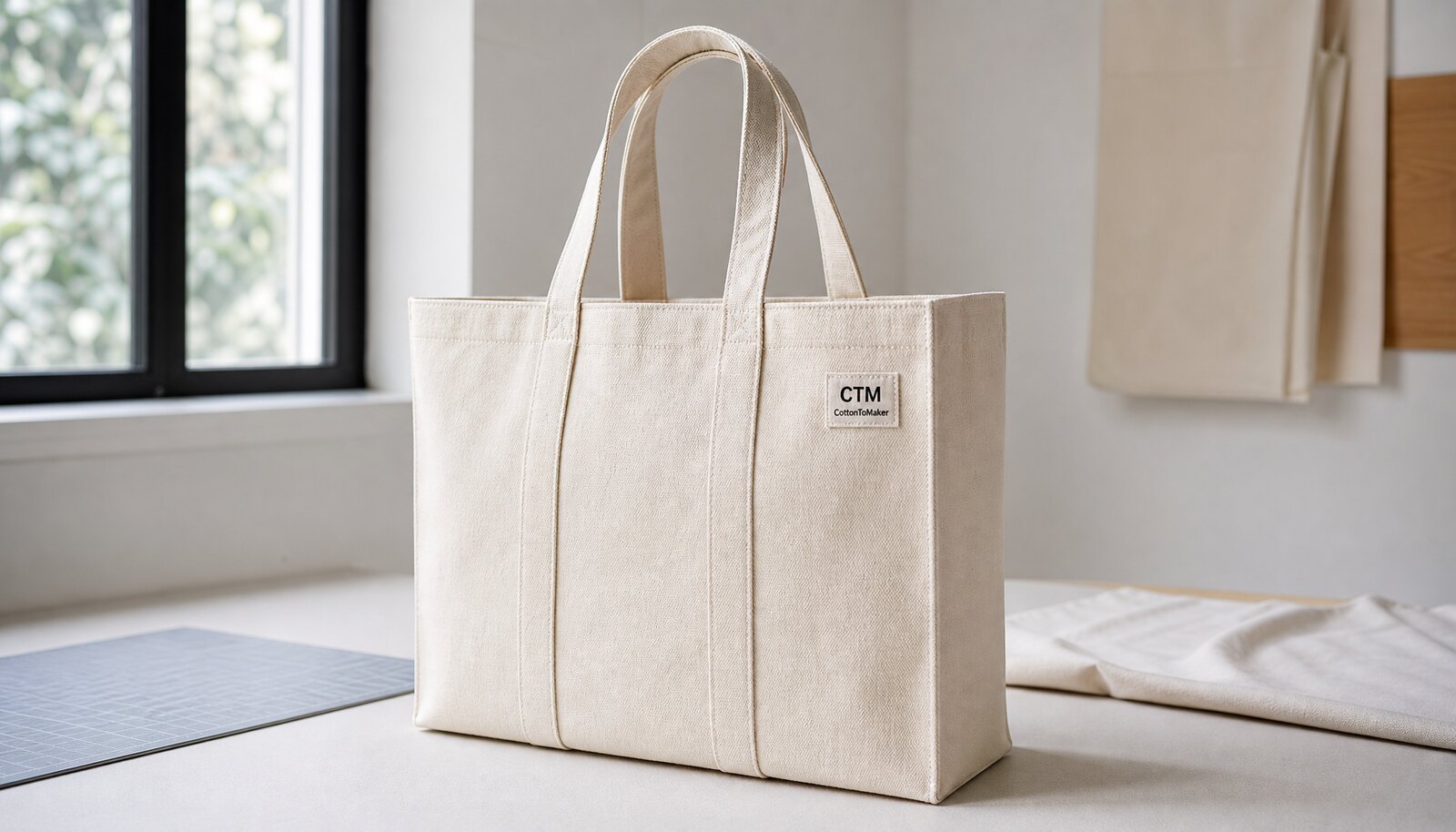
What The Winery Buyer Is Trying To Solve
A winery is not buying a canvas tote the same way a bookstore or trade show team does. The bag may be used for tasting-room retail, membership kits, event handouts, bottled product, or a seasonal gift set, and each use case changes what matters most. A retail tote needs a cleaner face, better fold, and more consistent decoration. A member gift tote can justify more structure and a richer finish. An event handout can tolerate a simpler build if the buyer is trying to keep landed cost down. If the use case is unclear, the supplier will fill in the gaps with defaults that are usually optimized for generic promo work rather than a branded private-label program.
The main sourcing mistake is treating the logo as the whole product. In practice, the spec is doing the heavy lifting. Fabric weight, handle style, side seam reinforcement, decoration method, and pack format all affect how the tote looks next to wine on a shelf and how it survives repeated handling. A bag that looks fine on a sample table can still fail the program if it arrives wrinkled, collapses under a bottle-shaped load, or needs too much warehouse rework to sell through cleanly. The buyer's job is to define the end use first, then choose the construction that fits it.
- Separate retail presentation from carrying performance.
- Treat the tote as a branded product with a shelf life, not a disposable promo item.
- Write the channel into the brief before asking for prices.
Start With A Use Case, Not A Generic Tote Size
The best library tote format for a winery is usually a structured open-top canvas bag with a flat or lightly gusseted base. That layout gives enough room for brochures, tasting notes, and bottle-shaped items while still presenting like a retail product. A typical starting point is around 14 to 15 inches wide, 15 to 16 inches high, and 3 to 4 inches deep, but those dimensions should follow the intended load, not a catalog standard. If the bag only holds printed collateral and a small bottle, a lighter and flatter bag may be the right choice. If it needs to support heavier retail kits, the gusset and handle anchoring become more important than a larger front panel.
The spec should also state how the bag is expected to behave when empty. Some winery buyers want a tote that stands up visually on a shelf or counter. Others only need it to fold flat and move through warehouse storage efficiently. Those are different priorities, and they can lead to different build choices. A bag that must stand upright benefits from a firmer fabric, more controlled bottom construction, and a cleaner top edge. A bag that is mainly stored in volume can use a softer build if the finish still looks premium when opened.
- Write target dimensions in the brief and require the factory to confirm them back.
- State the intended contents, especially if the bag will carry bottles or heavy inserts.
- Define shelf behavior: upright display, flat storage, or both.
Fabric, Handle, And Decoration Choices Drive Most Of The Commercial Outcome
For winery private label work, 10 oz natural canvas, roughly 340 GSM, is a useful baseline because it balances structure, print clarity, and price. It generally feels substantial enough for retail while staying efficient enough for repeat orders. Move to 12 oz, around 400 GSM, when the brand wants a firmer body or the tote has to carry heavier contents. Lighter fabrics can work for giveaway programs, but they usually wrinkle more, telegraph the contents more easily, and read as promotional rather than retail. Heavier fabric improves shelf presence, but it also changes sewing effort, carton count, and freight weight, so the landed cost can move more than the factory quote suggests.
Handle choice is equally important. Self-fabric handles create a cleaner visual line and are easy for a factory to standardize. Cotton webbing handles often feel better in hand and can improve the perceived quality of a winery gift or retail item. Short hand-carry handles are fine for display use, but a longer shoulder-capable drop is better if guests will walk the bag out of a tasting room. Decoration should follow the brand position. Screen print is the workhorse for simple logos and one or two colors. A woven label or sewn patch works well when the brand wants a quieter private-label look. Embroidery can feel premium, but it adds thickness and can distort thinner panels if the artwork is too detailed.
- Use screen print for bold, durable logo work with limited colors.
- Use woven labels or sewn patches when the brand wants a cleaner private-label finish.
- Avoid tiny serif text or thin lines if the canvas texture will fight the artwork.
How To Compare Supplier Routes Without Getting Trapped By Unit Price
Procurement teams often compare factories before they compare production routes, which makes the quotes harder to read than they need to be. A direct sewing factory with in-house printing is usually the cleanest option for a repeat winery program because the same team owns cutting, sewing, decoration, and packing. That gives one party responsibility when a handle shifts, a logo prints out of register, or the carton count is wrong. A specialist bag workshop that outsources decoration can still be effective, but the handoff between sewing and print needs to be explicit in writing. A trading company or sourcing agent is useful when the buyer needs mixed SKUs, coordination support, or a single commercial point of contact, but the actual factory should still be named and understood before award.
The sourcing region matters too. Coastal China is common for broad trim options and large-scale cut-and-sew capacity. India is often relevant when the program is built around cotton canvas, dyeing, or a natural-fiber story. Vietnam can be a good fit when the buyer wants stable export manufacturing with a cleaner communication path. Turkey is often worth looking at for EU-facing programs where transit time and closer oversight matter more than the lowest unit cost. Mexico or domestic finishing can make sense when speed, replenishment, or local pack-out matters more than volume efficiency. There is no universal best region; the right answer depends on the commercial priorities for that season.
- Ask who makes the bag body, who applies decoration, and who signs off final QC.
- Keep the quote format identical across supplier routes so comparisons stay clean.
- Do not accept a bundled quote if the factory will not separate production, packing, and shipping assumptions.
Pricing Bands, MOQ Logic, And Realistic Budget Expectations
For a standard natural canvas tote in the 1,000 to 5,000 unit range, a practical FOB ballpark is often around $1.20 to $2.20 for a simple one-color screen print, depending on fabric weight, handle construction, and packing. A heavier 12 oz build, a woven label, reinforced handles, or a more retail-ready finish can move the range to roughly $1.80 to $3.50. If the program needs individual polybags, hangtags, barcode labels, or a more polished shelf presentation, the landed price can move into the $2.50 to $4.80 range even before freight. Those are not universal prices, but they are useful guardrails for buyers who need to separate a viable quote from a quote that is missing scope.
MOQ usually follows setup complexity rather than a marketing promise. A natural canvas tote with one-color print and standard packing can support a lower minimum than a custom dyed bag with a woven label, inner pocket, or retail insert. If the supplier can make the number look low only by omitting the work that actually matters, the buyer should treat the MOQ as incomplete. The more custom the build, the more important it is to approve the sample on bulk fabric rather than on a placeholder material. For winery programs, the cheapest mistake is usually not the bag itself. It is approving the wrong combination of fabric, decoration, and packing and then paying for it later in rework or slow inventory movement.
- Use price bands to sanity-check quotes, not to replace a detailed spec.
- Expect MOQ to rise when you add custom dye, multiple print colors, or sewn-on components.
- Approve on bulk fabric when color, texture, or drape affects the final retail look.
Build The RFQ Around The Facts The Factory Actually Needs
A useful RFQ for canvas library tote bags should read like a production brief, not a purchasing note. The factory needs to know the exact dimensions, fabric weight, decoration method, handle construction, and packing format before it can quote responsibly. If those items are left vague, different suppliers will fill in different assumptions and the prices will not be comparable. The goal is to force every quote onto the same basis so the buyer can compare true differences instead of missing scope. That means the RFQ should include artwork files, print size, artwork placement, desired carton count, and the shipping basis the buyer wants to compare, whether that is FOB, EXW, or delivered pricing.
Sampling should follow a clean sequence. Start with a prototype if the structure is new or if the supplier is proposing a different fabric. Move to a pre-production sample that uses bulk fabric, final artwork, and the actual trim or label. If the program will repeat, keep one sealed gold sample on the buyer side and one on the supplier side. That gives both sides a fixed reference for future reorders and avoids the common dispute where each party remembers a different version of the approved sample. If the bag needs to fit a bottle or a rigid insert, test that fit before bulk approval, not after the order is in sewing.
- Attach artwork, dimensions, and packing requirements to the RFQ.
- Request prototype, pre-production sample, and gold sample as separate approval stages.
- Test the real contents in the sample, not just the empty bag.
QC Needs Measurable Limits, Not Just A Checklist
Basic inspection checklists are not enough if the buyer wants consistent retail quality. The bag should be checked against tolerances that the factory can actually hold. A practical starting point is +/- 1 cm on overall width and height, with left/right handle drop varying by no more than 5 mm on the same bag. Print placement on the front panel should stay within 3 mm of the approved position for visible artwork, and a one-color logo should not show blur, missing edges, or ragged transfer. If the design uses multiple colors, the register shift should be small enough that a buyer would not notice it from normal shelf distance.
For durability, ask for a buyer-agreed handle load test, often 10 to 15 kg held for 60 seconds without seam pop or obvious distortion. If the factory has a documented seam or handle pull test, ASTM D1683 or an equivalent internal method is a reasonable reference point. For print wear, a dry rub check using an AATCC-style crocking approach is useful, and a grade 4 or better on the visible face is a practical target for most one-color logos. The point is not to create laboratory theater. It is to catch the failures that will show up in a tasting room or on a retail shelf after the bags have been handled a few times.
- Set size tolerances in centimeters or millimeters, not only in words like acceptable fit.
- Use a static load check on the handle attachment, not just a visual inspection.
- Make the factory record the failure mode if the seam or print test does not pass.
Compliance, Labeling, And Market Requirements Should Be Confirmed Early
The compliance burden depends on where the bag is sold, but the buyer should not wait until final packing to ask. For retail textile items, country of origin and fiber content labeling are often required. If the bag is sold in the EU or UK, the buyer should ask for relevant textile labeling and chemicals documentation, plus any applicable REACH-related restrictions or azo dye controls if color treatment is involved. If the program is going into California retail, confirm whether Prop 65 review is needed based on the materials, print inks, and use case. If the bag is a promotional giveaway rather than a retail textile item, customs and import documentation still matter, even if consumer labeling rules are lighter.
Compliance is not only about the law. It also affects how the supplier manages traceability. Ask which mill supplied the fabric, whether dye lots are controlled, whether the factory can identify the production batch on the carton marks, and whether the packing line can separate sizes or artwork versions cleanly. Those details matter when a winery runs seasonal product, club shipments, or regional assortments. The best suppliers are the ones that can connect the sample to the bulk order without improvisation. If they cannot explain where the fabric came from, how it was labeled, or how the cartons were coded, the risk is too high for a branded program that has to move through retail channels.
- Confirm target markets before artwork approval so labeling does not need to be reworked later.
- Ask for fabric and trim traceability by batch, not only by purchase order.
- Check whether any inks, coatings, or finishing agents create extra market-specific review steps.
Packing, Freight, And Seasonal Timing Can Change The Winner
For winery buyers, packing is part of the product. A tote that arrives with hard fold lines, crushed corners, or inconsistent label placement can create receiving work and hurt shelf presentation even if the bag itself meets the spec. Retail-ready packing usually means a controlled fold, a predictable label position, and clean carton marks. Bulk fold is fine when the bags will be counted and restacked by the warehouse, but the buyer should understand the tradeoff in presentation. Carton density matters too. Too tight and the bag develops permanent crease lines across the face or logo. Too loose and freight cube gets wasted. The right answer is the one that keeps the bag saleable without paying for needless air.
Seasonality matters as much as the production line. Winery demand often clusters around harvest, holiday gifting, membership fulfillment, and event calendars. That means the sourcing plan should run backward from the ship date, not forward from the factory quote. Leave space for sample revisions, artwork sign-off, carton review, and any correction cycle before mass production. If the lane is import-heavy, add time for port congestion, customs clearance, and final warehouse receiving. The cheapest quote is not the best quote if it misses the launch window or forces an emergency air shipment. Buyers should award on landed cost plus schedule confidence, not on factory price alone.
- Choose retail-fold packing when bags go straight to shelves.
- Choose bulk fold packing when the warehouse will rework or count the bags anyway.
- Build the schedule backward from the sales date and include approval buffer time.
How To Make The Final Award Decision
Once the quotes are normalized, the award should come down to four questions. First, did the supplier quote the real product or a simplified version of it? Second, can the factory show that it can hold the agreed tolerances in sewing, print placement, and packing? Third, does the supplier understand the market the bags are going into, including labeling and carton expectations? Fourth, is the lead time believable once sampling, approval, and freight are included? If one supplier is cheaper but vague on any of those points, the savings may disappear in rework, delays, or warehouse handling.
A private-label tote program works best when the buyer controls the spec and the supplier controls the process. That means the winery team should decide the use case, the retail finish, the target cost, and the required market documentation before asking for price. The supplier should then prove it can make that exact bag repeatedly. That approach produces cleaner quotes, faster approvals, and fewer surprises after the order is placed. It also makes future reorders easier because the decision is anchored to a real production standard rather than a loose sample memory.
- Award to the supplier that quotes the real spec clearly, not the one that sounds cheapest.
- Use the approved gold sample as the reorder reference.
- Keep the specification tight enough that the next buy is a reprint, not a redesign.
Specification comparison for buyers
| Supplier option | What to verify | Commercial advantage | Buyer risk to control |
|---|---|---|---|
| Direct sewing factory | fit-test photos with reference bottle, bottom reinforcement close-up, handle load proof, and final carton photo set | Better sample-to-bulk control and faster production feedback | May be weaker on export paperwork or branded packing unless checked early |
| Trading company | Factory name, production photos, trim-source proof, and who owns QC decisions | Can coordinate small mixed orders and extra services | Markup can hide real factory capability and slow defect decisions |
| Specialized bag workshop | bottle fit, bottom reinforcement, handle or cord strength, divider option, seam allowance, and upright stability | More practical for detailed construction, trims, and repeat programs | Capacity may be limited during peak seasons |
| Low-price general supplier | cotton canvas, jute, felt, nonwoven, or laminated paper sized to bottle diameter, weight, and condensation risk | Useful for simple promotional runs with loose specs | Material downgrades, weak packing, and vague inspection scope can erase savings |
| Retail-ready supplier | upright or flat packing, bottle-protection insert, carton count, moisture control, and retail display orientation | Can handle labels, SKU separation, carton marks, and receiving rules | Higher unit cost must be compared against reduced warehouse work |
| Compliance-focused supplier | Fabric records, labeling review, test plan, and production traceability | Safer for retail programs and repeat brand orders | Documentation claims need evidence, not only sales language |
| Local sample room plus bulk factory | Signed sample, bulk factory handoff, first-piece photos, and deviation owner | Good for complex branding before large production | Sample room quality may not match bulk line unless handoff is controlled |
Buyer checklist before sampling
- Define the primary channel first: tasting-room retail, member gift, event giveaway, or shelf merchandise, because that changes structure, print quality, and packing.
- Lock the fabric in finished weight, composition, and color, not just the word canvas. Ask for oz and GSM in the same quote.
- Specify the tote dimensions, gusset depth, and handle drop so the bag can be compared across suppliers on the same basis.
- Choose the decoration method before pricing: screen print, woven label, sewn patch, embroidery, or a combination of methods.
- State whether the bag must stand upright on a shelf, fold flat for warehouse storage, or hold a bottle-shaped load without tipping.
- Set the target market up front so the supplier can align labeling and compliance work for the US, EU, UK, or another destination.
- Ask for a sample plan with prototype, pre-production sample, and final gold sample, and confirm who pays each sample and courier charge.
- Request separate pricing for bag body, decoration, packing, and freight so the landed cost is visible before award.
Factory quote questions to send
- What is the exact finished fabric weight, fiber content, and weave spec in the quoted price, and is it the same material used for the sample?
- What dimensions are included in the quote for body width, height, gusset, and handle length, and what tolerance do you hold at bulk production?
- Which decoration method is included, how many colors or placements are covered, and are setup charges or plate fees extra?
- What is the quoted MOQ by color, artwork, and packing format, and how does the MOQ change if we add a woven label or inner pocket?
- What packing format is included: bulk fold, retail fold, individual polybag, hangtag, barcode sticker, and master carton marking?
- What is the production lead time after final sample approval, and what steps can add delay, such as fabric booking, color approval, or label approval?
- What overrun or underrun tolerance do you work to, and how are short shipments or excess units handled on the final invoice?
- Which inspection standard do you use, and can you share the in-line and final QC checkpoints for seams, print, handle strength, and carton pack-out?
Quality-control points to confirm
- Finished size should stay within +/- 1 cm on width and height, and the left/right handle drop should not vary by more than 5 mm on the same bag.
- Fabric weight should match the approved spec within a practical production tolerance, and any lighter shade or thinner handfeel should be treated as a pre-approval issue.
- Print placement should stay within 3 mm of the approved position on front-facing artwork, with no visible blur, missing edges, or broken register between colors.
- For one-color screen print, a dry crocking result of grade 4 or better on an AATCC-style rub check is a sensible buyer target; any visible transfer should fail review.
- Handle attachment should survive a buyer-agreed static load test, commonly 10 to 15 kg for 60 seconds, without seam pop, distortion, or stitch tearing.
- Use ASTM D1683 or an equivalent sewn-seam pull test for handle joins or a documented internal equivalent, and require the factory to record failure mode if the seam opens.
- Stitching should be straight and consistent, with no skipped stitches, broken thread bundles, or loose ends that create a retail finish problem.
- Seams at the gusset corners and handle base should show no puckering or twisting, and the bag should sit square when empty and under a normal loaded state.
- Carton count should match the packing list exactly, with barcode labels, master carton marks, and inner pack counts all reconciling before shipment release.
- Any visible stains, oil marks, needle damage, odor, lint clumps, or contamination on the visible face or inside seams should be rejected at final inspection.