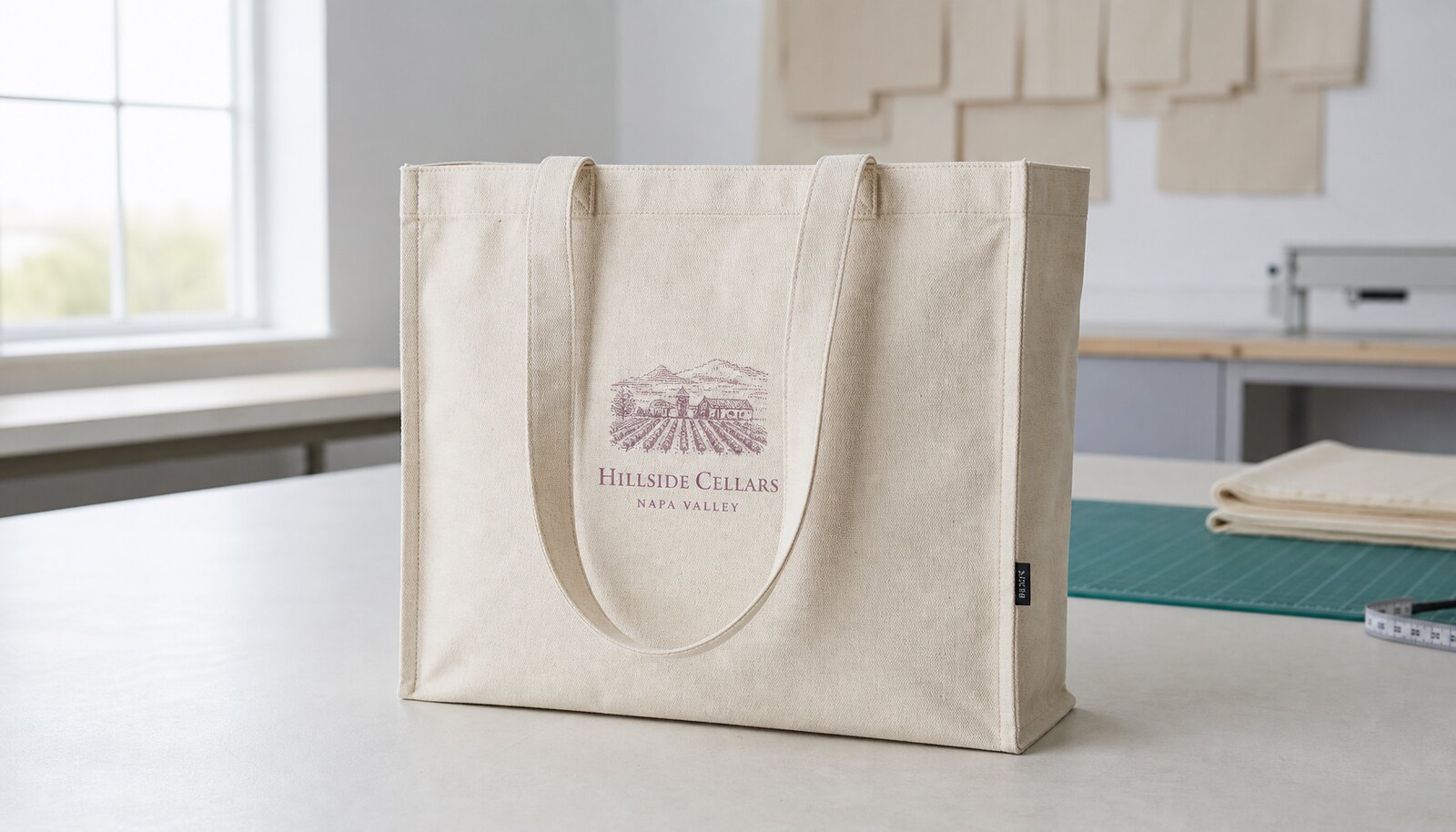
Why wineries need a different tote buying lens
A winery tote is not just a carrier. It often functions as retail merchandise, tasting-room packaging, club gift collateral, and a reusable brand item that customers keep in view. That means the print method has to do more than place a logo on canvas. It has to support shelf appeal, tolerate repeat handling, and stay visually consistent when the winery reorders for the next season or event.
That is why the keyword question behind canvas library tote bags for wineries print method comparison is really a procurement question. Which decoration method gives the right mix of unit cost, durability, repeatability, and acceptable lead time for the winery’s actual buying pattern? A method that looks efficient on the quote sheet can become expensive if it causes sample delays, inconsistent color, or packing problems once the bags reach the gift shop or warehouse.
For winery programs, the buying lens should include three layers: the bag itself, the decoration process, and the distribution channel. A retail shop needs a tote that looks polished on a hook or shelf. A direct-to-consumer bundle may need ship-ready packing and a cleaner fold. A club gift may need consistent color across multiple replenishment cycles. The print decision should be made with those downstream uses in mind, not just with artwork in isolation.
- Judge the tote as a retail item, not only as a decorated blank.
- Match print method to reorder pattern, shelf use, and seasonality.
- Treat packing and repeatability as part of the product, not add-ons.
Start with the bag spec before you compare print quotes
Print method only makes sense when the underlying bag spec is already defined. For most winery library tote programs, canvas weight sits in a practical middle range, often around 10 oz to 14 oz for lighter retail carry bags and around 12 oz to 16 oz when the buyer wants a heavier hand feel and better body. The exact number matters because weave density, ink holdout, and shipping weight all shift as the fabric gets heavier or looser.
A 10 oz tote can be fine for lighter retail use, but the fabric may show more movement under a large print area and can feel less substantial on a gift-shop display. A 12 oz to 14 oz canvas is usually the easiest range for procurement because it balances printability, structure, and landed cost. A 16 oz body can support a premium presentation, but it raises sewing cost, carton weight, and freight cost, and it can feel less flexible if the tote is meant to fold flat inside a bottle bundle or mailing box.
Size and construction matter just as much. Handle length, handle drop, gusset depth, top edge finishing, seam allowance, and bar tacks all affect where the logo lands. If the tote has a wide gusset, the print zone on the finished bag may be narrower than it looks on a flat art template. If the bag is expected to carry bottles, glassware, or heavier retail bundles, the buyer should ask for a working-load assumption and seam reinforcement details. Otherwise, the bag may look right in a proof and fail the intended use in practice.
- Ask for fabric weight in oz and gsm, not only a vague heavy canvas description.
- Define the print area on the finished bag pattern, not only on a flat template.
- Confirm whether the canvas is natural, bleached, dyed, washed, or pre-shrunk.
- State the working load expectation if the tote will carry wine bottles or heavier retail packs.
How the main print methods compare on canvas
Screen printing is still the baseline method for many winery canvas totes because it gives a strong balance of cost, color consistency, and repeatability. On natural canvas, a one-color logo often prints cleanly when the mesh count, ink viscosity, squeegee pressure, and cure settings are managed correctly. For buyers who expect to reorder the same style across multiple seasons, screen print is often the easiest method to repeat because the supplier can reuse screens and keep the master settings stable.
The limitation is that screen print becomes more complex as color count rises or artwork gets finer. Each additional color adds setup, registration control, and a chance for edge mismatch on a rough weave. Large solids can also look inconsistent if the ink lays too thin in one area and too heavy in another. For this reason, a screen-printed tote should be specified with a clear line-thickness minimum and a defined approval standard for coverage, not just a logo file.
DTF and heat transfer solve a different problem: they are useful when the artwork has gradients, tiny text, or full-color elements that would be expensive or impractical in multiple spot colors. They also make low-MOQ tests easier because the setup burden is often lower than screen print. The tradeoff is that the hand feel can be less textile-like, and the buyer has to verify peel resistance, edge lift, and heat stability. If the transfer sits on a canvas weave with too much texture, the finish can look less premium after a few handling cycles.
Embroidery and sewn patches create a more tactile and often more premium result, which can fit winery gift-shop SKUs or limited editions. But embroidery is not automatically better. It can make fine text unreadable, and stitch density can raise cost quickly. Patches reduce the strain on the canvas itself, but they add a sewing step and can change the way the tote folds. Buyers should use embroidery or patching when the brand wants a more elevated look and the logo can tolerate simplification.
In practice, the best method is the one that matches the art and the commercial plan. Simple one-color branding usually belongs with screen print. Highly detailed art often belongs with transfer. Premium retail positioning may justify embroidery or a patch. The wrong choice is forcing a method because it sounds nicer in a quote while ignoring the fabric, order volume, and reorder pattern.
- Screen print is usually the best value for simple logos and repeat orders.
- Transfers help when the artwork has detail that would be lost in spot-color printing.
- Embroidery and patches fit premium retail positioning, not tiny text.
- Avoid decoration methods that fight the fabric texture or make the tote feel stiff in hand.
Side-by-side print method comparison for winery buyers
Procurement teams often need a clearer decision table than a supplier brochure. The key comparison is not just appearance. It is how the method behaves on canvas, what it costs to launch, how it holds up under handling, and how painful it becomes on the second and third reorder. The table below reflects that commercial view rather than a decorative one.
For winery buyers, the most useful columns are durability, cost, MOQ, lead time, and art limits. A method with a lower launch price may still be the wrong choice if the artwork is fragile or the method cannot be repeated accurately. Likewise, a more expensive method may be justified if it reduces changeover risk for a retail program that stays live all year.
- Compare methods against the actual buying cycle, not only the first PO.
- Use durability and repeatability as primary filters.
- Ask the factory to quote the same art across two or three methods if you are undecided.
What each sourcing route changes in commercial terms
The decoration method is only one side of the sourcing decision. The other side is the route. A direct sewing factory with in-house print capability can simplify handoffs, reduce transit between production steps, and make repeat orders easier to control. For a winery that expects the same tote to return every season, that control can be worth more than a slightly lower quote from a fragmented supply chain.
A split route, where the bags are sewn in one place and decorated in another, can be useful when the decoration needs specialized equipment or when a local decorator is better suited for a trial run. But it adds transportation, receiving, re-bundling, and QC points. Every transfer is a chance for packing damage, wrong lot mixing, or artwork shift. If the buyer chooses this route, the contract should say who owns final acceptance and who pays for any rework caused by the handoff.
Trading-company routes can be commercially acceptable when the trading partner is disciplined and the actual factory is known. They are often useful when the buyer needs broad category access or wants one contact across multiple tote variations. The risk is opacity. If the real print site is hidden, it becomes harder to audit process control, screen retention, or repeat sample matching. That is fine for one-off buying only if the buyer is comfortable treating the order as a transactional purchase rather than a repeat supply program.
For wineries, the practical question is whether the route supports the business model. A gift shop that replenishes often usually benefits from a named factory, visible process control, and a retained master sample. A seasonal launch with uncertain demand may accept a more flexible route if the supplier can move quickly and the price is still commercially sensible.
This is where supplier qualification matters more than the sales pitch. Ask who owns the screens or plates, where the final QC happens, whether the factory can show a production photo of the same bag, and whether the supplier can produce a repeat order without redesigning the process. If those answers are vague, the quote may not be as competitive as it looks once rework and delay are counted.
- Direct factory route: best when repeat consistency and process control matter.
- Split route with decorator: useful for specialist decoration, but QC ownership must be explicit.
- Trading route: workable if the real production site and responsibility chain are transparent.
- Ask for proof of the actual tote style, not generic printing examples.
How to read a tote quote line by line
A quote for canvas tote bags should separate the moving parts clearly enough that two suppliers can be compared on the same basis. At minimum, the buyer should be able to see the bag body price, the decoration setup or plate charge, the unit print price, packing cost, and any additional charges for labels, hangtags, or special folding. If these are bundled together, the quote may still be usable, but the buyer must ask for a line-by-line breakdown before making a final award.
The most common hidden cost is setup. Screen print often has a lower unit cost once volume rises, but the setup fee can matter on small runs or when there are several colors. Transfer methods can look cheap at low quantity because there is less setup, but the unit cost may stay high enough that they stop being attractive at scale. Embroidery and patches can also be deceptive: the quote may look manageable until stitch count, patch size, or sewing time is specified in detail.
A useful procurement tactic is to ask for the same order at more than one quantity tier, such as 1,000, 3,000, and 5,000 pieces. That exposes whether the supplier is pricing the launch only or the life of the program. It also reveals whether the supplier really understands how the cost changes with setup amortization, material booking, and packing density. If the quote does not show overrun or underrun tolerance, ask for it. Otherwise, the final invoice can shift even when the design does not.
- Separate fixed setup cost from variable unit price.
- Confirm whether the MOQ applies to the bag body, decoration, or both.
- Ask whether packing includes folded polybags or only bulk carton loading.
- Request pricing at multiple volume tiers if you expect reorders.
Sample approval and QC: what should be verified before bulk release
Sample approval should prove three things: the tote is built correctly, the artwork is reproducible, and the final presentation matches the commercial use. A paper mockup cannot do that. Procurement buyers should insist on a physical pre-production sample or strike-off made from the final canvas, final decoration method, and final packing spec. If the supplier changes one of those three items after approval, the sample is no longer a valid reference.
For print QC, the buyer should define what success looks like in measurable terms. That means a placement tolerance in millimeters, an ink coverage expectation, and a clear rule for what counts as a misregistration or edge blur defect. For screen print, ask the factory to show a daylight-view master sample and a close-up of the print edge. For transfer methods, include a rub check and an edge-lift check. For embroidery or patches, inspect stitch density, thread tails, and the integrity of the sew-down line.
If the bag is intended for retail, presentation matters as much as structure. The fold needs to be consistent, the handles should lie flat, and any label or patch should be positioned so it does not crumple in the carton. If the winery is buying for gift-shop shelf display, ask the supplier to pack a few samples exactly as bulk goods will ship. That is the easiest way to see whether the retail-ready look survives packing.
Many buyers mention QC in general terms but stop short of specifying an acceptance standard. That is a mistake. A reasonable procurement file should state the inspection method, the defect categories, and the acceptable threshold for major and minor defects. If your team uses AQL language internally, apply it here; if not, at least align the factory on what constitutes a rejectable print flaw, seam flaw, or packing flaw. The goal is not to over-engineer the program. It is to make sure the same standard applies to the sample, the pilot, and the bulk lot.
- Approve the decoration on the actual tote, not only on fabric swatches.
- Keep one signed master sample per style and colorway.
- Run dry rub, wet rub, and flex checks where the method warrants it.
- Reject samples with weak topstitching, uneven handles, or poor registration.
Packing and distribution details that affect buyer satisfaction
Packing is often treated as the last step, but for winery tote programs it can determine whether the product feels retail-ready or like a bulk commodity. A cleanly folded tote that arrives in a consistent polybag or carton pack is easier for store staff to price, display, and bundle. If the bags are shipped as part of a tasting-room program, packing should support quick replenishment. If they are part of a direct-to-consumer order, packing should minimize scuffing and preserve the print surface.
The buyer should specify fold style, packed dimensions, barcode placement, and carton marks. If the tote has a woven side label, patch, or heat transfer that can crease, the fold spec matters more than the bag size itself. For export programs, carton quality and humidity protection also matter, especially on natural canvas. Too much protective packaging can create fold marks; too little can leave the print exposed to rubbing. The right answer depends on the channel, not on a generic packaging habit.
If the tote is part of a wine gift bundle, the buyer should also test how the bag sits with the bottle pack, tissue, or insert. A tote that looks great alone may be awkward when nested in a shipping box or club pack. That is why it helps to ask for a packed sample, not just a loose sample. The goal is to verify the real presentation path from factory to shelf or customer handoff.
- Specify fold method and final packed dimensions.
- Confirm whether cartons are single-wall or double-wall for export.
- Test barcode readability on the final carton surface.
- Avoid overpacking that creates permanent fold marks or crushes decoration.
Lead time, reorder control, and where delays usually happen
A tote order usually moves through sample approval, fabric booking, production, packing, inspection, and shipment. The time risk is not evenly distributed. Sample approval and artwork revision are often the biggest delays, not the sewing line itself. If the winery changes the logo placement, text weight, or bag color after the first proof, the calendar can slip much more than the team expects.
Screen print tends to be the most repeatable route for reorders because the screens and settings can be retained if the supplier has disciplined process control. Transfers can be fast for a one-off run, but if the art changes or the method needs requalification, the schedule can reset quickly. Embroidery and sewn patch applications add manual steps, so the lead time is usually more sensitive to labor availability and line balancing.
Seasonality matters. Winery buying often clusters around harvest, holidays, club campaigns, and event calendars. That means the best vendor is not necessarily the one with the fastest first sample. It is the one that can hold a stable production sequence when the factory is busy. Buyers should ask for the latest date by which art, color, and packing must be frozen. That single date prevents a lot of avoidable schedule damage.
For repeat orders, the buyer should also ask whether the supplier retains the same screen, digital file, or master reference. If the answer is yes, confirm how that repeat asset is stored and how long it is retained. If the answer is no, treat the next order as a new development cycle, not a simple reorder. That distinction matters for both time and cost.
- Use one master approval date for art, fabric, and packing.
- Treat second-round changes as schedule risk, not minor edits.
- Reserve extra time for color matching on dyed canvas.
- Build contingency around inspection and document sign-off before shipping.
Landed cost and repeat-order economics for winery totes
The best landed cost is not always the lowest unit price. Freight, carton density, packing method, and print setup all affect the final number. A heavier canvas tote can cost more to make, but if it presents better in a retail environment and reduces the chance of complaints, it can still be the better commercial choice. Buyers should compare FOB or ex-factory pricing together with carton volume and shipping weight rather than isolating the print price from the rest of the order.
Repeat orders change the economics even more. If the tote becomes a core gift-shop SKU, the supplier’s ability to repeat the same artwork and construction matters almost as much as the initial quote. A factory that retains the master sample, keeps the print settings stable, and can replenish without recutting the spec is often cheaper over time than a low-cost vendor who requires a fresh setup for each reorder. This is especially true when the bag is tied to a seasonal design language the winery wants to preserve.
For procurement teams, the right buying rule is simple: compare launch cost and reorder cost together. If the tote will be a one-time promo item, a low-MOQ transfer or decorated blank route may be commercially acceptable. If it will become a steady retail item, prioritize screen print or another repeatable method through a supplier that can show process discipline and retained assets. The program should make sense not just at purchase order one, but at reorder three.
That approach keeps the tote from becoming a one-off production exercise. It becomes a controlled supply item with a defined spec, a repeatable print method, and a known path for replenishment. For winery buyers, that is where margin and brand consistency are protected.
- Compare unit price at the planned reorder volume, not only the launch volume.
- Check carton cubic size because freight can erase small savings in unit cost.
- Keep artwork file names and revision control consistent across seasons.
- Ask whether the supplier stores screens, plates, or digital files for repeats.
Specification comparison for buyers
| Spec decision | Best-fit method | Commercial upside | Main tradeoffs to verify | Typical buyer check |
|---|---|---|---|---|
| 1-color winery logo on natural canvas | Screen print | Lowest setup burden at repeat volume; strong reorder consistency; clean retail look when ink density is controlled | Can look thin on coarse weave; setup fee still matters on small runs; ink coverage varies if cure is weak | Ask for Pantone drawdown, print-area tolerance, and a rubbed/cured sample |
| 2 to 4 spot colors with crisp text or crest | Screen print with separate screens | Good balance of cost and durability for tasting-room retail and club gift bags | Setup rises with each color; misregistration risk increases on rough 12 to 16 oz fabric | Confirm screen count, registration tolerance, and minimum line thickness |
| Full-color artwork, gradients, or photo-like label art | DTF or heat transfer | Supports detailed art at lower initial setup; useful for launch tests and short seasonal runs | Hand feel may be less textile-like; peel and edge lift risk if curing or application is weak | Request wash/rub verification, edge-lift check, and heat exposure note |
| Premium tactile branding with small logo | Embroidery or sewn patch | Higher perceived value for gift-shop SKUs and limited editions | Stitch count can push cost up quickly; tiny text can disappear; patch sewing adds another process step | Ask for stitch-density spec, text-size limit, and thread color approval |
| Dark dyed canvas with light logo | Screen print with underbase or opaque ink system | Readable contrast on black, navy, or burgundy bags; useful for premium positioning | Opaque coverage can crack if ink deposit is too heavy or if curing is underdone | Require a flex test, rub test, and close-up check for cracking at folds |
| Very low MOQ pilot order | DTF/transfer through a decorator or local converter | Lets buyers test artwork before committing to a larger factory run | Higher unit cost, more handoffs, and more variation between decorators | Clarify whether MOQ applies to the blank bag, decoration, or combined order |
| Long-run replenishment program | One sewing factory with in-house print or tightly managed print line | Easier repeat calibration; fewer handoffs; lower risk of drift in later reorders | Requires stronger supplier qualification and proof of process control | Request master sample retention, screen retention policy, and repeat-order lead time |
| Gift-pack presentation and ship-ready retail | Hybrid route with print plus woven side label or hangtag | Improves shelf presence and bundle value without overcomplicating the main logo | More components mean more QC points and more packing steps | Confirm label application, fold spec, barcode placement, and carton marks |
Buyer checklist before sampling
- Approve the final bag size, gusset depth, handle length, handle drop, and seam reinforcement before art placement is frozen.
- State fabric weight in oz and gsm, plus whether the canvas is natural, bleached, dyed, washed, or pre-shrunk.
- Provide vector artwork with Pantone references, minimum line thickness, and minimum text size.
- Define the print area on the finished sewn bag, not only on a flat template, and set a placement tolerance in millimeters.
- Choose the decoration method based on artwork complexity, reorder plan, and target retail price—not only on launch sample appearance.
- Confirm whether MOQ applies to the bag body, the print method, or the combined order.
- Request a physical strike-off or pre-production sample using final fabric, final ink, final stitch construction, and final packing.
- Set carton pack count, fold method, polybag requirement, barcode location, and master carton marks before bulk release.
- Clarify who owns the screens, digital files, master pattern, or transfer plates for future repeats.
- Ask for a lead-time schedule that separates sample approval, bulk production, packing, inspection, and shipping.
Factory quote questions to send
- What is the exact canvas weight in oz and gsm, and is the fabric pre-shrunk, washed, or finished before sewing?
- Is printing done in-house, through a controlled subcontractor, or by a trading partner—and who owns final QC?
- What is the setup fee per color or per method, and does it include screens, plates, films, or artwork conversion?
- What MOQ applies to the bag style, and what MOQ applies to the decoration method?
- Can you show a physical sample or production photo from the same bag style, same fabric weight, and same print method?
- What placement tolerance do you hold for the logo on the finished tote, including side-to-side and top-to-bottom variance?
- What are your curing requirements, rub test standard, and inspection criteria for the print?
- How are the bags folded, packed, labeled, and carton-marked for export or retail distribution?
- What is the production lead time after art approval, and which events can extend it?
- Do you retain screens, digital files, or master samples for repeat orders, and for how long?
Quality-control points to confirm
- Fabric weight matches the approved spec within the factory tolerance and the hand feel is consistent across the lot.
- Print color matches the approved master sample under daylight and shop lighting, not only under one lamp type.
- Logo placement stays within the agreed millimeter tolerance on every panel, including tolerance at gusset edges.
- Ink coverage is even, with no pinholes, ghosting, over-bleed, or dry spots at the edges.
- Cure is complete, with no tackiness, cracking, or rub-off after a basic flex and rub test.
- Handles are equal length, bar tacks are secure, and seam stress points are clean and symmetrical.
- Gusset and side seams do not distort the logo or create obvious slanting when the tote is filled.
- Folded packed size matches the agreed carton plan and does not crush a sewn label, patch, or heat transfer.
- Barcode, carton mark, and SKU label information match the purchase order and are scannable on arrival.
- Master sample, bulk sample, and packed goods all match the same revision of artwork and packing spec.