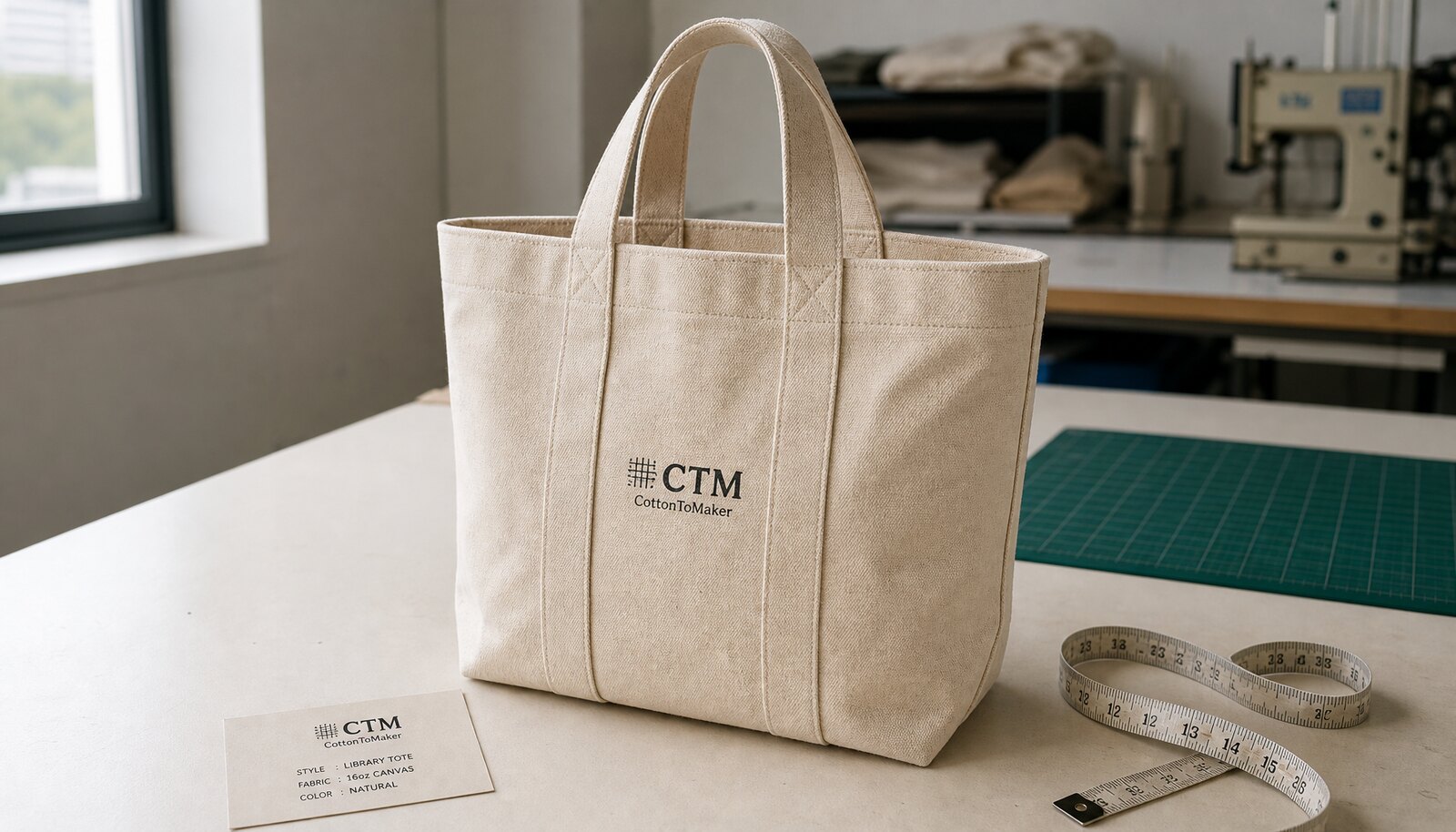
What a wellness retail launch needs from a canvas tote
A wellness brand launch usually needs a tote that does three jobs at once: it has to look calm and premium on shelf, survive actual daily use, and price out cleanly enough to support retail margin. That is a different brief from a generic promo bag. Buyers often focus on the logo and miss the operational details that decide whether the product can be repeated across stores, channels, and replenishment cycles. The right starting point is a bag that feels intentional in hand, not just printable on paper.
For a retail launch, canvas library tote bags work best when the construction supports visible structure. A bag that collapses too softly can look cheap in a store fixture, while a bag that is overbuilt can push freight and unit cost past the price point the brand needs. The sourcing brief should state the target shelf appearance, expected carry weight, and whether the tote is meant for books, skincare sets, yoga accessories, or general lifestyle use.
- Set one retail role for the bag before quoting: gift item, impulse buy, or core accessory.
- Use the shelf look as a spec input, not as a vague creative direction.
- Define carry load in practical terms, such as a few hardback books or a mixed wellness set.
Fabric weight and build choices that hold up in store use
For most wellness retail launches, 10 to 12 oz cotton canvas is the practical starting range. It gives a clean, natural surface for print, enough stiffness to present well, and a cost profile that still leaves room for packaging and margin. If the brand wants a more premium, more structured hand feel, 14 oz or 16 oz canvas is a valid step up, but the buyer should expect higher sewing time, heavier freight, and a bag that may feel too rigid for casual daily carry if the silhouette is not sized correctly.
The useful comparison is not just grams per square meter. Buyers should also look at weave tightness, shrinkage behavior, and how the canvas accepts ink. A loose weave can make the bag feel rustic but can also create print fill issues and inconsistent seam appearance. A tighter weave usually gives better logo definition and a cleaner retail presentation, especially for wellness brands that prefer quiet branding and a natural color palette.
- 10 to 12 oz: practical, retail-friendly, easier to print, better for lower landed cost.
- 14 to 16 oz: more premium, heavier, better structure, higher freight and sewing cost.
- If the bag needs to stand upright on shelf, ask for reinforcement at the bottom and handle anchor points.
Decoration method: what looks good, what lasts, and what costs less
For simple wellness branding, screen print is usually the most predictable option. It is strong on solid logos, works well on natural canvas, and gives buyers a clear cost curve by color count. The tradeoff is that it needs proper artwork preparation and consistent registration. If the design uses fine lines, gradients, or photographic detail, transfer methods may reproduce it better on a small run, but the hand feel can be less natural and some retail buyers will reject anything that feels overly glossy.
Embroidery, woven labels, and sewn-on patches can work if the brand wants a more tactile finish, but they should be treated as separate cost and lead-time drivers. For a launch run, a buyer often gets better control by keeping the bag itself simple and adding one primary decoration method. A clean single-position logo on one side panel usually sells better than a bag overloaded with multiple placements, unless the store program is built around a giftable or premium collectible look.
- Use screen print for one to three solid colors and stable repeat production.
- Use transfer print only when the artwork needs detail that screen print cannot hold at the target run size.
- If embroidery is proposed, confirm stitch density, backing material, and whether the fabric can handle the stitch pull without distortion.
How to compare sourcing routes without losing margin
The sourcing route matters as much as the tote specification. A direct factory can usually give the best control over canvas weight, print registration, and carton packing, but only if the factory truly owns the sewing and decoration steps. A trading company can reduce coordination effort and sometimes speed up sample handling, though the buyer needs to understand where the real production happens and who is responsible when a print defect or sewing issue appears.
For urgent retail launches, a domestic decorator working from imported blank bags can be the fastest route to test demand. The risk is that the buyer sees a low blank-bag price and assumes the whole program is cheap, when the actual decorated and packed landed cost is materially higher. The right comparison is not supplier type alone. It is total control over spec, time, and landed cost.
- Direct factory: best for repeatability and cost control if the line is stable.
- Trading company: useful when the program needs coordination across multiple factories or easier communication.
- Domestic decorator: good for small tests, but compare decorated unit cost and freight before choosing it.
Comparison table: supplier routes and what they mean for a retail launch
A wellness brand launch should not compare suppliers only by FOB price. The better question is which route gives the cleanest path to a repeatable retail unit. The table below compares common sourcing options by the decisions that actually affect launch execution: specification control, sample speed, packing accuracy, and the risk of surprise cost later in the program.
Use this as a sourcing filter before sending the RFQ. It will show whether the project needs a single accountable factory, a managed sourcing partner, or a local finishing route for a test drop.
- Write decisions in measurable language, not only descriptive wording.
- Ask for sample photos plus one physical approval sample for important orders.
- Keep quotation, sample approval, and inspection notes tied to the same spec version.
MOQ logic: how volume affects price, setup, and repeatability
MOQ is not just a barrier number. It is the point where fabric planning, print setup, and packing efficiency start to work in the supplier's favor. For canvas library tote bags, the MOQ often changes with fabric color, print complexity, and whether the bag uses a standard body pattern or a custom shape. A buyer who asks for too many variables at a low volume will usually get a quote padded with risk, even if that padding is not obvious on the first page.
The smarter way to handle MOQ is to separate what must be custom from what can stay standard. If the wellness brand wants a custom logo but can accept a standard natural canvas base and standard handle length, the factory can usually price more competitively. If the project also requires custom sizing, special interior pockets, and retail hangtags, expect the minimum to move up because every added choice slows the line and increases the chance of rework.
- Keep the first launch run simple: one fabric, one size, one print location, one packing spec.
- Use MOQ questions to identify which items are setup-driven and which are material-driven.
- Ask whether the quoted MOQ is per colorway, per logo version, or combined across a size set.
Sample approval: what should be locked before bulk production
A good sample process for this product should include more than a visual approval. The first sample should confirm body proportion, handle feel, print opacity, and how the bag hangs when loaded. A pre-production sample should then match the intended bulk materials and packing method, because a neat sample made with hand-picked materials can hide problems that show up once bulk fabric and full-line sewing start.
Wellness brands often care about understated aesthetics, so small defects become more noticeable than on a loud promotional tote. A crooked print, poor stitch alignment, or uneven canvas shade can undermine a retail launch even if the bag is technically functional. Put acceptance criteria in writing before approval so both sides understand what passes and what does not.
- Approve finished size, not just cut size.
- Compare the sample under the same lighting conditions used in retail or photography.
- Check handle symmetry, top edge recovery, and print placement against a paper template or measured reference.
- Require a pre-production sample if the bulk run will use a different print batch, carton pack, or trim source.
Packing, barcodes, and retailer compliance
Packing is where many otherwise good tote programs fail in the warehouse. A flat-packed canvas tote can save freight, but only if the fold method, inner pack count, and carton sizing are planned together. If the bag has a pocket, zipper, or gusset, the folding sequence can change the silhouette and affect carton density. That may seem minor until a buyer receives mixed carton counts and has to manually reconcile inventory at receiving.
For a wellness retail launch, the packing spec should be treated as part of the product spec. If the retailer needs barcode placement, origin labeling, fiber content labeling, or a hangtag with care instructions, those details must be priced up front. Every label added late in the process increases the chance of line disruption and warehouse rework.
- Specify inner pack count and outer carton count before the PO is issued.
- Set barcode location and scan orientation if the bag will be sold through retail systems.
- Confirm whether the bag ships folded, stuffed, banded, or individually polybagged.
- Align carton markings with the receiving team, not only the sales team.
Lead time and schedule risk in a launch calendar
Lead time should be planned backward from the retail date, not forward from the purchase order date. For a custom canvas tote, time is consumed by artwork approval, sample iteration, fabric sourcing, print plate or screen preparation, bulk sewing, finishing, packing, and shipment. If any one of those steps depends on buyer-side approval, the calendar can slip quickly even when the factory is ready to run.
The biggest schedule risk is usually scope creep after sampling. A buyer who changes the logo size, adds an interior pocket, or upgrades the canvas weight after the sample stage resets parts of the schedule and can force the factory to reorder materials. If the launch date is fixed, lock the spec early and protect the critical path. A slightly simpler bag on time is better than a delayed premium version that misses the retail window.
- Build time for sample review and one revision cycle before bulk approval.
- Treat special trims, custom labels, and nonstandard packaging as schedule risk items.
- Ask the factory what material lead item controls the critical path: fabric, print setup, or cartons.
Buyer checklist and quote questions that prevent expensive mistakes
A useful RFQ for canvas library tote bags for a wellness launch should read like a production brief, not a marketing summary. The buyer should define the end use, the target fabric range, the print method, and the exact packing method. That gives suppliers a chance to quote the same item and makes the comparison meaningful. If each quote is built on different assumptions, the lowest number is often just the one with the most exclusions.
The best way to protect margin is to force clarity early. Ask the factory to state what is included, what is excluded, and what can move the price if volume or artwork changes. This is where buyers avoid hidden issues such as underquoted label costs, low-grade carton specs, or unexpected surcharge for print color changes.
- Buyer checklist: define use case, lock fabric weight, finalize artwork, set packing spec, and confirm carton count.
- Buyer checklist: get a written sample approval point, not just an email okay.
- Buyer checklist: compare landed cost, not only FOB or ex-works price.
- Buyer checklist: verify whether the supplier can repeat the same spec in the next reorder.
- Buyer checklist: confirm compliance labels and barcode placement before production starts.
Specification comparison for buyers
| Spec decision | Recommended option | When it fits | Buyer risk to check |
|---|---|---|---|
| Sourcing route | Direct factory with print and packing in-house | Best for retail launches that need tighter control over fabric, decoration, and carton count | Confirm whether the factory actually owns sewing and printing lines or is subcontracting the job |
| Sourcing route | Trading company managing multiple factories | Useful when you need speed, smaller development work, or mixed product programs | Ask who owns QC responsibility if the print and sewing happen at different sites |
| Sourcing route | Domestic decorator using imported blank bags | Works for very short replenishment runs or local retail tests | Compare landed cost after decoration, not just blank bag cost |
| Fabric weight | 10 to 12 oz cotton canvas | Good balance for retail shelf appearance, print stability, and cost control | Check shrinkage, hand feel, and whether the fabric is too soft to stand upright |
| Fabric weight | 14 to 16 oz canvas | Fits premium wellness positioning and heavier in-store use | Risk of higher sewn cost, slower drying after washing, and more freight weight |
| Print method | Screen print for 1 to 3 spot colors | Best for simple logos, strong opacity, and predictable unit cost | Watch for pantone drift and ink cracking on heavy fold lines |
| Print method | Heat transfer or digital transfer | Useful for gradients, fine lines, or small pilot runs | Check wash durability and whether the finish feels too plasticky for a natural brand |
| Closure and trim | Open top with long shoulder handles or inner pocket add-on | Good for library, wellness retail, and gift-with-purchase use | Make sure trim does not add hidden labor that breaks your target FOB |
| Packing route | Flat packed with size-controlled inner packs | Best for freight efficiency and retail-ready counting | Confirm polybag thickness, label placement, and carton pack count before production |
Buyer checklist before sampling
- Confirm final bag size, gusset, handle drop, and usable loading weight.
- Specify fabric type, GSM/oz weight, color tolerance, and shrinkage expectations.
- Send vector artwork and define logo size, print position, and Pantone references.
- Ask for sample photos plus one physical pre-production sample before bulk approval.
- Agree carton packing, barcode or hangtag needs, and shipment marks before production.
- Record inspection checkpoints for stitching, print adhesion, stains, and quantity count.
Factory quote questions to send
- What exact canvas weight, yarn count, and weave construction are you pricing?
- Is the quote based on sewn blank bags, printed bags, or fully packed retail units?
- What is the MOQ by fabric color, print color count, and carton assortment?
- What sample stage is included: reference sample, pre-production sample, or shipment sample?
- Which print method is included in the quote, and what is the cost per additional color or placement?
- What carton pack, inner pack, and polybag spec are included?
- What is the production lead time after sample approval, and what can delay it?
- What tolerances do you use for size, stitching, and print placement?
- Are shipping marks, barcode labels, and country-of-origin labels included or extra?
- What is excluded from the quote that might appear later as tooling, plate, or rework charges?
Quality-control points to confirm
- Fabric weight should match the approved spec within a practical tolerance; do not rely on visual guesswork alone.
- Finished size should be measured after sewing, not only on the cut panel.
- Handle length and stitch count should be verified on the first article sample and again on a pre-production sample.
- Print position should stay centered within an agreed tolerance so the logo does not drift near the seam or bottom gusset.
- Ink coverage should be opaque enough that the logo reads cleanly through retail lighting without heavy bleeding into the weave.
- Stitch tension should not pucker the top edge or distort the body panel when the bag is packed flat.
- Carton pack count should match the buyer's receiving system exactly; mixed counts create warehouse delays.
- Polybag, hangtag, and barcode placement should be confirmed against retailer compliance rules before mass production.