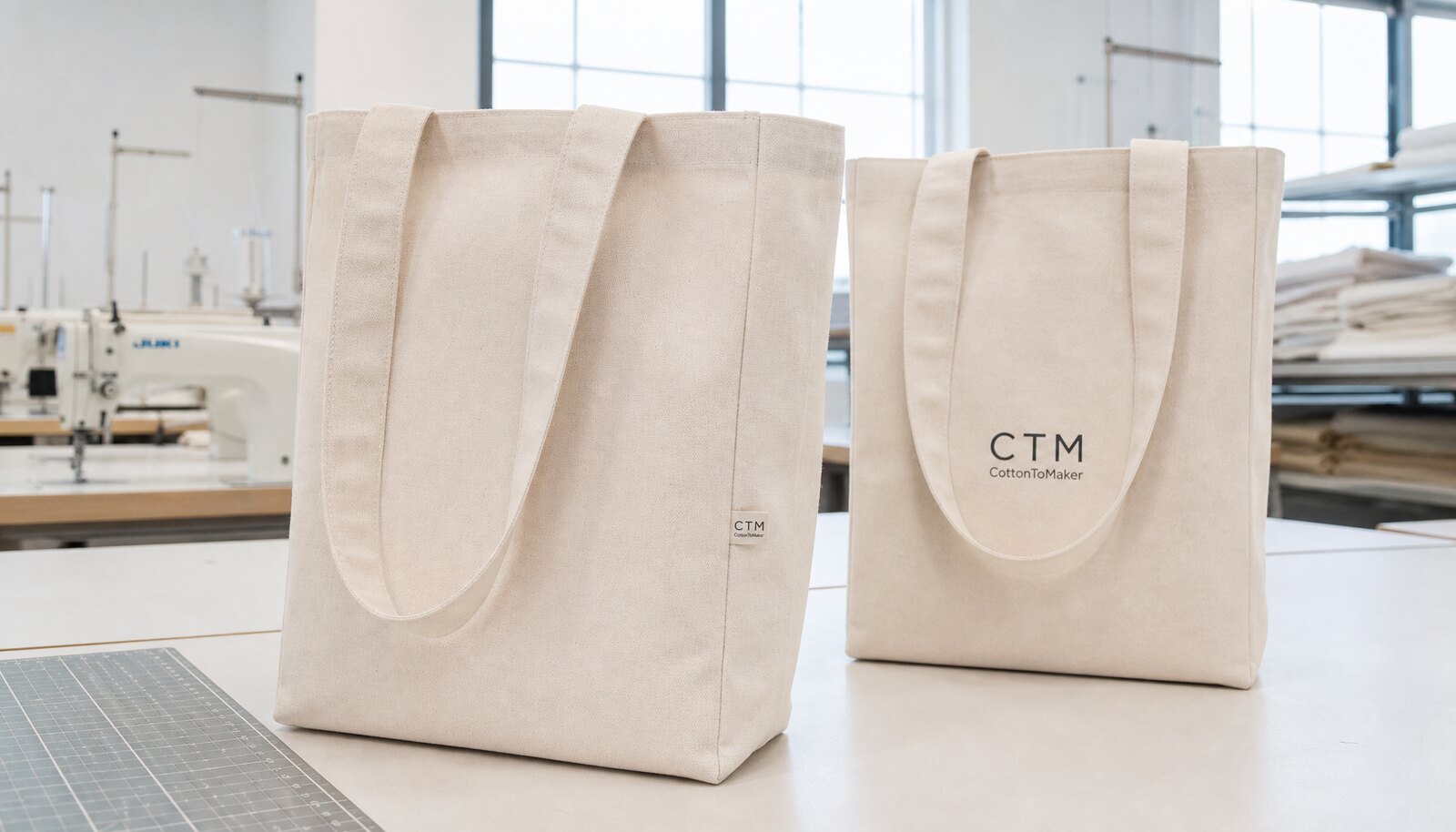
Why print method matters more on wellness tote programs
For wellness brands, a canvas library tote is usually not just a carry bag. It sits at the intersection of retail presentation, event merchandising, and daily reuse. The decoration method changes how premium the bag feels, how long the artwork lasts, and how easy it is to source repeatable production from a factory. A calm brand with soft neutrals and minimalist typography often looks better on a tote than a loud multicolor print, but the wrong process can make even a clean design look cheap.
The biggest buyer mistake is treating all decoration methods as interchangeable. Screen printing, heat transfer, embroidery, woven labels, and sewn patches all behave differently on canvas. The right choice depends on artwork complexity, order size, selling price, and whether the tote is meant for retail resale or as an included gift. Procurement teams should define the use case first, then match the print method to that use case.
- Retail tote: prioritize feel, wash durability, and print sharpness.
- Event giveaway: prioritize unit cost, fast sampling, and low minimums.
- Membership gift or premium bundle: prioritize clean decoration and structure.
- Daily-use bag for books, yoga gear, or journals: prioritize handle strength and abrasion resistance.
Choose the canvas weight before comparing quotes
Canvas weight changes everything downstream. For most wellness brand library totes, 12oz to 14oz canvas is the practical range. It gives the bag enough body to stand up at retail, better resistance to wear, and a cleaner surface for printing than very loose lightweight canvas. If the bag will hold books, refill items, or bottled products, 12oz is usually the minimum I would put on an RFQ. If the bag is a premium retail item, 14oz feels more substantial and reduces the chance of the bag looking collapsed on shelf.
A 10oz canvas can still work for low-cost event programs or large giveaways, but buyers need to control expectations. Light canvas shows wrinkles more easily, can distort under a heavy print, and usually needs stronger handle construction to keep complaints down. On the other end, 16oz canvas gives a more rigid, premium hand but increases fabric cost, sewing difficulty, and shipping weight. Unless the brand needs a heavy artisan look, 12oz to 14oz is the best commercial balance.
- Use GSM or oz in the RFQ, not just the word “heavy canvas.”
- State whether the canvas should be natural, bleached, washed, or garment-dyed.
- Ask for fabric shade swatches because unbleached canvas can vary lot to lot.
- Confirm whether the bag body is single-layer or lined; lining changes cost and lead time.
Print method comparison for a clean wellness look
For most canvas library tote bags, screen print is still the most economical and stable route for one- to two-color artwork. It works well for simple logos, short taglines, and centered brand marks. The key is not to over-design the art. On coarse canvas, thin serif fonts, hairline graphics, and tiny text can fill in or break apart. A good factory will suggest mesh count, ink thickness, and artwork simplification before production starts. That is a sign of a useful supplier, not pushback.
Heat transfer makes sense when the artwork has multiple colors, gradients, or finer detail and the order volume is too low to justify full screen set-up. It is often the easiest route for short runs, but procurement should watch for edge lift, surface gloss, and lower abrasion resistance. Embroidery and woven labels work best when the brand wants a more premium identity with very small logo space. They are not the cheapest options, and they are not ideal for large filled logos, but they can make a wellness tote feel more like a retail accessory than a promo item.
- Screen print: best for simple art, repeat orders, and tight unit cost control.
- Heat transfer: best for small runs and detailed graphics, but needs abrasion review.
- Embroidery: best for premium accents and small marks; verify stitch density.
- Woven/side label: best for subtle branding and low visual noise.
Supplier route comparison for wellness tote sourcing
The source route matters as much as the decoration method. A factory-direct supplier with in-house printing can usually control lead time, color matching, and rework more effectively than a trader who outsources decoration after the bag body is sewn. That does not mean traders are unusable; it means the buyer should know who owns what process. If the print is subcontracted, there is more risk around sample timing, artwork interpretation, and quality accountability.
For brand owners and distributors, the best quote is the one that clearly shows where the bag is sewn, where it is printed, and who signs off the pre-production sample. If the supplier cannot explain fabric sourcing, print subcontracting, or carton packing details, the landed-cost estimate is not reliable. A cheaper quote that hides decoration costs usually becomes the expensive quote after the first revision or shipment delay.
- Factory-direct: stronger control of sample approval and print consistency.
- Trader with print partner: useful for complex kitting or mixed product programs.
- Domestic decorator: can help with rush launches, but check fabric source consistency.
- Mixed-source quote: acceptable only if every process owner is named in writing.
What drives cost on the actual quote
A useful quote should separate bag body cost, decoration cost, sampling cost, and packing cost. Many buyers compare only unit price and miss the real cost drivers. On a canvas library tote, the main pricing levers are fabric weight, bag size, handle length, number of print colors, print location, and packing style. Add embroidery or a sewn label, and labor steps increase. Add a zipper top, gusset lining, or special wash treatment, and the bag becomes a different product class, not just a variation.
For procurement teams, the best way to compare quotes is to ask for the same base spec across suppliers and then isolate one variable at a time. For example, request 12oz natural canvas, one-color front print, standard webbing handles, flat fold, and bulk carton pack. Once the base is aligned, the effect of a second print color or woven side label becomes visible. Without that discipline, a low quote can simply mean a lighter fabric, smaller print, thinner handle tape, or weaker packing.
- Compare quotes only after standardizing bag size, canvas weight, and print area.
- Separate sample fee, plate fee, setup fee, and unit price.
- Ask whether the printed price includes one-side print, both-side print, or no print prep.
- Clarify whether freight, duty, and carton labels are included in the unit quote.
MOQ logic by decoration method
MOQ is usually driven by set-up economics. Screen printing needs screens and setup time, so the MOQ tends to be higher when artwork has multiple colors or multiple placements. Heat transfer can support lower quantities because the setup is lighter, but the unit cost may be higher. Embroidery usually has a digitizing and machine setup threshold, which means a lower MOQ is possible but the per-unit cost may not suit a promotional program. Woven labels sit somewhere in the middle depending on whether they are generic stock labels or custom made.
Wellness brands often start with a launch order that mixes retail and sample distribution needs. That is where MOQ mistakes happen. A buyer may request too many versions at once: natural and black canvas, front and side print, plus a patch and a hangtag. Each variation multiplies setup and inventory risk. The practical approach is to launch one core tote, one artwork location, and one decoration method first, then expand after sell-through or response data is available.
- Higher color count usually means higher MOQ on screen print.
- Simple one-color branding is the easiest route to a manageable MOQ.
- Launch with one SKU unless the channel truly needs multiple variants.
- Ask the supplier to quote both MOQ and a price break at the next volume tier.
Sample approval: what should be on the desk before PO release
A decorated tote should not move into bulk production on the strength of a digital proof alone. For a wellness brand, the sample has to prove the visual mood, the fabric hand feel, and the functional strength. Review the blank bag first if the supplier is proposing a new canvas weight or new handle construction. Then inspect the printed sample under normal light, not only under bright factory lighting. Natural canvas can make pale inks look weaker than expected, while black or dark art can show slight edge thickening that was not obvious on screen.
The sample should also prove the practical details: artwork placement, seam alignment, handle balance, fold appearance, and print resistance to rubbing. If there is a woven label or side label, check stitch direction and label edge finishing. Buyers should require that the pre-production sample match the intended bulk process, not a hand-finished sample that hides line-speed problems. If the sample is too perfect for the factory’s normal equipment, it is not a good approval standard.
- Approve artwork size in centimeters or inches, not just by visual reference.
- Check whether the print sits flat without cracking at the seam curve or gusset edge.
- Rub the print lightly with a dry cloth to look for immediate transfer or smear.
- Weigh the sample if the seller claims a specific fabric weight or reinforced build.
Packing and carton planning for wholesale and retail channels
Packing affects both landed cost and product presentation. Most wholesale buyers can accept bulk folded totes in polybags and master cartons, but retail programs often need a cleaner fold and less crushing of the printed face. A printed canvas tote that is packed too tightly can develop permanent fold marks, especially on heat transfer graphics. A bag with embroidery can create pressure points if the carton is overfilled. For this reason, carton packing should be part of the quote, not an afterthought.
If the bags are heading to a distributor warehouse, standard carton pack is usually the most efficient route. If they are going directly into retail stores, ask for a pack style that minimizes creases and includes carton labels that match the PO, size ratio, and barcode format. Buyers should also confirm whether the factory inserts tissue, inner paper, or simply folds and polybags. Those details affect labor, volumetric weight, and how the product looks on first inspection.
- Request carton dimensions and gross weight for freight planning.
- Prevent print cracking by keeping the print face inside the fold or separated with tissue.
- State whether retail hangtags must be attached before boxing.
- Align carton pack count with the destination receiving workflow.
Schedule risks that delay wellness tote launches
Lead time on these bags is rarely just sewing time. The schedule includes fabric sourcing, sample approval, printing setup, decoration curing or drying, inspection, packing, and cargo booking. Screen print with simple art is usually more predictable than a multi-step decoration program, especially when a supplier must first source a specific canvas weight. If the buyer changes artwork after the sample is approved, the clock resets on more than just printing. It can trigger new screens, new color matching, and a new QC review.
One of the most common delays comes from unclear artwork delivery. If the logo file is not vector-ready, the factory spends time cleaning lines and negotiating line thickness. Another common delay is late confirmation of the packing spec, which is often treated as minor until the cartons are already designed. Procurement teams should lock artwork, bag dimensions, and packing instructions before the supplier starts pre-production. That simple discipline prevents most avoidable slippage.
- Build time for sample approval before bulk start, not after the PO.
- Treat artwork revisions as schedule events, not informal edits.
- Confirm whether the supplier needs drying time for ink before packing.
- Reserve freight space early for seasonal launches and retail resets.
Landed-cost comparison: what to model before selecting a method
A smart buyer compares landed cost, not just FOB unit price. For canvas library tote bags, the landed cost includes decoration setup, sample spend, carton pack, freight volume, and defect allowance. Screen print often wins on landed cost for simple one-color branding because the unit cost stays stable at scale. Heat transfer can look attractive on a small order, but the cost per bag may remain higher as volume rises. Embroidery and woven labels may justify a higher unit cost if the retail price point or brand positioning supports it.
The real question is whether the bag will be sold, gifted, or included in a bundle. A wellness brand selling the tote at retail can usually support a better decoration method because margin and perceived value matter. A distributor packaging the tote as a promotional add-on may need the lowest total delivered cost. Buyers should model at least two scenarios: a launch order and a reorder quantity. If the price curve is flat, the method may be expensive for scale. If the price drops materially at the next tier, it may be worth planning for a second purchase order.
- Model FOB, sample cost, freight, and expected defect replacement together.
- Compare first order and reorder pricing separately.
- Use the target retail price to judge whether premium decoration is justified.
- Include one tolerance allowance for decoration rejects in the landed-cost model.
Specification comparison for buyers
| Spec decision | Recommended option | When it fits | Buyer risk to check |
|---|---|---|---|
| Print method | 1-color screen print on body or gusset | Core wellness merch, retreat packs, bookshop gifts, low-color brand marks | Fine lines may fill in on coarse canvas; confirm mesh count, ink coverage, and wash rub resistance |
| Print method | Heat transfer for short-run, multicolor art | Small launch orders, detailed graphics, seasonal campaigns | Transfer edge lift, plastisol feel, and lower abrasion tolerance on high-use totes |
| Print method | Embroidery or patch for premium accent | Spa retail, premium membership gifts, minimal logos, high perceived value | Need enough fabric stability; heavy stitch counts can distort lightweight canvas |
| Print method | Woven label or side label branding | Brands wanting subtle identity without covering the bag front | Label placement can look cheap if label size, fold, or stitch color is not controlled |
| Fabric weight | 12oz to 14oz canvas for most wellness retail programs | Daily-use library totes, paid retail SKUs, and repeat purchase bags | Too light looks flimsy; too heavy can feel stiff and raise freight cost |
| Fabric weight | 10oz canvas for event giveaways or low-cost packs | High-volume giveaway programs where price matters more than structure | Handles and bottom seams need reinforcement or complaints will rise after first use |
| Construction | Reinforced handles with cross-stitch and bar-tacks | Totes carrying books, journals, water bottles, or sample kits | Handle seam failure is the first defect buyers notice; test with load weight before approval |
| Supplier route | Factory-direct with decoration in-house | When you need tighter control over print, sample speed, and cost transparency | Confirm whether printing is truly in-house or outsourced to avoid quote gaps and schedule slippage |
| Packing route | Bulk polybag with carton pack, unless retail-ready fold is required | Wholesale shipments, distributor warehouses, and kitting at destination | Over-folding can crease print areas; retail-ready pack may increase labor and carton volume |
Buyer checklist before sampling
- Define the artwork size, print location, and maximum color count before requesting quotes.
- State the target fabric weight in GSM or oz, and specify whether a washed or unwashed finish is acceptable.
- Request one blank sample and one decorated sample, not just a render or digital proof.
- Set an acceptance standard for print opacity, registration, and wash/rub fastness.
- Confirm handle length, seam reinforcement, and finished bag dimensions with tolerance.
- Specify carton pack quantity, polybag requirement, and whether folding must protect the print face.
Factory quote questions to send
- Is the print method in-house screen print, outsourced transfer, or contracted embroidery, and what does that change in lead time?
- What canvas weight do you recommend for this bag size, and what is the exact GSM or oz after finishing?
- What is the MOQ by print method, color count, and artwork placement?
- What sampling fees apply for blank samples, printed samples, and pre-production approval samples?
- What is the standard carton pack count, carton size, and gross weight for this tote specification?
- What inspection criteria do you use for print registration, stitch quality, and handle pull strength before shipment?
Quality-control points to confirm
- Fabric weight should match the approved range within agreed tolerance; verify by supplier spec and spot measurement.
- Print coverage should be even with no pinholes, excessive cracking, or visible ghosting at the edges.
- Artwork placement should stay within the agreed center point or offset tolerance across the lot.
- Handles should be bartacked or cross-stitched consistently, with no skipped stitches or loose threads at load points.
- Seams should lie flat without puckering, and bottom seam stress should not open under reasonable hand load.
- Color should remain consistent across the first production run, with no obvious shade shift between panels or batches.
- Packing should avoid creasing printed areas; cartons should not overfill and crush bag edges.