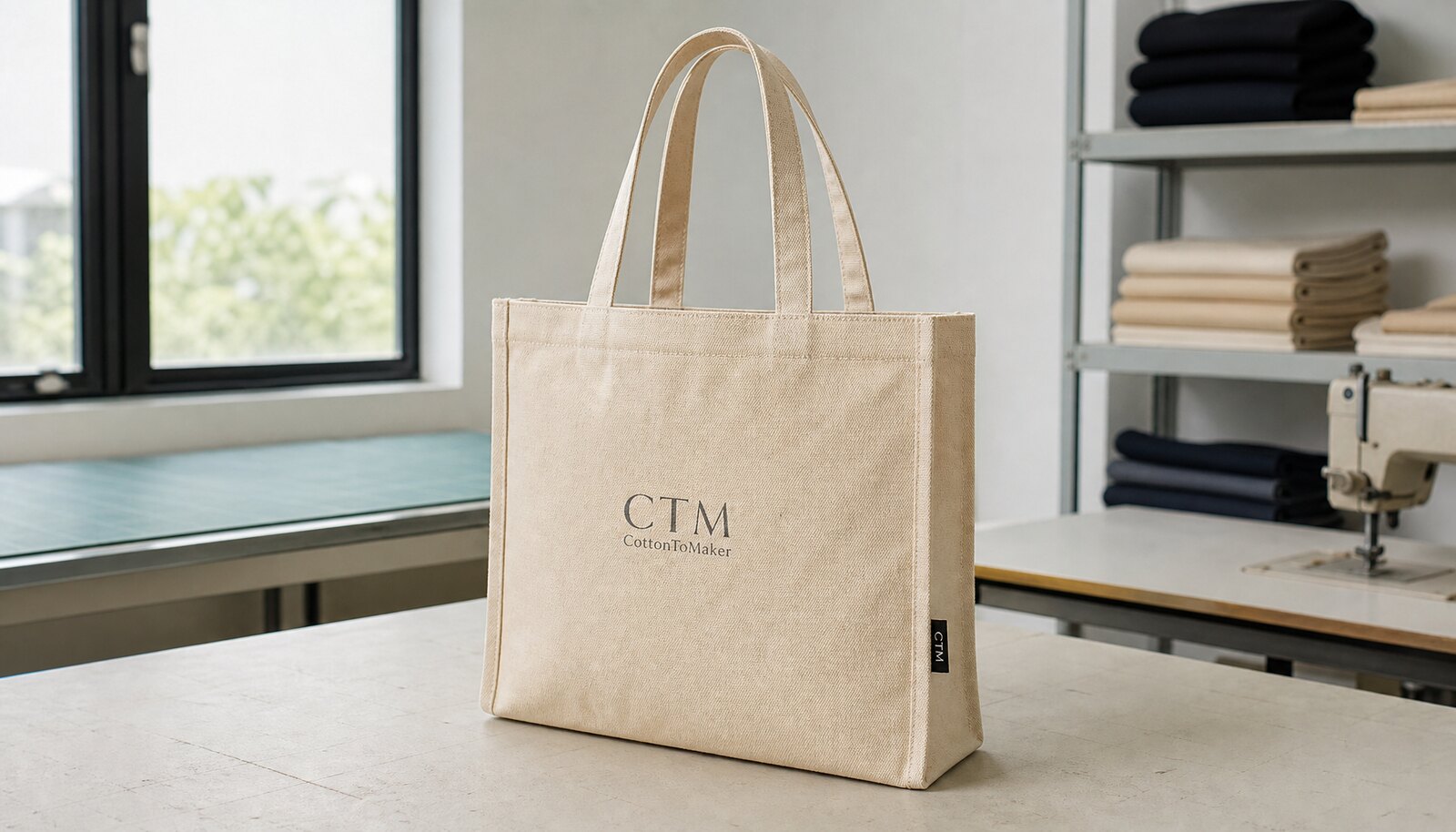
Why a Library Tote Spec Fails at Trade Shows
Canvas library tote bags for trade shows are not just a cheap giveaway. Buyers use them to carry catalogs, brochures, samples, notebooks, and sometimes boxed inserts across a long show day. That means the bag has to stand up, stay open enough to load quickly, and survive repeated handling without stretching out of shape. A tote that looks fine on a flat layout can still fail in the aisle if the canvas is too soft, the handles are too short, or the bottom seam is too weak.
The buying mistake is treating the order as a print job instead of a sewn product. The right spec starts with capacity and load, then moves to logo decoration. If the tote is too small, it gets abandoned. If the canvas is too light, it looks inexpensive and wrinkles badly. If the construction is overbuilt, the bag becomes expensive and takes up too much carton space. The best programs keep the bag simple but deliberate: enough structure to hold materials, enough print area to show the logo, and enough consistency that the supplier can repeat it without rework.
- Think about what goes inside the tote first: brochures only, or books and product samples too.
- A trade show tote needs better load behavior than a casual shopping bag.
- Simple construction usually works better than decorative complexity when the order volume is high.
Choose Fabric Weight and Construction Before You Price the Logo
For most trade show programs, 10 oz to 12 oz canvas is the practical starting point. Around 10 oz, the bag feels lighter and cheaper to ship, but the body may wrinkle more and show contents through the weave if the canvas is loosely woven. At 12 oz, or roughly 407 gsm, you get a better balance of body, durability, and print stability. If the tote must hold heavier books or be sold in retail channels after the event, 14 oz or 16 oz can make sense, but the cost and carton weight rise quickly.
Construction matters as much as fabric weight. A gusset of 10 to 15 cm usually gives enough room for catalogs without making the bag bulky. Reinforced bottom seams and bar-tacked handles are not optional if the tote will be loaded heavily. If you want the bag to stand upright on a table or registration desk, add a firmer bottom panel or insert. For a pure handout bag, a simpler unlined build may be enough, but the buyer should still specify handle length, handle width, stitch count, and whether the tote must be folded flat for packing.
- 10 oz canvas is useful for lighter handouts and lower-cost programs.
- 12 oz canvas is the most common middle ground for a trade show library tote.
- 14 oz and above are better when the bag must feel premium or carry heavy reference material.
- Lock handle width and handle drop early, because small changes affect both comfort and sewing time.
Compare Sourcing Routes Before Comparing Supplier Quotes
The lowest quote does not always come from the best sourcing route. A direct factory is usually the strongest option when you need control over fabric weight, print method, packing format, and repeat consistency. It is easier to compare apples to apples when one team handles cutting, sewing, printing, and packing. The tradeoff is that you need a cleaner RFQ and more disciplined sample approval because the factory will build exactly what you spec, including your mistakes.
A trading company or sourcing agent can help when the project is small, the artwork is still changing, or you need multiple product types combined into one shipment. A domestic decorator can be useful for urgent programs or very small runs, but the fabric cost is often higher and the print options may be limited. For a buyer comparing quotes, the key is to identify what is actually inside each offer: fabric source, print location, packing style, carton count, and whether the supplier is quoting ex-works or including any inland handling.
- Direct factory works best for repeat programs and custom construction.
- Trading routes can simplify communication but may hide margin layers.
- Domestic decoration is useful for speed, but usually not for the lowest unit cost.
Logo Method Should Follow Artwork, Not Habit
Most canvas library tote bags for trade shows use screen printing because it handles bold logos, simple messaging, and medium to large quantities efficiently. It is the right choice when the artwork has a limited number of colors and the brand can tolerate a slight texture from the canvas weave. On natural canvas, one or two solid ink colors usually read best. On darker fabric, ink opacity becomes the issue, so the supplier needs to confirm whether an underbase is required and whether the logo edges will hold cleanly.
Embroidery, woven labels, and sewn patches are useful when the tote is meant to feel more retail-ready or bookstore-ready than purely promotional. The tradeoff is cost, placement complexity, and lead time. Very small text, fine lines, gradients, and detailed illustrations are weak candidates for direct print on coarse canvas. The right way to decide is to review the artwork at production scale, not just on a screen. If the logo must stay crisp from five feet away, simplify it. If the brand wants a premium texture, spend the budget on a label or patch rather than forcing a weak art file through a print process that cannot support it.
- Use screen print for bold branding and larger runs.
- Use embroidery or a woven label when retail feel matters more than cost.
- Avoid tiny copy and thin lines on coarse canvas.
- Confirm the approved art size in millimeters, not only in pixels.
Make the Quote Comparable Before You Decide on Price
A good supplier quote should let you compare fabric, construction, decoration, and packing without guessing. If the quote only shows a single unit price, you do not yet have a usable commercial offer. Ask for the finished size, fabric weight, handle spec, logo method, carton pack, and sample fee to appear separately. That way you can see whether one supplier is using lighter canvas, fewer stitches, a smaller print area, or cheaper packing to reach a lower number.
MOQ logic should also be visible in the offer. A simple one-color screen print on standard 12 oz canvas may allow a smaller minimum if the factory already stocks the base material, while custom dyed fabric, multiple print colors, or special labels will push the minimum up. Buyers often save time by asking for tiered pricing at 500, 1,000, 3,000, and 5,000 pcs, plus a separate line for replacement samples. That gives you a realistic picture of where the pricing curve starts to flatten.
- Ask for pricing at multiple quantities, not one single MOQ number.
- Separate blank bag cost from printing and packaging wherever possible.
- Review whether the quote includes setup, plates, labels, or carton marks.
- Check if the supplier is quoting by ex-works, FOB, or another trade term.
Sampling Needs Three Stages, Not One
The sample process should prove the bag, not just the logo file. A blank sample tells you whether the fabric feels right, whether the size is correct, and whether the bag sits properly when filled. A printed pre-production sample then confirms the actual logo size, placement, ink density, and color behavior on the chosen canvas. If the supplier changes fabric lot, print screen, or packing method after that approval, the buyer should ask for a fresh confirmation before mass production starts.
The sample review should be practical. Fill the bag with the same weight and shape of materials the trade show team will carry. Check handle comfort, top opening behavior, bottom stability, and whether the tote folds back to an acceptable size for storage. Measure the sewn dimensions, inspect stitch lines at the handle joints, and compare print alignment from both sides. If the supplier cannot produce a clean sample in the right fabric and construction, the mass order will usually be worse, not better.
- Stage 1: blank sample for size and construction.
- Stage 2: printed sample for artwork and placement.
- Stage 3: pre-shipment reference sample retained by buyer and factory.
- Reject any sample that hides problems with over-ironing, temporary stitching, or manual touch-up.
Packing Choices Affect Damage, Labor, and Event Readiness
Packing should match how the bags will move through your supply chain. For trade shows, bulk packing by 25 or 50 pcs per carton is often the most efficient route because it lowers labor and keeps unit cost under control. If the tote is also being sold at retail or shipped to multiple branch locations, individual polybags or barcode labels may be needed. Those choices increase handling time, carton volume, and plastic use, so they should be treated as a business decision rather than a default.
The buyer should also specify how the cartons are marked and whether the bags need to be folded a certain way. Canvas can crease badly if it is packed too tightly or stacked against rough carton edges. A simple fold standard, a clean master carton label, and a clear case count prevent a lot of warehouse confusion. If the bags are going directly to a show site, it can be worth asking for palletizing, moisture protection, and extra carton corners so the shipment arrives without crushed handles or dirty panels.
- Bulk pack is usually the right answer for trade show handout bags.
- Retail-ready packing is only worth the cost if the bags are being sold or distributed by location.
- Use carton marks that match your receiving team’s labeling system.
- Protect the canvas from crease damage and carton abrasion.
Lead Time Risk Comes from Decisions Made Too Late
Most schedule problems in tote programs are caused by late changes to artwork, construction, or packing. A realistic plan usually starts with a few days for quotation and clarification, then sample approval, then production, then freight. For simple canvas library tote bags, sample development can be relatively quick, but production still depends on fabric stock, printing queue, and current factory workload. If the design includes multiple colors, woven labels, or custom packaging, the timeline expands because each extra step creates another point for delay.
The safest approach is to back-plan from the event date and protect time for correction. Do not assume a factory can absorb a late logo change or a size revision without affecting everything else. Buyers should build in enough buffer to re-approve a sample if the first one misses the target, especially when the tote is new or the supplier has not made that exact spec before. Freight mode also matters: air can solve a deadline problem, but it can destroy the economics of a bag program. The buyer should decide early whether the order is a cost project or a schedule project.
- Treat art approval as a production gate, not a design discussion.
- Expect more delay when labels, special packing, or dyed fabric are involved.
- Build buffer time for sample correction and freight variance.
- Do not let a rush order hide a weak spec.
Set QC Thresholds That A Factory Can Actually Follow
Quality control for canvas tote bags should be measurable. The buyer should define acceptable size tolerance, print shift tolerance, and the maximum number of minor defects per carton. A vague instruction like nice quality is not useful to the factory. Better language is specific: no broken seams at handles, no oil stains, no hole marks, no loose thread bundles, no major print smears, and no bag that fails to stand or carry the approved load. If the tote will be used for books, add a simple load test that reflects the real use case.
The buyer should also pay attention to shade variation in natural canvas. Some variation is normal, but if the bags in a shipment drift too far apart visually, the set will look inconsistent on the show floor. Print quality should be judged by edge clarity, color density, and position repeatability. If a logo touches a seam, crosses a gusset fold, or sits too close to the edge, approve that placement only if the factory can repeat it consistently. A good QC spec reduces arguments during final inspection because both sides already know what acceptable looks like.
- Define measurable size and placement tolerances.
- Set a visible defect limit for stains, holes, and broken stitches.
- Use a load test that matches actual event use.
- Keep one approved sample as the visual reference for the shipment.
Use Landed Cost, Not Unit Price, to Choose the Supplier
A low ex-factory price can still produce a bad landed cost if the supplier is using stronger packing, higher carton weights, extra setup fees, or a freight mode that does not fit the shipment. Buyers should compare the bag on a landed basis: unit price, sample fee, setup cost, packing cost, inland freight, main freight, duty basis, and any testing or documentation charges. If one supplier appears cheaper, ask which part of the order was reduced to get there. Often the answer is a thinner fabric, smaller print area, or simpler carton packing.
For reorder planning, the real question is not whether the bag is cheap enough once. It is whether the factory can make the same bag again without drift. Reorders usually go faster and cleaner when the buyer keeps the approved sample, the final spec sheet, the carton details, and the print file in one place. If the tote is being used for recurring trade shows, a library program, or a seasonal campaign, lock the spec early and then buy repeat runs from the same approved benchmark. That is how you reduce quote noise, avoid surprise changes, and keep the bag consistent across events.
- Compare total landed cost, not just ex-factory price.
- Track sample and setup fees separately from recurring unit cost.
- Keep the approved spec package for reorder control.
- Reward suppliers that can repeat the same bag without hidden changes.
Specification comparison for buyers
| Spec decision | Recommended option | When it fits | Buyer risk to check |
|---|---|---|---|
| Sourcing route | Direct canvas factory with in-house printing | You need control over fabric, print, carton packing, and repeat orders | Verify that the factory is not outsourcing key steps and that sample approvals are tied to the actual production line |
| Fabric weight | 12 oz canvas, about 407 gsm, in natural or bleached finish | Trade show totes carrying catalogs, notebooks, and samples without feeling flimsy | Light fabric can bag out or show print strike-through; heavy fabric raises cost and packing volume |
| Handle build | Self-fabric or cotton webbing handles with bar-tacks at stress points | When bags will be filled and handed out in volume | Handle width, stitch count, and attachment length must match load expectations or the tote will fail at the top seam |
| Print method | 1 to 2 color screen print for most buyer programs | Large logo, bold artwork, and stable repeat runs | Fine text, gradients, and small reverse-out details can blur or fill in on coarse canvas |
| Decoration route | Woven label or small patch plus print for premium retail programs | When the tote must feel more finished for bookstore, museum, or brand merchandise use | Extra decoration increases lead time and can push the factory to use mixed subcontracted finishing |
| Construction | 10 to 15 cm gusset with reinforced bottom seam | For books, directories, event kits, and product catalogs | Flat tote bodies may look simple but often collapse when loaded and make the bag feel smaller than expected |
| Sampling route | Blank pre-production sample before printed approval | First order, artwork with tight positioning, or new supplier onboarding | Approving only a PDF mockup hides real issues in size, seam line, ink density, and handle symmetry |
| Packing route | Bulk pack 25 to 50 pcs per carton with carton marks and case counts | Trade show distribution, warehouse receiving, and low handling cost | Retail-ready polybags add labor and volume, while loose stacking can create creases and dirty corners |
Buyer checklist before sampling
- Confirm target use: handout bag, bookstore merch bag, or premium branded tote, because the correct weight and construction change with the use case.
- Lock the finished size, gusset depth, and handle drop before asking for quotes.
- Specify fabric weight in oz and gsm, plus whether the canvas is natural, bleached, dyed, or prewashed.
- State print area, number of colors, print side, and whether artwork must match a PMS reference.
- Ask the supplier to quote blank bags, printed bags, and packaging separately if possible.
- Request a blank sample and a pre-production sample before mass production starts.
- Clarify carton pack quantity, master carton size, gross weight, and whether palletizing is required.
- Set a defect tolerance for broken stitches, crooked print, oil marks, and size variance.
- Confirm the production lead time, not just the sample lead time, and include transit time in the plan.
- Ask for landed-cost inputs, including freight mode, duty basis, and any packaging or testing charges.
Factory quote questions to send
- What is the finished size, fabric weight, and handle construction used in your quoted price?
- Is the quote based on direct factory production, or are any printing or packing steps subcontracted?
- How much does the unit price change at 500, 1,000, 3,000, and 5,000 pcs?
- What setup charges apply for screen printing, plates, sampling, labels, or custom packing?
- How many logo colors are included, and what is the add-on cost for each extra color?
- Can you provide a blank sample, then a printed pre-production sample for approval?
- What is the standard carton pack, carton size, and gross weight per carton?
- What lead time do you need after sample approval, and what could extend it?
- What inspection standard do you use for stitch quality, print alignment, and size tolerance?
- Please separate ex-works price, packing cost, inland freight, and any test or document charges.
Quality-control points to confirm
- Finished size must stay within the agreed tolerance, especially for width, height, and gusset depth.
- Handle attachment must use even bar-tacks or reinforced stitching with no skipped stitches or loose thread ends.
- Print position must stay centered or within the approved placement window, with no visible smearing or registration drift.
- Ink coverage must be opaque enough on natural canvas that the weave does not break the logo into patchy bands.
- Seams must stay straight and closed under load, with no popped stitches at the bottom corners or handle joins.
- Fabric must be free from holes, thick yarn knots, staining, and shade variation that is visible across the batch.
- Cartons must match the approved pack count, label format, and marking language required by the buyer.
- A pull or load test should be run on the handles for the intended use case before shipment is released.