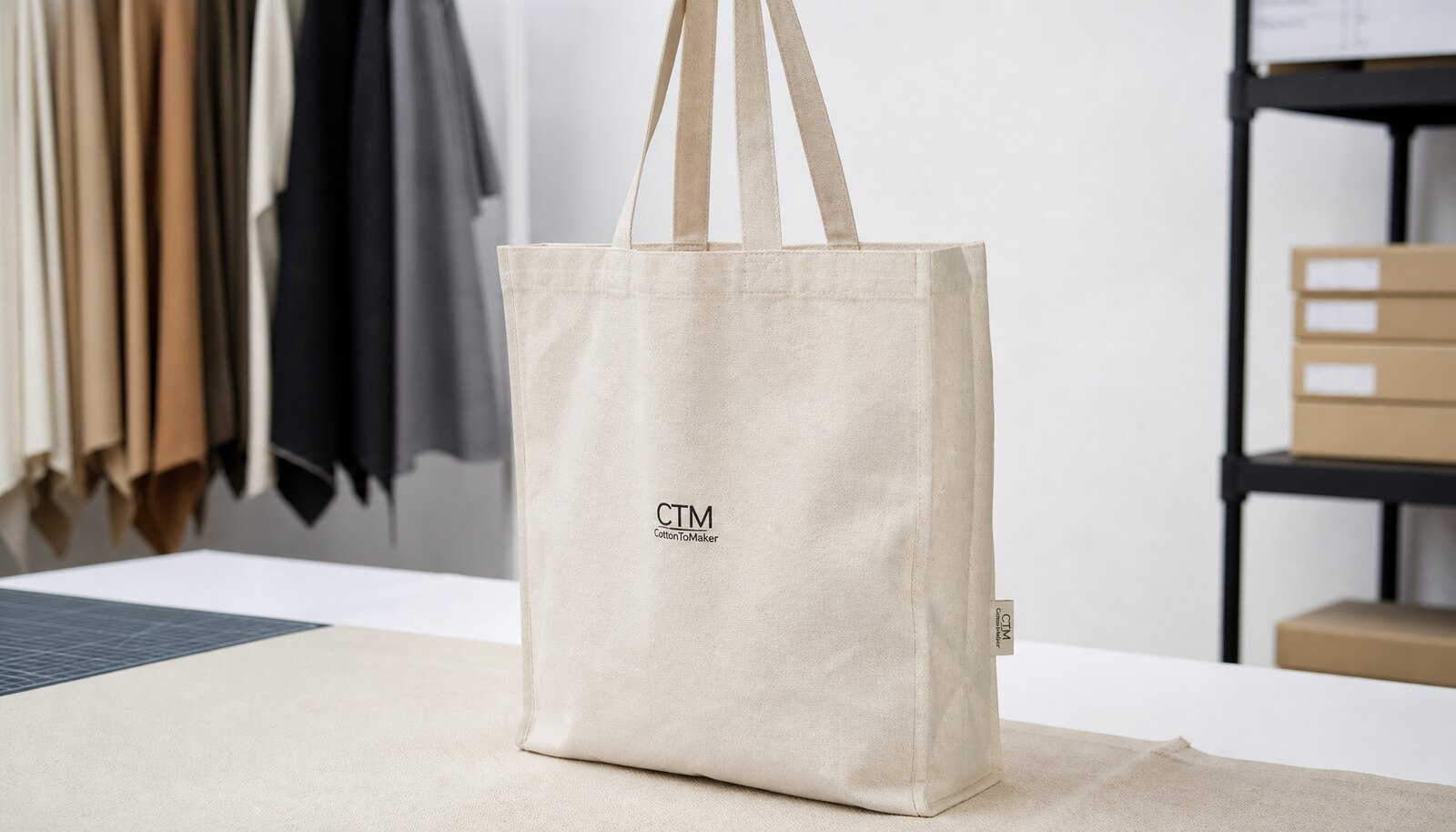
Start With the Event Use Case, Not the Bag Name
A canvas library tote for a trade show is not the same item as a retail shopping tote. At an event, the bag is carrying brochures, notebooks, sample packs, water bottles, and whatever the visitor picks up in the booth. That means the design has to stay open enough to pack fast, but sturdy enough to survive a full day on the show floor and the trip home. If the bag feels flimsy when empty, it will read as cheap before anyone even sees the logo.
Start the spec by describing what the tote must hold and how it will be handed out. For most trade show programs, a body size around 38 x 42 cm with a 10 to 12 cm gusset works well, because it fits flat literature but still folds cleanly for packing. Keep the handle drop long enough for shoulder carry if the tote is meant to leave the booth with the visitor. If the event kit includes heavier items, reinforce the handle join and the bottom panel instead of trying to solve the problem later with thicker print or a larger logo.
- For light handouts only: use a slimmer body, basic open top, and a lighter canvas weight.
- For book or catalog carry: specify a wider gusset and enough handle length for shoulder use.
- For sample kits: define the heaviest expected load and ask for a reinforced bottom seam.
Choose Fabric Weight for Carry Performance, Not Just Cost
The practical range for canvas library tote bags is usually 8 oz to 12 oz, or about 260 GSM to 400 GSM. An 8 oz build is fine for flyers, a notebook, and a light giveaway set, but it will wrinkle faster and can look soft when the bag is empty. A 10 oz fabric is the common middle ground for trade show use because it balances body, print clarity, and price. A 12 oz bag starts to feel more retail-grade and usually presents a cleaner front panel for branding, but it can also increase sewing effort and carton weight.
Do not treat fabric weight as the only quality signal. The yarn density, weave tightness, shrinkage, and finishing process matter as much as the number on the spec sheet. Ask whether the fabric is pre-washed, pre-shrunk, or bio-washed, because that affects finished size after production and after the first few uses. Natural canvas shade will vary from lot to lot, so if your brand expects a cleaner off-white, define the accepted shade range instead of assuming every batch will match a studio sample exactly.
- Use 8 oz for short-life promotional use and low-cost distribution.
- Use 10 oz for the best balance of feel, print quality, and event durability.
- Use 12 oz when the tote must carry heavier materials or needs a more premium hand feel.
- Ask for finished-size tolerance, not only cut-size tolerance, because canvas can shrink after sewing and finishing.
Match the Print Method to the Artwork and Order Size
Screen print is usually the most practical method for a giveaway tote when the logo is simple, flat, and limited to one or two colors. It gives solid coverage on natural canvas and holds up well through repeated handling. If the artwork has many colors, gradients, or fine tonal detail, heat transfer can reproduce more of the design, but the finish may feel less integrated with the fabric and can become a durability issue if the tote is folded tightly or washed often. Embroidery works when the brand wants a more premium look, but it adds thickness and can distort the fabric if the logo sits too close to a seam or handle anchor.
The main mistake is choosing a method before the art is ready. A factory can usually screen print a clean logo if the file is simple and the color count is controlled. They can also quote a heat transfer or embroidery option, but the buyer should understand how that changes the hand feel, production time, and rejection risk. Specify the exact print area, Pantone references, and how much clear space should stay around the logo. For trade show use, the logo needs to be readable at a glance from a few meters away, not just impressive in a design file.
- Use screen print for simple logos and repeat volume.
- Use heat transfer only when the artwork needs more color detail or short-run flexibility.
- Use embroidery sparingly on heavy canvas and keep it away from stress points.
- Request a strike-off or print swatch before approving mass production.
Read the MOQ Ladder Before You Compare Quotes
MOQ is rarely a single number. A factory may quote one minimum for the bag body, another for the print setup, and another for packaging or custom labels. That is why two quotes can look similar at first glance but behave very differently once the buyer adds a second color, a woven side label, or individual polybags. Good procurement practice is to ask for pricing at several quantities, such as a pilot run, a standard run, and a larger reorder tier, so you can see where the unit cost starts to flatten.
A usable quote should separate the bag body, print setup, labor, packaging, carton packing, and the shipment basis. If a factory only gives a single all-in number, the order is harder to control later when something changes. The most common hidden charges are extra color screens, special handle construction, inner labels, barcode stickers, and rework from shade or print mismatch. When the factory can explain exactly what changes the price, you can compare suppliers on a fair basis instead of guessing which bid is truly cheaper.
- Request pricing at more than one quantity so you can see the real MOQ logic.
- Ask whether one-color and two-color prints have different minimums.
- Confirm overrun or underrun tolerance before the order is issued.
- Check whether labels, stickers, or custom packing change the MOQ.
Compare Supplier Routes Before You Buy on Price Alone
Direct factory buying is usually the strongest route when the tote spec is fixed and the event calendar is real. You get better control over fabric, handle reinforcement, and carton pack-out, and the factory can usually offer cleaner process visibility if the order size justifies it. The tradeoff is that the buyer has to manage sampling, approvals, and timing more tightly. If the factory is weak on communication, low price can become expensive very quickly once the order is in motion.
Trading companies, local decorators, regional small-batch makers, and promo brokers each solve a different problem. A trading company is useful when you need one contact point across bags and other event items. A local decorator using imported blanks can win on speed when the event is close and the design is simple. A regional small-batch maker can be right for pilot programs or market tests. The buyer should choose the route based on lead time, control, and consistency, not only on the quoted unit price.
- Use direct factory sourcing when you want repeatability and enough volume to justify a full production setup.
- Use a local decorator or regional maker when speed matters more than exact spec flexibility.
- Use a broker or trading company when the order is part of a wider event kit and one PO is valuable.
- Use a dual-source setup when you need a main production order and a small emergency reserve.
Approve the Sample Like a Production Run
The sample is only useful if it represents the actual build. A pre-production sample should show the same fabric weight, handle construction, print method, label placement, and folded size that the bulk order will use. If the factory sends a sample made with a different canvas or a different ink system, the sample is a style reference, not an approval basis. That distinction matters because trade show totes are often judged by how they feel in the hand before the logo is even noticed.
Treat the sample review like a short production audit. Measure body dimensions, gusset depth, handle drop, and seam symmetry against the spec sheet instead of relying on appearance alone. Put event materials into the bag and see how it sits when loaded. The tote should not collapse awkwardly, twist at the handles, or expose stress marks around the corners. For any logo that sits near a seam, inspect registration and distortion at the final size, not only on a flat sample photo.
- Check finished size with a ruler, not just by eye.
- Reject samples with print off-center beyond the agreed tolerance or with obvious seam twist.
- Test the bag with the actual literature, bottle, or sample pack it will carry.
- Record the approved sample version so later production cannot quietly drift.
Lock Packing Before the Factory Packs for You
Packing changes both cost and logistics. Flat folding and bulk packing are the cheapest way to move a tote, but they require the receiving team to sort and count on arrival. Individual polybags protect the print and keep the bags cleaner for premium handout programs, but they add material, labor, and disposal cost. If the event team plans to preload flyers, samples, or inserts, define whether the factory will do that work or whether it happens at a local fulfillment point. That one decision can change the whole schedule.
Carton planning should be part of the quote, not an afterthought. Ask for the carton size, the number of pieces per carton, and whether the carton is suited to pallet loading or direct warehouse intake. For event use, pre-counted bundles of 25 or 50 usually work better than loose bulk because booth staff can distribute bags quickly without opening every carton. If the bags are going to different show floors or channels, carton marks should include the PO number, quantity, and destination clearly enough that a warehouse team can route them without opening the box.
- Specify whether the tote ships flat, folded once, or individually bagged.
- Ask for carton dimensions before freight is booked.
- Define whether inserts or collateral are packed by the factory or by the receiving team.
- Use bundle counts that match how the event staff will hand out the bags.
Protect the Timeline Around Art, Sample, and Transit
Most event delays come from the front end of the order, not the sewing line. Artwork changes, sample revisions, and late approval of print placement usually consume more time than the actual bag production. That is why the buyer should work backward from the handout date and build in approval windows for each stage. If the tote needs a custom woven label, special dye, or a more complex print build, that buffer has to be larger because those details often add their own waiting time before bulk production can start.
Transit risk needs to be planned separately from production risk. If the event is fixed and the bags are coming from offshore, the buyer should decide early whether the main shipment will move by ocean freight with a local backup or whether a small portion will move faster as a reserve. Air freight can rescue a narrow timing problem, but it often changes the economics enough that the tote is no longer a sensible giveaway. The safer path is usually a realistic production schedule, a locked sample cycle, and a small contingency stock if the program is large enough.
- Freeze artwork before the first serious quote round.
- Limit the sample cycle so the schedule does not drift from revision to revision.
- Add buffer for peak season, holiday shutdowns, and port congestion.
- Treat the event date as the deadline, not the ship date.
Build a Landed-Cost View, Not Just a Unit Price
A tote can look inexpensive at the factory and still miss the budget once freight, duties, inland trucking, warehouse intake, and repacking are added. The right way to compare suppliers is landed cost per usable tote, not factory price per sewn bag. That matters even more for event giveaways, where a bag that arrives late or in the wrong carton format is not usable no matter how low the quote was.
Landed cost also exposes the hidden choices inside the spec. A second print color can add setup and labor. A larger print area can increase rejection risk. A heavier canvas weight can improve hand feel but may push the order into a different freight bracket. If the supplier cannot explain which parts of the quote are fixed and which scale with quantity, the quote is not yet procurement-ready. You need a cost model that shows how the order behaves when you move from a pilot run to a full event run or from one-color art to two-color art.
- Compare quotes on the same shipment basis and the same carton plan.
- Separate factory cost from freight, duty, and inland handling.
- Model the effect of overrun or underrun before final approval.
- Track the cost of extras such as inserts, labels, and individual packing.
Write the RFQ So the Quotes Are Actually Comparable
A useful RFQ for canvas library tote bags is specific, but not bloated. State the finished size, gusset, fabric weight, handle type, print area, color count, and packing requirement. Add the event use case so the factory understands whether the tote is meant for flat literature, heavier samples, or a branded kit. If the buyer wants to compare options, ask the factory to quote both a base build and an upgraded build in the same response. That gives the procurement team a clean view of where the price moves when the spec improves.
The strongest RFQs also include a reference sample photo or a dimensioned sketch, because words alone do not capture handle placement, seam style, or the visual balance of the print area. When the supplier replies, the buyer should be able to compare quote A to quote B without having to normalize three different assumptions. That is the real objective: turn a creative promo item into a controlled buying item with a known spec, known risk, and known landing cost.
- Attach a reference image or sample sketch with measurements.
- State the event use case so the supplier sizes the tote correctly.
- Ask the supplier to confirm every deviation before quoting.
- Request a base spec and a premium spec if you want to see the cost of upgrades.
Specification comparison for buyers
| Spec decision | Recommended option | When it fits | Buyer risk to check |
|---|---|---|---|
| Direct cut-and-sew factory | Best for full spec control and repeat orders | 1,000+ pcs, stable artwork, fixed event date, and a need to control handle, gusset, and carton details | Verify the actual factory, not just the salesperson, and get sample photos from the production line |
| Trading company or sourcing agent | Useful when you need one contact for bag, insert, and packing coordination | Multi-item event kits or buyers without a local QC team | Margin can be hidden inside the quote, so compare line items and ask who makes the bag |
| Local decorator using imported blanks | Good for short deadlines and simple logo runs | Rush programs, lower quantities, and one-color branding | Blank quality, fabric shade, and finished size may vary by batch |
| Regional small-batch manufacturer | Useful for pilot runs or flexible MOQ | 200-800 pcs, early-stage events, and buyers testing a new tote size | Unit cost is usually higher and print options may be limited |
| Overseas factory with in-house printing | Strong choice for repeatable logo placement and scale | 3,000+ pcs, standard giveaway builds, and a longer production window | Freight, customs, and transit damage need to be part of the landed-cost view |
| Promo distributor or broker | Good when the bag is one item in a wider event package | You need a single PO across bags, lanyards, notebooks, and other collateral | Quote comparability can be weak if spec details are not fixed in writing |
| Sample-room pilot run | Best for first-time design validation | New bag shape, new handle style, or a print area that needs visual approval | Sample conditions may not match bulk production conditions |
| Dual-source strategy | Main volume from one factory and a small reserve from a local supplier | Seasonal events where you need backup stock or a replenishment option | Color drift, shrinkage, and carton differences can create inconsistency |
Buyer checklist before sampling
- Lock the finished size, gusset depth, handle length, and the type of event contents the tote must carry.
- Choose the fabric weight in GSM or oz/yd2 before requesting quotes, and state whether pre-washed or pre-shrunk fabric is required.
- Confirm the print method, number of colors, Pantone references, and the maximum print area in centimeters.
- Decide whether the tote ships flat, folded once, or individually polybagged, and whether inserts will be packed inside.
- Ask for a sample made with the same fabric, handle, and print method that will be used in bulk.
- Compare all quotes on the same Incoterm, carton count, and overrun tolerance.
- Set an approval deadline for artwork, sample, and pre-production sample so the event date has buffer time.
- Require the factory to confirm any deviation from the spec before production starts.
Factory quote questions to send
- What exact canvas weight, weave type, and fabric finish will you use for the bulk order?
- Is the sample built from the same fabric, handle material, and print method as the production order?
- What is the MOQ for the bag body, each print color, and any special packing format?
- What are your sample lead time, pre-production sample lead time, and bulk production lead time?
- What are the finished size tolerances, handle tolerances, and print registration tolerances?
- What packing options do you offer, and what carton size and carton count will you use?
- What is your overrun or underrun policy, and how do you handle rework if defects are found?
- Can you quote FOB, CIF, and DDP separately so we can compare landed cost accurately?
Quality-control points to confirm
- Finished size stays within the agreed tolerance, typically within 1 cm for body dimensions unless the spec allows more.
- Fabric weight matches the approved swatch and does not feel lighter or looser than the sample.
- Print color matches the approved strike-off under neutral light, with no obvious shade drift across the order.
- Print registration is centered and aligned, with no more than 5 mm visual shift unless the artwork allows an off-center layout.
- Handles are secure, bar-tacked or cross-stitched where specified, and there are no skipped stitches at stress points.
- Seams are even, corners are clean, loose threads are trimmed, and there is no seam grin or needle damage.
- Cartons are marked correctly with PO number, quantity, and packing style, and the packed count matches the order sheet.
- Bags are clean, odor-free, and free from oil marks, broken fibers, or stains that would fail an event handout standard.