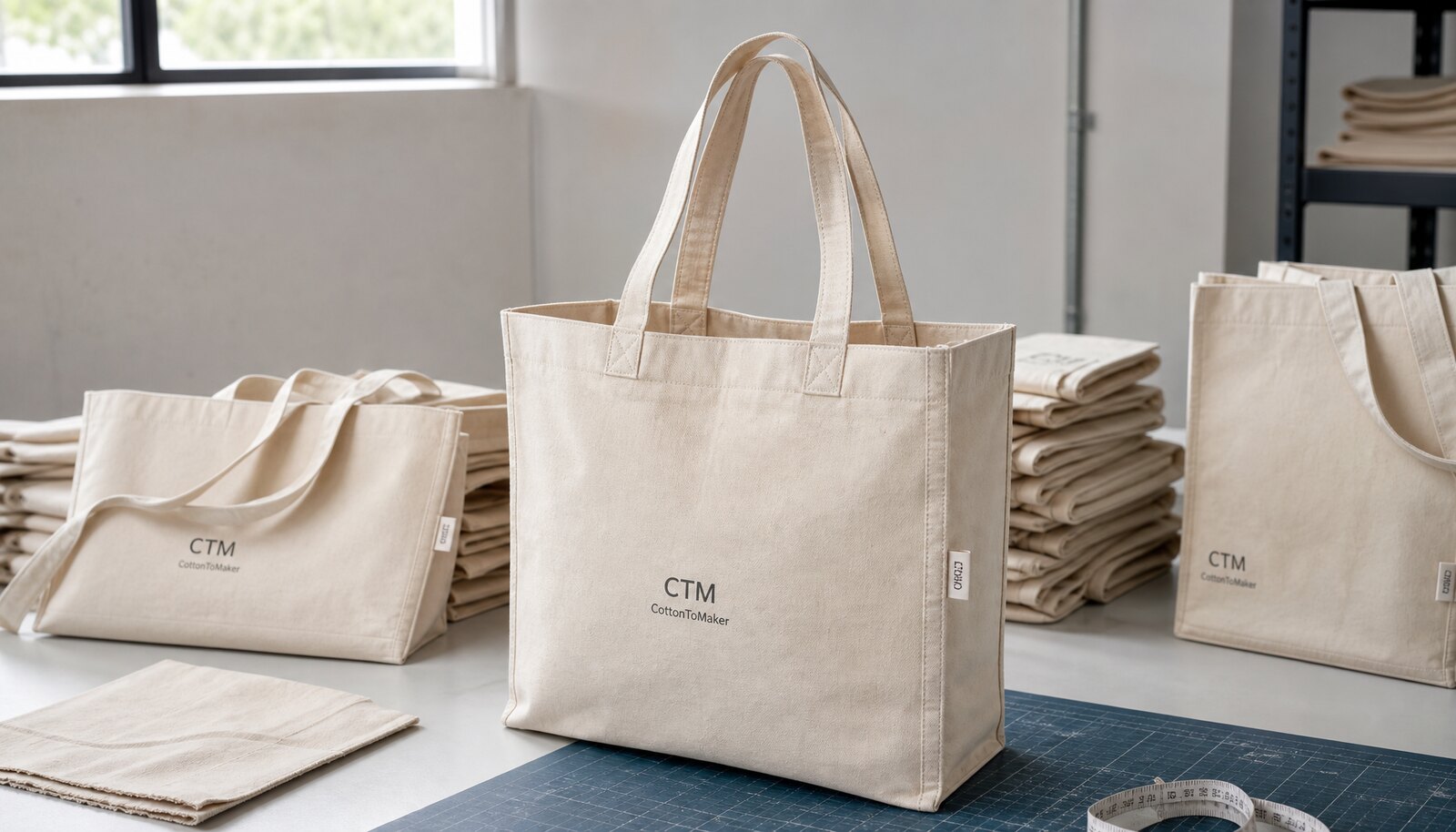
1) Start With the Box, Not the Tote
For subscription-box programs, the first sourcing question is not whether the tote looks attractive. It is whether the bag fits the carton, moves through the packing line without slowing labor, and arrives with enough structure to feel intentional. A tote that is too wide, too bulky, or too stiff can turn a low-cost insert into a higher-cost program once you add upsized cartons, extra handling, and rework at fulfillment.
The tote also has a commercial role that should be defined before quote requests go out. Some bags function as a gift with purchase. Others act as a reusable retail-style item that should survive repeated use. Some are just a branded insert that creates perceived value when the box is opened. Those are different requirements even when the bag shape is similar.
Treat box fit as a gate, not an afterthought. Measure the actual shipper or subscription carton, define the maximum folded footprint, and test the tote with the other box contents in place. A bag with a gusset, boxed corners, or thick handles can occupy much more space than the flat drawing suggests. That matters because dimensional weight, carton count, and packing speed all affect total landed cost.
Useful procurement decisions usually come from asking where the tote sits in the BOM. If it adds only a little to the unit price but slows pack-out, the total economics can worsen. If it looks cheap inside a premium subscription box, the unboxing experience can suffer. The right answer is rarely “lowest quote only.” It is the bag that fits the box, the line, and the brand standard with the fewest surprises.
- Define the tote’s role before requesting quotes.
- Measure the actual carton and test the folded tote inside it.
- Treat packing labor and dimensional weight as part of the spec.
- Include the other subscription items in the fit test, not the tote alone.
2) Write a Fabric Spec That Stops Quote Drift
A canvas quote is only useful when the fabric is defined tightly. If the RFQ just says “canvas,” suppliers may quote very different materials: light canvas, duck canvas, washed canvas, or a blend that looks similar in a product photo but behaves differently in sewing and wear. For most subscription programs, 10-12 oz canvas, or roughly 340-420 GSM, is a practical starting band because it balances structure and packability.
Weight alone does not describe the material. State the finish and the look you want: natural, bleached, dyed, washed, or bio-finished. These choices affect color consistency, handfeel, shrink behavior, and how the print sits on the fabric. Natural canvas often shows slub and weave variation, which can be acceptable for a library-tote look. If the brand wants a cleaner premium surface, say that explicitly rather than assuming the factory will infer it.
The next issue is lot control. A supplier can quote the same nominal GSM while delivering different results from one roll or lot to another. Ask how they check incoming fabric, whether they measure GSM on receipt, and how they handle shade variation if more than one roll is needed. If the order may require a second roll or a reorder, ask whether they can hold the same fabric source or whether substitutions are possible.
Traceability is worth asking for even on simple totes. If the supplier can name the mill or provide the lot document for the actual fabric being quoted, that is a good sign they are controlling the source instead of merely reselling stock. It also helps later if you need to shade-match a reorder or investigate a complaint at lot level.
- Specify oz and GSM together, plus finish and acceptable variation.
- State whether slub, flecking, or weave variation is acceptable.
- Ask how the supplier controls shade and roll-to-roll consistency.
- Request the mill name or lot document for the actual material quoted.
3) Construction Is Where Tote Programs Usually Fail
Most tote failures come from construction, not fabric. A bag can look sturdy on a sample table and still fail if the handles twist, the seam allowance is too narrow, or the reinforcement is only decorative. Library-style totes are simple by design, which means the weak points are easy to overlook: handle bases, bottom corners, and the seam transitions around any gusset.
Handle design deserves specific attention. Ask for handle width, finished handle drop, and the reinforcement pattern at the attachment point. A common practical handle drop is roughly 8-11 in (20-28 cm), but the right number depends on whether the tote is hand-carried, shoulder-carried, or packed flat into a subscription box. Narrow handles save cost but can feel cheap; longer handles improve usability but may add bulk.
Reinforcement should be written into the spec, not left to the factory’s default. Ask whether the supplier uses cross-stitch, box-stitch, or bar-tacks, how many rows are used at the stress point, and whether the attachment anchors into the body seam. If the bag has a boxed bottom, define that construction and the seam allowance. If it has a side gusset, confirm the gusset depth and whether the seam is fully enclosed.
Stitching should also be measurable. You do not need to dictate machine settings, but you do need a clear standard for seam appearance and durability. Ask the supplier to state the stitch density on the main seam and the reinforcement areas, then inspect sample pieces for skipped stitches, loose thread tails, and uneven tension. Small construction defects become expensive when they show up in a retail-facing subscription program.
- Write handle drop, handle width, and reinforcement into the spec.
- Require a defined reinforcement method at the handle load point.
- State whether the body is flat-seamed, boxed, or gusseted.
- Check stitch density and seam appearance on the sample, not just the photo.
4) Choose Decoration Based on the Artwork, Not the Cheapest Method
Decoration is easy to oversimplify. A logo may look similar in a PDF whether it is screen printed, transferred, or embroidered, but the production result is not the same. The right method depends on the artwork complexity, the quantity, and the visual standard the brand needs. For a subscription-box insert, the usual goal is a clean, durable mark that reads well on canvas and survives folding and handling.
Screen printing is often the best fit for simple one-to-three-color graphics and repeat orders. It usually delivers the cleanest bulk economics once screens are made. But it is less suited to tiny text, gradients, or very fine lines. Heat transfer or digital transfer can handle smaller runs or detailed art, but the print can feel layered and may be more vulnerable to edge lift or rub marks. Embroidery can feel premium, but it adds cost and can distort lighter fabric if the design is too large.
The key procurement risk is repeatability. Ask for a strike-off or actual fabric sample if the design has fine text, negative spaces, or color-sensitive branding. If color consistency matters, require Pantone references and ask how ink matching is controlled between runs. If the tote will be folded for box packing, ask how the print looks after folding and handling. A clean print on a flat sample is not enough if the decoration wrinkles badly once packed.
On natural canvas, opacity matters. Light inks can look weak if the supplier under-applies them, while dark inks can crack or feel heavy if over-applied. The RFQ should state the print area, color count, placement tolerance, and whether the ink must match an approved sample under daylight conditions. That gives procurement and the factory the same target.
- Match the print method to the artwork complexity and order quantity.
- Require a strike-off or physical sample for fine text or color-sensitive art.
- State print placement tolerance and Pantone references if color matters.
- Check the decorated tote after folding, not only before packing.
5) Vet the Supplier for Real Operating Control
Supplier route affects more than price. It affects whether your team can trust the answers about fabric, printing, schedule, and reorders. A direct factory is usually strongest for repeated canvas tote programs because it can control cutting, sewing, and decoration more tightly. A trading company can be helpful when the order includes multiple items or when you want one commercial contact. A local converter can work well for short-run launches or domestic deliveries.
What matters is whether the supplier can prove how the tote is made. If they claim to be the factory, ask for sewing-line photos, print equipment details, and a clear explanation of which steps are done in-house. If they are brokering production, ask who owns incoming QC and who signs off on fabric lot acceptance. A business license alone does not tell you whether the supplier can answer technical questions about stitch density, print registration, and shade control.
Ask for practical fabric-source information. The mill name or lot document for the quoted canvas is more useful than a generic promise of good quality. If the canvas is dyed or washed, ask how shade consistency is checked and what happens if one roll differs from another. If stock fabric is being used, ask whether the stock is reserved or could be substituted later. If it is made to order, ask how availability is confirmed before lead time is committed.
Compliance and traceability should be requested early if your program requires them. Depending on the market and brand standard, that may include fabric content details, restricted-substance statements, or packaging material information. The goal is simple: if there is a claim later, you want the carton, lot, and material source to be identifiable without guesswork.
- Confirm who cuts, sews, prints, and packs the tote.
- Ask for mill or lot documentation for the actual canvas quoted.
- Verify who owns QC if the supplier is an agent or trader.
- Request compliance and traceability information before award.
6) Make Sample Approval a Production Gate
A tote sample should be a decision point, not a courtesy item. Photos and mockups are useful only as early references. The sample that matters is a physical pre-production sample made from the intended canvas, with the intended decoration method, trim, and folding format. If the supplier cannot produce that sample before bulk, the buyer is accepting avoidable uncertainty.
Review the sample against the spec, not against memory. Measure body dimensions after pressing, confirm gusset depth and handle symmetry, and inspect seam straightness and thread trimming. Check how the bag behaves when it is folded into the target carton. If the tote has a natural canvas look, compare it against the desired aesthetic standard: some brands want a raw, textured look; others need a smoother, more uniform surface.
Add basic load testing to the review. Fill the bag with a realistic weight, then pull the handles and inspect for seam creep, distortion, or loose stitching. If the tote is going into a subscription box, test the actual pack-out sequence. A sample can look fine on a table and still be awkward in a kitting workflow. That kind of issue usually shows up only when the bag meets the real operation.
Approval should also be documented. If the sample is accepted with notes, those notes need to be attached to the PO and the final spec sheet. Otherwise the factory may treat later changes as new requirements. Sample approval should reduce ambiguity, not create it.
- Approve a physical pre-production sample made from the intended materials.
- Measure the sample after pressing and compare it to the final spec.
- Test load, handle behavior, and foldability in the actual box.
- Attach approval notes to the PO so the sample record is not lost later.
7) Packing, Cartons, and the Real Cost of Fulfillment
Packing can change tote economics quickly. A bag that seems inexpensive at the factory can become costly if it needs to be refolded, pressed, or repacked by warehouse staff. That is why the packing spec should be built around fulfillment labor, not only around shipping protection. Ask how the tote will be folded, whether it will be polybagged, and how many pieces go into each inner pack and master carton.
Carton design matters because receiving and cross-docking are part of the cost. Ask for carton dimensions and gross weight early. If your warehouse has handling limits, build to those limits before production begins. A carton that is too large or heavy can create palletizing issues and slow receiving. The same is true if the shape forces extra rework at the table. Even a small increase in unpacking time can erase a unit-price advantage at scale.
Polybags should be a deliberate choice. For some brands they protect the print and keep the bags neat in transit. For others they add cost, waste, and unpacking labor. If polybags are used, define thickness, venting if needed, and the orientation of the print inside the bag. If polybags are not used, ask what protection the factory will provide instead, such as tissue wrap or carton dividers.
A useful packing spec includes the fold sequence, packed dimensions, carton count, and a photo or sketch of the folded tote in the carton. That gives the warehouse something concrete to test and helps procurement estimate labor before the order is placed. For a subscription-box program, packing is part of the product design, not a post-production detail.
- Write fold sequence, inner pack count, and master carton count into the spec.
- Request carton dimensions and gross weight before bulk approval.
- Decide whether polybags are required, optional, or prohibited.
- Test the folded tote inside the actual subscription box and shipper.
8) Use QC Rules That Can Actually Be Enforced
Quality control works best when it is specific. For wholesale tote purchases, define the inspection method, defect list, and acceptance threshold before production starts. An AQL plan is a practical tool because it gives both buyer and factory the same sampling rule. Many consumer accessory programs use AQL 2.5 for major defects and 4.0 for minor defects, but the right target depends on the tote’s role and the brand’s tolerance for visible variation.
The defect categories should be concrete. Critical defects are the ones that make the tote unsafe, unusable, or noncompliant: severe seam failure, missing handle attachment, major contamination, or the wrong material. Major defects are customer-visible or functionally serious: out-of-tolerance size, wrong print placement, weak reinforcement, obvious shade mismatch, or too many skipped stitches. Minor defects are cosmetic but still countable: loose threads, small fold marks, or slight carton-mark issues.
Inspection should cover fabric, sewing, print, and packing. Sample cartons from different pallet positions, not only the top layer. Measure finished dimensions, inspect handle attachment, verify print placement, and compare the lot against the approved sample. If the order has multiple colors or print versions, inspect each variant separately. One acceptable variant does not prove the whole order is acceptable.
The PO should also define the action if a lot misses the standard. State whether the factory must rework, reprint, re-pack, or hold the shipment. For a subscription box program, the most important outcome is that receiving gets the right SKU, the right carton labels, and the right folded product without extra sorting. QC is not only about defects; it is about protecting downstream labor.
- Use a written AQL target before production, then define what counts as critical, major, and minor.
- Inspect multiple cartons from different pallet positions.
- Check each color or print version separately if there are variants.
- Tie rework, reject, or hold decisions to the PO and defect list.
9) Compare Quotes on Landed Cost, Not Headline Price
Two suppliers can quote the same tote and still land very differently once setup fees, cartons, freight, duty, and domestic delivery are added. For canvas totes, freight and packing labor can outweigh a small difference in ex-factory pricing, especially if the bag is heavier or packed less efficiently. Compare suppliers on the same Incoterm and destination basis so the numbers are actually usable.
Separate one-time charges from repeat costs. One-time items can include screens, plates, sample fees, lab dips, and special packing setup. Repeat costs are the unit price, carton price, and freight for each reorder. A very low unit price can look attractive until the buyer sees the setup fees or the warehouse cost of handling the carton format. That is why reorder economics matter as much as first-order economics.
Add packing labor to the comparison if the tote is going to a fulfillment center. For example, one supplier might ship flat and cleanly folded, while another requires repacking or sorting by carton. The second option can be more expensive overall even if the factory price is lower. Ask the warehouse team to estimate any extra seconds per unit before awarding the order.
A practical comparison score includes price, quality confidence, lead time, and operational fit. Operational fit means foldability, carton efficiency, traceability, and how much internal labor the tote creates. For subscription-box use, the best supplier is often the one that minimizes disruption, not the one that wins on unit price alone.
- Compare quotes on the same Incoterm and destination basis.
- Separate one-time setup fees from repeat-order unit costs.
- Ask the warehouse to estimate added kitting labor per tote.
- Score suppliers on price, quality confidence, lead time, and operational fit.
10) Use a Short RFQ Checklist That Covers the Decisions That Matter
A useful RFQ for canvas tote sourcing should read like a procurement document, not a marketing brief. Start with the product spec: dimensions, fabric weight, finish, construction, reinforcement, handle drop, print method, and tolerance. Then add packing: fold format, polybag decision, inner pack count, carton size, and carton marks. Finally add commercial terms: MOQ by variant, sample fee, lead time, payment terms, and the exact quote basis.
The best RFQs also force the supplier to answer the risk questions. Ask where the canvas comes from, whether the supplier sews and prints in-house, how shade variation is controlled, and what inspection standard they use. Ask for a physical sample, not only a digital proof. Ask for landed-cost detail, not just ex-factory pricing. Ask for traceability. These items turn a decorative tote order into a manageable wholesale program.
It is also useful to create a one-page internal approval sheet before award. That sheet should show the approved sample photo, the final spec, the QC plan, and the packing plan. Then merchandising, sourcing, and fulfillment are reviewing the same document. That reduces revisions and keeps assumptions from leaking into production.
The final rule is simple: do not award the order until the supplier can quote the bag you actually want to receive. If they cannot answer fabric-source, reinforcement, carton, print, or sample-approval questions clearly, the price is only a placeholder. In this category, exact specs produce useful quotes.
- Use a one-page approval sheet with the final spec, sample, QC plan, and packing plan.
- Make the supplier answer traceability and in-house capability questions before award.
- Separate product spec, packing spec, and commercial terms in the RFQ.
- Do not accept placeholder pricing that omits freight, cartons, or setup costs.
Specification comparison for buyers
| Supplier/spec choice | Typical price and lead-time profile | Best-fit use case | Tradeoff / risk to verify |
|---|---|---|---|
| Direct factory, in-house sewing and printing | Usually strongest base pricing on repeat orders; lead time often depends on fabric availability, print complexity, and sampling approval timing | Repeat subscription box programs, stable artwork, and buyers who need tighter control over fabric, stitching, and packing | Confirm the factory actually controls cutting, sewing, and printing; ask who handles incoming fabric checks and final packing |
| Trading company / sourcing agent | Often higher than a direct factory quote because of coordination and margin; timing depends on how many parties are involved | Launches with multiple SKUs, buyers who want one commercial contact, or teams without technical sourcing staff | Verify who the real manufacturer is, who owns QC, and whether the agent can answer construction and test questions without delay |
| Local converter / domestic printer | Higher unit cost but easier communication and faster sample turnaround for small runs | Short-run seasonal inserts, urgent replenishment, or programs that need domestic delivery and low coordination overhead | Check whether they make the tote or only decorate a blank; confirm capacity and print-method limits |
| 10-12 oz natural canvas, about 340-420 GSM | Often the practical middle ground for feel, structure, and packability | Most subscription box inserts that need a reusable look without creating excess weight or bulk | Ask for finished fabric behavior after cutting and sewing, not only greige fabric weight |
| 12-14 oz canvas, about 420-475 GSM | Usually higher material cost and heavier cartons; may add handling and shipping cost | Premium retail-style add-ons or bags meant to carry heavier contents | Test carton fit, gross weight, and kitting speed before release |
| Screen print, 1-3 spot colors | Setup is efficient for repeat orders; unit economics improve with volume | Simple logos and brand marks where durability and clean edges matter more than image complexity | Review opacity, placement, and fine-line performance on actual canvas |
| Heat transfer or digital transfer | More flexible for smaller runs or complex art; pricing can move with size and quantity | Launches, low-MOQ test runs, or designs with fine detail | Check rub resistance, edge lift, and how the print looks after folding |
| Flat-pack, carton-matched inner pack | Best for fulfillment labor control and receiving efficiency | Programs where every second of packing time matters | Verify folded dimensions, count per inner pack, and whether the bag needs pressing or repacking |
Buyer checklist before sampling
- Define the tote’s role in the subscription box: giveaway, retail-style add-on, premium insert, or repeat-use bag.
- Write the finished dimensions into the spec: body width, body height, gusset depth, handle drop, and handle width.
- State fabric weight in both oz and GSM, plus finish, color, and whether slub or natural variation is acceptable.
- Specify construction details: seam type, seam allowance, handle attachment method, and reinforcement pattern.
- Lock the artwork spec before quoting: print method, print area, color count, Pantone targets, and minimum readable line size.
- Ask for MOQ by variant, not just a headline MOQ; separate MOQ for color, print version, trim, and packing format.
- Require a physical pre-production sample made from the intended fabric and intended decoration method.
- Build a box-fit test into the schedule using the actual shipper and the other subscription items, not the tote alone.
- Specify packing precisely: fold format, polybag yes/no, inner pack count, master carton count, and carton marks.
- Request destination-based landed-cost quoting on the same Incoterm so freight, duty, cartons, and domestic delivery can be compared cleanly.
Factory quote questions to send
- What is the finished fabric weight after cutting and sewing, and what variation do you allow from lot to lot?
- Where is the canvas sourced, and can you share the mill name or lot document for the actual material being quoted?
- Do you cut, sew, and print in-house, or is any step outsourced? If outsourced, who performs QC at that step?
- What is the finished handle drop, handle width, and reinforcement method at the handle base?
- What seam allowance do you use on the body seams, and how do you control skipped stitches or seam puckering?
- What print method do you recommend for this artwork, and what are the limits for size, color count, and line thickness?
- What is the MOQ by color, print version, and packing format? Does the MOQ change if we approve a second dye lot or second artwork version?
- What is included in the unit price: fabric, sewing, print, label, folding, polybag, inner pack, master carton, and inland handling?
- What sample rounds are included, what are the sample fees, and how long do you need for a physical pre-production sample and strike-off?
- What inspection method do you use for bulk goods, and can you share the critical, major, and minor defect list before we place the order?
Quality-control points to confirm
- Finished dimensions: measure at least 5 pieces per lot after pressing, not while the bag is creased in transit. Many buyers use about +/- 0.25 in (6 mm) on body dimensions and +/- 0.5 in (12 mm) on handle length unless the program needs tighter control.
- Fabric quality: inspect weave density, slubs, holes, oil marks, discoloration, and lot consistency before print approval. If the canvas is dyed, compare the approved shade against bulk fabric from the same lot.
- Stitch quality: check seam allowance, stitch density, and skipped stitches. Require a documented pull or load test on sample pieces rather than relying on a visual inspection alone.
- Handle attachment: inspect both sides of each handle for symmetry, reinforcement placement, and consistent stitching. Missing reinforcement or a loose base should be treated as a serious defect.
- Print quality: verify placement, opacity, color match, cure quality, and rub resistance. On natural canvas, light inks can look weak; dark inks can crack or feel heavy if over-applied.
- Packing quality: count inner packs, verify carton marks, and confirm folded size matches the approved box-fit test. A tote that needs repacking at the fulfillment center is a commercial defect even if the sewing is fine.
- Defect thresholds: use a written AQL target with the factory before production starts. Many consumer accessory programs use AQL 2.5 for major defects and 4.0 for minor defects, but tighten the plan if the tote is premium or customer-facing.
- Acceptance rule: define critical, major, and minor defects in the PO. Critical defects should be zero tolerance; major defects should trigger hold or rework if they exceed the agreed limit; minor defects should be counted rather than waived informally.
- Traceability: each carton should carry SKU, color, size, PO number, and lot/date code. If there are multiple dye lots or print runs, carton labels should identify them clearly.