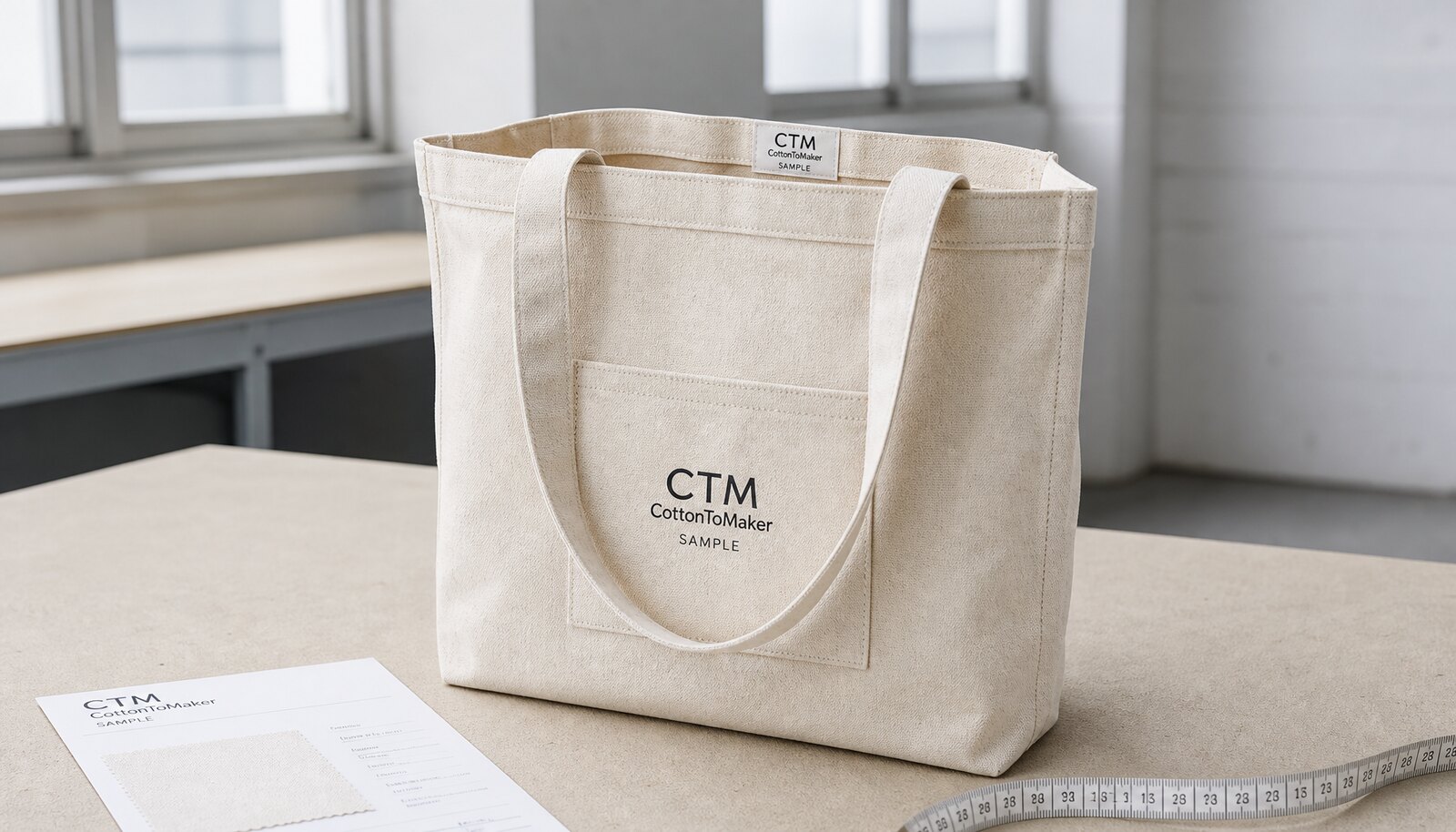
Why subscription-box canvas totes need a buyer-specific inspection plan
A canvas library tote bag for a subscription box should be sourced like a packaging component, not like a generic promotional giveaway. In a subscription program, the tote is part of the customer’s first impression. It may be the visible outer gift, the reusable carrier for inserts, or the part of the box most likely to be reused after unboxing. That means the bag has to do several jobs at once: look clean on arrival, pack efficiently in a fulfillment workflow, hold up to repeat use, and match the brand presentation every time the box ships.
That combination makes quality control more important than it would be for a one-time event tote. A bag that is slightly off-center, poorly folded, or marked with dirt can lower the perceived value of the entire box. A weak handle or stretched seam may not fail in the first delivery, but it can still trigger complaints after the customer uses the tote a few times. For procurement teams, the right approach is to define measurable standards before requesting quotes, then verify the same standards again with sample approval, in-process checks, and final inspection.
The most common mistake is treating the tote as a low-risk accessory. In practice, the tote often moves through the most handling steps: fabric cutting, printing, sewing, folding, bulk packing, warehouse receiving, and repacking into the subscription box. Every one of those steps creates an opportunity for dirt, size drift, stitching defects, or carton mismatch. A serious inspection plan has to reflect that reality rather than relying on a generic factory promise.
- Treat the tote as a presentation item and a functional carry item at the same time.
- Expect more handling than a normal retail tote order because the bag travels through fulfillment and subscription pack-out.
- Define quality gates before PO placement so the supplier can quote against a real standard.
Start the RFQ with the exact bag spec, not a broad idea
The quality of the quote depends on the clarity of the spec. For a subscription-box tote, the buyer should define the size in finished dimensions, the canvas in oz or GSM, the color, the print method, the handle construction, and the intended pack-out load. If those items remain open, suppliers will quote different assumptions and the comparison will be misleading. One factory may assume a lighter weave, another may assume thicker webbing, and a third may quote a simpler print process than the brand actually needs.
For most programs, 10 oz to 12 oz cotton canvas is a practical baseline because it gives enough structure without driving the price and freight too high. But that range is not a rule. If the tote must carry heavy books, a dense product kit, or rigid inserts, the buyer may need heavier canvas or stronger reinforcement. If the bag is mainly decorative and will be flat-packed with light contents, the lower end of the range may be enough. The key is to tie the fabric choice to the real use case rather than to a generic tote category.
Pre-shrunk fabric matters whenever the pack-out depends on fixed dimensions or repeated folding. Without pre-shrinking, the bag can shift after cutting, pressing, or storage, and the final size can drift outside the approved window. If the supplier cannot confirm whether the canvas is pre-shrunk, ask how they manage shrinkage in cutting and whether their sample reflects the same treatment as bulk production. That question is especially important when the tote has a precise fold pattern or needs to fit into a subscription box sleeve.
- Write finished size, not only nominal size.
- Match fabric body to the intended content weight and brand position.
- Ask specifically whether the canvas is pre-shrunk or controlled another way.
How to compare supplier routes without being fooled by price alone
Procurement teams often compare a direct factory and a trading company as if they were the same supply route. They are not. A direct factory usually gives tighter control over cutting, printing, sewing, and final packing. That matters when the tote must stay consistent across monthly replenishment cycles or when corrective action needs to happen quickly. The buyer can speak to the team that actually makes the goods and can verify where defects are introduced.
A trading company can still be useful when the buyer wants multi-item consolidation, easier administration, or access to several product categories through one account. The tradeoff is that quality ownership may be less transparent. The trading layer can also hide the real fabric source or make the correction loop slower if the sample misses the approved standard. If the supplier cannot explain who owns each production step, the price advantage may not be real.
The practical way to compare routes is to ask a process question set: who sources the canvas, who prints, who sews, who packs, who checks the cartons, and who approves rework. If the same company owns all of those steps, it is easier to enforce consistency. If the route is fragmented, the buyer should expect a stronger paper trail, more sample checkpoints, and more detailed defect acceptance language in the PO.
- Direct factory is usually better for repeated replenishment and correction speed.
- Trading route can help with mixed baskets of products, but process ownership must be clear.
- Ask who handles each production step; do not stop at the unit price.
Use a robust quote comparison framework, not a thin price table
A quote for canvas library tote bags should break the project into the parts that actually drive cost and risk. That means fabric spec, print setup, sewing complexity, packing, carton size, sample policy, and lead time assumptions. If those items are bundled into one number, it becomes hard to identify what the supplier changed to reach a lower price. A cheap quote can easily hide lighter canvas, fewer reinforcement stitches, simpler packaging, or a lower inspection scope.
For subscription-box programs, packing format often changes the economics more than buyers expect. Bulk flat packing is usually the best fit when the tote is inserted into the box later by a fulfillment center. Individual polybags may be justified if the bag needs retail presentation or extra dirt protection, but they add labor and freight cube. If the carton is overfilled with air because the tote is folded inefficiently, the freight rate can rise even when the piece price looks attractive.
The best comparison framework is to force every supplier to quote against the same assumptions. Ask for the same finished dimensions, the same fabric weight, the same print method, the same label plan, the same carton target, and the same inspection scope. Then compare landed cost, not just ex-factory price. Landed cost should reflect the actual carton weight, carton count, expected freight cube, and the cost of the required sample or testing. That is the only way to see whether the lower quote is a true saving or just a narrower scope.
- Standardize the RFQ so every supplier is quoting the same construction.
- Include sample charge, packaging format, and carton dimensions in the comparison.
- Use landed cost and freight cube to evaluate the actual economics.
Print method, art limits, and the details that prevent rejected samples
Print method choice should be driven by the artwork and the canvas texture, not by habit. Screen print is often the most practical option for subscription-box totes because it gives strong color density and holds up well on simple logos or text. It is usually the most cost-effective method for recurring orders where the artwork does not change much. But screen print also has limitations: it can struggle with tiny type, delicate line work, or artwork that depends on smooth gradients.
That is why a digital proof is not enough. The buyer should ask for a strike-off or print sample on the actual production canvas. The same logo can look clean on a screen and rough on textured cloth if the weave is too open or the ink deposit is uneven. Ask the supplier to confirm minimum line width, smallest font size, and placement tolerance. If the logo is close to a seam or pocket edge, the risk of misalignment rises, and the acceptable window should be written in the approval note.
Heat transfer or other decoration methods may be appropriate when the artwork needs more detail, but the buyer should verify the finish, hand feel, and durability on the actual fabric. Some methods look sharp at first but feel stiff or show edge lift after handling. Woven labels or embroidery can create a premium impression, yet they add sewing steps and can affect the flatness of the tote when packed into a box. The correct method is the one that fits both the artwork and the fulfillment process.
- Use screen print for simple, repeatable artwork where cost control matters.
- Demand a physical strike-off on the production canvas whenever the art is not trivial.
- Define minimum line width and font size so the supplier knows the real print limit.
Factory-process questions that reveal whether the tote can be made consistently
A serious tote buyer should ask process questions that expose how the factory really works. Cutting accuracy is the first one. If the markers are not laid out cleanly or if the fabric is not tensioned evenly, size drift can begin before sewing starts. Printing is the second. If the print line does not control registration well, the logo can shift from panel to panel. Sewing is the third. A factory that cannot explain stitch count, seam allowance, and reinforcement method is not likely to hold a stable spec across the whole lot.
Ask how the factory controls handle attachment. For canvas totes, handles should normally be reinforced with X-box stitching, bar-tacks, or another recognized reinforcement pattern. The supplier should be able to state where the reinforcement sits, how many passes are used, and whether the same thread is used throughout. If the handles are simply sewn straight without reinforcement, the bag may still pass a casual visual review, but it is more likely to fail when the customer carries heavier inserts.
Also ask whether the supplier keeps retention samples from previous lots and whether they can compare the new lot against the earlier approved sample. That is one of the most practical ways to catch drift in canvas hand feel, print density, or stitch appearance. If they do not keep retained samples, the buyer should keep one sealed golden sample on their side and require the factory to label the bulk run with the same style code, color code, and lot reference.
- Ask how cutting, printing, sewing, and packing are controlled step by step.
- Confirm reinforcement type on handles and corners, not just “strong stitching.”
- Use retained samples to check drift between the approved sample and later production lots.
Sample approval: the control point that should not be rushed
The sample is the control standard, not a courtesy item. A pre-production sample should be made from the same or equivalent production fabric, with the same print method, the same thread color, and the same packing approach. If the factory changes the fabric weight, handle tape, or label placement for the sample, the buyer should treat it as a reference only, not as final approval. A photo of a sample is even less reliable because it cannot show hand feel, seam density, or odor.
The sample review should combine visual checks and measurements. Measure finished width, height, gusset, handle length, and handle drop. Place the actual subscription insert load inside the bag and check whether the tote still folds correctly and closes neatly for the pack-out process. If the box uses a specific folding pattern, test that exact fold on the sample. The goal is not only to approve the bag but to approve how it behaves in the box line.
Keep one golden sample sealed and dated. Record the approved artwork placement, fabric spec, packing format, and carton pack. When a production lot later needs review, the golden sample gives the warehouse or QA team a physical baseline. If the supplier sends a replacement sample or revises the art, the earlier version should be clearly retired rather than left floating in email threads. That prevents confusion when several shipment cycles are running at the same time.
- Approve from a physical sample, not from photos alone.
- Measure the sample with the actual insert load if the tote will be packed that way.
- Seal and date a golden sample so later inspections have a real reference.
Inspection checklist for canvas library tote bags for subscription boxes
A field-ready inspection plan should be written in the same order the goods will be checked. Start with documentation, then cartons, then bag construction, then print and finishing, then quantity and packing. That sequence matters because it helps inspectors catch systemic issues early. If the style code or carton count is wrong, there is no point in spending time on fine stitching checks until the identification problem is resolved.
Use an AQL-based sampling plan rather than eyeballing the shipment. For most B2B apparel-accessory purchases, a common starting point is a general inspection plan with separate defect classes for critical, major, and minor issues. The exact AQL depends on buyer policy and the supplier relationship, but the important point is to define it in advance and to apply it consistently. Critical issues usually include broken handles, open seams, heavy stains, major odor, or wrong artwork. Major issues usually include size failure, crooked print, weak reinforcement, or poor label position. Minor issues are typically loose threads, small fold marks, or slight shade differences that do not materially affect function or presentation.
Measurement tools should be named in the inspection instruction so the factory knows how checks will be done. A tape measure is enough for body dimensions and handle drop. A ruler or caliper can help when checking print placement, seam spacing, or tiny label offsets. A visual light box or strong white light helps reveal dirt, ink pinholes, and weave irregularities. If the bag is dyed, compare color under the same lighting conditions every time. If the tote carries odor-sensitive retail products, include an odor check after cartons are opened and the bag has had time to air for a short period.
A practical inspection checklist should include the following sequence on every lot: - Check carton marks against the PO and packing list. - Open cartons randomly across the lot, not only from the top layer. - Verify bag style, color, size, and print against the approved sample. - Measure dimensions on sampled units and record any variance. - Inspect stitching, reinforcement, and loose thread length. - Inspect print position, clarity, ink coverage, and registration. - Check odor, stains, dust, mold, and foreign fibers. - Count inner packs and master cartons to confirm quantity. - Review carton condition, tape integrity, and moisture damage before release.
If a lot fails, the escalation path should already be written. For serious issues, the buyer may require rework, replacement, or shipment hold until corrective action is approved. For borderline issues, the buyer may allow sorting or partial acceptance with a written concession. That decision should depend on the defect class and on whether the tote is a presentation item, a functional carrier, or both.
- Use AQL-based sampling rather than visual judgment alone.
- Inspect cartons first, because packing errors can make the rest of the check meaningless.
- Write the escalation path in advance so failed lots do not stall the launch plan.
Defect examples and measurement methods buyers should actually use
Good inspection guidance becomes much more useful when it names the defect and the measurement method. For example, size should be checked on a flat surface with the bag relaxed, not stretched by hand. The inspector should measure the body width at the widest approved point, the height from top edge to bottom seam, and the gusset at the deepest point if present. Handle drop should be measured from the top edge of the body to the inside apex of the handle, not estimated by eye. If the supplier uses a folded top edge, that fold should be included in the measurement standard so the numbers are consistent.
Stitch quality should be checked with a visual count over a short measured segment. The buyer does not need to over-engineer the method, but the factory should know what stitch density is expected and where reinforcement is required. A skipped stitch in a load-bearing area is not the same as a loose decorative thread near the top edge. That distinction matters when the QA team decides whether a defect is minor or major.
Print quality also needs objective boundaries. For canvas, inspect at normal viewing distance and at close range. At normal distance, the logo should look centered, legible, and balanced. At close range, the buyer should check for pinholes, off-registration, ink bleed, and edge jaggedness. If the artwork has a brand color match requirement, compare against an approved swatch under consistent lighting. Do not rely on a phone photo because camera settings can hide subtle tone shifts.
Color and odor are often overlooked until late in the process. For natural or bleached canvas, color variation should stay within the approved sample range and should not be obvious across the same carton. For dyed canvas, the buyer should ask about shade banding, crocking, and batch-to-batch consistency. Odor is harder to quantify, but the inspection note should still define what is unacceptable. A strong chemical smell, mildew smell, or oil smell is a legitimate rejection reason in a customer-facing box program, even if the sewing is perfect.
- Measure dimensions on a flat, relaxed bag and record each key dimension separately.
- Count stitch density and distinguish load-bearing defects from cosmetic loose threads.
- Inspect print under both normal distance and close view to catch misregistration and ink defects.
Carton audit steps that protect receiving, warehousing, and launch timing
Carton inspection is not just a logistics detail; it is part of quality control. A tote can pass sewing and print checks and still arrive unusable if the cartons were packed badly, mislabeled, or damaged in transit. Subscription-box buyers often receive goods directly into a warehouse or fulfillment center, where a receiving error can create downstream delays before the launch. That is why the carton audit should be written as a formal step, not left to the freight forwarder.
At minimum, verify style, color, quantity, carton number, and lot reference on every master carton label. If the buyer uses a case-pack plan, the carton should match that count exactly. If the supplier ships mixed counts or changes the carton load without approval, inbound receiving becomes slower and short counts are harder to identify. Check that tape is secure, corners are not crushed, and cartons are dry and free from water marks. Reused or damaged cartons can be acceptable only if the buyer explicitly allows them, which most retail-facing programs should not.
A carton audit should also include a cube and gross-weight check against the quote. If the cartons are much heavier than expected, freight costs can rise. If they are much lighter, that may suggest under-packed goods or a packing mismatch. Recording the actual carton dimensions and gross weight helps procurement compare suppliers more accurately on landed cost, and it gives logistics a better basis for booking freight. This is one of the simplest ways to avoid a quote that looks good on paper but performs poorly in transit.
- Verify label content, carton count, and lot traceability before release.
- Check carton condition for moisture, crush, and tape failure.
- Record actual carton dimensions and gross weight to validate freight assumptions.
Specification comparison for buyers
| Decision area | Buyer-ready recommendation | Why it matters for subscription boxes | Factory-side tradeoff to watch |
|---|---|---|---|
| Fabric construction | 10 oz to 12 oz cotton canvas with consistent weave, preferably pre-shrunk if the pack-out depends on fixed dimensions | Gives enough body for books, inserts, and product bundles without feeling flimsy in a curated box | Lighter canvas can save cost but may show more weave irregularity and print show-through; heavier canvas increases freight and carton cube |
| Canvas finish | Natural or bleached canvas for base programs; dyed canvas only when the brand system justifies the extra dye-lot control | Keeps color consistent across repeated monthly or seasonal launches | Dyed fabric adds shade variation risk, longer sourcing time, and possible crocking if the finish is weak |
| Print method | 1-color or 2-color screen print for stable art; woven label or embroidery only when premium positioning supports the extra cost | Most subscription totes use simple logos and need repeatable placement and clean edges | Screen print is cost-effective but weak on fine text; transfer methods can look sharp but may change hand feel or crack if quality is poor |
| Handle design | Self-fabric handles or matching webbing with reinforced X-box or bar-tack stitching | Improves carrying comfort and supports repeated reuse after the box is opened | Longer handles raise material use; short handles can make the tote awkward for shoulder carry |
| Bag structure | Flat tote for lightweight insert kits; gusseted tote when the box contents must stand up or carry more volume | Subscription boxes often need predictable folding and compact pack-out | Gussets improve capacity but add sewing complexity and size variance risk |
| Supplier route | Direct factory for repeated replenishment; trading company only if you need multi-item consolidation or smaller administrative burden | Direct communication is easier when artwork, QC, and correction cycles matter | Trading layers can blur responsibility for defects, fabric source, and corrective action |
| MOQ strategy | Start with one size, one fabric color, and one print setup; vary only what is essential to launch | Reduces setup cost and makes sample-to-bulk comparison cleaner | Too many variants hide true cost and increase the chance of mix-ups in packing |
| Packing method | Bulk flat pack in carton with clear count labels; add individual polybags only if retail presentation or dirt control requires them | Best for warehouse receiving and subscription fulfillment line speed | Polybagging adds labor, plastic, and carton cube; loose packing increases dirt and edge damage |
| Inspection method | AQL-based incoming and final inspection with measured size, stitch, print, odor, and carton checks | Gives a repeatable acceptance framework when multiple lots ship across the year | If the supplier cannot agree on defect classes and sampling, disputes are harder to resolve |
Buyer checklist before sampling
- Lock finished size first, including body width, body height, gusset depth, handle length, and handle drop before requesting pricing.
- Write the fabric spec in both oz and GSM if possible, and note whether the canvas must be pre-shrunk, bleached, natural, or dyed.
- State the intended pack-out load so the supplier can match fabric body and reinforcement to the real use case.
- Confirm print method, ink color count, artwork placement, minimum line width, and whether a strike-off is required before bulk.
- Ask for seam details: seam allowance, top-stitch count, corner reinforcement, and whether the handles use X-box stitching or bar tacks.
- Define acceptable packing format, including bulk pack, inner polybag, carton count, carton label content, and whether inserts are packed separately.
- Require one pre-production sample made from the same fabric lot and production method whenever practical, not a photo or mockup only.
- Set a defect policy that names critical, major, and minor defects with examples for size, print, stitching, smell, and contamination.
- Specify measurement tools and tolerances in advance so the supplier knows what the inspection team will use.
- Compare suppliers on landed cost, not ex-factory price alone, and include the effect of carton size and freight cube.
Factory quote questions to send
- What is the exact fabric construction, including oz or GSM, weave type, and whether the canvas is pre-shrunk before cutting?
- Can you confirm finished dimensions, handle length, handle drop, gusset depth, and tolerance by dimension?
- Which print method will you use, what is the ink system, and what is the minimum line width or smallest text size you can hold reliably?
- Is the quoted sample made from the same fabric lot, the same print method, and the same packing method as bulk production?
- How many stitches per inch do you use on body seams, handle seams, and reinforcement points?
- Do handles receive X-box stitching, bar-tack reinforcement, or both, and where exactly are those stitches placed?
- What is the MOQ by fabric color, print color, and packaging style, and are there separate setup fees for each?
- What are the sample lead time, approval lead time, and bulk lead time after sample sign-off?
- What are the expected carton dimensions, gross weight, and count per carton for the final packing format?
- What inspection standard do you use, and can you align to a named AQL level for critical, major, and minor defects?
Quality-control points to confirm
- Finished size within the approved tolerance measured with a tape measure on a flat surface; record body width, body height, gusset depth, and handle drop separately.
- Fabric weight matches approved swatch or lab strip; check for obvious underweight cloth, loose weave, thin spots, or panel-to-panel inconsistency.
- Canvas hand feel is consistent across the lot, with no stiff boardy sections, oily residue, or paper-thin areas that signal mixed fabric input.
- Print placement stays within the approved window; check centerline, distance from top edge, edge clearance, and panel-to-panel consistency.
- Print quality shows no major blur, pinholes, crackling, ghosting, color shift, or ink seepage; inspect under strong white light.
- Stitch count is consistent enough to support the approved spec; check stitch density on seams, top edge, handle attachment, and reinforcement points.
- Handle attachment is secure with no skipped stitches, loose thread chains, or pull-away when tested by hand and under light pull force.
- Seam integrity is intact at side seams, bottom seam, gusset corners, and pocket edges if applicable; no open stitch holes or puckering that distorts shape.
- Odor level is acceptable for retail or subscription use; reject mildew smell, fuel/oil smell, strong chemical odor, or wet-storage odor.
- Cleanliness is acceptable; reject visible dust, black marks, oil spots, rust stains, mold specks, lint clumps, or print smears.