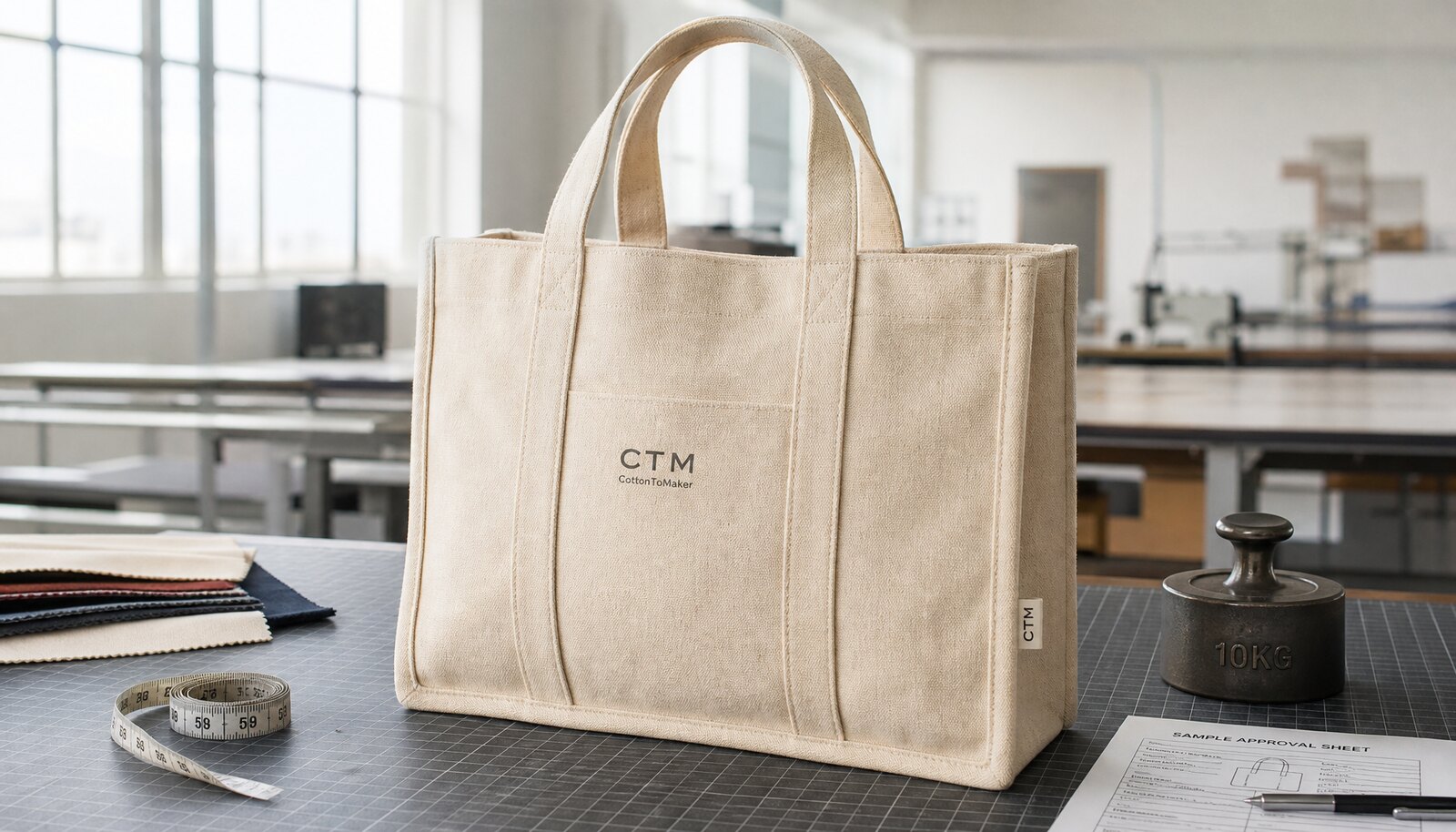
1. Start With the School Use Case, Not the Artwork
A school canvas tote is bought for repeated handling, not for decoration. If it is used for library loans, reading challenge kits, classroom handouts, or book fair packs, the bag must hold its shape, carry a realistic book load, and survive a term of rough use without seam failure or handle stretch. That means the first procurement question is not the logo file. It is the use case and the maximum normal load. If you skip that step, the supplier will fill in the blanks with a generic promotional tote spec, which is usually too light for school use or too expensive for the job.
The practical buying rule is simple: build the bag around the heaviest normal load, then decide whether the use is one-off event distribution or repeated daily circulation. A library tote for younger students needs different construction from a teacher resource bag. Once you separate those use cases, your quote comparison becomes cleaner because you can ask every supplier to price the same finished dimensions, the same reinforcement method, and the same acceptance test.
- State the actual use case in the RFQ: library circulation, classroom handout, event pack, or teacher resource bag.
- Define the heaviest normal load in kilograms and the expected service life.
- Do not let the supplier choose the spec from a photo alone.
- Use the use case to decide whether the bag needs a structured body, heavier canvas, or stronger handles.
2. Turn the Bag Into Measurable Fabric and Size Requirements
For most canvas library tote bags for schools, 10 oz to 12 oz canvas is the safest starting point because it balances body, print quality, and price. That is usually about 340 to 410 GSM depending on weave and finishing. Below that range, the bag can sag under books and feel underbuilt. Above that range, the bag can become unnecessarily stiff for younger students or simple handout packs. The right choice is not about maximizing fabric weight. It is about matching the fabric to the expected load and school usage.
Do not stop at fabric weight. Ask for finished dimensions, seam allowance, weave type, finishing method, and shrinkage allowance. If the bag is dyed, bleached, or washed, the final size must already account for shrinkage. A quote that ignores finishing is incomplete because a bag that arrives short by 15 mm or more can alter print placement, handle balance, and carton count. The inspection checklist should therefore include both the build spec and the post-finish tolerance.
- Use 10 oz to 12 oz canvas as the default range for school library totes unless the load is light.
- Ask whether GSM refers to greige cloth or finished cloth.
- Lock finished size, not cut size, into the PO.
- Require shrinkage to be stated in writing before sampling starts.
3. Lock Print Method, Placement, and Rub Resistance Early
For school logos and reading-program marks, one or two-color screen print is usually the best commercial choice. It is consistent, readable from distance, and easier to control across repeated orders than a transfer that can peel or crack. Screen print also gives clearer unit economics when the same design is repeated across multiple schools. The key is to approve the print area and placement before screens are made, because a late revision can trigger a new setup cost and move the delivery date.
If the artwork is small and premium presentation matters, embroidery or a woven label can work, but do not assume it is better. Dense embroidery on lightweight canvas can pucker the panel and distort the body. Heat transfer is acceptable for short runs or highly variable multi-color artwork, but you should treat it as a different risk profile, not as a default upgrade. Whatever method you choose, test the print on the real fabric, check the cure, and confirm that normal handling does not transfer ink to a white cloth or neighboring bags.
- Use screen print as the default for simple school logos and repeat orders.
- Use embroidery only when the design is small enough to avoid panel distortion.
- Keep logo placement tolerance within a written spec, typically about +/- 5 mm.
- Check rub resistance on the approved sample before bulk production starts.
4. Put Seams, Handles, and Load Capacity Into the Acceptance Criteria
A tote bag can look correct and still fail in use if the handle and seam construction are weak. For school buying, the handle join is usually the highest-risk point because books create a downward pull that repeats over and over. A decent baseline is a 2.5 to 3 cm handle with reinforced stitching at the connection point, either as a box-X or a dense bartack pattern. That construction is more important than decorative finishing because it protects the bag where the force actually lands.
Buyers should define a specific load test, not just a general statement that the bag should be strong. A practical acceptance test for a school tote is a 20 kg static load for 60 seconds, with no seam opening, no handle separation, and no functional failure. If the tote is intended for heavier teacher resources, increase the load target. The point is to align the test with the real use case so the supplier cannot pass with a flimsy bag that only survives a light sample check.
- Require reinforced handle joins and side seams in the technical drawing.
- Set a static load test in the PO, not just a vague strength requirement.
- Reject bags with handle twist, uneven handle drop, or visible stitch gaps.
- Use the load test to validate the build, not just the fabric.
5. Use Sample Approval to Freeze the Exact Production Standard
A school order should not move into bulk production until the buyer has approved a true pre-production sample made from the same fabric lot, same stitching method, same print method, and same packing method as the bulk order. A visual sample made from substitute cloth or a different printing setup is useful for review, but it is not an acceptable production reference. If the supplier changes the cloth, the ink, or the handle construction after approval, the buyer loses the only reliable benchmark for dispute resolution.
Inspect the sample the way the bag will actually be used. Fill it with books, check handle symmetry, examine the print under normal room light, and confirm that the body does not distort under load. Then sign off a golden sample and keep it sealed. If there is any later change in fabric, print shade, label position, or handle width, treat it as a revision that needs explicit buyer approval. That discipline protects you from the common problem where the bulk run is close to the sample but not close enough to be acceptable.
- Require a pre-production sample from the actual production process.
- Keep one sealed golden sample with signed approval.
- Test the sample under realistic book load, not as an empty bag.
- Treat any change in cloth, print, or trim as a formal revision.
6. Compare Supplier Routes by Risk, Not by Brochure Language
The supplier type matters because it changes what you can verify. A direct factory is usually the lowest-risk route for repeat school programs if it owns cutting, sewing, printing, and final inspection. You can ask for lot traceability, production-line photos, and named quality ownership. A trading company can still be useful when you need communication support or multi-item consolidation, but it may add a layer between you and the actual producer. Stock sellers or resellers are faster, yet they often cannot control fabric weight, dye lot, or exact carton pack-out.
The correct comparison is therefore not unit price alone. It is price, sample speed, document quality, and production control together. A supplier that is slightly higher on price but can prove who made the sample, how the bulk lot is controlled, and which inspection process is used is usually the safer procurement choice. For schools, consistency matters more than clever product descriptions. If the bag is going to be repeated across terms or districts, the supplier with the best process evidence often wins even when the headline quote is not the lowest.
- Direct factory sourcing is usually the strongest option for repeat orders and tighter QC control.
- Trading routes can help with communication, but they reduce visibility unless the factory is named.
- Stock or reseller routes are faster but weaker on custom control and traceability.
- Compare total accepted cost, not just the cheapest unit price.
7. Vet the Factory With Documents, Not Promises
A serious procurement review should ask for more than a price sheet and a sample photo. Request the factory profile, business license or registration details where relevant, production site photos, sewing and printing capacity, QC process, and the name of the person responsible for final signoff. If the supplier uses outside subcontractors, ask which processes are in-house and which are outsourced. That distinction matters because the biggest quality failures usually happen when cutting, printing, and inspection are split between multiple hands and nobody owns the final result.
Document control should be part of qualification. Ask for any existing test reports for fabric strength, shrinkage, and colorfastness from a named lab or a clearly described internal method. Ask for an audit summary if one exists, even if it is only a basic internal audit or customer audit summary. For traceability, insist on lot codes for fabric, print, and packed cartons. If the supplier cannot tell you which lot produced the approved sample, you have no reliable way to separate sample quality from bulk quality later.
- Request factory identity, production location, and named QC owner.
- Ask which processes are in-house and which are subcontracted.
- Request test reports or clearly documented internal test methods.
- Require lot traceability for fabric, print, and carton packing.
8. Inspect Bulk Production With AQL and a Real Test Protocol
A practical bulk inspection plan should combine visual inspection, dimensional checks, load testing, and carton verification. If your team uses ANSI/ASQ Z1.4 or ISO 2859-1, keep that framework. If not, write the inspection rule into the PO so everyone uses the same defect logic. A useful starting point is zero tolerance for critical defects, AQL 2.5 for major defects, and AQL 4.0 for minor defects. Critical defects would include open seams, unsafe handle failure, contamination, or a bag that cannot be used. Major defects would include broken stitching, off-center printing beyond tolerance, or incorrect dimensions that affect function. Minor defects would include small loose threads or cosmetic issues that do not affect use.
The test protocol should also be concrete. Check fabric weight against the approved spec, measure finished dimensions, confirm handle symmetry, and perform a static load test with books or calibrated weights. For print, check placement and color against the approved sample. For dyed cloth, compare the shade with the master swatch under controlled light. If the supplier claims the bag is washable or prewashed, verify shrinkage after the agreed condition. A bag that passes visual inspection but fails the load test is not a passed lot; it is an unfinished problem.
- Use an AQL structure such as 0 critical, 2.5 major, and 4.0 minor unless your policy differs.
- Classify defects before inspection so the factory and buyer use the same language.
- Include dimensional checks, load testing, and print verification in the same inspection plan.
- Stop the lot if critical defects appear, even when the bag looks acceptable at first glance.
9. Make Packing and Carton Logic Part of the Product Spec
School orders often go to a warehouse, district office, or several campuses, so packing design is not a minor detail. If bags are packed randomly, the receiving team has to sort by school, class, or program after delivery, which adds labor and increases the chance of miscounts. The better approach is to define pack-out by destination from the start. Ask for carton marks that match the packing list, and if possible, tie each carton to one school, one grade, or one program line. That reduces receiving time and makes reconciliation much easier if the shipment is partial or split.
Packing also affects condition on arrival. Canvas can crease, pick up dust, or absorb moisture if the cartons are packed carelessly. Ask how many pieces go in each carton, whether polybags are used, and what the gross weight target is. If the order is going straight to students, a clean pack-out is worth more than saving a small amount on carton material. The final inspection should include carton count, carton integrity, and label legibility because warehouse errors often begin with packing errors, not sewing errors.
- Specify packing by school, class, or destination when the order has multiple delivery points.
- Make carton marks match the packing list exactly.
- Ask for carton dimensions and gross weight early so freight quotes are realistic.
- Check carton count and label clarity before inspecting individual bags.
10. Write a Clean RFQ and Compare Landed Cost the Way Procurement Actually Buys
The fastest way to get better quotes is to make the RFQ harder to misunderstand. Do not ask for 'good quality' school totes. Ask for fabric weight, finished size, handle spec, print method, load target, shrinkage limit, packing method, and acceptance criteria. That forces the supplier to quote the same product instead of its own version of the product. It also makes the quote easier to defend internally because the buyer can point to measurable criteria rather than subjective language.
Then compare landed cost on the same basis. Separate unit price, sample fee, screen or plate cost, packing cost, inspection charge, and freight term. If one quote looks cheaper but leaves out a setup charge or omits testing, it is not a true comparison. For school procurement, the winning offer is usually the one with the clearest technical control, the best document trail, and the lowest risk of rework. The cheapest paper quote is often not the cheapest delivered bag.
- Write the RFQ around measurable acceptance criteria instead of general quality language.
- Compare quotes with the same scope line by line.
- Treat missing fields as risk, not savings.
- Choose the supplier who can prove control, not only the supplier who can promise speed.
Specification comparison for buyers
| Spec decision | Recommended buyer choice | Useful test or document | Supplier risk to check |
|---|---|---|---|
| Sourcing route | Direct factory with in-house sewing, printing, and final inspection | Factory profile, production photos, QC flow chart, and named inspection owner | Trading companies can hide the real maker and weaken traceability; resellers often cannot prove fabric lot or test history |
| Fabric weight | 10 oz to 12 oz canvas, roughly 340 to 410 GSM for book-carrying use | Fabric spec sheet showing GSM, weave count, and finishing state | Check whether GSM is greige or finished fabric; a quoted weight can look strong but still shrink or soften too much after finishing |
| Handle build | 2.5 to 3 cm wide handles with box-X or dense bar-tack reinforcement | Handle drawing with stitch count, stitch length, and reinforcement map | Thin handles or weak bartacks may pass a visual sample but fail under repeated book loads |
| Print method | One or two-color screen print for most school logos | Pre-production sample, ink cure note, and rub-resistance check | Heat transfer can be fine for short runs, but it adds peel risk and can complicate repeat orders |
| Sample turnaround | Pre-production sample in the same fabric and print method as bulk | Sample approval sheet, signed golden sample, and revision log | A fast sample made from substitute cloth or a different print process is not a reliable production reference |
| Carton efficiency | Standardized carton pack-out by school, class, or destination | Packing list template, carton marks, and carton dimension forecast | Loose mixed packing increases receiving labor and can distort freight quotes |
| QC document set | Inspection report with AQL results, photos, lot codes, and defect counts | Final inspection report, test records, and packing verification sheet | If a supplier cannot provide documents before shipment, disputes become difficult to resolve |
| Risk by supplier type | Lowest-risk option is the supplier who can prove control of cutting, sewing, printing, and inspection | Audit evidence, sub-supplier list, and traceability records | The biggest risk is not price; it is a supplier who cannot show who made the sample, which lot was used, or where final QA happened |
Buyer checklist before sampling
- Confirm the actual school use case before comparing quotes: library lending, reading program kits, classroom handouts, book fair packs, or teacher resource bags. The heaviest normal load should drive the spec, not the lightest sample.
- Set the finished size, fabric weight, handle length, handle width, and reinforcement method in writing before artwork is discussed. If those items are open, the quote will be too vague to compare.
- Define the load target in kilograms and the expected use duration. A tote for one-term event use can be lighter than a tote expected to last a full academic year.
- Require shrinkage limits in the spec. A practical starting point is no more than 3% length or width shrinkage after the agreed wash or finishing condition.
- Put print placement, logo size, and placement tolerance into the RFQ. For most school totes, keep logo placement within +/- 5 mm of the approved sample.
- Ask for a pre-production sample made from the same fabric lot and the same print method as bulk production. Do not approve a substitute cloth as the production benchmark.
- Require a golden sample signed off by both sides. Keep it as the reference for color, hand feel, placement, and stitch layout.
- Use a defect classification in the PO: critical defects get zero tolerance, major defects use AQL 2.5 as a common starting point, and minor defects use AQL 4.0 unless your district policy says otherwise.
- Specify the load test in the PO. A good baseline for school library totes is 20 kg static load for 60 seconds with no seam opening or functional handle failure.
- Ask the supplier to identify the fabric lot, print lot, and production line used for your order. Lot traceability matters if the bulk run differs from the approved sample.
Factory quote questions to send
- What is the finished fabric weight in GSM and oz, and is that the same after finishing and shrinkage allowance?
- What are the exact finished dimensions, seam allowance, handle length, handle width, and handle drop height you will hold during cutting?
- Which print method are you pricing, how many colors are included, and what is the setup charge if the artwork or school name changes?
- Can you provide a pre-production sample made from the same fabric lot, same stitching method, and same print process as the bulk order?
- What is your MOQ per color, per artwork version, and per size if we split the order across multiple schools or year groups?
- What tolerance do you hold for body dimensions, handle symmetry, print placement, and fabric shade variation? Please put that tolerance in writing.
- What shrinkage result do you expect after the agreed washing or finishing condition, and do you have a report to support it?
- What carton spec do you recommend for this bag size, how many pieces per carton, and what gross weight target do you use?
- How will you pack by school, class, or destination, and can you label each carton to match the packing list and delivery schedule?
- Which documents will you provide with shipment: packing list, carton count sheet, final inspection report, lot traceability, and any test reports?
Quality-control points to confirm
- Fabric weight matches the approved spec within a practical tolerance, typically within about +/- 5% of the quoted GSM unless the contract says otherwise.
- Finished body dimensions are within +/- 10 mm for standard school totes, and panel skew is not visible from normal viewing distance.
- Shrinkage after the agreed wash or finishing test is no more than 3% in length or width, or the contract-approved limit if the bag is prewashed or garment-dyed.
- Handle width, handle length, and handle drop height are consistent bag to bag, with handle-to-handle symmetry within 3 mm on the approved sample.
- Handle reinforcement uses box-X stitching or dense bartacks, and the stitch pattern is complete with no skipped stitches, loose loops, or weak ends.
- Static load test passes at 20 kg for 60 seconds without seam opening, stitch pullout, or handle attachment failure; increase the target if the bag is for teacher books or laptop carry.
- Seam strength holds under a pull or hanging test with no opening at the side seams, bottom seam, or handle joins; any visible gap is a major defect.
- Print placement stays within +/- 5 mm of the approved sample, with registration aligned and no visible bleed, smudge, or ghosting at normal reading distance.
- For dyed or colored canvas, shade variation within one carton should be minor enough that it does not stand out at 1 meter; if you use lab data, a delta E target of 2.0 or better is a practical buyer benchmark.
- Rub resistance is checked with a dry cloth rub test on the approved sample and bulk sample; the print should not transfer visibly or become tacky after normal handling.