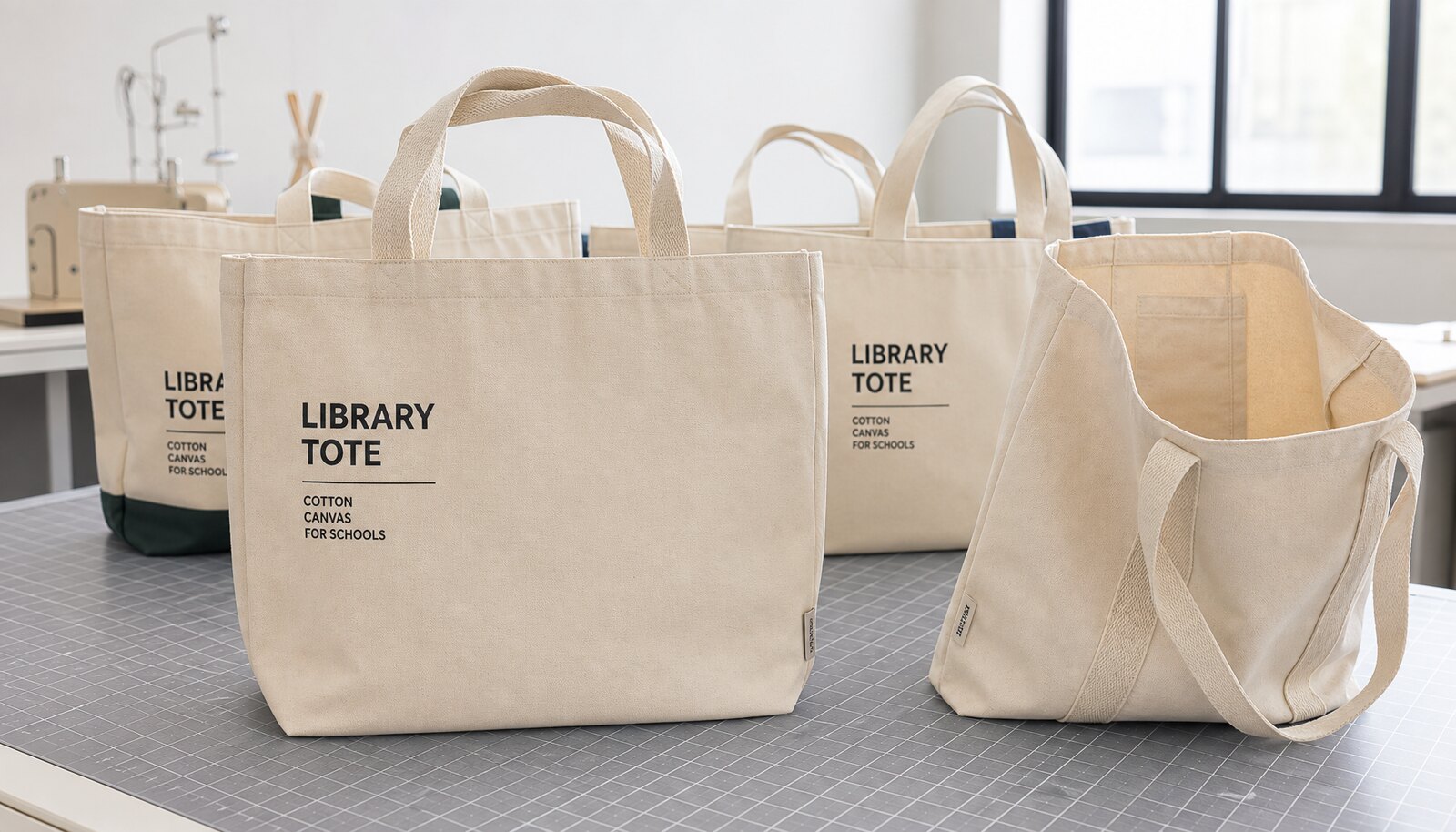
What schools are actually buying
Schools do not buy canvas library tote bags as casual merchandise. They buy a practical carry item that has to survive repeated loading, classroom handling, bus rides, and storage between loan cycles. That changes the buying logic. Procurement teams should start with what the bag will carry, how often it will be reused, and who will receive it, because those variables define the spec more accurately than any logo mockup.
The same bag can serve very different programs. A primary-school reading incentive pack may only need to hold a few picture books and a newsletter. A middle-school library program may need to carry thicker paperbacks, folders, and a device sleeve. A district-level rollout might need uniformity across multiple schools and a delivery schedule tied to the start of term. Those are different purchasing problems, even if the tote looks similar in a product photo.
This is why a cheap-looking quote can be expensive in practice. If the bag is too light, handle failures and bottom wear create replacements and complaints. If it is too heavy or overbuilt, the unit cost rises and the freight burden increases without improving school utility. The correct target is a durable, repeatable spec that can be bought again next term without redesigning the program.
- Best-fit uses: library lending, reading challenge packs, classroom take-home kits, parent engagement giveaways, and school fair bundles.
- Poor-fit uses: grocery-style heavy loads, overnight travel, or premium retail programs that need fashion finishing.
- Decision drivers: load capacity, repeatability, carton efficiency, print durability, and on-time delivery before term start.
Build the spec around books, not branding
The first commercial decision is fabric weight. For most school tote programs, 10 oz to 12 oz canvas, or roughly 340 to 410 GSM, is the practical band. That range gives enough body to hold books and folders without making the tote feel flimsy. Below that, the bag can distort under load and corners can wear early. Above that, the tote becomes stiffer, more expensive, and slower to sew, which matters once you move from sample quantity to hundreds or thousands of units.
Size should follow the school use case, not the print design. A common working size is around 35 x 40 x 10 cm for standard reading packs. If the tote has to take taller books, a folder, or a bottle, increase depth carefully rather than widening the bag too much. Wider bodies use more fabric, increase carton volume, and can push the print position outward if the supplier is not reworking the artwork file.
Handle construction is the next weak point. Handles often fail before the body fabric does. Self-fabric handles are acceptable for light or moderate loads if the top hem is reinforced and the stitch pattern is dense. Cotton webbing gives a cleaner load path and is easier to audit. If the school wants a structured look or repeat use over several terms, specify a reinforced top hem, a bottom seam that is not undercut, and bar-tacks at the handle anchors.
- Put fabric weight, weave type, and finish in the RFQ instead of saying only heavy canvas.
- State finished size, handle length, gusset depth, and tolerance so each quote is built on the same dimensions.
- If the school expects repeated use, ask for reinforced handle anchors and a top hem that does not collapse under load.
- Do not over-specify decorative features if they do not change classroom function; they raise MOQ and slow sampling.
MOQ logic: what sets the floor and how to buy below it
MOQ is usually driven by production setup rather than the tote body itself. The big drivers are fabric type, number of colors, artwork complexity, labels, and packing format. One SKU with natural canvas, one logo, and standard bulk packing is straightforward. The moment you add custom dye, multiple print colors, individual names, side labels, or alternate handles, you are no longer buying one bag spec. You are buying a collection of production steps, each with its own setup cost.
For direct factory sourcing, a simple school tote program often lands in the 500 to 1,000 piece range per artwork or color. If the bag needs dyed fabric, multiple school names, or specialty hardware, the floor can rise materially because the factory must reserve material, screens, and labor time. Smaller runs are still possible, but buyers should expect a premium. In practice, low MOQ often costs 15% to 35% more than a larger run once setup, waste, and handling are counted.
If the order is truly small, the best tactic is to simplify the spec rather than asking for a miracle price. Use natural canvas, keep the print to one color, avoid zipper hardware, and standardize the carton pack. If the school wants to personalize by grade or class, consider using a blank core spec and adding variable labels locally after import. That keeps the factory MOQ lower and makes the reorder path cleaner next term.
- One SKU equals one fabric, one body size, one handle spec, one print setup, and one packing plan.
- Each extra logo color or artwork version can create a separate setup charge or raise the MOQ per variant.
- Natural canvas with one-color printing usually gives the best balance between MOQ, durability, and price stability.
- If the supplier offers an unusually low MOQ, ask which cost was absorbed into the unit price and whether the price is repeatable.
Supplier route comparison: direct factory, trader, stockist, or local decorator
Direct factory sourcing usually gives the best control when the school program will repeat. You can lock fabric weight, handle reinforcement, print placement, and carton packing to a stable spec. The tradeoff is time: the first order usually takes longer because sampling, correction, and production scheduling all run through the factory. This route makes sense when the buyer cares more about repeatability and landed cost than about immediate availability.
A trader or sourcing company is useful when you need multiple items in one PO, want a single point of contact, or need help coordinating export paperwork. The tradeoff is margin and visibility. A good trader can still manage QC well, but the buyer should insist on seeing the actual factory spec, not a generic re-sell description. If the quote does not disclose the origin or the packing detail, you may lose the ability to compare reorders later.
A stockist is the fastest route for urgent school deadlines, but the buyer pays for speed and accepts less control. Stock colors may be fixed, carton counts may be rigid, and the actual canvas weight can vary from batch to batch. A local decorator works best when you already have blank bags in hand and only need printing or a label application step. That route can be efficient for rush events, but it is not the best full-package solution for a large school rollout.
- Direct factory: best for repeat programs, better spec control, and stronger landed cost at scale.
- Trader: useful for consolidation and communication, but require transparency on factory origin and included services.
- Stockist: useful for urgent small orders, but verify material weight, shade, and print consistency before you buy.
- Local decorator: useful for blank-stock printing, not ideal when you need full custom construction and long-term replenishment.
Landed-cost logic: compare more than the unit price
A serious procurement review should compare landed cost, not just the unit price on the supplier quote. Two suppliers may both quote a similar ex-factory number, but one may use better carton packing, a more efficient cutting layout, or a lower-defect construction standard. The other may be cheaper on paper and more expensive once freight, receiving, and rework are included. For school buyers, the cost of a late or rejected order can matter more than a small change in unit price.
The most useful comparison includes fabric cost, sewing labor, print setup, packing, carton volume, freight basis, duty or tax treatment, and receiving labor. Ask every supplier to quote on the same basis: same size, same artwork, same carton count, same packing method, and same Incoterm or freight assumption. If one quote is EXW, another is FOB, and a third is DDP, the numbers are not directly comparable until you normalize them.
Freight can erase a weak-looking price advantage very quickly. A slightly higher ex-factory price may still win if the supplier packs more efficiently and lowers the CBM. Conversely, a cheaper bag can become expensive if it uses a bulkier carton format or requires re-bagging at the receiving warehouse. For school programs, especially those tied to term-start schedules, the buyer should treat freight efficiency and late-delivery risk as part of the price.
- Compare unit price, carton count, estimated CBM, gross weight, and freight basis together.
- Request a line-by-line quote for cutting, sewing, print setup, labels, packing, and any hardware.
- If the quote is DDP, ask what is included and whether duties, local delivery, and clearance fees are fully covered.
- If one supplier is 8% cheaper but 20% less efficient in packing, the landed result may be worse even before defects are counted.
Print and branding that survives school use
For most school tote programs, screen print is still the default starting point. It is cost-effective, easy to reproduce on natural canvas, and durable when the ink is properly cured. One-color logos and school names usually print cleanly with a stable result across reorders. If the artwork is simple, screen print gives the strongest balance of price, repeatability, and acceptable wear resistance.
Heat transfer and digital methods can be useful, but only when the artwork really needs them. Fine lines, gradients, and photo-style designs are harder to reproduce in plain screen print. That said, a more complex print method should be justified by the use case. On a library tote, the graphic needs to stay readable after folding, carrying, and daily handling. If the design cracks or peels early, the bag loses value even if it looked good at first approval.
Branding should also be placed with the bag structure in mind. A large centered logo can interfere with the visual balance if the gusset expands. A small woven label on the side seam may be cleaner for a school that wants a low-key identity. If the school needs precise color matching, request a Pantone reference only when the supplier can actually hold it consistently. Otherwise, approve by physical sample and define acceptable visual variance.
- Screen print is usually best for one- to two-color school logos and names.
- Heat transfer is better for short runs or more complex art, but confirm abrasion resistance before bulk approval.
- Embroidery is durable but usually too expensive and too heavy for standard school tote programs.
- If the print area is large, require a clear proof of placement, registration tolerance, and cure standard.
Sample approval and QC thresholds that buyers can actually enforce
A pre-production sample should prove the real bag, not a presentation version. It should use the production canvas, the final handle material, the exact print method, and the same packing format that will be used in bulk. A blank hand-made mockup is not enough because it does not prove sewing speed, print registration, or carton fit. For a school buyer, the sample is the last place to catch a bad assumption before the entire order is locked.
QC should be written in measurable terms. Ask for an inspection plan using AQL 2.5 for major defects and AQL 4.0 for minor defects on general inspection level II, or the buyer's own standard if stricter. Define seam allowance, stitch density, print cure, and load test in the PO. A tote that looks fine in photos can still fail on seam strength, so the inspection standard needs to cover what actually breaks in use.
The most useful acceptance thresholds are simple and auditable. For load-bearing seams, 7 to 9 stitches per inch is a practical target, with a seam allowance of at least 10 mm and dense bar-tacks at the handle ends. For size tolerance, allow only small variation. For print cure, require a dry rub and fold test. If the supplier cannot confirm these basics before production, the buyer is taking unnecessary risk.
- Approve one sealed golden sample and label it with PO number, revision, and date.
- Require fabric weight tolerance of +/-5% and finished size tolerance of about +/-1 cm on standard bags.
- Use a handle load test of 10 to 15 kg for 60 seconds as a simple acceptance check.
- Check that prints do not flake, crack, or transfer after 20 dry rubs and a fold test.
- Inspect at carton level too: count, labels, and packing list must match the PO exactly.
Packing, cartonization, and warehouse handling
Packing is part of procurement, not an afterthought. For school programs, bulk packing in cartons is usually more efficient than retail-style individual packaging unless the bags are being sold to parents or distributed as finished gift packs. A common pack count is 50 to 100 pieces per carton, depending on fabric thickness and fold profile. The right count keeps the carton manageable and reduces damage from over-compression.
Carton dimensions matter because freight pricing is volume-based and warehouse labor is physical. A cheaper bag can become a more expensive shipment if the carton is bulky or too heavy to handle comfortably. As a practical buying rule, ask suppliers to keep gross carton weight in a manageable range and to avoid overpacking that crushes seams or creases printed surfaces. If the bags are going into a warehouse before school distribution, carton labels should make receiving easy: PO number, size, quantity, and destination route or school name.
If the order will be distributed by grade, campus, or classroom, carton discipline saves time at the receiving end. Do not leave school sorting to the warehouse team if the cartons arrive mixed. Ask for clear outer marks and a consistent internal pack count. If the buyer needs polybags, barcodes, or warning text, define them in the RFQ so the supplier does not improvise a retail pack that raises cost without solving a real distribution issue.
- Agree carton count before production because it changes freight, labor, and receiving accuracy.
- Ask for carton dimensions and gross weight so you can compare CBM, storage, and pallet fit.
- Use double-wall cartons if the bag is dense, the route is long, or the cartons will be rehandled several times.
- Only require individual polybags or inserts if the final distribution path actually needs them.
Lead times by route and region: plan the calendar backward
The real lead time is not the production days alone. It is sample approval plus production plus shipping plus any corrective time if the first sample misses the spec. This is why school buyers miss term-start deadlines even when a factory says it can sew the order quickly. If the artwork is still being revised, or if the buyer wants extra changes after sampling, the schedule can move from weeks to months without a visible warning until the shipping window is already gone.
As a practical planning guide, stockist supply can ship in days if the right color and size are already in inventory. Direct factory production for a standard canvas tote often needs several weeks once sample approval is complete. Add more time if the order uses custom-dyed fabric, extra hardware, or multiple artwork versions. Sea freight can add a meaningful transit window, so a well-priced order that is too late for the school calendar is still a bad purchase.
Regional nuance matters too. A coastal factory with established export handling can usually move samples and booking faster than an inland mill that still needs domestic transport to port. Holiday periods also matter. The closer you get to major factory shutdown windows, the more likely you are to lose scheduling flexibility. For school procurement, the safest approach is to work backward from the first issue date and include a buffer for inspection, freight booking, and unexpected corrections.
- Stockist inventory: often 3 to 10 days if the spec is close to what is already on hand.
- Direct factory, standard spec: often 25 to 45 days after sample approval, before international transit.
- Custom fabric or added hardware: often 35 to 60 days or more, depending on setup and sourcing complexity.
- Sea freight should be planned early for term-start orders; air freight is a backup, not the default plan.
- Build extra buffer around holidays, port congestion, and the time needed to approve artwork or print proofs.
RFQ checklist and award criteria for school procurement
A useful RFQ should make it easy to compare suppliers without chasing clarifications. Include the target use case, finished size, fabric weight, handle spec, print artwork, pack count, carton limits, delivery date, and preferred freight basis. If any of those are missing, suppliers will fill in the gaps differently and your quotes will not be comparable. The best quotes are the ones that make the buyer's job easier, not the ones that only look low at first glance.
When the order is for a school calendar, award decisions should consider more than price. Reorder consistency, ability to hold the same shade and print placement, and the supplier's responsiveness during sampling all matter. A district-level buyer may prefer a supplier with a slightly higher landed cost if that supplier can guarantee the same spec across a second or third term. That is often the cheaper answer over the full procurement cycle.
A useful scenario test is simple: if you needed to repeat the same tote next term, could the supplier make the same bag again without re-engineering it? If the answer is no, the quote is not strong enough for a school program. The best procurement outcome is a repeatable product, a clear approval trail, and a delivery window that survives the school calendar.
- Use one RFQ template for all suppliers so you can compare fabric, print, packing, and freight on the same basis.
- Ask for a separate line item for sample fees, tooling, labeling, carton marks, and freight assumptions.
- Award on landed cost, spec compliance, QC confidence, and delivery reliability, not unit price alone.
- If the tote will be reordered, prioritize suppliers who can hold the same fabric weight, handle build, and print placement across batches.
- For district programs, request a second-order pricing note so you understand the repeat-run economics before you award the first PO.
Specification comparison for buyers
| Spec decision | Baseline recommendation | Lower-cost alternative | Higher-spec alternative | Typical cost impact |
|---|---|---|---|---|
| Fabric weight | 10 oz to 12 oz canvas, about 340 to 410 GSM | 8 oz to 9 oz canvas for light-use programs | 14 oz canvas for repeated heavy book carry | Lower spec can reduce unit price by 8% to 18%; heavier cloth usually adds 10% to 20% |
| Body size | About 35 x 40 x 10 cm, adjusted to school book format | Smaller 30 x 35 x 8 cm bag for giveaway packs | Larger 40 x 45 x 12 cm bag for folders or laptops | Smaller sizes can save 5% to 10%; oversized bags can add 6% to 15% in material and freight |
| Handle construction | 25 mm cotton webbing or self-fabric handles with bar-tacks | Single-layer self-fabric handles for light loads | Double-layer handles with reinforced top hem and longer bar-tacks | Webbing and reinforcement typically add 5% to 12% |
| Print method | 1-color screen print on natural canvas | Heat transfer for short runs or complex artwork | 2-color screen print or larger branding area | Heat transfer can be 10% to 25% higher; extra screen colors add setup cost |
| Closure | Open top unless privacy or weather protection is required | Snap closure or tie-top for light security | Zip top for books, tablets, or rain exposure | Closures usually add 8% to 20% and extra hardware cost |
| Supplier route | Direct factory for repeatable specs and better landed cost at scale | Stockist for urgent low-quantity replenishment | Trader for consolidation or multi-item sourcing | Stockist pricing is often 15% to 35% higher than factory-direct on similar specs |
| Packing format | Bulk pack in cartons with clear carton marks | Loose-packed or mixed cartons for very small urgent orders | Individual polybag plus insert card when presentation matters | Retail-style packing can add 5% to 15% in labor and packaging |
| Freight basis | FOB or delivered quote with freight itemized separately | EXW if your team already consolidates cargo locally | DDP when you need one landed number and fewer handoffs | DDP may look higher but can reduce hidden receiving and clearance costs |
Buyer checklist before sampling
- Define the end use first: library lending, literacy giveaway, classroom kit, school fair, or district resale.
- Lock the finished size, handle length, gusset depth, and acceptable tolerance before asking for quotes.
- Specify fabric weight in GSM or oz, not vague terms like heavy canvas or premium cotton.
- Confirm whether the bag must handle books only or books plus a tablet, bottle, or folder.
- Keep the artwork simple enough for the chosen print method and state the number of colors up front.
- Ask for a pre-production sample made from production fabric, not a hand-cut mockup or digital proof.
- Request quotes from at least two supplier routes so you can compare factory-direct, trader, and stockist economics.
- Ask each supplier to quote the same packing count, carton size, and freight basis so landed cost is comparable.
- Build the schedule backward from the school handover date and include sample approval, inspection, and shipping buffers.
- Set QC acceptance in measurable terms: stitch density, seam allowance, rub resistance, load test, and carton count.
Factory quote questions to send
- What canvas weight do you recommend for a typical school load of books, and is that weight in stock or woven to order?
- What is your MOQ per artwork, per color, and per size if we use natural canvas with a one-color screen print?
- How much does the unit price change if we move from open top to zip top, or from self-fabric handles to webbing handles?
- Can you quote the same tote as direct factory, trader, and stockist supply so we can compare route-by-route pricing?
- What are the lead times for sample making, sample courier, bulk production, and shipment booking after sample approval?
- What is included in the quote: cutting, sewing, print setup, labels, carton packing, and export carton marks?
- What carton pack quantity, gross weight, and carton dimensions do you recommend for school distribution and warehouse receiving?
- What QC checks do you run for fabric weight, stitch quality, print cure, and finished size before shipment?
- Can you provide a landed-cost quote with freight basis, estimated CBM, and any extra charges for labeling or individual packing?
- If we reorder next term, how do you protect fabric shade, print placement, and handle construction consistency across batches?
Quality-control points to confirm
- Confirm fabric weight on incoming rolls with a tolerance of +/-5% against the agreed GSM or oz spec.
- Measure finished dimensions on at least 5 to 10 pieces per carton, not only on flat samples, and allow +/-1 cm on standard sizes.
- Use a written AQL plan before shipment, commonly AQL 2.5 for major defects and AQL 4.0 for minor defects on general inspection level II.
- Check load-bearing seams for 7 to 9 stitches per inch, a seam allowance of at least 10 mm, and bar-tacks at handle ends of about 18 to 25 mm.
- Run a static pull or hang test on sample bags at 10 to 15 kg for 60 seconds; reject any seam opening, handle slip, or visible distortion.
- Inspect print alignment, color density, and cure. A rubbed print should not flake or transfer visibly after 20 dry rubs with a white cloth.
- If the order uses heat transfer, add a fold test and tape test on the print area so cracking or edge lift is caught before shipment.
- Check carton count, carton labels, and packing list against the purchase order, with special attention to school name, route code, and size marks.
- Approve one sealed golden sample and attach it to the PO revision so final inspection can compare production against the agreed benchmark.
- Reject mixed shade lots unless shade variation was explicitly approved; canvas shade drift is a common cause of buyer complaints.