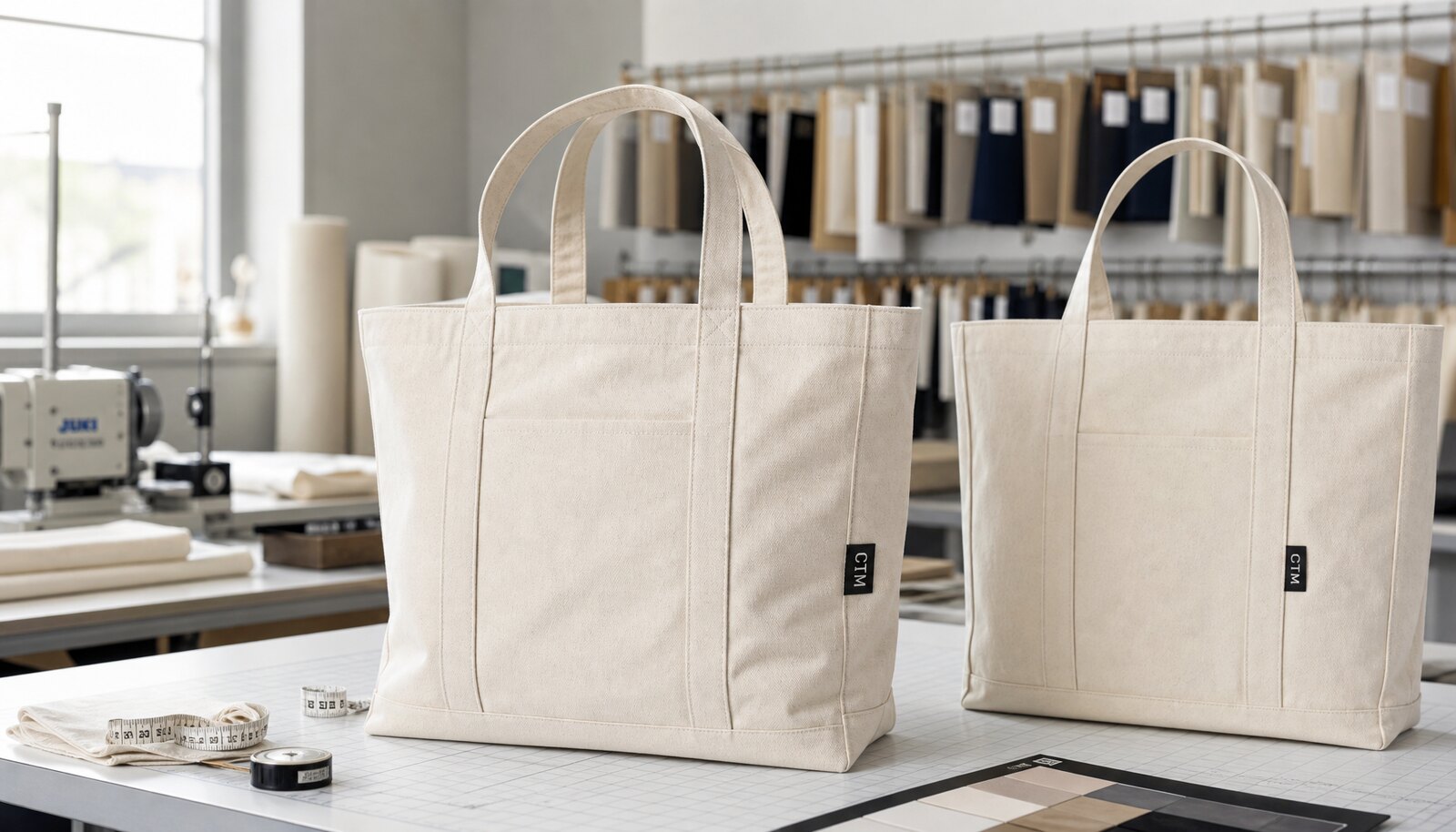
1. Start With the School Use Case, Not the Bag Name
Canvas library tote bags for schools are not generic promotional totes. They are carry items that need to fit books, folders, worksheets, and sometimes repeated library checkouts. If the request only says “canvas tote,” the factory fills in the gaps with its own assumptions about fabric weight, reinforcement, print area, and packing. That is how a quote looks competitive on paper but fails the actual school brief.
The fastest way to make factory quotes comparable is to define the use case before any pricing discussion. A primary-school reading bag, a teacher carry bag, and a district giveaway are not the same product. Younger students usually need lighter carry weight, smaller hand opening strain, and stable dimensions. Library circulation bags need more durability, better seam control, and print that survives handling. A one-time event tote can be lighter, but only if the buyer accepts shorter life and lower structure.
The RFQ should also describe the receiving environment. Will the tote be stacked in a district warehouse, handed out flat, stored in classroom cubbies, or shipped directly to students? That matters because a bag that must stand upright needs a different construction than one that only needs to fold flat and ship cheaply. The more specific the use case, the easier it is to compare suppliers without hidden assumptions.
Useful use-case inputs belong in the first paragraph of the RFQ, not in a follow-up email. State who will use the bag, what will go inside it, how long it should last, and whether the bag must maintain shape after packing and handling. If the supplier knows the real use, the quote will usually be more realistic and the sample easier to approve.
Buyer note: if the program is school-library focused, the bag is usually judged by durability, usable size, and print retention more than by decorative detail. That is the right procurement lens for this product type.
- Target user: primary students, middle school, teachers, library staff, or district giveaway audience.
- Load profile: number of books, folders, or classroom items the tote must carry without handle strain.
- Storage need: upright shelf use, flat packing, or cubby-compatible sizing.
- Program type: one-season promotion, annual school supply, or repeated library circulation.
2. Choose Fabric Weight Based on Load, Not Marketing Language
Fabric weight is the first serious quality lever in a school tote program. Buyers often hear terms like “heavy canvas” or “premium cotton” without a measurable spec behind them. That is not enough. For most school library tote bags, the workable zone is usually around 12 oz to 16 oz cotton canvas, with the exact choice driven by load, durability expectations, and whether the bag should hold a firm shape. Lighter cloth can save money, but it may collapse under books, show print-through, or soften too quickly at the handle roots.
Ask for finished-bag performance, not only mill cloth. Raw fabric GSM is useful, but the sewn bag can behave differently after cutting, sewing, washing, pressing, and folding. A tight 12 oz canvas may outperform a loose 14 oz canvas if the weave is denser and the finishing is better. A quote that only lists a nominal ounce weight without finishing context is too vague for procurement.
For school programs, ask the factory to define whether the fabric is natural, bleached, dyed, washed, or pre-shrunk. Those decisions affect cost, hand feel, shade consistency, and shrinkage risk. If the tote will be washed, or if the end user will expect the bag to keep a fixed size after use, the supplier should tell you the expected shrink range before bulk begins.
Color also changes the sourcing logic. Natural canvas is usually the simplest and most repeatable route. Bleached or dyed canvas may improve appearance but requires more control over shade and lot variation. If the school or sponsor has a target tone, ask for a Pantone reference or a visual standard and confirm whether the production lot will be measured against it or only judged by eye.
A good quote should not just say “12 oz canvas.” It should say what the buyer gets after finishing, what the shrink and shade expectations are, and whether the fabric lot is stable enough to keep the bags visually consistent across the whole order.
- Request finished GSM or at least a measurable fabric spec range, not only descriptive terms like “thick” or “premium.”
- Ask whether the canvas is pre-shrunk, washed, or steam-controlled before sewing.
- Confirm whether the weave is stable enough to keep print edges sharp and seams aligned.
- If the bag will be washed, specify expected shrinkage tolerance in advance.
3. Treat Dimensions and Handle Construction Like a Production Drawing
Many school tote quotes drift because the dimensions are not written tightly enough. A supplier can price a “standard tote” in several ways, and even small differences in width, height, or gusset depth affect material usage, sewing time, and how the bag feels in the hand. For canvas library tote bags for schools, the buyer should state the finished width, finished height, gusset depth, and handle drop separately. Those numbers should appear in the RFQ and again on the approved sample sheet.
Handle construction is where many tote bags fail first. Thin handles dig into the hand, stretch out under books, or tear away at the top seam. A wider handle with proper reinforcement is usually the better procurement choice for school use. Ask the supplier to specify handle width, handle length, handle drop, whether the handle is single-layer or folded/turned, and how the top anchor point is reinforced.
The seam construction should be written just as clearly. If the tote is expected to carry books repeatedly, ask for reinforced corners and a defined anchor method such as bartacks or a box-X pattern at load points. “Factory standard” is not a spec. It simply means whatever the line is already set up to do. That may be acceptable for a giveaway bag, but it is too vague for school circulation or any order where replacement costs matter.
A practical spec separates measured items from visual expectations. Measured items include width, height, gusset, handle width, handle drop, and seam allowance. Visual expectations include neat stitching, even grain, and a clean top edge. This makes it easier to compare quotes and easier to reject a sample that changes one of the critical dimensions.
If you want the bag to sit neatly on shelves or in classroom distribution, ask whether the tote will stand upright after folding and packing. That question often reveals whether the supplier is quoting a soft promotional bag or a more structured school tote.
- Write finished width, height, gusset depth, handle width, and handle drop in the RFQ.
- Specify the top hem, seam allowance, and anchor reinforcement method.
- Ask if the bag can stand upright when filled with the intended school load.
- Require the sample to be measured and signed off before bulk starts.
4. Compare Print Methods by Artwork, Budget, and Reorder Risk
Most school tote artwork is simple: a school name, reading slogan, mascot, sponsor logo, or one-line message. Because the art is usually simple, screen print is the default option for many orders. It is cost-effective, readable on natural canvas, and easy to reorder when the screens or setup are retained. That said, the print route should be chosen based on the actual artwork, not on habit.
If the design has fine text, multiple colors, or a premium look requirement, another decoration method may be more practical. Embroidery, woven labels, sewn patches, or heat transfer can improve appearance or abrasion resistance, but they also change MOQ, setup effort, placement rules, and cost. The right decision is not “which method is cheapest,” but “which method keeps the artwork readable after handling, shipping, and school use.”
Print quality should be measurable. Ask the factory how it cures the ink, how it checks adhesion, and how it tests for rub transfer before packing. A logo that looks clean in the sample room can still fail if the ink is under-cured or too thick. During stacking, folded bags can transfer ink to each other, which creates damage before the tote ever reaches the school.
Placement control matters as much as the decoration method. The printable area on a tote changes with bag size, seam layout, and gusset depth. A design that fits one size may crowd the seam line on another. Always approve the art on the actual production dimension, not only on a flat mockup. For multi-school programs, require version control so school names cannot be mixed in the wrong carton.
For procurement comparison, ask the supplier to show the print method, setup cost, repeat-order cost, and the practical limits of the artwork. If they cannot explain why one method was chosen over another, the quote is probably not built around the real product requirement.
- Ask for print method, ink type, and cure method in the quote.
- Confirm acceptable variation in logo placement, registration, and shade.
- Request close-up photos of one finished print on the actual canvas weight.
- If repeat orders are expected, ask whether screens or plates will be stored and reused.
5. Read MOQ as a Production Logic Problem, Not a Sales Number
MOQ should tell you how the factory makes money on the job, not just how many pieces it wants to sell. For canvas library tote bags for schools, MOQ usually follows cutting efficiency, fabric utilization, print setup, sewing line changeover, and packing labor. If the seller gives one blended MOQ without saying what changes by size, color, or artwork, the quote is incomplete.
The cleanest order structure is usually one body size, one fabric color, and one artwork version. That keeps cutting efficient and reduces the chance of version mix-ups. If the order has several school names, print colors, or size variants, the cost rises because the factory has more setup, more sorting, and more QC risk. Buyers should expect that and ask for the price impact by version rather than accepting one flat number.
Ask which part of the MOQ is tied to which process. A supplier may have a low sewing MOQ but a higher print MOQ because screens or setup time are fixed. Another may require a bigger order only because it purchases fabric specially or because the requested color is not a standard stock shade. Those are different business models, and the quote should make that clear.
For district programs with multiple schools, version control is a real cost driver. Mixing school names or artwork versions in one carton can create warehouse errors and receiving delays. If the order needs carton-by-carton segregation, ask whether that is included or charged as a sorting fee. A quote that ignores this may look cheaper but be more expensive in landed cost.
A useful supplier response should explain the MOQ by version and the repeat-order logic after setup is already complete. That gives procurement a clearer path for pilot orders, reorders, and year-over-year planning.
- Ask for MOQ by size, color, and artwork version separately.
- Confirm whether sample charges are credited against bulk orders.
- Ask if repeat orders can use existing screens, labels, or patterns.
- Check whether mixed-color or mixed-version cartons increase the MOQ or add sorting fees.
6. Verify Supplier Type Before You Trust the Price
Before comparing unit price, verify who is actually making the bags. A direct factory with in-house cutting, sewing, printing, and packing is usually easier to control for school programs, especially when repeat orders or strict deadlines are involved. A trading company or broker can still be useful, but the buyer should know exactly which steps are in-house and which are outsourced.
The risk with brokers is not always price. It is control. If the buyer thinks it is sourcing a factory but the work is actually split across several subcontractors, quality accountability gets weaker and lead time becomes less predictable. That is why a quote should be backed by company registration details, a real factory address, current production photos, and a clear explanation of where the bag is sewn and decorated.
Ask whether the supplier has previously handled institutional or school orders. A seller that understands school distribution usually knows how to keep packing consistent, label cartons correctly, and avoid version mix-ups. If they cannot explain their carton marking logic or their method for packing by school name, that is a sign they may be stronger at sales than at production control.
A practical qualification step is to request evidence from the same product family, not unrelated bag photos. Sample-room pictures are easy to collect; production-line proof is more meaningful. If the seller cannot show cutting tables, sewing lines, print stations, or packed cartons that match the requested tote, treat the quote as preliminary until verified.
Procurement note: supplier identity affects defect remedy as well. If the seller is only an intermediary, your correction path should clearly state who pays for rework, who issues replacements, and how disputes are handled if the factory and seller disagree.
- Ask for legal registration, factory address, and current production photos.
- Confirm which steps are in-house and which are subcontracted.
- Request evidence from the same tote type, not just generic bag photos.
- Clarify who is responsible for rework or replacement if defects are found.
7. Use Sample Approval to Lock the Spec Before Bulk Cutting
The pre-production sample is the buyer’s last easy chance to stop spec drift. For a school tote, the sample should confirm fabric feel, finished size, handle comfort, seam finishing, print location, label placement, and the way the bag folds or stands. If the sample is judged only by appearance, the factory may treat hidden details as flexible and change them in bulk.
An effective sample approval needs more than a yes/no note. Record the exact measurements, the approved artwork placement, the handle length and drop, and the packing format. Mark any differences from the RFQ and decide whether those differences are acceptable. If the sample is approved with silent exceptions, those exceptions often become the bulk standard, and the dispute appears only after delivery.
It is smart to test the sample with real load. Put in books or equivalent weight and check whether the handle stitches hold, the top hem keeps shape, and the bottom seam remains stable. That quick functional test is often more useful than a visual-only review. If the bag is intended for younger students, assess hand comfort and carry length as well, because a tote that looks good can still be awkward to use.
Do not accept a promise that bulk will be “the same but better” unless the factory defines what changes. If fabric weight, print method, or seam construction changes after sample approval, that is a spec change and should be priced and approved as such. The sample is the benchmark. The quote should be based on that benchmark, not on a moving target.
A sample approval packet should include marked photos, a measurement sheet, the signed approved version, and the packing style. That document becomes the reference point for QC and defect claims later.
- Measure and record finished width, height, gusset, handle drop, and handle width.
- Check front and back print placement against the actual bag panel.
- Load-test at least one sample bag with books or an equivalent weight.
- Confirm that the bag folds, stands, and packs as required.
- Sign off on packing style, carton marks, and version labeling before bulk starts.
8. Put Packing, Cartons, and Distribution Rules Into the Quote
School tote orders often fail after production, not during sewing. The bags may be made correctly but packed badly, mixed by school name, or labeled in a way that slows warehouse receiving. Packing should therefore be part of the product spec, not a shipping afterthought. If the totes go directly to schools, bulk packing is often enough. If they are resold or distributed in a retail-like setting, individual packing may be worth the extra labor.
The quote should specify whether bags are packed flat or folded, how many pieces go into an inner pack or master carton, and what labels appear on the carton. For multi-school orders, version segregation matters. A carton with mixed school names may be fine only if the receiving plan allows sorting. Otherwise, it creates labor and error risk at the destination.
Ask for master carton dimensions and gross weight before freight is booked. Those numbers affect freight cost, pallet count, warehouse handling, and the total landed cost. A low unit price can become expensive if the cartons are oversized, inefficiently packed, or too heavy for the receiving environment. Freight efficiency is part of procurement value, not just logistics detail.
The polybag decision should also be made up front. Polybags add cost and plastic use, but they may be useful for retail display or protection during transit. For direct school distribution, bulk packing is often more practical. If the buyer has not decided yet, ask the factory to quote both options with clear labor and material differences.
Packing rules should be written clearly enough that a receiving team can check them without asking the factory for clarification. That is especially important when different school names, sizes, or versions move through the same shipment.
- Quote bulk packing and individual packing separately if the final pack format is still undecided.
- Ask for master carton dimensions, gross weight, and carton count by SKU.
- Require carton marks to match the PO and packing list exactly.
- Ban mixed school names or mixed artwork in a carton unless the PO explicitly allows it.
9. Compare Quotes Using Real Cost Drivers and Landed Cost
A useful factory quote exposes the real price drivers. For school canvas tote bags, those drivers are usually fabric weight, finished dimensions, handle reinforcement, decoration complexity, packing labor, and freight terms. If the buyer only sees one blended price, it becomes difficult to tell whether the supplier is offering a better bag or just a lighter specification.
The biggest comparing mistake is reading two quotes as if they are equivalent when they are not. One supplier may be quoting lighter canvas, thinner handles, or looser packing. Another may include stronger reinforcement or more careful carton labeling. The buyer should compare the finished bag spec and the packing standard, not only the unit price. A slightly higher factory price can still be the better choice if it reduces rework, returns, or receiving delays.
Ask for tiered pricing at pilot quantity, standard quantity, and repeat quantity. That shows how the price changes once setup costs are already absorbed and helps the buyer decide whether to stage the order or place it in one lot. It also reveals whether the supplier is being realistic about setup amortization or simply quoting one number to win the order.
Landed cost is where weak comparison usually shows up. If the bags cross borders, include freight, duty, inland delivery, inspection charges, and any sorting or receiving fees at destination. For schools, the landed cost may also include the internal cost of re-packing, labeling, or district distribution. A quote that looks cheap at the factory can be costly once those items are added.
The best procurement practice is to compare line-by-line, then compare total landed cost, then compare risk. That order matters because a lower price is not a saving if it creates quality claims or schedule misses later.
- Ask the supplier to itemize fabric, sewing, print, packing, setup, and freight-related assumptions.
- Request tiered pricing for pilot, standard, and reorder quantities.
- Compare finished-bag specs before comparing unit price.
- Add freight, duty, inland delivery, inspection, and receiving costs into landed cost.
10. Use QC Standards That Match How the Bags Will Actually Fail
A practical QC plan should be built around likely failure points: seams open, handles stretch, print rubs off, fabric shrinks unevenly, and cartons arrive short or mixed. Words like “good quality” do not help much in inspection. The buyer needs measurable acceptance criteria that the factory, inspector, and receiving team can all follow.
For seams, ask the factory to define the test method in writing. A simple hang test or pull test on the handle roots and bottom seam is often more useful than a visual-only inspection. The load, duration, and pass/fail result should be written into the approval record. The same logic applies to stitch density: a clear SPI target is easier to control than a vague promise of strong sewing.
Print cure should be checked before packing. After the ink cools, do a dry rub and damp rub with a white cloth. If the tote will be reused or cleaned, add a wash or steam test on a pre-approved sample. Ink transfer in cartons or cracking after first use is not a minor issue for school bags; it is a defect that can trigger complaints or replacements.
Size control should use a clear tolerance band. Measure the finished bag after finishing, not only after cutting. If the tote must fit shelves or cubbies, define the permitted variation tightly enough that one bag cannot break the fit plan. If washing is part of use, specify acceptable shrinkage before the order is placed so the factory can choose the right fabric and finish.
AQL is useful when it is tied to defect definitions. Many buyers use AQL 2.5 for major defects and 4.0 for minor defects, but the exact target should match the order risk and deadline. The important part is to define major, minor, and critical defects before inspection starts. That way, broken seams, wrong artwork version, severe stains, and short counts all have an agreed remedy path.
A stronger workflow is pre-production sample approval, inline inspection during production, and final AQL inspection before shipment. That sequence catches problems early and gives the buyer leverage to correct them before the order is fully packed.
- Seam test: define a hang test or pull test for handle roots and bottom seams.
- Rub test: check print transfer with dry and damp cloth rub after cure and cooling.
- Wash or steam test: confirm the bag stays within shrink and print limits if cleaning is part of use.
- Dimensional control: measure finished size after pressing, not only after cutting.
- Count control: verify carton count, version, and PO label at packing and pre-shipment.
- Defect definitions: list what counts as major, minor, and critical before inspection begins.
Specification comparison for buyers
| Decision area | Option A | Option B | Procurement tradeoff | Buyer risk to check |
|---|---|---|---|---|
| Fabric weight | 10–12 oz canvas | 14–16 oz canvas | Option A lowers cost and bulk; Option B improves shape retention and handle durability | Confirm finished bag performance, not just mill fabric weight; ask for shrink and load behavior |
| Handle construction | Single-layer handle with basic bar tack | Turned/folded handle with reinforced stitching or box-X | Option A is cheaper and faster; Option B is more comfortable and resists pull-out better | Thin handles and weak anchor stitching usually fail first under book loads |
| Decoration method | 1-color screen print | 2-color screen print, woven label, embroidery, or heat transfer | Option A suits simple school logos; Option B fits premium branding or small text, but raises cost or setup complexity | Check cure, rub resistance, fine-line legibility, and reorder setup charges |
| Packing method | Bulk packed by SKU in master cartons | Individual polybag, belly band, or retail-ready pack | Option A is efficient for district distribution; Option B helps retail presentation or protection | Mixed cartons and unclear count rules cause receiving errors and version mix-ups |
| Supplier type | Direct factory with in-house cutting/sewing/printing | Trading company or broker with disclosed factory partner | Option A is easier to control for repeat orders; Option B may help with sourcing support but adds verification work | Verify legal identity, actual production address, and subcontracting status |
| QC standard | Basic visual check only | Pre-production sample + inline check + final AQL inspection | Option A is insufficient for school-critical orders; Option B gives better defect control | Define major/minor/critical defects and measurable acceptance criteria before production |
Buyer checklist before sampling
- State the school use case in the RFQ: library circulation, classroom carry bag, reading program giveaway, teacher tote, or district distribution.
- Define finished dimensions, gusset depth, handle width, handle drop, and whether the bag must stand upright or fold flat.
- Specify fabric route by finished weight and finish: natural, bleached, dyed, washed, or pre-shrunk canvas.
- Ask for the exact decoration method, number of colors, print area, and acceptable placement tolerance in millimeters.
- Request separate prices for sample, setup, unit price, packing, label changes, and freight terms rather than one blended quote.
- Confirm MOQ by size, color, artwork version, and packing style; ask what changes if you reorder using existing screens or patterns.
- Ask the supplier to quote both bulk packing and individual polybag or retail-ready packing if the decision is still open.
- Require carton counts, master carton dimensions, gross weight, carton marks, and pallet assumptions before booking freight.
- Lock an approved sample with signed measurements before bulk cutting starts.
- Ask for remedy terms in writing: remake, reprint, replacement, or credit for shortages, wrong version, or major defects.
Factory quote questions to send
- Are you quoting as the direct factory, or are you a trading company, broker, or export agent? If any step is subcontracted, which step and to whom?
- Can you share your company registration, factory address, and current production photos showing cutting, sewing, printing, and packing for this bag type?
- What is the finished fabric weight of the sewn bag, and what tolerance do you hold across production lots?
- What handle width, handle drop, and reinforcement pattern do you recommend for this school load profile, and why?
- What stitch density do you use for side seams, bottom seams, and handle attachments, and how do you verify it during production?
- What load or pull test do you use for handle anchors and bottom seams, and what is the pass/fail criterion?
- What print method is included in the quote, what is the setup charge, and what changes if we reorder later?
- How do you verify print cure, rub resistance, and color consistency before packing?
- What is the MOQ by body size, fabric color, and artwork version, and does the MOQ change with different packing formats?
- Can you quote with and without individual polybags, and provide carton count, carton dimensions, and gross weight for each option?
Quality-control points to confirm
- Finished size: verify width, height, and gusset against the approved sample after pressing or finishing, not only after cutting. A practical starting band is often ±0.5 cm to ±1.0 cm depending on size and fabric behavior.
- Handle strength: require a simple hang test or pull test at the handle roots and top edge. Define the test load and duration in the PO or sample sheet so the factory and inspector use the same method.
- Seam quality: inspect side seams, bottom seams, hem edges, and handle anchors for skipped stitches, loose loops, broken thread, puckering, or weak reinforcement. Any opening at a stress point is a major defect.
- Stitch density: record the approved SPI range on the sample card and check production consistency. Large variation usually indicates rushed sewing or multiple operators not following the same standard.
- Print cure: after ink cooling, check dry rub and damp rub with a white cloth. For school totes that may be reused or cleaned, add a simple wash test or steam test on a pre-approved sample.
- Print placement: verify logo centerline, top edge distance, and alignment to the seams on the actual bag size. If the art is multi-color, define registration tolerance in millimeters.
- Fabric defects: reject holes, oil stains, off-grain cutting, severe slubs in the logo area, uneven dyeing, or any visible flaw that would be obvious to a school receiving team or end user.
- Shrinkage: if the bag may be washed or steamed, require a measured shrinkage limit for length and width. If the tote must keep a fixed shelf or cubby size, tighten the tolerance accordingly.
- Load behavior: test one bag with books or an equivalent weight that matches the use case. Reject if handles distort, stitches open, or the bottom seam sags beyond the agreed limit.
- Packing accuracy: verify SKU, school name, artwork version, and carton count against the packing list. Mixed versions in one carton should be banned unless the PO explicitly allows it.